This is one of the 10 predictions for 2025 in my pinned post. The background of this statement is: The market size of RWA has more than doubled since 2004, and the market size has reached 18 billion, but there has been no discussion in the secondary market.
It was not until this year that RWA-focused tokens entered the market and started to make some noise.
As an L1 with financial attributes, Injective has crossed the cycle and entered the RWA market while continuing to build.
Many things in RWA have already been conceptualized and implemented in business scenarios, but due to unclear policies, they have not been promoted on a large scale.
Today I also have a post opinion: RWA is blowing a demonic wind
Putting aside stablecoins, the following figure not only shows the development cycle trend of the entire RWA track, but also most intuitively shows the composition of the track sub-categories.
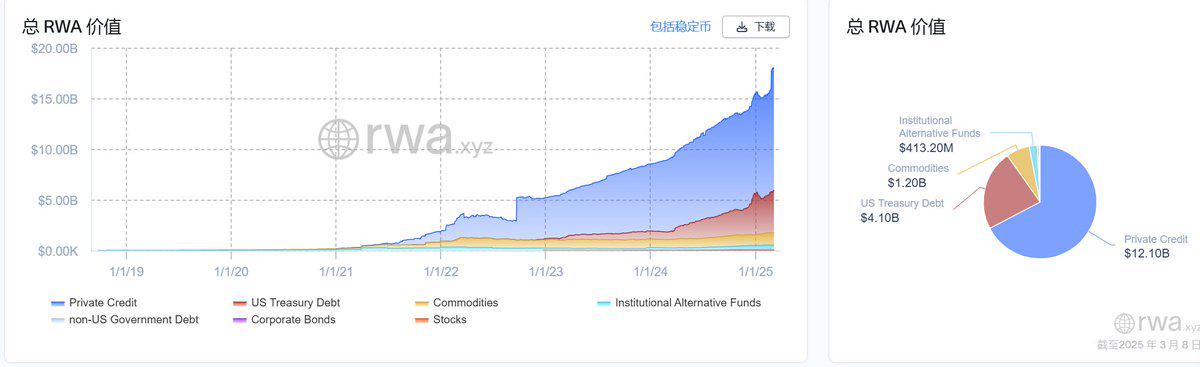
Personal credit, US bond market, commodities (precious metals) and institutional non-standard funds are the main participants in the entire track.
Among them, the U.S. bond market and institutional non-standard funds account for a quarter of the entire RWA market share under the current crypto-friendly background of the United States.
By deploying Libre on Injective, on the one hand, it expands the diversity of Injective's ecosystem, and on the other hand, it enables users on the Injective chain to access on-chain fund products through its application [Libre Gateway] (BlackRock is one of the main issuers in the U.S. debt tokenization market)
________________________________________
In addition, there are fund strategies for alternative assets. Through Libre, a chain-neutral strategy developed by Laser Digital is introduced.
The specific principle is not explained in detail, but it is said that the funding rate and pledge rate are used. I guess that the original income of POS assets is added on the basis of [earning fees by hedging positions] to achieve better asset management income opportunities.
And through further tokenization of fund assets, it can drive the development of other DeFi ecosystems on the Injective chain. This logic is somewhat similar to the role of USDT natively deployed on a certain chain.
Libre only introduces these deployments to Injective as a third party, playing a role similar to "asset liquidity injection"
The issuance of protocol assets in the RWA track often means that it has the support of regional regulators. Therefore, it is difficult to refer to the original market mainstream primary airdrop benefit method for the main idea of this track.
However, from the perspective of the derived ecology, the external RWA protocol integration plays the role of liquidity injection, or the hook role of [new asset portfolio], which actually brings a Lego-style DeFi combination gameplay
This is what I have recently thought about the significance of RWA for the on-chain ecosystem through the issuance of stablecoins.
________________________________________
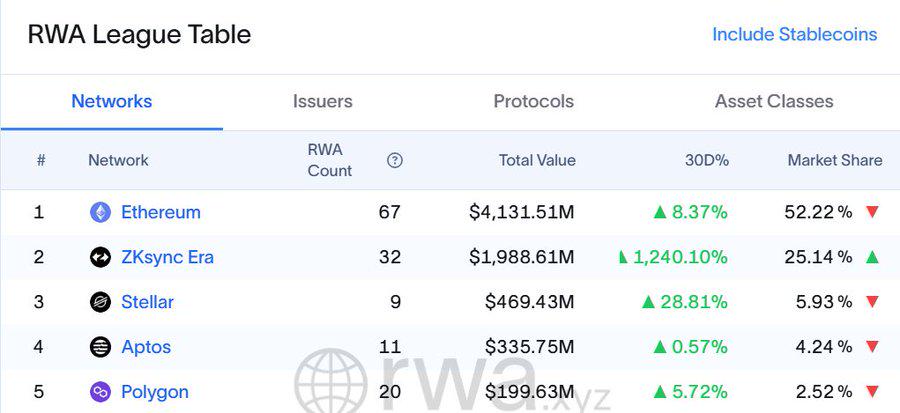
According to data from rwa.xyz, the top five chains currently account for 90% of the value of RWA issued in the entire industry. Injective has expanded RWA by integrating Libre, and it is completely foreseeable that it will quickly seize market share, as it is focused on the DeFi field.
In addition, Injective has recently put Nvidia’s stock trading on the blockchain, and users can trade Nvidia stock 24/7 through Injective (code: $iNVDA )
This is achieved through its previously launched RWA asset framework iAssets, through which any stock, bond or ETF can be launched on the chain. The core principle is actually quite simple, which is to use the oracle to achieve price anchoring on and off the chain.
Security tokens have always been the mainstream of the RWA market, but the growth in volume has not been as fast as other concepts. I remember that FTX once launched "Stock Tokens", which allowed users to trade Tesla (TSLA), Apple (AAPL) and Coinbase (COIN) stocks in the form of tokens, but this was based on a centralized entity.
Injective's framework is issued through an on-chain method. It is foreseeable that it will seize market share in this track with many incremental markets.
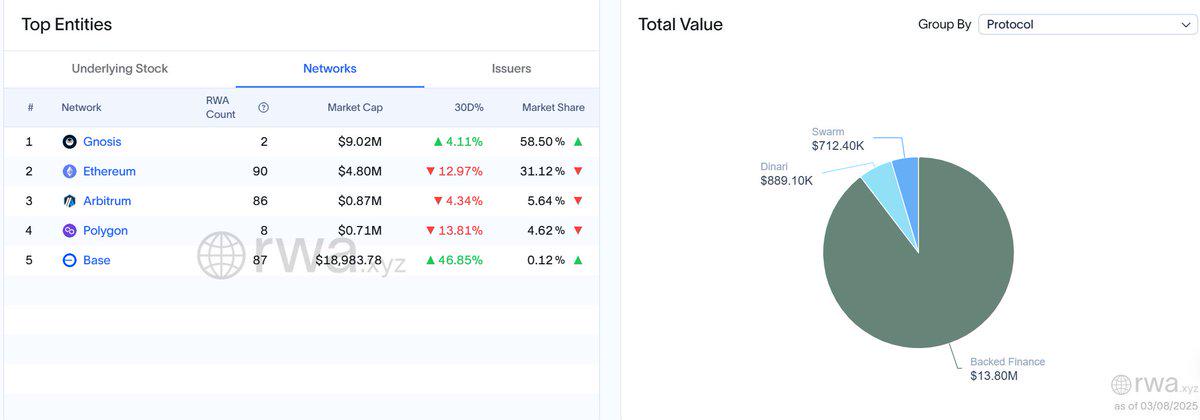
Supplement: According to data from rwa.xyz, the current volume of securities tokenization is less than 20 million