Since the Solana Foundation last published the Validator Health Report and Network Performance Report, the Solana network has continued to grow, improve, and thrive. This report consolidates the two previous reports and provides updates on the entire network and ecosystem.
The report discusses in detail the following notable achievements:
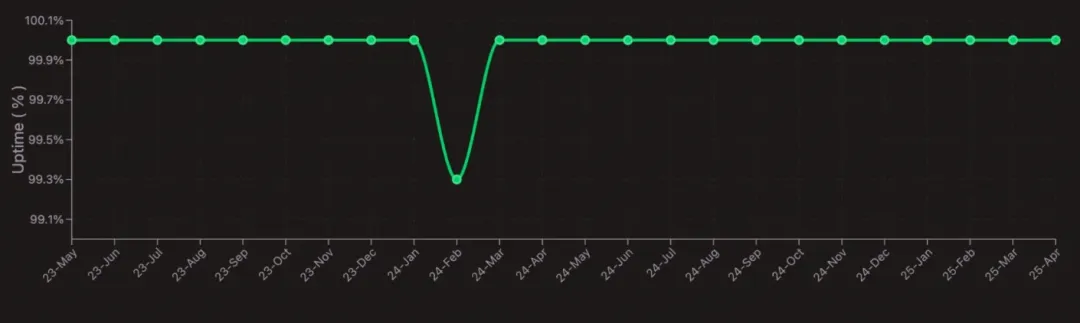
Network health continues to improve, with 16 consecutive months of normal operation (and counting), including a period of high network load in January 2025.
Release of Frankendancer - a new validator client built by the Firedancer team.
Setting a record for the highest voting participation rate in blockchain history, nearly 75% of staked SOL participated in the SIMD-228 vote.
Improved validator economics, including increased block rewards, significant growth in REV, and 100% of priority fees now going to validators.
Measured by the Satoshi coefficient, Solana’s level of decentralization remains stable and industry-leading.
While network improvements are an ongoing goal, Solana continues to lead the way in network performance and validator health, both in terms of decentralization, performance, and the robustness of the validator community.
Network performance
Reliable and fast networks are the core elements for blockchain to lead the industry.
First, let’s review the latest network performance since our last report. Fundamentally, a blockchain network should be fast, reliable, and stable. As Solana continues to grow and scale, the network’s resiliency and capacity have improved significantly .
Solana's performance
Solana network performance is booming.
The network has maintained 100% uptime for 16 consecutive months and counting.
Replay times (which were a bottleneck in 2022/2023) have been significantly improved and no longer limit the network. Replay times are consistently below 400ms, allowing epoch times to remain stable close to the expected 48 hours.
Pinocchio (a new library for creating Solana programs) has significantly optimized compute units (CUs, a measure of program execution cost), and the CU limit has been increased to 50 million and will soon increase to 60 million.
During a period of high network activity in January 2025, Solana broke multiple records, including the highest activity in blockchain history. While some network applications faced challenges during this period (notably Jito’s block engine performance degradation, user slippage issues, improperly prioritized fees set by applications resulting in transactions not being processed, and user experience issues with some applications), the overall network handled the traffic spike remarkably well with no downtime.
During this period of high activity, Solana successfully processed:
Over 200 million transactions per day for consecutive days
New wallet downloads exceeded 400,000 times
Liquidity inflow exceeded US$200 million
Decentralized Exchange (DEX) daily trading volume reaches $39 billion
High-load stress testing revealed multiple optimization areas that were subsequently enhanced, such as the new scheduler on Agave/Jito, which significantly increased fee processing capabilities by 80%.
Solana network uptime since May 2023
App Revenue
The growth in app revenues indicates a thriving ecosystem with strong funding and economic incentives.
One way to measure the success of a network is the "GDP" of that chain, defined as the fees generated by applications on that chain. It is a sign of health that applications generate more revenue than their base chain. Furthermore, strong application revenue not only encourages developers and applications to join and stay on the network, it also encourages the network itself to continue investing in its infrastructure and developer tools.
Solana's performance
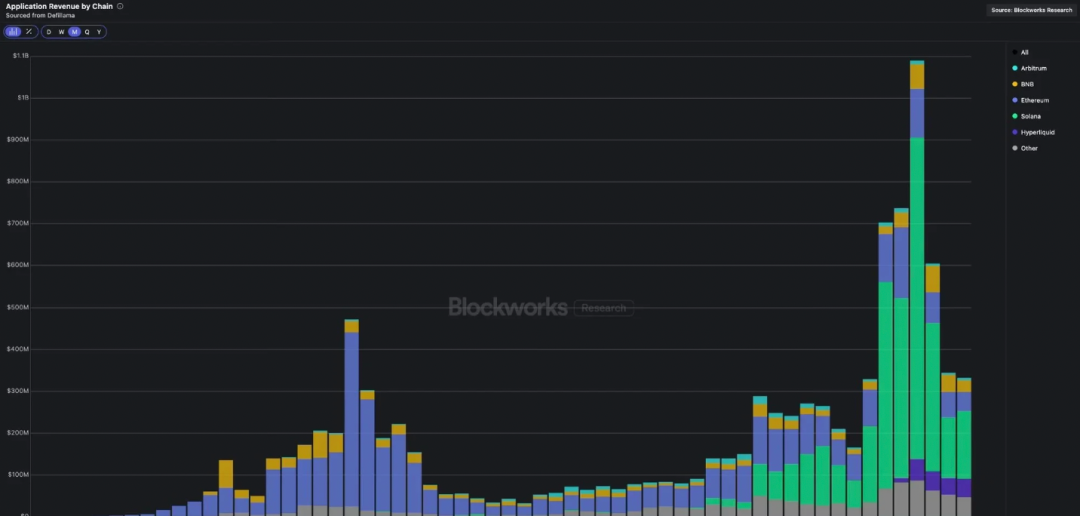
As shown in the above figure, Solana's application revenue has continued to grow since the third quarter of 2023. The past two quarters have significantly increased compared to the previous quarters, with application revenue exceeding $1 billion each quarter. Solana's application revenue is healthy and in an industry-leading position .
Development Tools
Powerful tools that are continually improving support the development of cutting-edge applications that are secure, easy to use, and scalable.
When developers have quality tools, it's easier to take full advantage of the power of the network. Better tools mean better applications, which in turn unlocks new use cases and more users.
Solana's performance
Over the past year, powerful tools have been released in the Solana ecosystem, including Pinocchio, Surfpool, Solana Proof Service, Token Extensions, and Blockchain Blinks and Actions. These tools make it easier for developers to create programs that take full advantage of Solana’s capabilities.
Pinocchio
Pinocchio is a zero-dependency library for creating Solana programs in Rust that does not depend on the Solana-program crate or any other external dependencies, making programs more lightweight and reducing potential conflicts.
Surfpool
Surfpool is a fast, developer-friendly Solana mainnet simulator that runs on your local machine. It does not require high-performance hardware while maintaining a realistic testing environment.
Solana Attestation Service (SAS)
SAS is a public product program for associating off-chain data (such as KYC checks, geographic qualifications, clip membership or certification status) with on-chain accounts. These proofs are signed, verifiable and reusable across applications without exposing sensitive data on-chain or repeating verification steps.
SAS supports compliance, access control, and programmable trust use cases on Solana, such as proving investor credentials for tokenized shares and RWAs, providing verifiable, decentralized reputations for individuals or DAOs (such as creditworthiness for lending in DeFi protocols), verifying regions before granting token issuance or minting access, etc. SAS is supported by Civic, Solana.ID, SOL.ID, Cogni, Trusta Labs, Wecan, Range, Polyflow, Bluprynt, Roam, and other participants across the ecosystem.
Token Extension
Released in early 2024, the Token extension is the next generation of the Solana library token standard. More than a dozen extensions, such as confidential transfers, transfer hooks, and interest-bearing tokens, provide advanced configurable features. The Token extension provides teams with flexibility and advanced features in their tokens.
Examples of products using token expansion include PayPal’s PYUSD stablecoin and Global Dollar Network’s USDG.
Blinks
Solana blinks was released in conjunction with Dialect in June 2024. It is an interface that converts any Solana operation into a shareable, metadata-rich link. Blinks can be clicked on any URL-supported platform on the Internet, including X, Discord, websites, mobile devices, etc. With Blinks, developers can integrate anything that can be done on Solana into their applications or websites.
Example use cases include using Crypto assets to pay for goods, buying or trading tokens, playing games, etc.
Developer Growth and Retention
Developer motivation to create applications and attract users is an important signal of network health.
Developers are the core of value creation on the network. The applications they build bring users, and new users attract more developers. The addition of new developers (and the retention of existing developers) is an important signal of a healthy network.
Solana’s Performance
Solana is the blockchain ecosystem with the most new developers in 2024 , with over 7,600 new developers and over 3,200 monthly active developers, an 83% year-over-year increase. Developers continue to join and thrive on Solana.
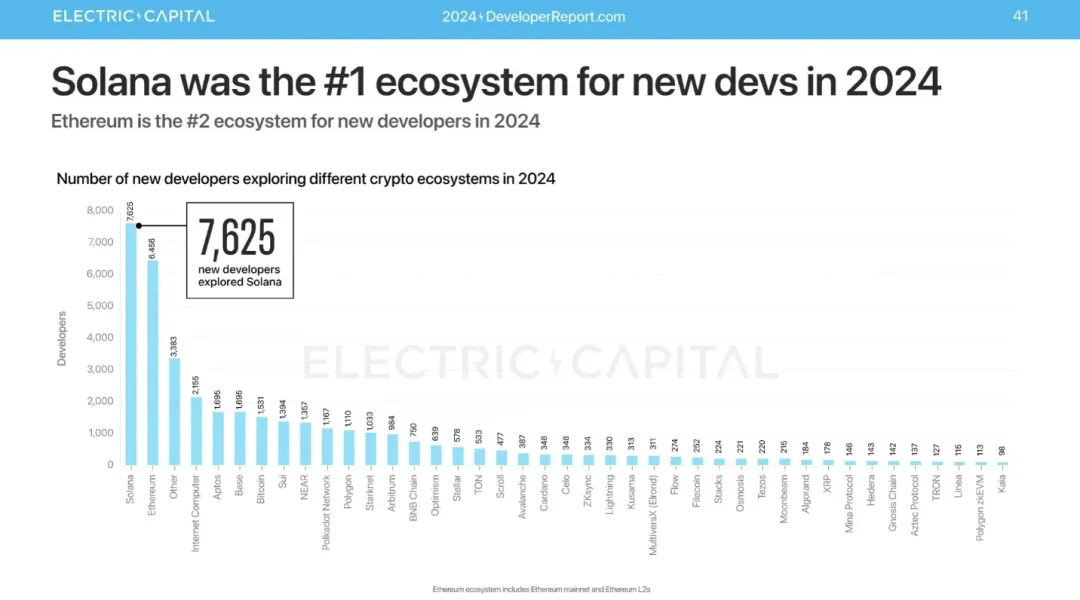
Source: Electric Capital 2024 Crypto Developer Report
Validator Health
Core Client
More different clients can improve the decentralization of the network and reduce the risk of network failure.
Validators are computers running the Solana Validator client, which is the operating system for the Solana network. For any blockchain network, having multiple software clients is critical to its resilience and decentralization: this helps ensure that there is no single point of failure for the network software.
With multiple validator clients, the risk of a vulnerability or malicious code in a single client is mitigated by the presence of other independent clients, which are less likely to have the same vulnerability or be attacked by malware, thereby reducing the possibility of a complete network shutdown.
Solana's performance
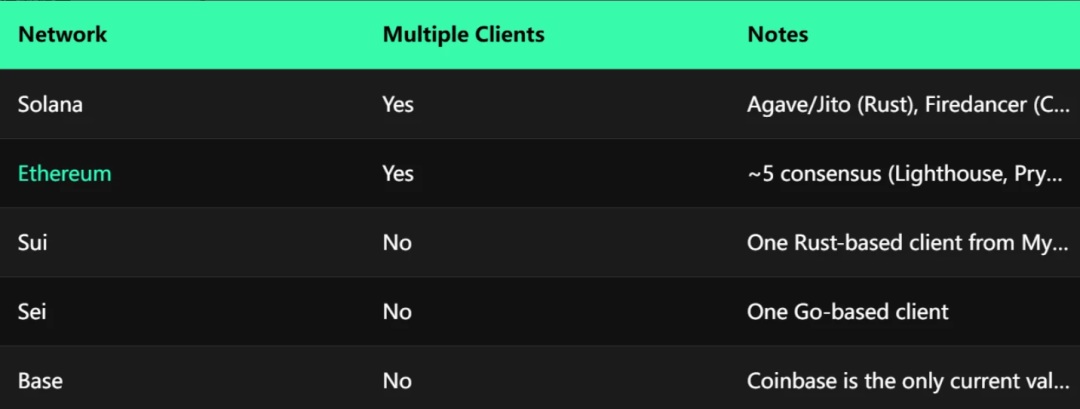
The Solana network currently has two major validator client implementations (Agave and Firedancer), with two more in active development (Mithril and Sig). While the Agave client is currently run by over 92% of Solana validators, the upcoming Firedancer client is expected to gain significant adoption, resulting in a more balanced client distribution.
The current Solana validator clients are as follows:
Agave/Jito: About 92% of the network’s stake
Agave is maintained by Anza and is written in Rust. It is a fork of the original Solana validator and was launched in early 2024.
Agave is under active development. Recent highlights include:
Firedancer: About 7% of the network’s stake
Firedancer is a brand new client written from scratch in C++ and maintained by Jump Crypto. As of April 17, 2025, 34 validators are using Firedancer (about 7%), but this number is expected to grow rapidly. The current version, Frankendancer, is a hybrid of Firedancer and Agave. Firedancer is designed for massively parallel processing and comes with a well-designed dashboard and telemetry tools.
Other Clients
Other clients in various stages of development include Mithril, developed by Overclock and written in Golang, and Sig, a read-optimized client developed by Syndica and written in Zig.
Comparison with other public chains
Solana and Ethereum are the only two L1 networks with multiple clients. Ethereum leads in number of clients, with Nethermind (21% usage) and Geth (54% usage) being the most popular.
Total number of validators
The greater the number of high-quality validators, the more resilient the network will be and the lower the risk of network failure.
Blockchains with more validators tend to be more resilient. When users execute contracts on a blockchain, they need to be confident that their transactions will be recorded. Ideally, every addition to a blockchain should be recorded on every validator on that chain, which is why it’s important to have a large and diverse set of validators: a large and diverse set of validators protects against catastrophic events like data center failures.
There are two types of validators: consensus nodes and RPC nodes.
Consensus nodes are critical to the operation of the network. They provide two basic functions: (1) create and propose new blocks to the rest of the network; and (2) vote on the validity of new blocks proposed by other nodes in the network.
Remote Procedure Call (RPC) nodes are the gateway for applications to access Solana infrastructure. They validate all new blocks and network changes, but do not participate in voting.
In this report, the Solana Foundation focuses only on consensus nodes.
Solana's performance
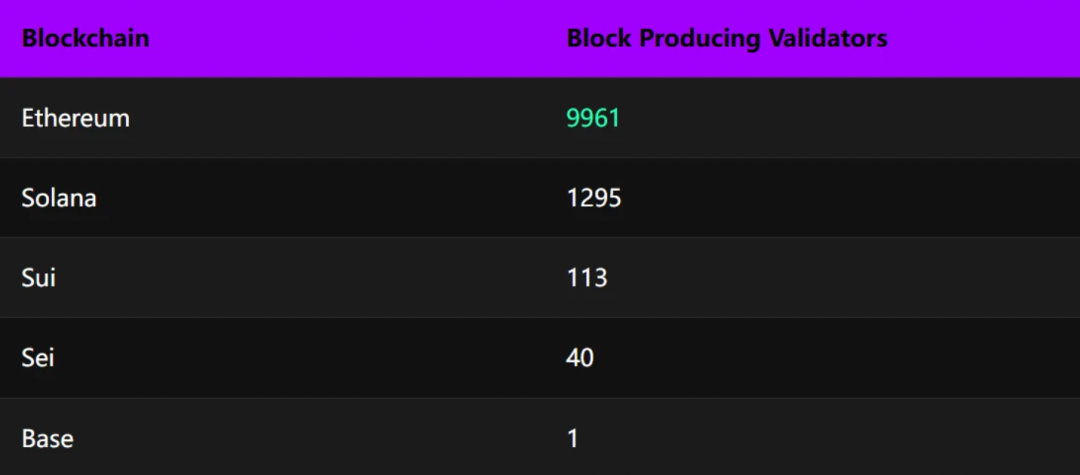
Since the last validator health report, the total number of consensus nodes has decreased from approximately 1900 to 1295 (as of April 16, 2025). Despite the decrease in total number, the remaining nodes tend to be healthy and high quality. What constitutes a "high quality" validator is subjective, but includes uptime, hardware performance, service levels, and validator community participation.
The Solana Foundation continues to support and encourage improvements in node quality, not just node quantity.
Comparison with other public chains
Relative to other Proof-of-Stake (PoS) blockchains, Solana’s number of consensus nodes is still quite high .
Voting Rights Satoshi Coefficient
A higher Satoshi coefficient for voting power means better decentralization and a more difficult time for malicious actors to disrupt the network.
The Nakamoto coefficient of voting power is defined as the minimum number of nodes that need to be compromised in order to censor a block or prevent the network from reaching consensus (thus preventing some or all new blocks and transactions within them from being confirmed). For most proof-of-stake networks, this is the number of nodes that require at least 33.4% of the voting power.
When the distribution of stake is highly concentrated, it may only take a handful of validators to represent 33.4% (a very small minority) of the total stake. In a network where the distribution of stake and consensus power is more decentralized, this set of nodes is much larger, making it more difficult for corporations, malicious actors, or other entities to manipulate the blockchain through censorship.
Solana's performance
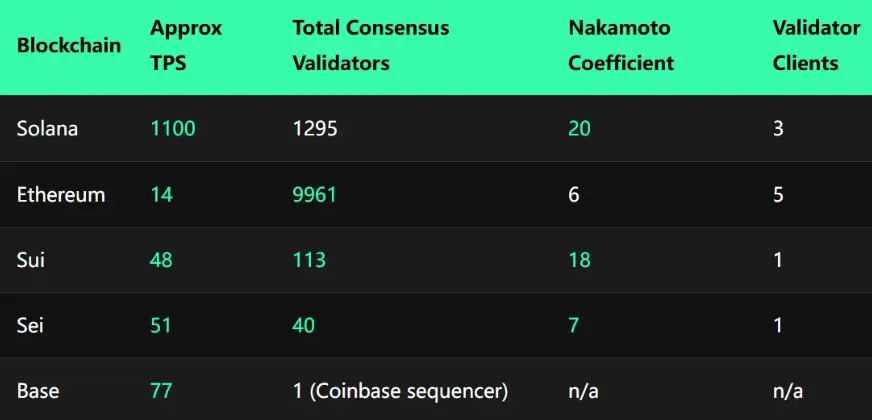
Solana’s voting power Satoshi coefficient increases steadily from March 2020, when the chain goes live, to September 2022, peaking at approximately 34 in August 2023. As of April 16, 2025, Solana’s voting power Satoshi coefficient is 20, meaning that at least 20 validators would need to collude to censor the network.
The change in recent months is due to the redistribution of stake among large validators. While the Solana Foundation still hopes to see this number increase over time, the Satoshi Factor of 20 is still robust and leading.
Over the past 18 months, the Satoshi coefficient has remained relatively stable.
It grows steadily over the next few months, reaching a peak of approximately 34 in August 2023. As of April 16, 2025, Solana's voting power Satoshi coefficient is 20, meaning that at least 20 validators would need to collude to censor the network.
Comparison with other public chains
Here are the Satoshi coefficients of several other blockchains for reference.
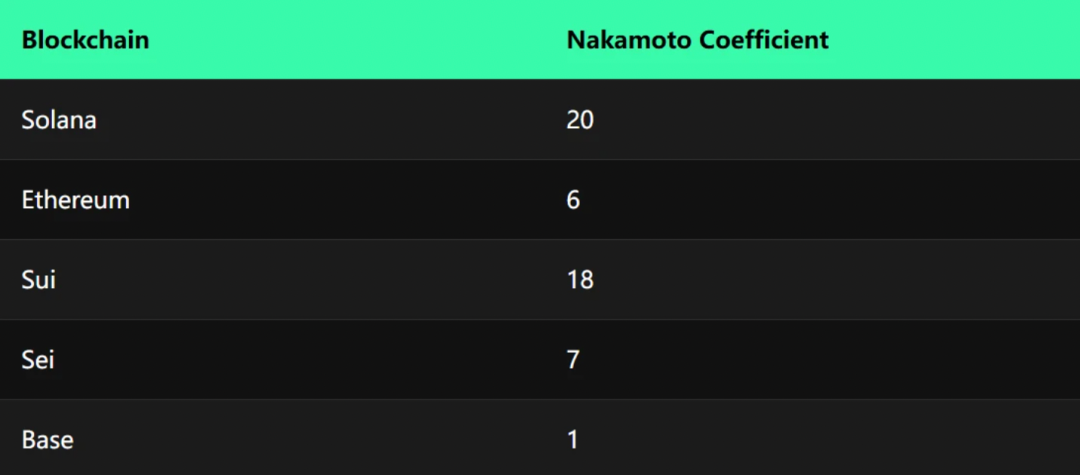
Source: https://nakaflow.io/
Geographic and data center distribution
Wide distribution (both geographically and across data center providers) reduces network risk from geopolitics, natural disasters, and company dependencies.
A global, resilient blockchain must be able to continue operating in the face of events anywhere in the world, whether in the face of natural disasters, censorious governments, or unfriendly data center hosts.
Consider the following scenario:
The government launched an attack on undersea fiber-optic cables, paralyzing the Internet across the region.
A dictatorship declares a chain illegal and shuts down all nodes within its country.
A natural disaster destroys all nodes in a particular region or data center.
A data center company that hosts many validators decides to disrupt or shut down a chain.
A resilient blockchain needs to continue to operate in these situations. A healthy blockchain requires a broad distribution of stakers and validators in terms of geography and datacenter distribution.
Solana’s Performance
Solana validator nodes are globally dispersed both in terms of geography and data center providers . However, nodes have begun to concentrate in regions with major data centers and the lowest latency (such as the cluster in Germany). The Solana Foundation believes this concentration is due to:
Timely Voting Points (TVC) incentivize stakers to move their stake (and validators to move their validation nodes) to areas with the lowest latency, which tend to be located in a few large cities.
Note that the new DoubleZero network (described in more detail in the “Looking Ahead” section at the end of the report) is expected to offset this effect by providing significantly higher bandwidth and lower latency to validators, allowing them to disperse geographically without worrying about TVC penalties.
The growth and economic opportunities created by Jito encourage validators to stay close to the Jito block engines, which are concentrated in areas with dense, high-performance networks.
Validators are active in 40 countries, with Germany, the United States, and the Netherlands leading in both the number of validators and stake ratio.
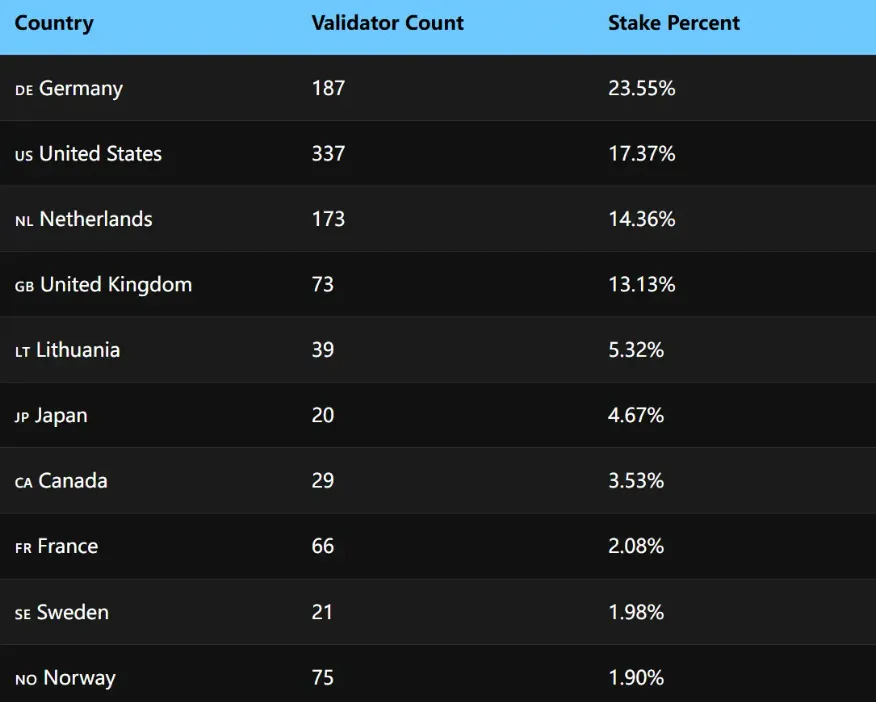
Top 10 countries by stake ratio
Validators are active in 40 countries, with Germany, the United States, and the Netherlands leading in both the number of validators and stake ratio.
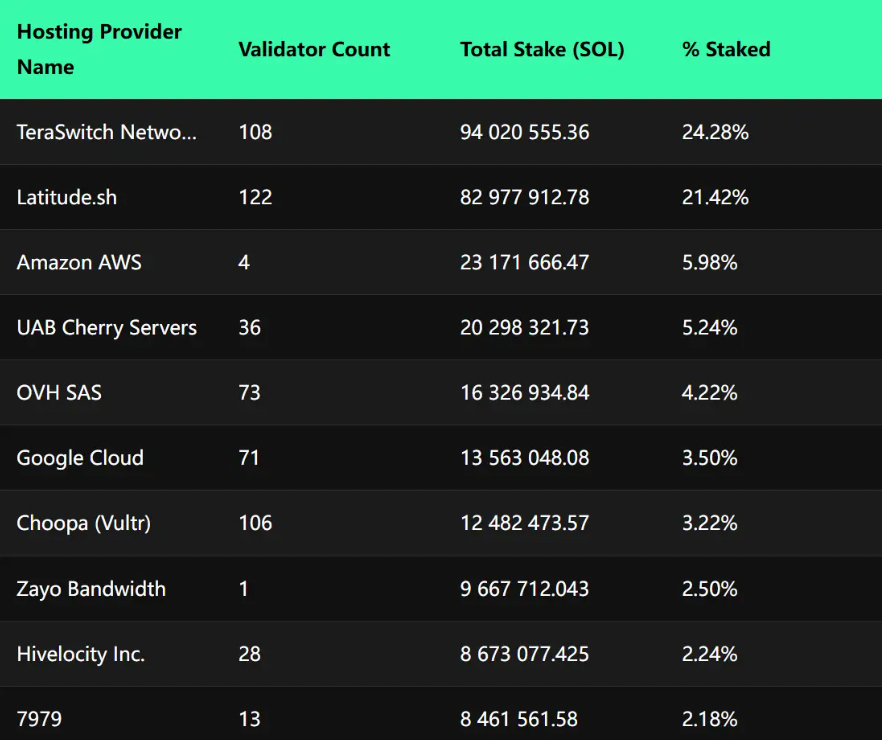
Top 10 data center providers by stake ratio
Validator Economic Health
The greater the profitability of validators, the greater the number of validators supporting the success of the network.
This update adds validator economic health as an indicator of validator health. If validators are profitable, they are more likely to continue serving as validators and investing in the security and health of the ecosystem.
Solana's performance
Validator health is good. Validators now receive income from multiple sources: not only increased inflation rewards and transaction fees, but also 100% priority fees (SIMD-0096), MEV (via Jito), and off-protocol transactions.
SIMD-0033, implemented in November 2024, introduces Timely Voting Credits (TVC). TVC rewards fast and consistent voting. TVC incentivizes validators to participate in validation activities quickly and reliably, and increases the rewards for fast validators (increasing their annualized rate of return).
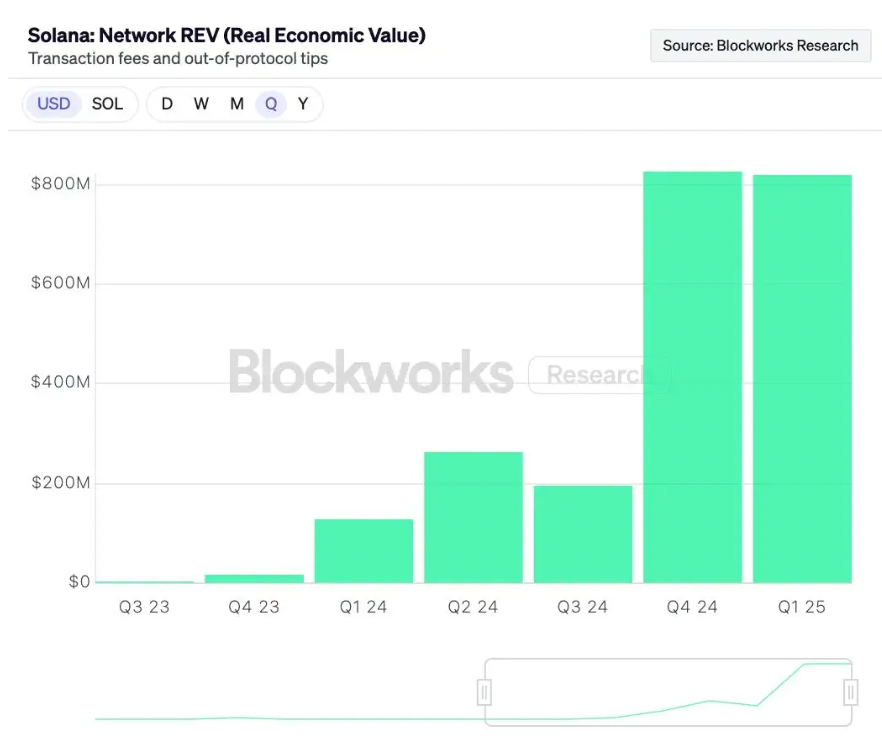
Realized Economic Value (REV, the sum of transaction fees and off-protocol tips) has grown significantly since the last report , with highlights including:
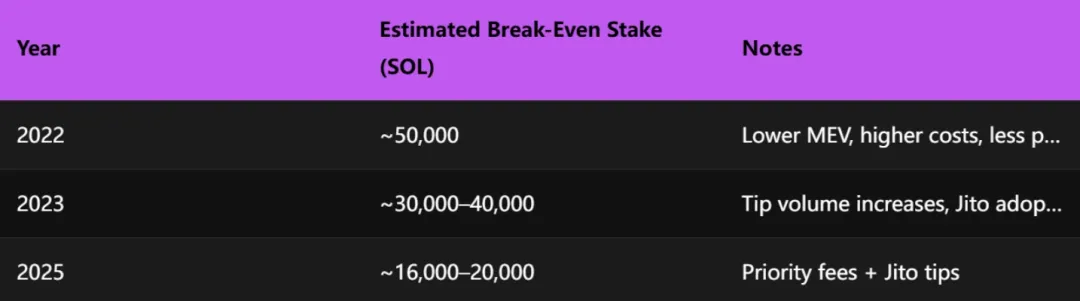
Due to these improved economics, the breakeven stake amount for validators has dropped from ~50k SOL to 16k SOL. Commission rates have trended towards 0% while APY has risen to 7.5%, further encouraging staking.
Engagement
A more active validator community is a lagging indicator of the overall health of the network.
Validator engagement is an often underestimated signal of validator health. Engagement means more than just online time or total stake, it reflects whether a validator is active and aligned with the goals of the Solana network. Healthy validators not only run nodes, they help shape the protocol.
Solana's performance
While validator participation remains a difficult metric to measure, the Solana Foundation is seeing several signs of high participation, including:
Looking ahead
The Solana Foundation remains committed to improving the health and performance of the Solana network. Here are some changes to look forward to in the future:
Alpenglow consensus algorithm: Announced at Scale or Die, this major consensus algorithm update is designed to reduce block times and improve network stability.
Slashing Mechanisms: Debate on slashing schemes and possible implementations.
DoubleZero Network: DoubleZero is already running on the testnet and is a new global network for high-performance distributed systems and blockchains. Validators migrating to the DoubleZero network can expect to receive significantly higher bandwidth and lower latency.
Compute Unit (CU) limit increase: The CU limit was recently increased to 50 million and will soon be increased to 60 million, with plans to further increase to 100 million and beyond in the future.
SIMD-123: Block Revenue Distribution: SIMD-123 has been approved, which will enable block-level fees to be shared with delegators, making delegator rewards more transparent and consistent.
SIMD-268: Increased cross-procedure call (CPI) nesting limit: This proposed change increases the cross-procedure call nesting from 4 to 8, allowing for more complex program composition and interaction.
Direct Mapping: The implementation of direct mapping is a prerequisite for many future performance improvements (such as increasing block space).
Continue to focus on improving network speed and reliability.
SIMD-0094 was implemented in early 2023 and successfully incentivized validators to vote faster and more consistently. The Solana Foundation sets and enforces standards for all validators who wish to participate in the Foundation’s delegation program, encouraging validators to remain engaged with the network.
The SIMD-228 vote was the most attended and largest in terms of market capitalization in the history of blockchain governance, with 910 validators (representing 74.3% of total staked SOL) participating in the vote. The event was widely covered in social media posts, debates, podcasts, and news. The voices of both large and small validators were heard, and ultimately smaller validators influenced the final vote, showing the true decentralization of the network.
Community-driven validator events continue to gain in popularity, with the last event attracting hundreds of participants and over 500 people in attendance.
REV increased significantly compared with the same period last year
Quarterly REV has averaged approximately $800 million over the past two quarters
A new all-time high of REV of approximately $56.9 million was reached on January 19, 2025
Gossip traffic dropped by 61%
Continuous performance improvement
Integrated the new central scheduler (v1.18) and greedy scheduler (v2.1)
The Solana Foundation is committed to improving and supporting the decentralization, adoption, and security of the Solana ecosystem. As this report shows, the Solana network has continued to grow, improve, and thrive over the past year, and we look forward to more achievements in the future.