
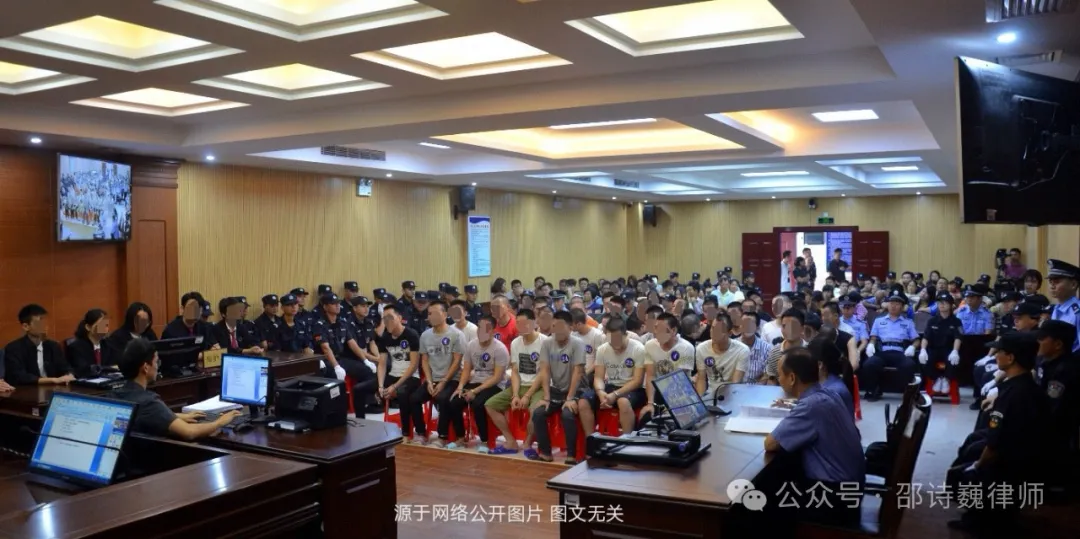
I had a dream last night. In the dream, I was in court. It felt quite interesting and I couldn’t help but want to record it.
Special statement: This story is purely fictional. Any similarity is purely coincidental. Please do not take it personally.
Author: Lawyer Shao Shiwei
1
Case Background
One day, when project staff of a virtual currency exchange were holding a passionate offline roadshow in a first-tier city in China, a large number of "uncles in hats" suddenly poured into the venue. Just like that, all the project staff were "pressed" by the police and escorted to a detention center in a fifth-tier city.
Why was the platform accused of suspected crimes? Because there is a module in this exchange, which the local police believed was a gambling game using virtual currency as bets.
But it has to be said that there is still a lot of controversy as to whether the module involves gambling:
The defense (lawyer) believes that the platform will immediately return the corresponding amount of coins to the user's account as the user invests, so there is no possibility of loss. Why do you say that the platform is involved in gambling? (To prove why the platform model is not involved in gambling, 10,000 words are omitted here... But it must be said that the boss of the platform can design such a game mode, which is really a talent!)
The prosecution (prosecutor) believed that if I thought you were gambling, then you were gambling, and you admitted it in your statement (yes, it was simple and rough...but it is said that when the statement was first taken, everyone was beaten)
Life in the detention center was really hard . Because the controversy over the gambling case was too great, all the inmates refused to plead guilty. The case was withdrawn from investigation by the procuratorate twice and the court was heard twice. All the inmates had been detained for more than a year, and finally the last hearing of the first instance court came.
Since there were quite a large number of defendants, each trial was held in the largest courtroom of the court. There were probably more than thirty people in total, including the defendants, lawyers, judges, prosecutors, and bailiffs. It was a huge event.
2
Court trial transcript
#Evidence presentation and cross-examination
This was the third court session, and the lawyers discovered that the prosecutor had a new face this time.
After the judge took his seat, he said, "The court is now in session." The prosecutor continued to present evidence. The prosecutor began to read from the script.
After reading the speech, the defense attorney asked, "Judge, why is the prosecutor different from the previous two hearings? What's going on?"
The judge was stunned for 2 seconds and said, Oh, defense attorneys, let me tell you now, they are indeed our prosecutors here.
(Defense attorney’s inner thoughts: Changing the prosecutor is important information that may affect the defense. How come my right to know is not protected at all? Forget it, let’s talk about it in court first.)
Prosecutor: Show the list of seized property (RMB obtained by selling all the defendant’s virtual currency).
Defense attorney: Without a court ruling, the parties’ virtual currency should not be disposed of! It is not clear whether these coins are illegal proceeds involved in the case, and the public security handling procedures are illegal!
The judge asked: Prosecutor, what do you think of the defense attorney’s statement?
Prosecutor: No.
(The defense attorney was shocked, thinking: You don’t even pretend? Don’t you have to say a few words? Do you think that the case has already been handled and detained?
In addition, the prosecutor did not answer any of the 10 or 20 questions raised by our lawyers last time. He said he would verify the situation after the court session. It has been several months since the verification. How is the verification going? There is not even a single word of response. This prosecutor is not taking any responsibility for the blame that his former colleague has thrown at him?
#Court debate
Judge: This case has gone through two trials for evidence presentation and cross-examination. Now we are entering the court debate stage. Please allow the prosecutor to express his opinion first.
Prosecutor: ...( Read the indictment for 2 minutes, then ended ).
(The defense lawyer was shocked, thinking: This is a major case involving tens of millions of virtual currencies, and all the defendants have advocated a not guilty plea. The trial has been going on for three days, and there is so much controversy over whether the platform is involved in gambling, and the evidence in this case is full of loopholes. Prosecutor, you...are you done?
Judge: Now, please allow each defense attorney to present their arguments.
Defense attorney: ... (passionate, tens of thousands of words omitted here)
But when the defense counsel made his defense, the presiding judge and his colleagues on both sides of the court were talking and laughing.
At first, the defense attorney could still hold it in for a few minutes, but the laughter got louder and louder, and he finally couldn't hold it in anymore. The defense attorney smiled and said kindly, "Your Honor, please listen carefully to my defense, okay?" The defense attorney immediately lost his smile and glared at the defense attorney.
About an hour passed after each defense attorney expressed his or her opinions.
Judge: Do the prosecution and the defense need a new round of defense?
The prosecutor answered immediately: No need!
After hearing this, the judge immediately responded: Okay, the court debate is finally over!
(The defense attorney was shocked again. It was rare to see a prosecutor who was so introverted and quiet.
In addition, I feel very sorry. This case is extremely controversial. The defense of innocence is also a collision of ideas between lawyers and prosecutors. Whether the model is related to gambling or not, the lawyer team always discusses it heatedly, and they rack their brains to think about what opinions the prosecutor may have and how we should refute these opinions. Who would have thought that we would meet such a taciturn prosecutor? It is really a pity.
Looking at the prosecutor who barely raised his head for most of the day, the defense attorney thought to himself: "Speak up, speak up, why don't you speak up? Why do you think the platform is involved in gambling? Don't read the law, just give your argument! "
#Others· The boss's responsibilities
I went to the detention center for a meeting the day before the trial and asked him, "Did you get food during the lunch break during the last trial?"
The client smiled bitterly: I was given a pile of rice. Fortunately, the boss asked them when the court opened, otherwise (just like the first court opening at noon) they would have no food to eat.
During the trial, two employees wanted to put the blame on the boss to prove their innocence. So they said in court, "It was all the boss who did it. I know nothing! I think the boss committed a crime, but I am not guilty!"
Because all the defendants used one microphone during the trial, and the microphone was a little far from the employee. The boss was worried that the judge couldn't hear the employee clearly, so even though he was handcuffed, he still held the microphone with both hands to help the employee speak louder. His eyes were like looking at a child, very calm.
Oh, this scene is really complicated. He is such an emotionally stable and responsible boss.
3
The verdict is finally announced
After more than a year, after the third court session, the first-instance verdict finally came.
First, I turned to the last page of the judgment to see the sentencing. Wow! Finally, it was an effective defense !
I still remember that when I communicated with the prosecutor, she meant that the boss would have to serve eight or nine years, and the others would have to serve five or six years , which put a lot of pressure on us. But we did try our best in the three court sessions to prove that there were procedural violations in this case, and there was no evidence to prove that this crime had been committed. So although the first instance still found them guilty, everyone's sentence was cut in half or even lower than what the procuratorate had requested.
But the defense attorney believes that this result is still unfair to the defendant, so he still wants to appeal.
After reading the sentencing, I began to carefully study the verdict and found that although the judge wrote dozens of pages, there was actually no substantive content. It was all copied from the defendant's confession during the public security investigation stage. That would be fine, but what makes people laugh is,
The following magical words appeared in the judgment: " This court believes that the virtual currency perpetual contract trading provided by xx Exchange is an illegal financial activity."
Hmm? When I saw the words "perpetual contract", I was in a trance for a moment? ? (I need to explain here that most of the cases involving virtual currency exchanges suspected of opening casinos across the country were because the perpetual contract module in the exchange was determined by the judicial authorities to be involved in gambling. But in this case, the exchange did not have a perpetual contract module, and no one mentioned these four words in the confessions of the defendants and in several court hearings. It is said that other exchanges have been run in the local area before, so the verdict is written like this. It can only be guessed that when the judge wrote the verdict, he mindlessly copied and pasted the content of other verdicts and forgot to proofread it)
In addition, this case actually has obvious characteristics of "distant-sea fishing" and "profit-seeking law enforcement", so as soon as the person was arrested, the local police transferred and sold all the virtual currencies of the person. Logically speaking, the coins sold should be confiscated as "illegal gains", but the court judgment did not say a word about whether the tens of millions of coins were property involved in the case, and how to characterize them. It only said in a rather subtle way that the money and property involved in the case were "handled according to law" by the seizing agency, so how should it be "according to law"?
So the second trial should be very interesting. Let's wait and see.
4
Case handling insights
As a lawyer, I have represented hundreds of cases, big and small, over the years. But I always believe that for the parties and their families, no criminal case is too small .
Because if someone is accused of a criminal offence or even detained, it will put any family under tremendous mental pressure. If the detained person is the main labor force in the family, or needs to hand over a huge amount of illegal income, the whole family will face both financial and mental pressure .
Criminal law itself is the most severe punishment for people, and the litigation process should also be serious and rigorous. This is specifically reflected in the compliance of the investigation agency in handling the case and collecting evidence. The case should not be handled for the sake of "profit-seeking", the parties should not be required to take statements from the perspective of presumption of guilt, and confessions should not be obtained under torture.
When the procuratorate examines evidence and decides to transfer the case to the court, it should be responsible for examining whether "the facts of the case are clear and the evidence is sufficient" to convict the party. It should not be that the party is guilty because the investigative agency has disposed of the property involved in the case; it should not be that "the gambling-related cases here are all sentenced very heavily", so this case must also be sentenced heavily; it should not be that the case has already been arrested, so all cases of arrest must be sentenced, without the possibility of withdrawing the case or not prosecuting.
When the court is trying a case, the standard for determining whether a party is guilty should be "the facts of conviction and sentencing are supported by evidence; the evidence used to determine the case has been verified through legal procedures; and based on the evidence of the entire case, reasonable doubt has been eliminated about the facts determined". It should not be based on the considerations of: "Since the prosecutor also finds the defendant guilty, he must be convicted"; "Even if the case is controversial, if he is acquitted, wouldn't that be a slap in the face of our sister unit?"; and it should not be based on "If he is acquitted, the party can apply for state compensation", thereby determining that the defendant has committed a crime.
Although lawyers, prosecutors, and judges have different roles in criminal cases, I believe they all have one thing in common: maintaining social fairness and justice and ensuring the correct implementation of the law. If the client is innocent, he or she should be cleared of all charges; if the client is guilty, he or she should be given a fair verdict.
However, during the course of handling this case, I could not help but recall a controversial statement I made earlier: “ The country does not allow mothers to lose ”[1], which made me feel extremely regretful.
[1] “The country does not allow mom to lose” This sentence comes from the article “Defender, you’ve had enough!” written by Lin Chundi, a prosecutor of the Hangzhou Municipal Procuratorate. On September 24, 2020, Lin Chundi published this article on the public account “Happiness Weird Power Circle”. The article records a conversation between her and her daughter. Her daughter asked her whether she had won the argument in court, and she replied, “Silly girl, the country does not allow mom to lose.” This sentence has caused great controversy.