Author: Nancy, PANews
As the global regulatory environment becomes clearer and the market is enthusiastic about crypto stocks, the crypto industry is ushering in a new round of sprinting into the capital market, especially in the exchange track. Recently, the old crypto exchange OKX was also exposed by foreign media that it is actively preparing for listing in the United States, which has attracted market attention. From the early years of realizing capital layout through backdoor listing in Hong Kong stocks to the current plan to move to the US capital market, this is not only a milestone event for OKX itself, but also a microcosm of the formalization process of the entire crypto industry.
A $500 million settlement in exchange for an “entry ticket” to the U.S. market
On June 23, according to Yueqi Yang, a crypto reporter at The Information, OKX is considering an IPO in the United States after returning to the U.S. market in April this year.

In fact, as early as March last year, according to Wu Blockchain, OKX had adjusted the compliance department located in the United States to the highest priority of all departments. All business is given the highest priority to the compliance department located in the United States. OKX founder Star also often goes to the United States.
In the past few months, OKX has been taking frequent compliance actions to pave the way for entering the US market.
At the end of February this year, OKX announced that its subsidiary Aux Cayes FinTech Co. Ltd. reached a settlement with an investigation by the U.S. Department of Justice, admitting that due to historical compliance control deficiencies, a small number of U.S. customers had traded on the company's global platform. According to the settlement agreement, OKX agreed to pay a fine of $84 million and give up approximately $421 million in revenue from U.S. customers during this period, most of which came from a small number of institutional customers.
This cost of nearly $500 million has won OKX a ticket to the U.S. market. After completing the settlement, OKX quickly restructured its internal power, especially the comprehensive replacement of the core legal and compliance executives. The resignations of former Chief Legal Officer Mauricio Beugelmans and former Compliance Director Vanessa Zhang were pointed out to be related to the $500 million settlement. More importantly, OKX began to introduce a large number of senior people with U.S. regulatory and traditional financial backgrounds. For example, Linda Lacewell, former director of the New York State Department of Financial Services, served as Chief Legal Officer and reorganized OKX's legal and compliance department after taking office; Jonathan Brockmeier served as Chief Compliance Officer. He had created a compliance system in the Americas at Singapore's fintech unicorn Thunes, and designed and implemented a regulatory framework covering the United States, Canada, Mexico and the entire Latin American market.
At the same time, OKX continues to expand into the US market. Since September last year, OKX US has set up teams in New York, San Francisco and San Jose, where it is headquartered, with a staff of about 500 people, and has obtained operating licenses in about 47 states and some regions (such as Washington, D.C. and Puerto Rico).
In May of this year, OKX officially announced that its CEX (centralized crypto exchange) and OKX wallet were officially launched in the United States, and a regional headquarters was established in San Jose, California. American customers can now use its platform, and OKX will continue to launch new features throughout the year. In this expansion, existing OKCoin customers will be seamlessly migrated to the OKX platform, and new customers will be accepted in stages, with plans to launch a full nationwide promotion in the United States later this year.
Roshan Robert, a former Barclays Bank and broker Hidden Road executive, will lead OKX's U.S. business expansion. According to The Block, Roshan had "played a role" in helping Barclays' futures trading department cope with the new regulatory system. His top priority now is to establish OKX's leading position in the spot trading market, while also planning to introduce OKX's existing payment and derivatives businesses to the United States. "Our long-term vision, of course, is to become a benchmark 'super app', and we plan to move towards this goal step by step."
OKX went public in Hong Kong through a backdoor listing in the early stage, and still faces compliance challenges in its expansion in the US
"Today's United States is not a forbidden area for crypto companies. On the contrary, if you approach it in the right way, it is a land of huge untapped opportunities," Robert once said.
In the past few years, crypto companies generally viewed the United States as a high-pressure regulatory area, where repeated policies and unclear regulatory standards have discouraged innovative projects. However, as U.S. regulatory policies have gradually become clearer, especially since U.S. President Trump returned to politics, U.S. regulators have shown a de-risking attitude towards digital assets, and the focus of supervision has gradually shifted from "prohibition" to "compliance to promote innovation", opening a new window for crypto companies.
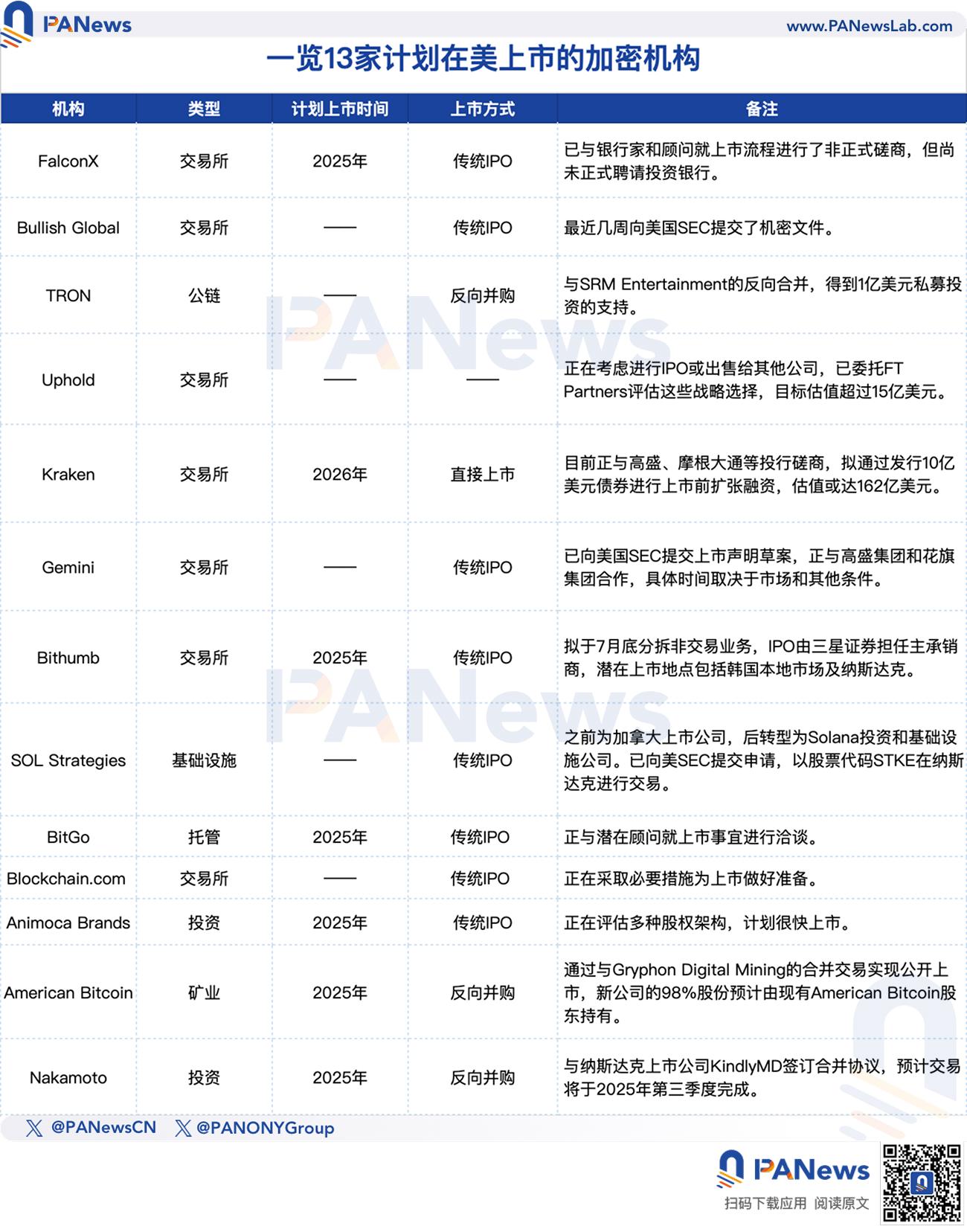
Coinbase's successful listing on Nasdaq has also become a pioneering example for centralized exchanges to enter the U.S. capital market. This year, exchanges such as OKX, Kraken, Bithumb, Bullish, and Gemini have also launched plans to go public in the U.S., and the competition for capital ownership rights of crypto companies has entered an accelerated track.
For OKX, this move is a restart of a strategic window. In fact, as early as 2019, when China's crypto regulatory policies were tightened, OKCoin (OKX's predecessor) parent company OKC Holdings Corporation bought 3.183 billion shares of Hong Kong-listed Qianjin Holdings through an over-the-counter acquisition, accounting for 60.49% of the total share capital, with a total transaction amount of HK$483 million, thus achieving a backdoor listing. At that time, OKX CEO Star (Xu Mingxing) became the actual controller. After the completion of the merger, OKCoin and OKEx began to operate separately. The former's Chinese brand name was changed to "OKEx Cloud Chain", and the latter is now OKX.
It is worth noting that before the listing, in order to reduce risks, early investor Giant Network (founded by Shi Yuzhu) transferred its 14% stake for US$28.5 million. One of the buyers was Kalyana Global Limited, whose actual controller was Shi Yuzhu's daughter Shi Jing. Based on the transaction valuation at the time, the market estimated that OKX's valuation was about US$200 million.
From the public information of OKC Holdings, we can find that the shareholder lineup behind it is very Chinese capital, including Shi Yuzhu's daughter Shi Jing, Ceyuan Ventures founder Feng Bo, Startup Factory founder Mai Gang, Meitu founder Cai Wensheng, Intime Group Chairman Shen Guojun, etc. Among them, Mai Gang is an early evangelist of Bitcoin in China, and has a deep relationship with Star. He was an angel investor of its early entrepreneurial project Docin.com. They are also one of the earliest supporters of Pop Mart.
Although the US market environment is relatively open, the compliance challenges faced by OKX in its US IPO cannot be underestimated. On the one hand, the US SEC still holds the position of "unregistered securities" for most platform coins, which may also become the main regulatory obstacle for OKX's US IPO. The market generally expects that if OKX promotes its IPO plan, it will inevitably split and reorganize its existing business structure, especially divesting the platform coin OKB issuance-related business, in order to avoid potential compliance risks.
More critical is the change at the legislative level. The CLARITY Act, which is regarded as a watershed in US crypto regulation, has been passed by the House of Representatives this year. The bill attempts to provide a clear legal definition and registration path for digital assets, and even redefines the classification of "digital commodities" and "securities". However, the negotiations on the bill are currently stalled, and the White House has vetoed the key provisions that limit conflicts of interest in cryptocurrencies. If the CLARITY Act is finally passed, it will provide a predictable and executable compliance registration path for crypto trading platforms including OKX, and significantly enhance their market confidence and valuation space.
It can be said that OKX's decision to enter the US capital market is not only a game of legitimacy, but also a reshaping of its own valuation and identity. But the premise is whether it can cross the compliance threshold and gain market recognition.