
By ChandlerZ, Foresight News
On February 24, the gas fee on the Bitcoin chain rose significantly after a long period of low operation, from the previous average of 1-2 satoshis/byte to more than 12 satoshis/byte for high priority. A few weeks ago, the Bitcoin memory pool was completely emptied for the first time in nearly two years, but the number of unconfirmed transactions has now climbed back to more than 100,000.
According to Geniidata data monitoring, in the past 24 hours, on-chain minting activities have shown a highly concentrated feature, mainly focusing on the MASK project.
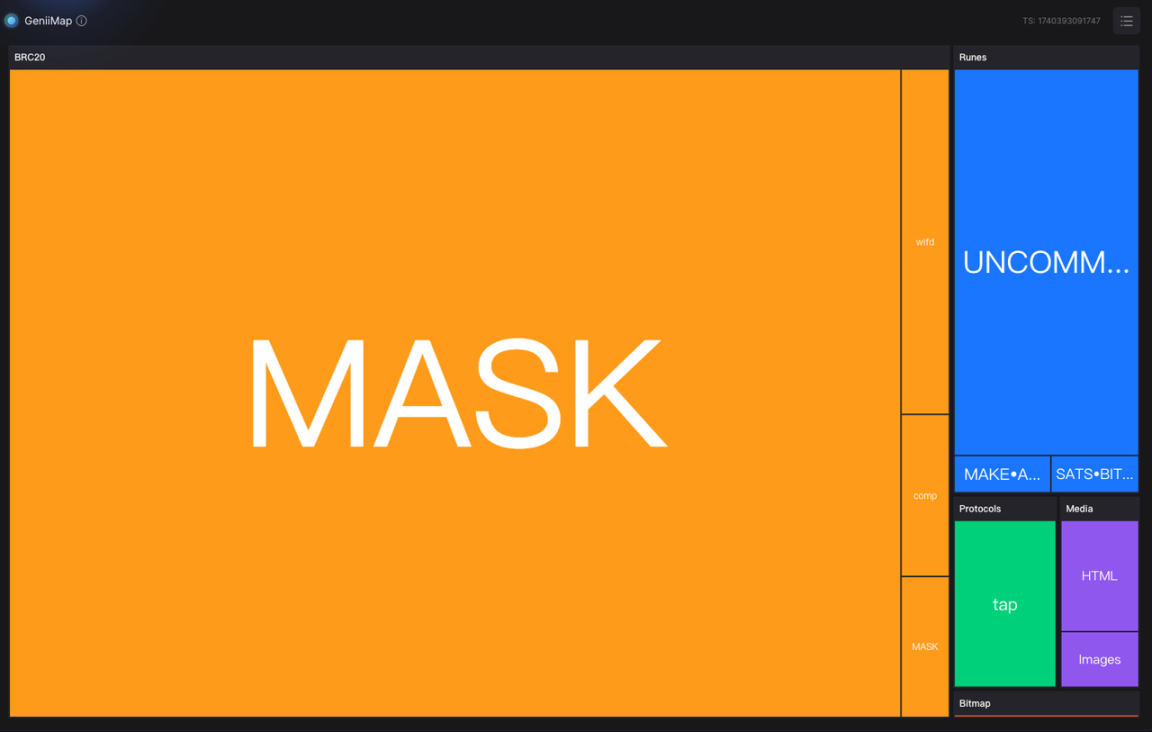
The total number of MASK minted is 2.1 million, each containing 10 tokens. The current market price is maintained at around $0.18, with a total market value of approximately $3.06 million. As of the latest data, the minting progress of the project has reached 82.69%. This increase in activity has triggered widespread discussion in the market that the BRC-20 ecosystem may usher in a new round of recovery.
From the perspective of the deep logic of the market, the current crypto market is at a special time node. At a time when the conspiracy group theory of the Solana ecosystem and the BSC ecosystem is widely questioned, BRC20, which symbolizes "fairness" to some extent, seems to have re-attracted market attention. However, the market's memory has not faded with time, and the previous violent fluctuations in the Bitcoin ecosystem still cast a shadow on the market.
I watched him build a tall building, and I watched it collapse.
According to data from The Block, since April 20, 2023, driven by the BRC-20 ecosystem, the number of transactions on the BTC network has begun to rise sharply, and the transaction volume has increased by nearly 100% in less than a month. The increase in transaction fees is even steeper, increasing nearly 10 times in less than half a month. During the most active stage of the BRC-20 ecosystem, more than 70% of transactions on the Bitcoin chain were related to the BRC-20 project.
Behind this prosperous appearance, there is a fragile ecological foundation. After entering 2024, the Bitcoin ecosystem gradually fell into a downturn. This change actually reflects the market's deep dilemma for the Bitcoin application layer. Although the market once had high hopes for the Bitcoin ecosystem and believed that innovations based on the inscription protocol could inject new vitality into the Bitcoin network, the actual development trajectory has deviated greatly from expectations.
Looking back at the development history of the BRC20 ecosystem, we have to face a cruel reality. Most of the early popular projects have experienced extremely significant price pullbacks. ORDI fell from a high of $87 to $11, and Sats fell from 0.00000086 to 0.00000012. It can even be said that most of the other projects and even the NFTs in the Bitcoin ecosystem have fallen by as much as 90%, and have long been "returned to zero". Only projects with a serious offline culture such as 𝛑 remain.
This phenomenon is not accidental, but an external manifestation of deep-seated market structural problems. The BRC20 protocol took "real fairness" as its core concept at the beginning of its design. Through a completely transparent on-chain mechanism, the reservation and scientist mechanisms were cancelled, attempting to provide all market participants with truly equal opportunities to participate. This design does achieve the greatest degree of decentralization in theory, but it has exposed significant limitations in practice.
The paradox of fairness and control
From the perspective of market structure, the scientist mechanism and initial chip allocation system in traditional crypto projects are essentially a market regulation tool. Although these mechanisms are often criticized as a manifestation of centralization, they play an indispensable role in maintaining market stability. Through these mechanisms, project owners can regulate market fluctuations to a certain extent and provide necessary price support for the long-term development of the project.
However, the fully open minting mechanism of the BRC20 ecosystem, while maximizing the fairness of participation, also leads to a highly decentralized chip structure. In the absence of an effective price support mechanism, market fluctuations tend to be more intense. In this case, when market sentiment changes, a chain reaction is likely to occur, leading to a rapid drop in prices.
The deeper problem lies in the motivation of big money to participate. In traditional crypto projects, big money can influence market trends through various mechanisms to gain profits. But under the inscription mechanism of BRC20, this operating space is greatly compressed. When these so-called "dealers" or "institutions" find it difficult to establish effective chip control, they will naturally choose to turn to other markets where fund management is easier. This creates a paradox: the pursuit of absolute fairness may lead to market instability, which in turn harms the interests of all participants. In this case, the market needs to find a balance between complete fairness and necessary market stability.
The resurgence of the MASK project shows to some extent that the market’s desire for a fair mechanism has not completely faded, regardless of whether this project will still become a “shooting star”. However, how to establish an effective market stability mechanism while maintaining basic fairness is still the core challenge facing the entire crypto ecosystem. This requires innovation at the protocol design level, and may require the introduction of new mechanisms to balance the two seemingly contradictory goals of decentralization and market stability.