Compiled by: SolEasy
Real-world assets (RWA) refer to physical or traditional financial assets such as stocks, real estate, commodities or credit instruments that are put on the blockchain through tokenization. Whether physical or non-physical, the value of these assets is derived from real-world utility, scarcity or demand, and is usually subject to existing financial regulations.
Tokenization is the process of presenting these assets as digital tokens on the blockchain. By encoding ownership as tokens, assets such as U.S. Treasuries, private equity or real estate can be issued, tracked and transferred more efficiently. This on-chain transformation is becoming a foundational pillar for institutional blockchain applications, enabling 24/7 settlement, increased transparency and support for fractional ownership of assets, thereby expanding access to global capital markets.
Today, the tokenized asset space is dominated by traditional instruments such as money market funds and government securities. Although still in its early stages, the tokenized real-world asset space has achieved rapid growth, with the total value of assets on blockchain (excluding stablecoins) now exceeding $24 billion (see chart below), up 114% year-on-year from $11.2 billion a year ago .
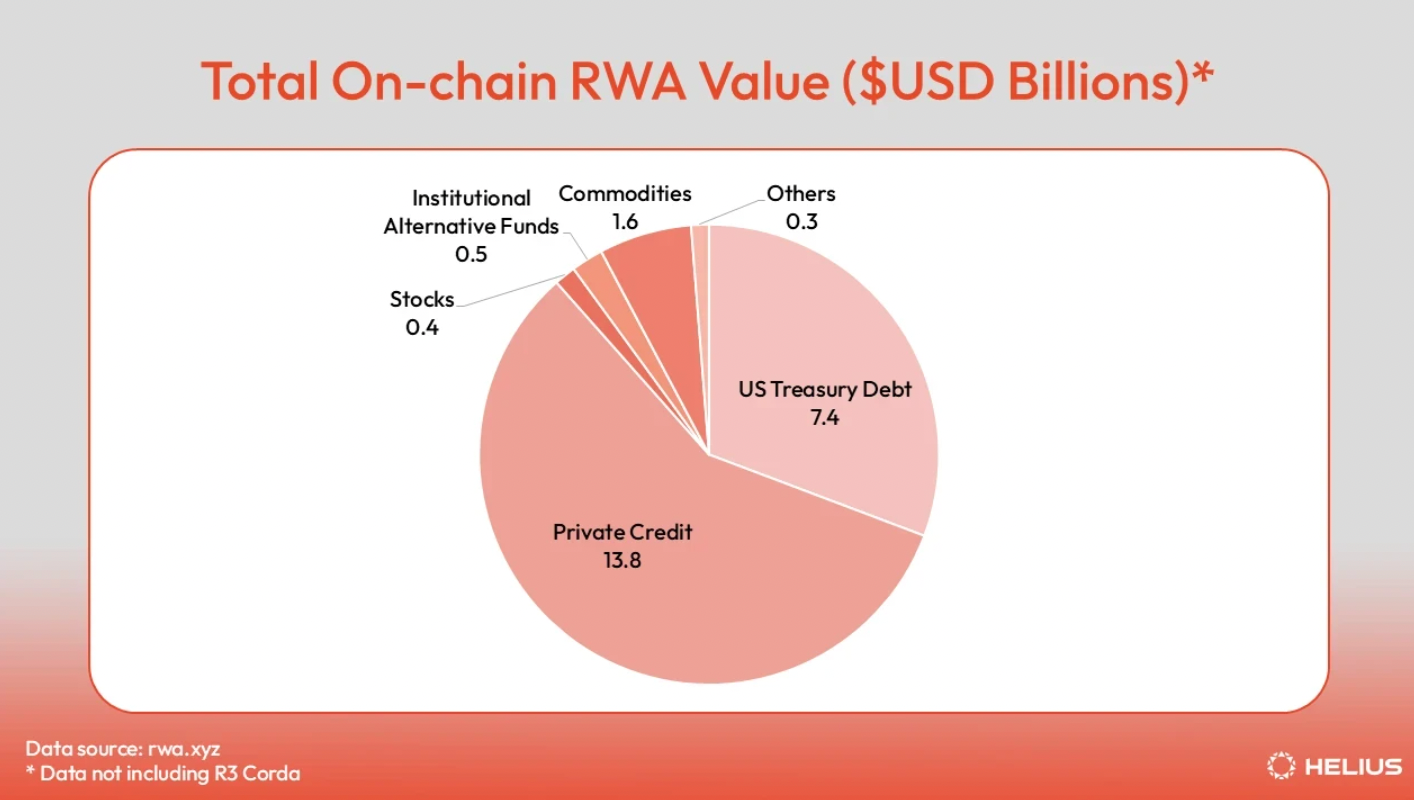
Total on-chain RWA value by category across all public networks
McKinsey Consulting predicts that by 2030, the market size of tokenized assets could reach $2 trillion, covering areas such as mutual funds, bonds, exchange-traded open-end index notes (ETNs), loans, securitized products and alternative investment tools. Meanwhile, Standard Chartered Bank is more optimistic and predicts that by 2034, the total demand for tokenized assets could soar to $30.1 trillion. Regardless of the specific forecast, it is clear that the demand for RWA will grow significantly in the future.
“We believe that the tokenization of financial assets will be the next step, which means that all stocks, bonds and other assets will be included in a unified general ledger.” - Larry Fink, CEO of BlackRock
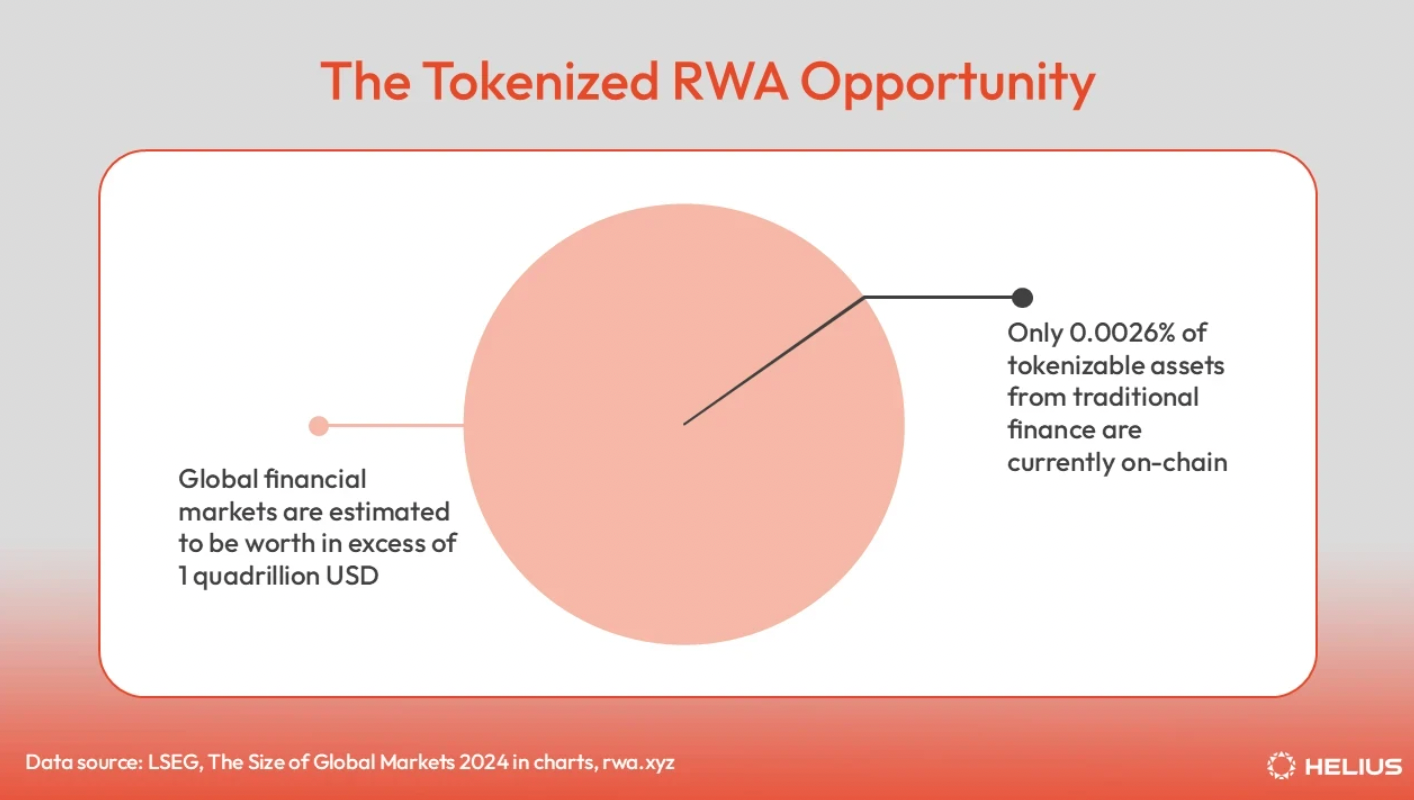
Tokenized RWA Opportunities
Advantages of Tokenized RWA
Tokenized RWA brings a series of transformative advantages that are difficult to match with traditional financial infrastructure:
Global accessibility : Currently, only about 15% of the world’s population can participate in the largest and most liquid capital markets in the U.S. Tokenization makes capital markets more inclusive, allowing anyone with an internet connection to participate, regardless of location or socioeconomic status.
24/7 Market : Unlike traditional finance, which operates within limited business hours, tokenized assets are available 24/7. This continuous accessibility enables instant movement of global capital and faster financial settlement.
Programmability : After tokenization, RWA becomes a programmable digital asset. This enables the automation of financial contract terms such as interest payments, maturity dates or compliance checks, thereby reducing management costs and operational risks.
Composability : A tokenized RWA issued by one protocol can be used by other on-chain financial products. These programs can interact with each other like building blocks without permission, unlocking powerful cross-asset strategies and applications. Fragmentation: Tokenization can divide the ownership of high-value assets such as real estate or art into smaller, more accessible units, thereby expanding investor participation, improving capital efficiency, and lowering investment barriers.
Transparency : Blockchain-based RWA provides real-time visibility of asset provenance, ownership history, and transaction flows on an immutable ledger, enhancing trust and reducing the need for intermediaries. Operational efficiency: By eliminating multiple layers of manual processing and reconciliation processes, tokenization reduces costs and friction throughout the lifecycle of assets from issuance to settlement.
Liquidity : At its peak, the cryptocurrency market has comparable or even exceeded the trading volume of traditional exchanges such as NASDAQ or NYSE. Tokenized RWAs take advantage of this massive and global liquidity, allowing investors to enter and exit the market more quickly and efficiently.
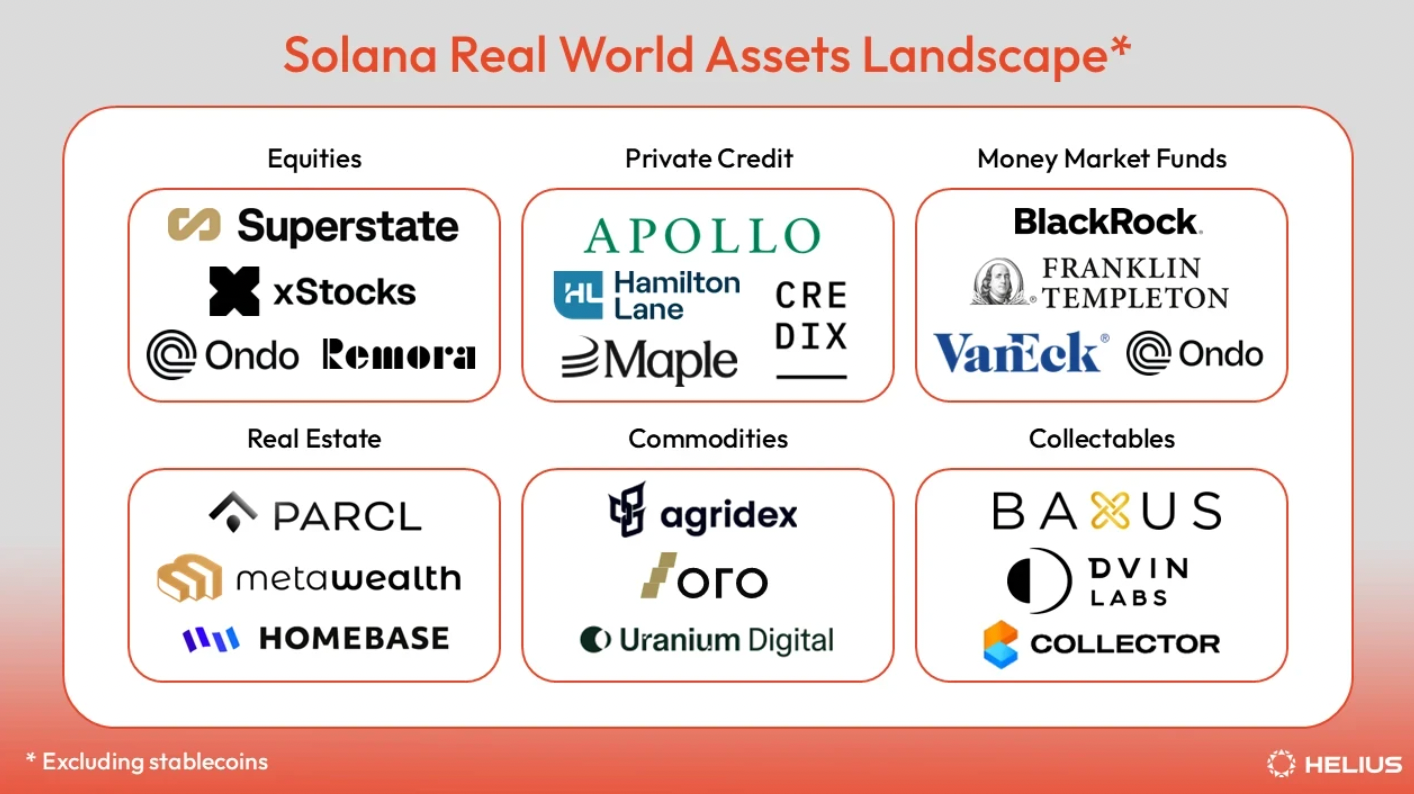
Solana Real World Asset Landscape (Excluding Stablecoins)
This report provides a comprehensive overview of the RWA space on the Solana blockchain, aiming to showcase the increasingly diverse RWA products and their practical applications. The core analysis revolves around the following seven key categories:
Stocks : Tokenized shares that represent fractional ownership of a company.
Money Market Funds : On-chain assets backed by U.S. Treasuries and other low-risk cash equivalents.
Commodities : Tokens backed by physical raw materials such as gold, oil or natural gas.
Stablecoins : Digital fiat currencies that primarily represent the U.S. dollar. Private credit: On-chain debt instruments that represent real-world loans to businesses or individuals.
Real Estate : Tokenized real estate assets that enable fractional ownership of real estate.
Collectibles : Digital tokens that represent ownership of unique physical objects.
Traditional fintech and enterprises are rapidly embracing the tokenization of RWAs. Accordingly, Solana’s RWA ecosystem is growing at an astonishing rate, with new projects and announcements emerging every month. While this article aims to provide a broad and representative overview, the rapid development of the field means that it may not be possible to cover every development. While this article is best read in sequence, each section is designed independently and can be read separately.
R3 and Corda
At the recent Accelerate conference, Solana announced a strategic integration with British software company R3 (developer of the enterprise-grade blockchain platform Corda), which is a key milestone for Solana to promote institutional adoption of RWA and enhance interoperability.
Corda is one of the most widely adopted blockchains in the institutional space, powering more than 60 live solutions. Notable applications include the SIX Digital Exchange, which hosts the Swiss National Bank’s wholesale central bank digital currency (CBDC), Euroclear’s D-FMI tokenization platform, HQLAᵡ’s collateral liquidity network, and the Italian National Payment System.
The Corda ecosystem is the world’s largest network of permissioned distributed ledger technology (DLT) platforms, processing tens of millions of transactions per month and securing tens of billions of dollars in tokenized assets. R3’s clients include Euroclear Bank, HSBC, Bank of America, the Central Bank of Italy, and the Monetary Authority of Singapore.
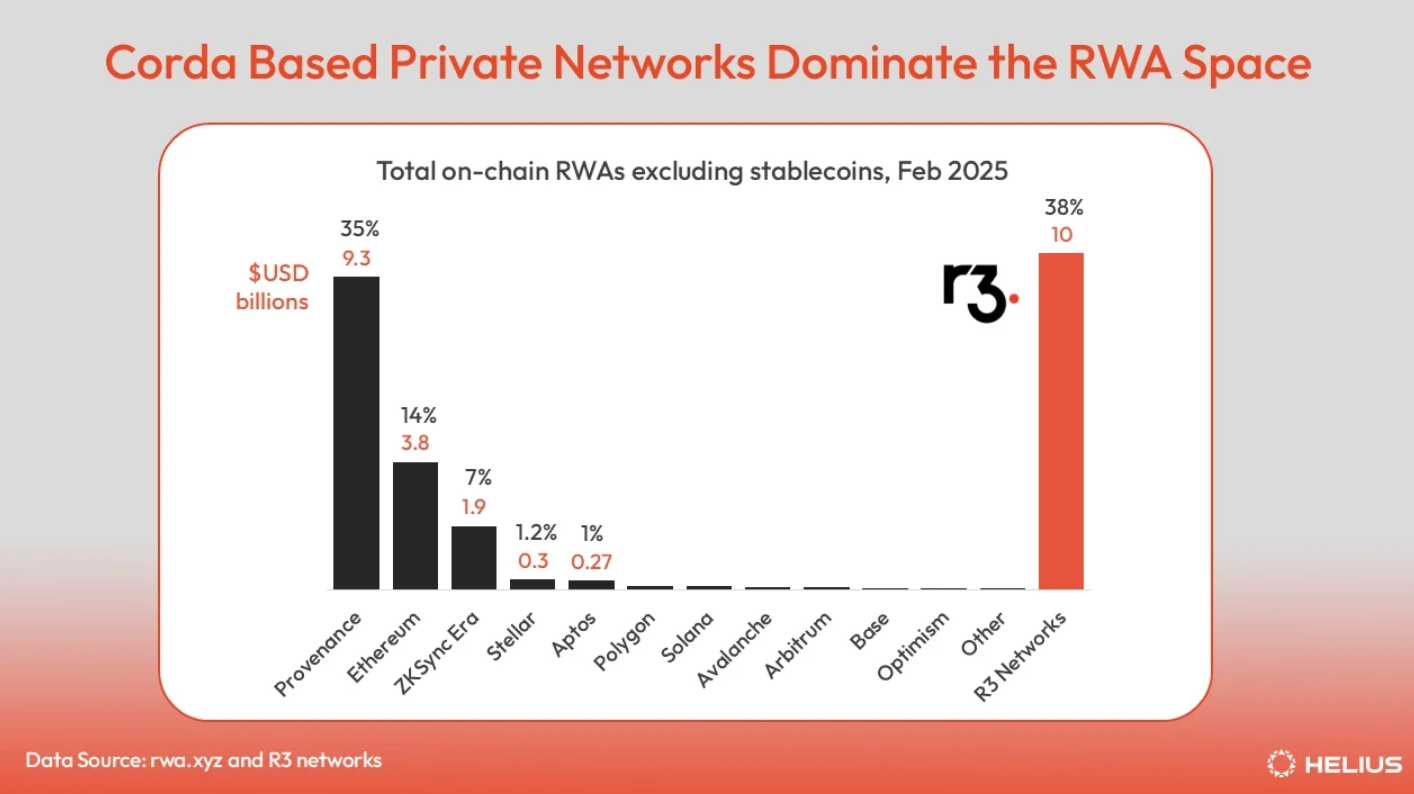
Corda-based private networks dominate the RWA space
The integration with Solana marks a shift from R3’s traditionally isolated private ledger environment to direct interaction with a high-performance public blockchain. The importance of this collaboration is underscored by the Solana Foundation’s commitment to invest an undisclosed amount in R3 and the fact that Solana Foundation Chair Lily Liu will join R3’s board of directors.
This integration introduces three core features:
Real-time transaction confirmation on Solana : Corda transactions can now be verified on Solana without the need for Corda’s internal notary infrastructure. Corda’s architecture ensures that no sensitive transaction data ever touches the public blockchain.
Stablecoin Settlement on Solana : Institutions using Corda will be able to use stablecoins on Solana (such as USDC) for tokenized asset transfer settlement, achieving atomic delivery and payment settlement without the need for intermediaries or external protocols.
Liquidity bridge directly to Solana : Assets issued on Corda (including stocks, digital bonds, and tokenized funds) will be able to flow directly into the Solana mainnet, expanding access to global liquidity pools.
stock
Stocks represent ownership of a company, giving shareholders a claim to its profits and assets. As of early 2025, the global stock market includes nearly 48,000 listed companies with a total market value of approximately $124 trillion, a year-on-year increase of 13% and a long-term annualized growth rate of approximately 6%. The United States remains the dominant force, with a market value of more than $63 trillion at the end of 2024, accounting for more than half of the global total.
Despite its size, the stock market is subject to multiple structural constraints. Trading is limited to weekdays, excluding weekends and holidays, which limits liquidity and responsiveness compared to 24/7 digital asset markets. Global access to U.S. stocks is uneven, and many investors are unable to directly participate in the market due to regulatory, custody or platform barriers. For companies, the path to listing is costly and complicated, with the average cost of a U.S. initial public offering (IPO) ranging from $10 million to $30 million, including underwriting, legal, compliance and listing fees, creating a high barrier to entry and limiting financing channels for emerging companies.
Tokenization on Solana solves these friction points, providing enhanced liquidity, global accessibility, and lower barriers to capital formation. Multiple Solana-based projects are seizing this opportunity, including Superstate’s Opening Bell.
Opening Bell at Superstate
Opening Bell is a platform developed by Superstate that enables companies to issue SEC-registered shares on the blockchain, starting with Solana. Shares are recorded and tokenized by Superstate’s SEC-registered, blockchain-enabled transfer agent (Superstate Services LLC), which is responsible for ownership tracking, share issuance and redemption, and dividend distribution. Importantly, Opening Bell tokens represent actual shares, are fully compliant, and are issued on-chain, without relying on synthetic exposure, wrapped assets, or offshore solutions.
By integrating whitelisting and permission control, Opening Bell ensures that only qualified investors (including qualified and non-qualified investors) who have completed Know Your Customer (KYC) verification can participate. Investors can buy and sell stocks like trading standard tokens, enjoying 24/7 DeFi transactions, instant settlement and transparent price discovery. Although the platform fee structure has not yet been announced, there is no minimum investment limit for non-qualified investors.
Opening Bell is open to both existing public companies and late-stage private companies. Public companies can gain access to new liquidity and attract crypto-native investors, while private companies can go public earlier than traditional markets allow and have a path to a full listing on Nasdaq or the New York Stock Exchange.
SOL Strategies ($HODL), a publicly traded Canadian company focused on Solana infrastructure, is one of the first companies to announce plans to list its common shares on Solana through Superstate.
Superstate, the New York-based blockchain company behind Opening Bell, is led by DeFi pioneer Robert Leshner, founder of the Compound lending protocol and partner at early-stage crypto venture capital fund Robot Ventures.
Kraken xStocks
At the Accelerate conference in May 2025, centralized exchange Kraken announced Solana as the official launch partner for its new tokenized stock product xStocks, providing permissionless, self-custodial access to some of the world’s hottest securities.
xStocks are tokenized tracking certificates representing over 55 of the most popular US-listed stocks and ETFs, issued as SPL tokens on the Solana blockchain.
For eligible users around the world, xStocks provides a new way to gain exposure to the U.S. market without relying on traditional brokers or custodians. Users can hold xStocks in self-custodial wallets, trade them on decentralized exchanges, and use them as collateral in lending protocols, expanding the utility of traditional assets.
Ondo Global Markets
Ondo Finance, a leader in RWA tokenization, is preparing to launch Ondo Global Markets (Ondo GM).
The platform will initially support liquid US listed stocks, bonds and ETFs, with plans to expand to other asset classes such as international stocks and corporate bonds. Each token represents 1:1 backing of the underlying asset held by a regulated broker-dealer and custodian. The tokens will come with transfer restrictions to ensure regulatory compliance, allowing transfers only between verified participants within the Ondo GM ecosystem.
Users can top up their accounts with fiat or stablecoins and submit instructions through on-chain programs, APIs, or web interfaces for Ondo GM to purchase specific securities (such as TSLA). These shares are purchased on traditional exchanges such as Nasdaq and held by regulated broker-dealers and custodians. In return, users receive a tokenized representation of the asset (such as tTSLA).
To support this vision, Ondo recently announced the formation of the Global Markets Alliance, a cross-industry initiative to promote standards and interoperability for tokenized securities. The alliance brings together prominent stakeholders including the Solana Foundation, Bitget Wallet, Jupiter, Trust Wallet, Rainbow Wallet, BitGo, Fireblocks, 1inch, and Alpaca to develop best practices around liquidity, investor protection, interoperability, and composability.
Remora
Remora Markets (formerly Moose Capital) is developing a Solana platform for compliant tokenization of traditional stocks. After being acquired by Step Finance in December 2024, Remora will allow users to purchase all or part of US-listed stocks such as TSLA, AAPL, COIN, and NVDA directly on the chain.
Each tokenized stock is issued as an SPL token, enabling seamless integration with the Solana DeFi ecosystem. These assets can be traded on DEXs, used as liquidity in liquidity pools, as collateral in lending protocols, or deployed in yield-generating strategies, bringing real-world stock exposure to on-chain financial applications.
Users deposit USDC to mint tokenized shares at real-time market prices, and asset backing is managed by a regulated custodian based in the United Arab Emirates (UAE). To ensure transparency and trust, proof-of-reserve audits will be published monthly, verifying the 1:1 backing of all tokenized shares.
Money Market Funds
Money market funds (MMFs) are open-end mutual funds that pool investor cash and purchase short-term, high-quality instruments, primarily Treasury bonds, government repurchase agreements, commercial paper, and certificates of deposit.
According to the latest data from the Investment Company Institute, U.S. money market funds held $7.01 trillion in assets in June 2025. Money market funds account for about 16% of global regulated fund assets .
Outside of North America, retail savers and even small businesses have limited access to U.S. dollar money market funds. Strict investor qualification rules, capital outflow quotas, and cross-border compliance costs combine to keep the product primarily in the hands of large institutions in a few financial centers. Tokenization provides a channel for money market funds to reach a broader global audience seeking highly liquid, U.S. dollar-denominated returns, democratizing access to these cash-equivalent products.
In recent quarters, several major players in traditional finance have brought tokenized versions of their flagship money market funds to Solana. Notable examples include BlackRock’s BUIDL Fund, Franklin Templeton’s FOBXX, and Vanda’s VBILL, marking a major step towards on-chain access to regulated cash-equivalent products.
BlackRock BUIDL Fund
In March 2025, BlackRock and Securitize announced the expansion of the BlackRock USD Institutional Digital Liquidity Fund (BUIDL) to Solana. Originally launched in March 2024, the fund has quickly become the largest fund in the tokenized money market space, with over $2.9 billion in assets under management.
The fund offers flexible custody arrangements, daily dividend distributions, and an annual management fee of 0.20% to 0.50%. Approximately $20 million in tokens have been issued on Solana. BUIDL's cross-chain interoperability is enabled by Wormhole Native Token Transfer (NTT), allowing tokens to move seamlessly and securely between blockchains.
Franklin Templeton FOBXX
Franklin Templeton is one of the top 20 asset managers in the world, with $1.7 trillion in assets under management. The company expanded its OnChain U.S. Government Money Fund (FOBXX) to Solana in February 2025. The fund manages over $700 million in assets and holds U.S. government securities, cash, and repurchase agreements. To date, the fund has minted over $23 million in FOBXX tokens on Solana, providing on-chain access to conservatively managed government-specific cash instruments.
Ondo OUSG and USDY
Ondo Finance is a leading DeFi protocol focused on RWAs. On Solana, it offers two tokenized products backed by money market instruments: USDY and OUSG.
Ondo USD Yield Token (USDY)
USDY is a yield-generating tokenized note backed by short-term U.S. Treasuries and bank demand deposits. As a true holder asset, anyone can buy, hold, or transfer USDY without registering with Ondo or completing KYC, making it a convenient stablecoin alternative for retail investors. The value of USDY increases as the underlying yield accumulates. Its current price is $1.09, reflecting an annualized native yield of approximately 4.3%. Currently, there are 162.8 million USDY tokens in circulation on Solana, with a total value of approximately $177 million.
Ondo Short-Term U.S. Government Bonds (OUSG)
OUSG provides tokenized exposure to short-term U.S. Treasuries and money market funds to qualified purchasers and institutions that have completed Ondo registration. Each OUSG token represents one share in the Ondo I LP fund, which holds the iShares Short-Term Treasury Bond ETF (SHV). As of this writing, over 700,000 OUSG tokens have been minted on Solana, representing over $79 million in assets.
Vanda VBILL
Vanda's Tokenized Treasury Bill Fund (VBILL) will be launched on Solana in May 2025. Designed for institutions and qualified investors, the fund accepts a minimum subscription of $100,000 on Solana, has a management fee as low as 0.20%, and supports 24/7 minting via USDC. The fund has issued approximately $8 million in VBILL tokens on Solana.
Stablecoins
Stablecoins are digital assets issued on-chain that are designed to maintain a stable value and are usually pegged to a fiat currency such as the US dollar. They come in the following forms:
Fiat-backed : Collateralized by cash and short-term assets (such as U.S. Treasuries).
Crypto-collateralized : Backed by cryptocurrency reserves such as SOL or ETH.
Algorithmic : Rely on market incentives and partial collateralization to maintain the peg.
Fiat-backed stablecoins are the most widely used and typically hold U.S. Treasuries and other short-term instruments as reserves. However, these stablecoins are not tokenized representations of the underlying assets and typically do not pass on the income generated by the reserves to holders. They represent a digital form of cash.
In 2025, the supply of stablecoins on Solana surged, doubling from $5.2 billion in January to $11.2 billion in June. USDC remains the dominant stablecoin, accounting for more than 70% of the total supply, followed by USDt, which accounts for about 18% . In addition to these two major players, more and more emerging stablecoins are gradually gaining momentum, providing users and developers with diverse choices.
Commodities
Commodities are undoubtedly the most basic form of RWA, they are the physical raw materials that underpin and drive the global economy. The category encompasses everything from energy (like crude oil and natural gas) to metals (like copper, aluminum and gold) to agricultural products (like coffee, wheat, corn and livestock).
Commodities make up one of the world’s largest and most complex asset classes. The gold market alone has a market capitalization of over $22 trillion. The oil and gas industry generated revenues of approximately $5.95 trillion in 2024.
Yet, despite their size, commodities markets suffer from a number of structural frictions:
Opacity and weak price discovery : Most trading still takes place over-the-counter; BCG notes that profits often depend on information asymmetries, which persist precisely because pricing is opaque.
Manual, Paper-Based Settlements : Cross-border shipments often rely on letters of credit and paper documentation, which adds days to processing time and often results in discrepancies that delay shipments.
Data fragmentation and off-market bargaining : Research by the International Monetary Fund (IMF) shows that in illiquid or opaque markets, the lack of a reliable benchmark widens bid-ask spreads and forces participants to incorporate valuation uncertainty into pricing.
AgriDex
Functionally, AgriDex serves as a digital marketplace where buyers and sellers can list, negotiate, and complete transactions. Stablecoin-based payments enable near-instant settlement, significantly reducing the time and costs associated with traditional payment channels. The platform also supports trade finance and insurance, integrating external data sources, oracles, APIs, and tax systems to simplify complex transactions.
Governance is managed through a DAO, enabling token holders to vote on proposals and shape the development of the platform. To combat food fraud and improve traceability, AgriDex records every transaction and product attribute, thereby enhancing trust throughout the supply chain. Its interface provides users with tools to manage transactions, track shipments, verify product quality, and access real-time market intelligence.
Uranium Digital
Uranium Digital is building the first institutional-grade, 24/7 spot market for physically delivered uranium, aiming to revolutionize the most opaque and bureaucratic commodity market. The project recently raised $6.1 million in a seed round led by Framework Ventures to bring efficiency, price discovery and real-time trading to a market long dominated by over-the-counter transactions and forward contracts.
Traditionally, buying uranium, especially yellowcake, the enriched uranium oxide powder used as nuclear fuel, has been a slow and fragmented process. Institutional buyers typically send out requests for quotes (RFQs) and wait months to receive non-binding quotes that often do not match the daily quotes. Settlement can take weeks or even months, and prices are almost completely opaque.
Uranium Digital revolutionizes this process by issuing tokenized representations of physical uranium, with each token corresponding to one pound of yellowcake stored in three globally recognized conversion facilities. The platform provides near-instant trading and settlement services to verified institutional participants, providing the first true alternative to traditional uranium procurement channels. Buyers who meet Know Your Customer (KYC)/Know Your Business (KYB) requirements and pass sanctions screening can take delivery of physical uranium, creating a direct bridge between the token market and the underlying commodity.
Uranium Digital aims to improve price discovery, reduce settlement times and provide a familiar, trusted and compliant environment for institutional clients. The project also addresses the urgent need for more efficient procurement of key raw materials in the clean energy transition, at a time when the global uranium market is currently facing a 25% supply-demand gap.
Oro
Oro is a gold tokenization platform that provides gold-backed tokens with real returns for holders. The UAE-based platform has raised $1.5 million in pre-seed funding and aims to revolutionize and democratize access to the global gold market.
Oro’s core products are two interoperable assets built on Solana:
GOLD : An SPL token fully pegged 1:1 to redeemable physical gold stored in secure third-party vaults. Each token represents one ounce of gold and can be minted or redeemed through the Oro platform. There is a 1% fee for minting or redemption, and the settlement time for USDC redemption is T+2.
stGOLD
The platform is designed with strong regulatory compliance and bankruptcy protection in mind, reducing custody and counterparty risk for retail and institutional users. Oro publishes third-party certifications monthly, confirming that the total supply of GOLD tokens is fully backed by gold reserves in the vault. Users must complete KYC verification to interact with the platform.
In addition to improving settlement speed and access, Oro addresses barriers to the global gold market such as government import restrictions, excessive taxation, and weak retail infrastructure by providing on-chain access to physical gold in a transparent and verifiable manner.
Private placement credit
Private placements are loans extended to companies or projects on a bilaterally negotiated basis, typically originated, held and serviced by non-bank lenders such as funds or business development companies. Unlike publicly issued instruments such as corporate bonds, private placements are not issued through the public market and take a variety of legal forms, including loans, notes, bonds or private securitization structures. Funds are raised from institutional and qualified investors and deployed directly to borrowers, providing faster and more flexible financing. For lenders, private placements offer floating rate instruments, tighter covenants (protecting lenders’ terms and conditions) and attractive risk-adjusted returns.
According to the 2025 Private Debt Report released by Preqin, a subsidiary of BlackRock, the scale of global private credit assets managed through traditional fixed-term closed-end funds will reach approximately US$1.7 trillion by the end of 2024. Broader estimates from the Alternative Investment Management Association (AIMA), which include open-end funds, separately managed accounts (SMAs) and evergreen funds, show that the scale of private credit assets under management is approximately US$3 trillion, and the asset class is expected to maintain strong double-digit growth in the next few years.
High investment barriers, complex underwriting processes and low liquidity have traditionally made the private credit market only open to large institutional investors, such as pension funds, insurance companies or sovereign wealth funds. Most private credit fund structures still require high minimum investment amounts (such as US$5 million or more) and are designed only for qualified or eligible buyers.
The tokenization of private credit funds enables partial ownership of the underlying assets, significantly reducing the minimum investment threshold and making the market more accessible and liquid. As one of the fastest growing areas in the global capital market, private credit offers attractive yields, making it an ideal choice for DeFi strategies such as mortgages and leveraged returns.
On Solana, multiple projects are actively integrating private credit into on-chain finance. Kamino Finance and Drift Protocol have adopted the tokenized Apollo ACRED Fund to introduce institutional-grade credit to the decentralized lending market. Meanwhile, Credix connects global investors with fintech lenders in emerging markets to provide loans to small and medium-sized enterprises in Latin America. Hamilton Lane’s SCOPE private credit fund is also available on Solana, while Maple Finance’s syrupUSD, which is backed by a secured private credit loan pool, has recently launched to great response.
Apollo ACRED
ACRED (Apollo Diversified Credit Securitization Fund), backed by $785 billion alternative asset manager Apollo Global Management, is now available on Solana as a regulated tokenized credit fund issued by Securitize. This integration marks the first tokenized credit fund to enter Solana’s DeFi ecosystem, enabling composability with lending protocols and unlocking attractive yield strategies.
The $1 billion ACRED Fund is primarily comprised of corporate direct lending (63%), targeting large corporate-originated and sponsor-backed issuers, investing in senior secured and unit loans. The remainder includes performing credit focused on liquid senior secured corporate debt (26%) and 10% asset-backed loans.
ACRED is the first asset tokenized using Securitize’s sToken framework on Solana, allowing investors to gain partial exposure to Apollo’s private credit strategy. The fund’s organic yield is approximately 9.5% APR, making it a strong candidate for DeFi leverage and revolving strategies.
Kamino Finance and Drift Protocol, two of the largest lending protocols on Solana, are actively supporting ACRED. Kamino is integrating it into the Multiply product, enabling users to deploy leveraged yield strategies. The integration is supported by Steakhouse Financial, which provides risk and consulting expertise to ensure robust credit modeling.
At the same time, Drift Protocol launched Drift Institutional, a service for large capital allocators, bringing RWA to the chain. Its first products include ACRED's institutional lending pool and leveraged vaults managed by Gauntlet, which is known for its sophisticated DeFi risk analysis.
ACRED represents a new class of programmable, high-yield, real-world credit assets that has now been combined with Solana’s on-chain financial infrastructure to lay the foundation for a new era of institutional DeFi.
Credix
Credix is a Solana-based private credit marketplace that connects institutional investors (such as hedge funds, family offices, asset managers, and qualified individuals) with fintech lenders serving small and medium-sized enterprises (SMEs) in emerging markets. The platform is currently focused on Latin America, with active operations in Brazil and Colombia, and has provided loans to SMEs through partners such as Tecredi, A55, Divibank, and Adiante.
In Brazil, SMEs account for approximately 50% of the country’s GDP, but face one of the highest loan rates in the world and have difficulty accessing affordable financing. Credix fills this gap by enabling non-bank fintech lenders (which need to raise capital externally) to raise capital through tokenized credit pools from a global institutional investor base.
Each Credix credit pool uses a multi-tranche structure, allowing investors to choose their preferred risk and return levels. The low-risk senior tranche has a lower return, while the high-yield junior tranche carries more risk. Once the transaction is approved and funded, the fintech lender will receive the USDC principal, which is then converted into local currency and issued to the borrower.
All borrowers are required to meet strict eligibility requirements and are vetted by the Credix underwriting team before transactions go live. The platform provides end-to-end transparency and real-time settlement through blockchain infrastructure, enabling investors to access real-world credit flows in emerging economies while eliminating inefficiencies in traditional debt markets.
Hamilton Lane
Alternative asset giant Hamilton Lane announced the launch of a private credit fund on Solana. The company’s Senior Credit Opportunities Fund (SCOPE) is accessible on-chain, enabling qualified investors to gain exposure to the private credit market.
Launched in 2022, SCOPE is designed for investors seeking "potential safety and income in both favorable and unfavorable market conditions," according to Hamilton Lane's website. The fund currently manages about $556 million in assets and offers an annualized return of 10% to U.S. dollar investors.
Maple Finance syrupUSD
Maple Finance's syrupUSD is a yield-generating stablecoin backed by fixed-rate, overcollateralized loans issued through Maple's institutional lending platform. These short-term loans provide syrupUSD holders with high and stable yields as well as short-term liquidity. The yields are derived from a mix of Maple's high-yield collateral and blue-chip collateral lending pools.
Since its founding in 2019, Maple has become a leading on-chain asset manager, having originated over $3.3 billion in loans to date, with $776 million currently outstanding. SyrupUSD is priced at $1.10 and offers a native APY of 6.52%, which can be further enhanced through staking incentives paid in Maple governance tokens.
In June 2025, syrupUSD was officially extended to Solana through the Chainlink Cross-Chain Interoperability Protocol (CCIP). Since its launch, more than $52.8 million worth of syrupUSD has been issued on Solana, with a current value of $58.5 million. The token has been deeply integrated with major DeFi protocols on Solana, including Kamino and Orca.
real estate
Real estate, which covers residential, commercial and agricultural properties, is the world's largest store of wealth, with underlying assets valued at approximately $379.7 trillion . Industry revenue is expected to reach approximately $4.13 trillion in 2024, with an estimated compound annual growth rate of approximately 6.2%.
Even at scale, the deal process remains slow and costly. A typical sale still takes 30 to 45 days to close, tying up capital and increasing execution risk, while closing fees and brokerage commissions can be as much as 2% to 10% of the property’s value. Compounding these frictions is fragmented local regulation and information asymmetry, which sap liquidity, distort price discovery, and make the market vulnerable to periodic bubbles.
In the following sections, we will explore three mature Solana-based projects: Parcl, Homebase, and MetaWealth, each of which takes a different approach to improving the efficiency of the real estate market. Homebase and MetaWealth enable on-chain fractional ownership of properties in the US and European markets, respectively, while Parcl focuses on the tokenization of real estate price indices, allowing users to gain exposure to the real estate market without owning physical assets.
Parcl
Parcl was founded in 2021. At the heart of Parcl is a proprietary real estate price data feed that aggregates over 100 million data points daily. This data is used to calculate the median price per square foot (or square meter) in hundreds of markets, updated every 24 hours. These synthetic price indices provide investors with transparent and real-time benchmarks.
Using Parcl’s perpetual automated market maker, users can go long or short on these indices with up to 20x leverage. This enables users to make directional trades on real estate markets in cities such as New York, Chicago, Dallas, and Washington, DC.
Parcl currently supports 34 real estate markets with a total locked value (TVL) of more than $10 million. By eliminating the complexity and low liquidity of purchasing physical properties or investing in traditional real estate investment trusts (REITs), Parcl provides a simplified, global and highly liquid path to the real estate market.
Built entirely on Solana, Parcl benefits from low fees and fast settlements, making it one of the most technologically advanced and accessible real estate protocols in the cryptocurrency industry.
MetaWealth
MetaWealth is a Solana-based investment platform focused on fractional ownership of real estate in the European market. Since its launch, MetaWealth has facilitated over $35 million in tokenized real estate investments, listing assets in countries such as Romania, Spain, Greece, and Italy, with over 50,000 investor accounts and 138 tokenized assets.
The platform offers a mobile-first experience through iOS and Android apps, providing investors with a dashboard to manage portfolios, track property performance, and receive rental income distributions. MetaWealth combines three main components:
Asset Tokenization : Real estate undergoes a detailed due diligence process, including valuation by Colliers International. Approved properties are tokenized into fractional ownership units, representing direct ownership of the underlying asset.
Investment Management : Investors can browse and invest in a selection of income-producing real estate assets.
Income Distribution : Rental income is automatically distributed to token holders in real time via the MetaWealth mobile app.
The platform also features a native utility and governance token, $AUM, which supports staking and governance participation.
MetaWealth was originally launched on Ethereum and strategically migrated to Solana for faster settlement, lower fees, and higher scalability.
According to the team: “Solana’s superior transaction speed, low cost, and environmentally friendly infrastructure align with MetaWealth’s mission to provide an efficient and seamless user experience.”
MetaWealth, headquartered in Dublin with offices in Zurich and Bucharest, recently received a European Virtual Asset Service Provider (VASP) license in April 2025. This regulatory milestone will enable the platform to offer compliant secondary market trading of real estate.
Homebase
Homebase enables U.S. residents to invest in real estate through fractional ownership, with a minimum investment of just $100. In March 2023, Homebase made headlines by tokenizing two single-family rental properties in McAllen, Texas. The two properties raised over $400,000 from 38 individual investors in two weeks, who purchased NFTs representing shares of a special purpose entity (SPV) that legally owns the properties. Of the 76 investors in Homebase's first two offerings, 78% were non-institutional investors, with an average investment of between $4,000 and $5,000.
The key to Homebase's infrastructure is the use of Solana. The network's low fees, fast settlements, and Circle's native USDC support ensure technical feasibility and investor confidence. Investors use USDC to make purchases, which are then converted to fiat currency for property acquisition. Property rental income is converted back to USDC and automatically distributed to investor wallets every month.
Ownership is represented in the form of NFTs and can be traded on the Homebase marketplace. These tokens are registered with the SEC, and Homebase provides a wallet recovery protocol to reduce security risks. Participation is currently limited to US residents and requires KYC verification.
Collections
Collectibles, which include art, wine, classic cars, sports memorabilia, luxury watches, comics and trading cards, have grown into a significant alternative asset class. The market is currently valued at nearly $300 billion and is expected to expand at a compound annual growth rate of 5.5% .
Transaction costs are high; auction houses such as Sotheby’s can charge a buyer’s premium of up to 26% and a seller’s commission of around 10%, meaning up to a third of the sale price can be lost in fees.
Authenticity and provenance are also long-standing challenges, particularly in the realm of vintage sports memorabilia, with the FBI estimating that up to half of items in circulation may be fake.
On Solana, the fastest growing real-world collectibles category is alcoholic beverages, specifically fine wine and whiskey. Notable projects leading this trend include BAXUS, which focuses on whiskey tokenization, dVIN, which brings wine collectibles on-chain, and Collector Crypt, which focuses on trading cards (primarily Pokémon cards).
BAXUS
BAXUS is the world's first peer-to-peer fine wine and spirits trading, storage and collectibles marketplace. The platform brings this traditionally opaque and illiquid asset class on-chain through tokenization and secure custody, enabling wider global access, liquidity and price transparency.
Based in New York, BAXUS allows users to purchase fractional ownership of bottles or cases of wine and spirits. Each asset is represented as an NFT, pegged to a physical bottle held in a vault. This means collectors and investors can own fractional ownership of high-end bottles without having to purchase or store a full bottle.
BAXUS uses a custodial model, with all bottles stored in secure, insured vaults. This ensures authenticity, proper climate-controlled storage, and the ability for assets to be sold with confidence. The platform addresses key friction points in the spirits market:
Secondary market liquidity : Rare bottles have traditionally only been sold through auctions or specialist retail channels
Transparent pricing data : replacing fragmented and often informal valuation systems
Capital efficiency : users can borrow USDC against their holdings
In May 2024, the company announced the completion of a $5 million financing round led by Multicoin Capital, with Solana Ventures participating to support its global expansion.
dVIN
dVIN is building decentralized infrastructure for the $1 trillion global wine industry (collectibles and wholesale) by tokenizing wine bottles and simplifying the highly fragmented supply chain. As of 2024, dVIN has partnered with more than 70 wineries and tokenized more than $2 million worth of wine, focusing on solving key issues across the industry, including authenticity, fraud prevention, supply chain traceability, customer acquisition, and supply chain transparency.
At the heart of dVIN is a "digital cork" system, where a unique NFT is assigned to each bottle of wine when it is produced. This digital cork serves as a certificate of authenticity and traceability, containing metadata about the wine's origin, production details, and supply chain journey. It creates a verifiable, tamper-proof link between each physical bottle and its digital counterpart on Solana.
When a consumer drinks the wine, they scan the NFC tag on the bottle through the dVIN app to open the digital cork, burn the original NFT and mint a tasting token, which not only proves that the bottle has been consumed, but also unlocks winery-specific rewards such as loyalty points in the form of VinCoin (VIN).
The global wine industry, with more than 30,000 independent winemakers and 10 million intermediaries, is a highly fragmented market. dVIN's infrastructure provides a unified, transparent source of truth for provenance and logistics, while unlocking new forms of loyalty, engagement and monetization for wine producers and collectors.
Collector Crypt
Collector Crypt brings real-world trading cards (primarily Pokémon cards) to Solana through a secure tokenization and custody service. Users can deposit graded cards into a trusted third-party custodian, where they are authenticated, insured, and linked to a wallet as an NFT. These tokenized assets can be held, traded, or burned to redeem physical card delivery.
Collector Crypt also offers Gacha-style blind box openings (with instant buyback options) and a unique eBay bid sniping service, allowing users to place last-second bids on Pokémon cards using USDC deposits. If the bid is successful, the card will be automatically tokenized and airdropped to the buyer; if it fails, the funds will be refunded. The platform combines physical collectibles with DeFi-style mechanisms, providing liquidity, tradability, and even collateralization of collectible assets.
in conclusion
RWA tokenization covers a broad and evolving space, from simple fiat-backed stablecoins and tokenized treasuries to more complex and illiquid assets such as private credit, real estate, stocks, and collectibles.
Although the RWA project has existed on-chain for many years, its growth has long been constrained by regulatory uncertainty, especially in the United States, the world's largest financial market. Recent changes in regulatory attitudes have sparked strong interest in bringing traditional financial assets on-chain. This momentum is rapidly accelerating, and Solana has become the leading platform for RWA projects with its battle-tested high-throughput architecture, low fees, and mature developer ecosystem. Solana's capabilities make it an ideal environment for efficiently issuing, managing, and trading tokenized assets.
This report explores several key categories emerging on Solana, including stablecoins, money market funds, tokenized real estate, stocks, commodities, collectibles, and private credit. This review highlights the diversity of use cases and the growing number of teams building foundational RWA infrastructure on the network.
As the space continues to develop, we expect Solana’s RWA ecosystem to experience significant upgrades, driven by increased institutional participation, clearer regulatory frameworks, and continued consumer demand.
Disclaimer: This article is for readers' learning reference only and is not intended as any investment advice. Please remain cautious and objective.
Original article from Helius, compiled by SolEasy team