
Source: Galaxy Research
Compiled by: BitpushNews
Crypto Treasury Trends
The trend of listed companies setting up cryptocurrency treasuries is expanding from Bitcoin to more crypto tokens, and the scale of allocation is also continuing to expand.
In the past week alone, two public companies announced they would buy XRP as treasury holdings, and another company said it was buying ETH as a reserve.
Bitcoin treasury companies have dominated the headlines for much of this year, with Strategy (formerly Microstrategy) leading the pack. VivoPower and Nasdaq-listed Webus announced their intention to launch $100 million and $300 million XRP treasuries, respectively, while SharpLink announced a $425 million ETH treasury.
Including these companies, Galaxy Research has compiled 28 cryptocurrency treasury companies:
20 focus on BTC, 4 focus on SOL, 2 focus on ETH, and 2 focus on XRP.

Crypto Treasury Company Overview
Our take
Given the momentum of existing companies, and the market’s seemingly strong appetite to fund these companies at a sizable scale and across a variety of assets, the trend toward crypto treasuries is expected to continue.
However, as more and more cryptocurrency treasury companies come online, skepticism continues to grow.
The main concern is the source of funding for some of the purchases: debt.
Some companies rely on borrowed funds, mainly zero- and low-interest convertible notes, to buy treasury assets.
At maturity, these notes can be converted into company equity at the investor's discretion, provided the notes are "in the money" (i.e., when the company's stock price exceeds the conversion price, making conversion to equity economically favorable). However, if maturity arrives and the notes are "out of the money," additional funds will be required to cover the liability - and this is the source of concern for Treasury's strategy.
Additionally, although less often discussed, there is the risk that these companies may lack sufficient cash to pay interest on their debt.
In either case, treasury companies have four main options. They can:
- Selling its cryptocurrency reserves to replenish cash could hurt asset prices, a move that could affect other treasury firms holding the same assets.
- New debt is issued to cover old liabilities, effectively refinancing the debt.
- Issuing new shares to cover liabilities is similar in nature to the way they currently fund treasury asset purchases through equity financing.
If the value of its cryptocurrency reserves fails to fully cover its liabilities, it will enter default.
In the worst-case scenario, the path each company will take will depend on the specific circumstances and market conditions at the time; for example, a treasury company can only refinance when market conditions allow.
The opposite of a treasury funding source is an equity sale, where the treasury company issues shares to finance asset purchases. Equity sales used to supplement asset purchases are less worrisome in the grand scheme of things because under this method, the company has no default obligations and does not incur liabilities for the asset purchases.
In our recent report on the crypto leverage landscape, we looked at the size and maturity schedule of debt issued by some Bitcoin treasury companies.
Based on our findings, we believe there is not as imminent threat as the market generally believes, as most of the debt matures between June 2027 and September 2028 (as shown in the figure below).
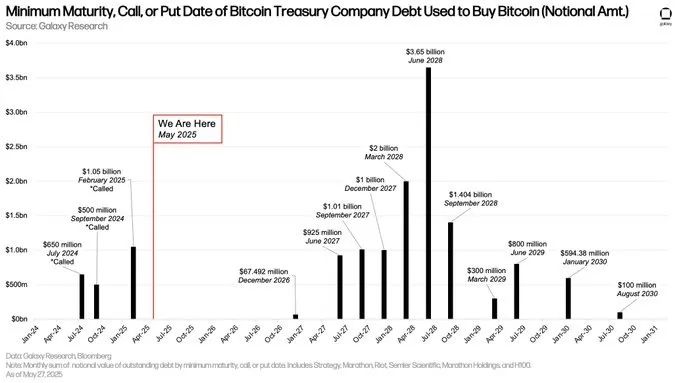
The above chart counts the debts issued by Bitcoin Treasury to purchase Bitcoin, and lists the earliest date (maturity/redemption/exercise date) when these debts may be required to be repaid, as well as the corresponding nominal amount of the debt.
Concerns about treasury firms’ debt-driven strategies are not unreasonable given the industry’s past history with leverage, but at this time, we see no significant risks to this approach.
However, this may not remain the case as debt matures and more companies adopt the strategy, potentially taking a riskier approach and issuing debt with shorter maturities.
Even in a worst-case scenario, these companies will have a range of traditional financial options to bail out, which may not end with the sale of treasury assets.
– Galaxy On-Chain Analyst @ZackPokorny_