Preface
As BTC hits a record high and ETH rises by more than 40% in a month, the crypto market has rekindled the "bull market expectations". The activity of on-chain funds has rebounded, the popularity of exchanges has increased significantly, and macro signals have also shown a positive trend.
But when you open your wallet, you find that altcoins are still standing still - is this still the bull market you are familiar with?
1. Did altcoins really miss the bull market?
As of May 22, 2025, the price of BTC has exceeded the $110,000 mark, setting a new record high; ETH has risen by more than 45% in the past month. In this round of sentiment recovery, funds and flows are concentrated in mainstream assets. At the macro-environment level, the easing of Sino-US trade and the increase in global capital risk appetite have provided a good upward channel for the entire crypto market.
However, against this backdrop of favorable conditions, the Altcoin sector is generally sluggish. Most altcoins not only did not rise, but even continued to fall back . The popularity of BTC and ETH conceals the fact that the entire market is undergoing a certain directional shift: altcoins are not without a market, but are being consciously "excluded" by funds and users.
Why does this round of bull market only belong to mainstream coins? Has the value logic of altcoins collapsed? Or do they need a new survival strategy? This article will analyze the challenges and solutions faced by altcoins behind this structural bull market from the perspectives of macro environment, capital preference, user mentality and mechanism innovation.
2. Macro-environment analysis: Is the bull market really coming?
1. Tariff easing and risk appetite recovery
As of mid-May 2025, the general tone of the macro market has shifted significantly.
The Sino-US tariff trade war is easing. After the economic and trade talks in Geneva, China and the United States issued a joint statement, saying that the additional tariffs would be reduced from the peak of 125% to 10%. This move not only triggered market optimism, but also released a positive signal to fight inflation .
Affected by this, the US stock market entered a structural upward channel. The S&P 500 index rose from 4,800 points at the beginning of the year to 5,940 points (as of May 20, 2025), approaching a record high. The risk appetite of funds has risen significantly, the Nasdaq and large technology stocks have risen, and gold and Treasury bonds have shown signs of capital outflow.
At the same time, the Crypto market has also benefited significantly. According to CryptoQuant and CMC data, since March, the overall net inflow of crypto assets, mainly BTC, has reached US$9.3 billion, most of which is concentrated in the spot market. In particular, the trading activity in the Eastern Time Zone of the United States has increased significantly, showing a trend of a large number of US funds entering the market.
2. Mainstream currencies continue to rise
BTC broke through $110,707 during intraday trading on May 22, 2025, jumping to a new all-time high; ETH has been rising strongly since April , and as of May 22, it rose to around $2,629, entering the "critical area" of breaking through $3,000.
3. Mainstream currencies become a "safe haven" for funds? What this reflects is "certainty preference"
Regulatory expectations are clearer: BTC and ETH have strong compliance attributes, and the US CFTC and SEC have gradually clarified their classifications;
Better liquidity: Large institutions (such as BlackRock and Fidelity) continue to absorb BTC through spot products or custody services ;
A more complete narrative: BTCFi and Ethereum L2 ecosystem have recently become the focus of a new round of topics.
This has caused mainstream coins to gain excess premiums in the new round of market conditions, while altcoins have fallen into the margins of funding.
4. Altcoins are generally flat
In comparison, the performance of the Altcoin sector is significantly worse.
The following is the price performance of BTC , ETH and representative Altcoins in the past month (data source: CoinMarketCap, TokenizeXchange ):
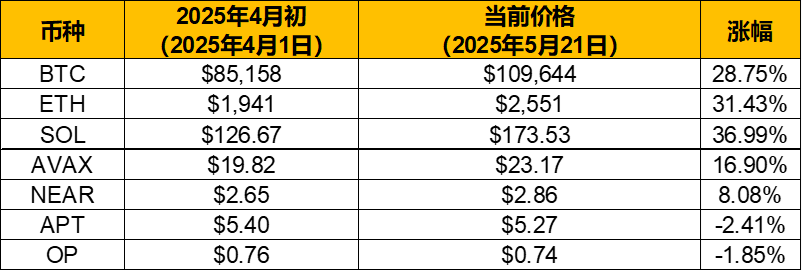
It can be seen that except for a few narrative hot projects such as AVAX and NEAR which saw a small increase, most Altcoins did not rebound synchronously with the mainstream coins, and even experienced a pullback, and funds were further concentrated in mainstream coins .
5. The market is not “lacking money”, but “unwilling to take risks”?
The interactive data on the Dune chain shows that the entire market is not lacking in liquidity, but rather extremely skewed in liquidity. Buying is concentrated on BTC and some high-profile projects, and the depth of altcoin trading continues to decline. The Google search volume for BTC and ETFs has soared.
The bull run in the market is indeed back, but it seems that it belongs only to Bitcoin and not to Altcoins.
3. Why haven’t altcoins caught up?
1. User mentality is mature: the cycle of chasing ups and downs is over
During the bull market in 2021, a large number of retail investors entered the market due to FOMO sentiment, blindly chasing various new currency projects, and most of them were deeply trapped in the periodic collapse of altcoins. According to a report by data analysis agency Messari, as of the end of 2022, more than 73% of non-mainstream token investors were in a loss after holding their positions for 6 months.
After market rotation, by 2025, investors generally formed a more cautious trading mentality:
More attention is paid to the number of real users and on-chain activity of the project
Prefer to choose projects with mechanism innovation, clear airdrop mechanism, and ecological support
No longer easily "listen to orders" or blindly go all in
Dune chain interaction data shows that the median participation in Altcoin projects after launch (7-day active addresses) has dropped from more than 13,000 in 2021 to less than 2,800 currently, and the cooling of community enthusiasm is visibly evident.
Users are not choosing not to enter the market, but are choosing to “wait smarter.”
2. KOL behavior transformation: from "buy" to "arbitrage"
In the past, altcoin projects were extremely dependent on KOLs and community communication. KOLs converted traffic into price through early position building, live broadcasts, and video content. However, in 2025, with the explosion of various tracks, memes, and changes in project airdrop strategies, KOLs began to change from "content distributors" to "game operators."
By observing the KOLs active on X, it is not difficult to find that: before promoting the project, the KOLs already have a certain proportion of tokens pre-allocated positions; after the community release, they gradually sell on the exchange/DEX to make a profit; and there is an obvious record of "pump & dump" behavior.
Especially in some of the recent "hot projects" in the Solana ecosystem, KOLs frequently participate in the "airdrop farm + group diversion" strategy, which increases the probability of loss for ordinary users.
In the long run, this behavior is accelerating the undermining of the trust foundation of altcoins.
3. Sector heat transfer: Narratives cannot compete with BTCFi, AI, and Restaking
The CoinGecko report points out that the current crypto narrative is focused on the following three tracks:
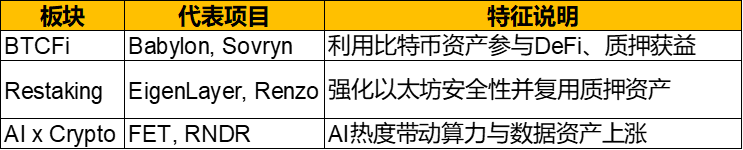
However, traditional Altcoin projects lack connection with the mainstream narrative, have thin narratives, no technological breakthroughs, and scarce ecological cooperation, making it difficult to attract new traffic and attention.
The hot topic is no longer "all coins can rise", but capital and users are focusing on "investing in the right story".
4. Market trust and liquidity structure are rewritten
The trust mechanism of altcoins is collapsing:
Users no longer trust project owners: most projects are only active for the first 30 days after launch, after which liquidity dries up.
Market makers’ interest has declined: MM strategy institutions have concentrated their resources on BTC , ETH and compliant stablecoins, and altcoin trading pairs have been delisted by multiple exchanges.
The more serious problem is that the lack of consensus has led to the "hollowing out" of the community: the project side is left with only operating accounts and no real community; retail investors have flowed to the points system, airdrop hunter channels, and even AI computing power to make money.
This also leads to a new phenomenon - altcoins are no longer a "bet on stupidity" but a "bet on speed": no one believes in the long term, and everyone is scrambling for short-term liquidity.
The reason why Altcoin doesn’t rise is not because no one is paying attention to it, but because there is no reason to believe in it.
When the incentive design of the project party is no longer sustainable, the credibility of KOLs cannot be established, and the user's game is only left with a "preemptive mechanism", the entire copycat ecosystem loses its basic trust and liquidity structure.
The next step is to redesign the system instead of repeating the old routine.
4. The rise of new “copycat gameplay”
1. Exchange-driven airdrop and points mechanism
As user enthusiasm wanes, some exchanges have begun to re-stimulate user participation by designing task systems, point redemption, and airdrop activities. In addition, some projects have also begun to introduce point multiplier mechanisms to encourage users' long-term participation and enhance community activity. The core of these mechanisms is:
Lower the threshold for participation: earn rewards by completing simple tasks, attracting more users to participate.
Enhance user stickiness: Points and airdrop mechanisms encourage users to continue to participate in the project ecosystem.
Expand community influence: The recommendation mechanism encourages users to actively spread projects and expand influence.
2. Peak at launch? The sustainability of Meme coin is questioned
Meme coins will show stronger community-driven characteristics in 2025. Project owners quickly gather popularity through social media, community activities and viral content dissemination. Before listing on exchanges, they usually spread through social media in a short period of time to quickly attract market attention; after the coin pair is launched, the price rises rapidly and then quickly falls back. Its sustainability is questioned, and the market is calling on project owners to continuously optimize security, governance structure and community building.
5. Future Outlook: The Breakout Path of Altcoins
1. Do altcoins need to change their skins or souls: repackaging old projects or reconstructing mechanisms?
Whether altcoins still have a chance does not depend on the market, but on whether they can "update themselves".
In the past, many projects disappeared in the bear market, but were revived in the early bull market: they changed their logo, updated their roadmap, added some AI keywords, and started telling stories again. But users in 2025 will no longer believe in "old wine in new bottles".
Compared with "changing skins", truly competitive projects have chosen to "change souls": reconstructing the Token economic model, introducing a fairer airdrop mechanism, and even guiding community co-governance through DAO, allowing users to change from speculators to ecosystem co-builders. At the same time, relying on extremely simple user experience and deep binding of on-chain native traffic, they have achieved sustained activity and liquidity.
The key to breaking through is not how trendy the packaging is, but how new the mechanism is, how genuine the emotions are, and how steady the rhythm is.
2. What do retail investors really need? Narrative? Utility? Or pure gaming?
What retail investors are chasing in 2021 are narratives and imagination space.
In 2025, retail investors will be more concerned about “Can I make mistakes at low cost?”, “Can I sell at any time?”, “Am I regarded as a counterparty by the project owner or KOL?”
They don't need a "grand vision", they need clear expectation management and quick feedback.
This also means that the project party must redesign the user participation path:
The mechanism of task, points, and NFT binding cannot only play "incentive", but also incorporate "exit cost" into the design;
Instead of pursuing explosive growth in the number of users, we will build a small and refined "core loyalty pool";
Make users feel that they are not being “designed” but “participating”.
3. How do project owners, platform owners, and communities rebuild user trust?
The current market has two growth engines:
Exchange/platform driven traffic system: The exchange platform is rebuilding the one-stop user flow path of "task → incentive → airdrop → coin listing". This is not only a project cold start tool, but also a "sandbox" to control traffic risks.
A new community-driven narrative system: Telegram fission, creator DAO, and low-threshold KOL incubation tools (such as Zealy and Galxe) have become the infrastructure for the autonomy of altcoin traffic.
If the previous traffic strategy was "overwhelming", the current strategy is more like "igniting the fire": allowing early believers to play, make money, generate real transactions and content, only then can fission and natural spread be achieved.
Summary: It’s time for altcoins to reshuffle
Altcoins are not disappearing, they are just on the verge of a reshuffle.
Projects that have no mechanism innovation, lack community participation, and fantasize about increasing their value 10 times by just shouting orders are destined to sink in this cycle.
However, projects that truly understand changes in user behavior, reconstruct incentive structures, and can achieve mutual coexistence and win-win results with the community may still be able to break through the siege in the "local bull market."
This bull market does not belong to all altcoins, but to those players who are serious about doing things.
It’s not about “whoever has the loudest voice wins”, but “whoever can stabilize people’s hearts will live longer”.