
On April 9, 2025, Trump's reciprocal tariff policy officially took effect, and the risk of a global trade war intensified. Trump is trying to make more money for the US treasury by imposing additional tariffs, and this strategy may reflect that the US economy may have entered a recession.
Trump's punitive tariff policy has broken the decades-long global trade order, triggering a new round of declines in the U.S. stock market and the crypto market. According to Bloomberg, the global stock market value has shrunk by $10 trillion. This trade conflict may put more pressure on the global economy and also affect the trend of the cryptocurrency market and the flow of funds in the market.
Macroeconomic indicators are worth paying attention to this week. The Federal Reserve will release the minutes of its March monetary policy meeting at midnight on April 10, Eastern Time. Most markets expect the Federal Reserve to release a signal of a rate cut, with three rate cuts of 25 basis points each this year.
In addition, the United States will release the March CPI (Consumer Price Index) data and the number of initial jobless claims for the week at 20:30 this Thursday (April 10). These two data will directly affect the market's expectations of the direction of the Federal Reserve's monetary policy and may trigger fluctuations in the crypto market and traditional financial markets. The March PPI (Producer Price Index) data will be released on Friday (April 11), providing further clues to inflationary pressure.
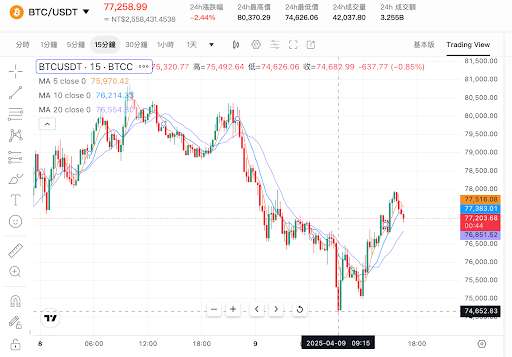
Today, the price of Bitcoin showed signs of rebounding from the lowest level of $74,650 in the morning to $77,930. According to BTCC market data, as of the time of writing this article, the price of BTC is $77,258, and the 24-hour decline has narrowed to 2.44%. Bitcoin fluctuates sharply in the short term, so please pay attention to the dual impact of policy expectations and market sentiment.
The Fed decided to maintain the benchmark interest rate in the range of 4.25%-4.50% and released an expected signal of three rate cuts this year, each time by 25 basis points. This policy signal triggered relatively optimistic expectations in the market, especially in the current context of high global economic uncertainty, interest rate cuts may become an important means to ease economic pressure and support risky assets.
Specifically, if the minutes show that Fed officials are more concerned about the rebound in inflation, the market may interpret it as a hawkish policy path, which will suppress expectations of rate cuts and even strengthen expectations of rate hikes, putting pressure on risky assets. On the contrary, if the minutes mention signs of economic slowdown, especially the intensification of pressure on the banking industry, it may further support expectations of rate cuts and bring expected support for loose liquidity to the crypto market.
In addition, if the CPI and PPI data show that inflationary pressure has increased, it may exacerbate market concerns that the Fed will continue to maintain a high interest rate policy. This expectation may lead to greater selling pressure on cryptocurrencies such as Bitcoin, especially when the current market is in a state of "high volatility and low directionality". On the contrary, if the inflation data is in line with or lower than expectations, especially if the cooling trend continues, it may stimulate market expectations for interest rate cuts, once again provide liquidity support for the crypto market, and drive the price of crypto assets such as Bitcoin to rebound.
From a technical perspective, if inflation data reinforces expectations of tightening, Bitcoin may face downside risks and test key support levels (such as the $70,000-74,000 range). If the data is weak, it may trigger a short-covering rebound, further pushing up the price of Bitcoin.
In summary, in the short term, tariff policies, the Federal Reserve's monetary policy, inflation data, and global economic uncertainty will be the main factors affecting the crypto market. The crypto market is highly volatile, and investors should pay attention to risk control.