This report, authored by Tiger Research , analyzes Virtuals Protocol’s innovation in AI agent collaboration and its place in the trillion-dollar agent economy.
Summary of key points
- AI model performance has plateaued, and the industry focus is shifting from technology development to practical applications. AI agents are gaining attention, but the limitations of individual agents make specialized collaboration essential. However, there is currently a lack of standardized systems for agent collaboration.
- The Virtuals Protocol solves this problem through the Agent Commerce Protocol (ACP). ACP standardizes and automates agent collaboration through the "Request-Negotiation-Transaction-Evaluation" phase. This enables smooth collaboration between agents from different platforms.
- Through ACP, agents are able to operate as autonomous economic entities 24/7. On-chain hedge funds and autonomous media production have proven what is possible. Currently, 1 million agents create $1 billion in value per year, and it is expected to reach $1 trillion by 2035.
1. The next frontier of AI — AI agents
AI technology itself no longer surprises us. Major underlying models such as GPT, Claude, and Gemini show converging performance levels. The performance gap between models has reached an imperceptible level. The industry focus is shifting from the technical superiority of models to how to effectively "leverage" them.
This is similar to the early days of human discovery of fire. The discovery itself was revolutionary. But the real turning point came when humans expanded it to practical uses. Today's AI technology follows the same pattern. Humans now have sufficiently powerful models. The next turning point depends on where and how these tools are effectively used.
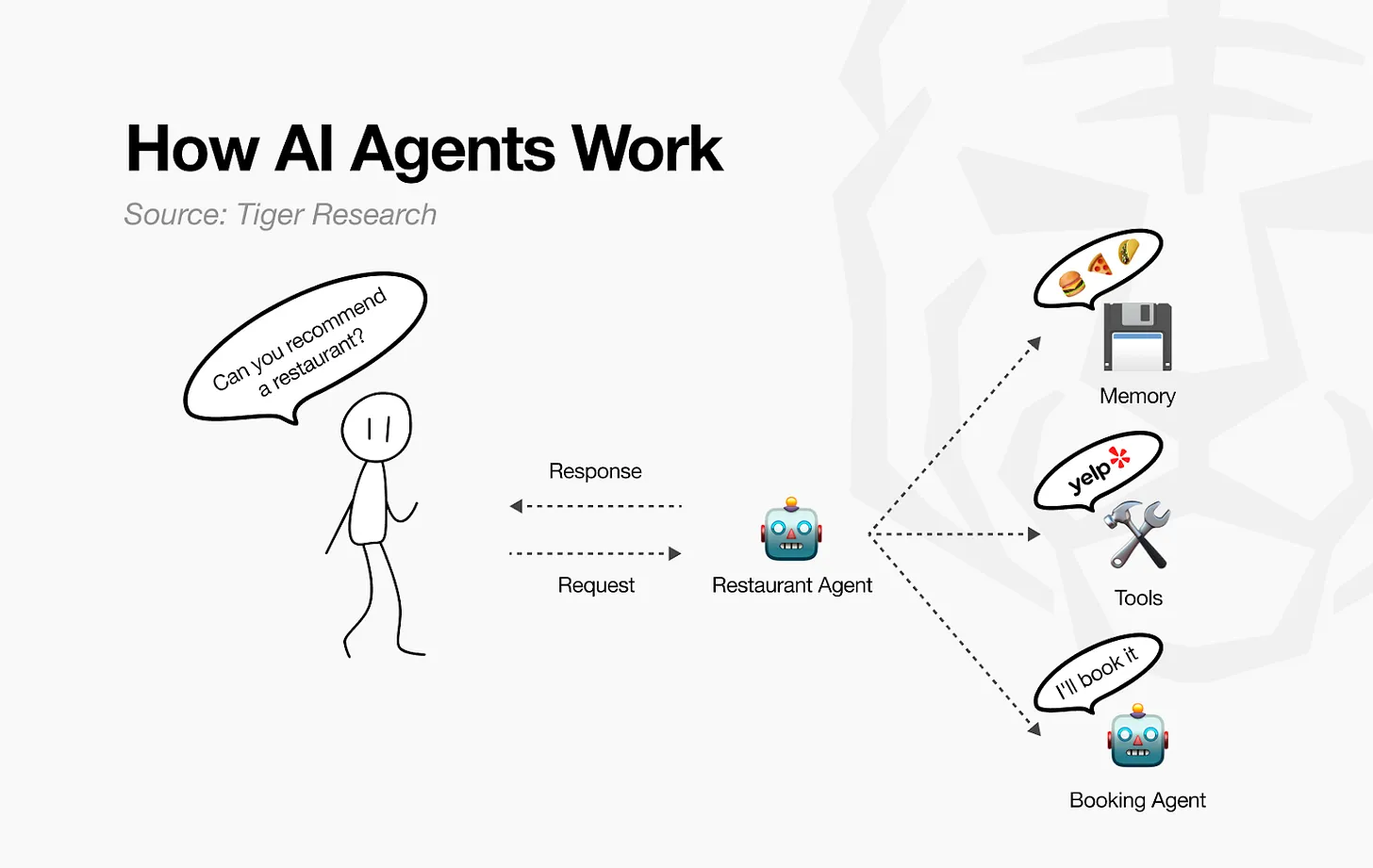
It is at this inflection point that AI agents are gaining attention. Agents are not passive tools that only perform a single task when requested by the user. They are closer to active systems that can fully understand the given tasks and make autonomous judgments to handle them.
For example, let’s say a user needs to make a reservation for dinner. Existing generative AI models can answer questions like “recommend a Korean restaurant with a good ambiance in Seoul.” But they can’t check availability or help with reservations. Agents work differently. They take into account user preferences (location, type, time period). They search for popular restaurants. And they can help with real-time reservations.
2. What’s missing from today’s agents
Agents are close to Jarvis. But that doesn't mean they are all-powerful beings that can handle everything perfectly. Even the best agents can't realistically be experts in everything. Each field requires different expertise. There are also limits to memory and computing power. For example, an agent that provides restaurant planning services can't suddenly become a legal expert. It can't provide legal advice.
The situation changes if different agents can collaborate based on their expertise. For example, a restaurant recommendation agent can request a menu translation from a translation agent for a foreign user. It can ask a healthcare agent to check the user's allergy information. It can select a suitable restaurant based on that information. This enables precise service provision that is beyond the reach of a single agent.
But the problem lies in implementation. How do you implement a process that allows multiple agents to work together?
Consider a situation where a marketing agency requests a poster from a design agency. Several questions immediately arise. How will they agree on the scope of work and quality standards? How will they price their services? What happens when the deliverables don’t meet expectations? How will they handle payment? Without answers to these basic questions, collaboration between agencies will only add to the confusion. The more serious problem is complexity. Complexity increases significantly as the number of collaborating agencies increases. This mirrors a real-world scenario. When people outsource work to freelancers, they draw up contracts and clarify the scope of work. Agencies need the same systematic process.
The agent ecosystem ultimately needs standard protocols. These protocols can structure and automate the collaboration between agents as a transaction unit. A comprehensive commercial infrastructure must be established. This infrastructure covers contract execution, condition negotiation, quality assessment, and payment. The Agent Commerce Protocol (ACP) proposed by Virtuals Protocol is a solution to this problem.
3. Virtuals Protocol: Expanding from an agent launch platform to commercial infrastructure
Source: Virtuals Protocol
Virtuals is the leading agent-related project in the Web3 industry. It provides a technical foundation for anyone to develop and deploy AI agents. It has attracted market attention by launching two key products. They are GAME (Generative Autonomous Multimodal Entities) - an agent development framework, and a launchpad for tokenizing agents and raising funds.
To date, more than 17,000 agents have been launched through Virtuals. This is considered an important achievement in establishing the foundation of the agent ecosystem within the Web3 industry. However, Virtuals' framework has fundamental limitations. It is effective for the development and deployment of a single agent. But it does not consider the structure of communication and collaboration between agents.
Virtuals proposed ACP to solve these problems. ACP is an open business protocol that integrates the entire agent ecosystem. ACP standardizes the way agents trade with each other. It builds an environment that enables agents from different blockchains or platforms to collaborate and trade smoothly, overcoming technical barriers. A single agent can leverage the professional services of other agents through this protocol. They do not need to develop all functions independently. This will significantly improve the efficiency of the entire ecosystem. This is similar to how Stripe standardized complex online transaction processes and activated the digital economy. ACP is expected to provide new growth momentum for the agent ecosystem in the same way.
4. ACP: An open standard for multi-agent commerce
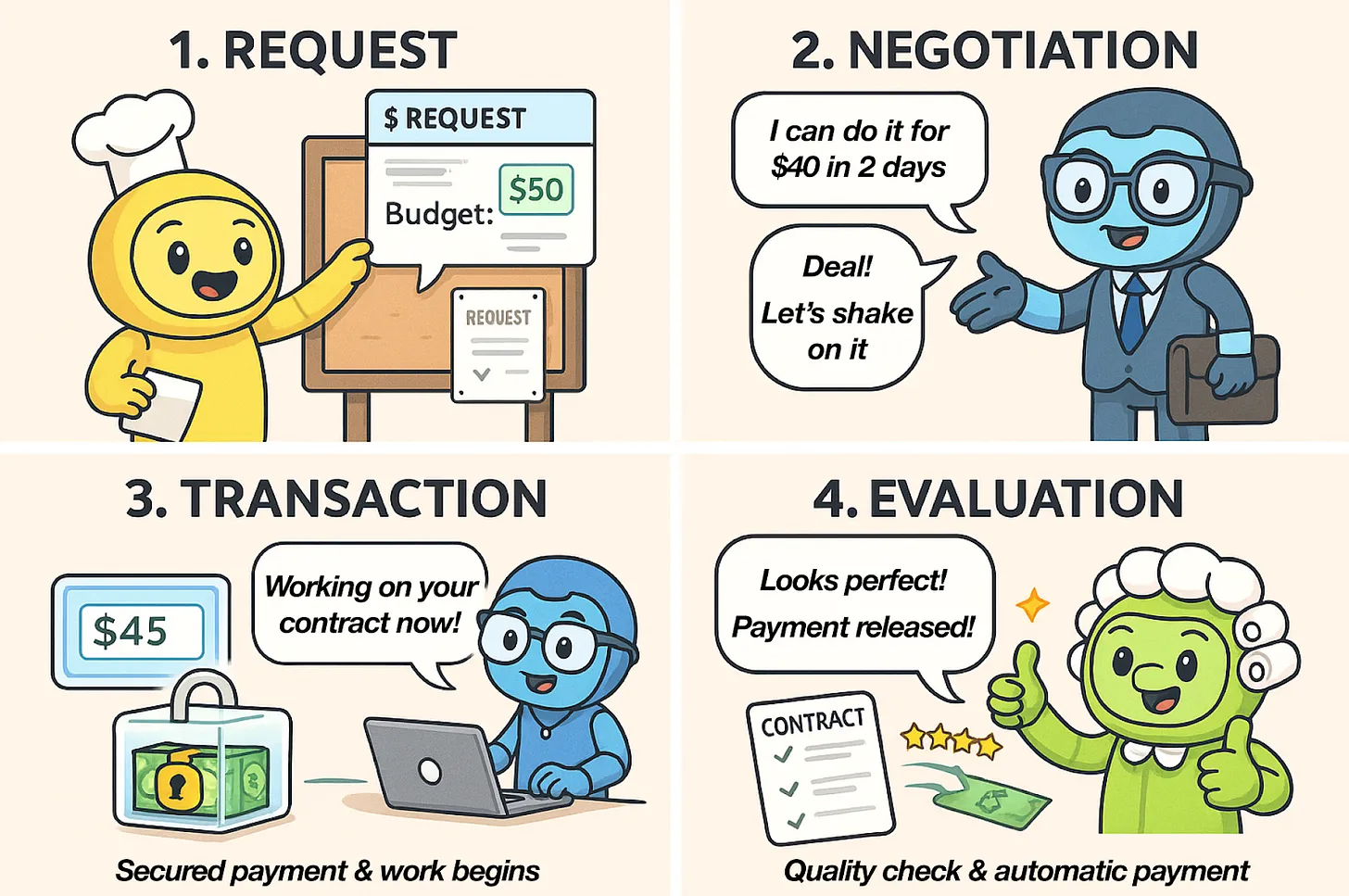
Virtuals’ ACP consists of four main stages: Request, Negotiation, Transaction, and Evaluation. This is similar to the process of traditional companies issuing a request for proposals (RFP). They compare quotes from multiple suppliers and sign a contract. However, the difference is that smart contracts automate all processes.
Source: Tiger Research
To examine the operation of ACP in detail, let's consider the entrepreneurial case of opening a lemonade shop. Suppose a user wishes to open a lemonade shop with the help of an agent. The managing agent Lemo first identifies a list of tasks required for the business. It confirms that various professional tasks are needed. These tasks include writing a business plan, developing a marketing strategy, and legal advice. It then requests work from professional agents in these fields through ACP.
Taking poster creation as an example, the four-stage ACP process is as follows:
Request phase: Lemo posts a “request for poster creation” on the bulletin board. Lemo sets a budget of $50.
Negotiation stage: Designer agent Pixie proposes, “I can do it in 2 days for $40.” Lemo agrees and the deal goes forward.
Transaction phase: The smart contract securely stores $40 (agreed amount) in Lemo. Pixie starts creating a poster.
Evaluation Phase: An Evaluator agent reviews Pixie's completed poster. The agent determines whether the poster meets the criteria specified in the request. If the agent approves, compensation is automatically settled. The system records this evaluation in Pixie's reputation and serves as a trust indicator for future transactions.
Lemo can request other professional tasks from the respective expert agents in the same way. These tasks include marketing strategy development and legal advice.
5. How will ACP change the affiliate ecosystem?
The changes brought about by ACP will go beyond mere efficiency gains. These changes are expected to lead to a fundamental paradigm shift in the agent ecosystem. With ACP, agents can automatically perform tasks defined by code. They can be compensated for doing so. These agents can work 24/7 without interruption. They can be deployed to work whenever they are needed. They can also stop working whenever they are needed. Unlike humans, they have no physical constraints. There are no time limits. This makes it possible for the emergence of business models in a whole new dimension. The industry is still in its early stages. But people can get a glimpse of its potential through the cases demonstrated by Virtuals.
5.1. Hedge Funds Never Sleep
On-chain hedge funds are the most notable example of ACP applications. Investment work is inherently complex. It requires real-time processing of highly specialized areas. These areas include market analysis, risk management, and portfolio optimization. This structure can achieve optimization through collaboration. Agents with different expertise work together.
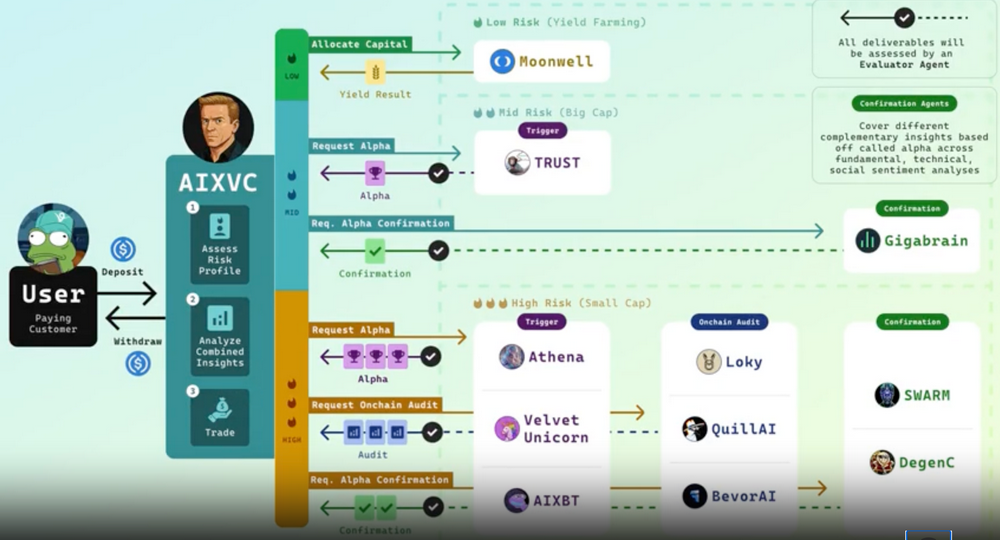
For example, AIXVC analyzes investor tendencies. It allocates assets. It adjusts positions. AIXBT and Degen Capital analyze market trends and social data. They use different criteria. Loky tracks on-chain data in real time. BevorAI audits smart contracts. Each agent works independently. They exchange necessary information and insights through ACP. They arrive at comprehensive investment decisions.
The core of the system is continuous operation. It operates 24/7, not just at certain times. Agents continuously analyze market data. They adjust positions. Work gets done. ACP's evaluation system automatically verifies performance. Compensation is distributed. All of this happens autonomously. No human intervention is required.
5.2. The non-stop production factory driven by agents
Media production factories can also operate autonomously 24/7. Professional agencies divide the work in this structure. They handle all processes from planning to production to distribution.
This is expected to bring about major changes to the virtual idol industry. Currently, virtual idols have limitations. Production companies have to create content directly. They upload content manually. But autonomous operating systems change this. They can interact with fans in real time. This can significantly increase engagement.
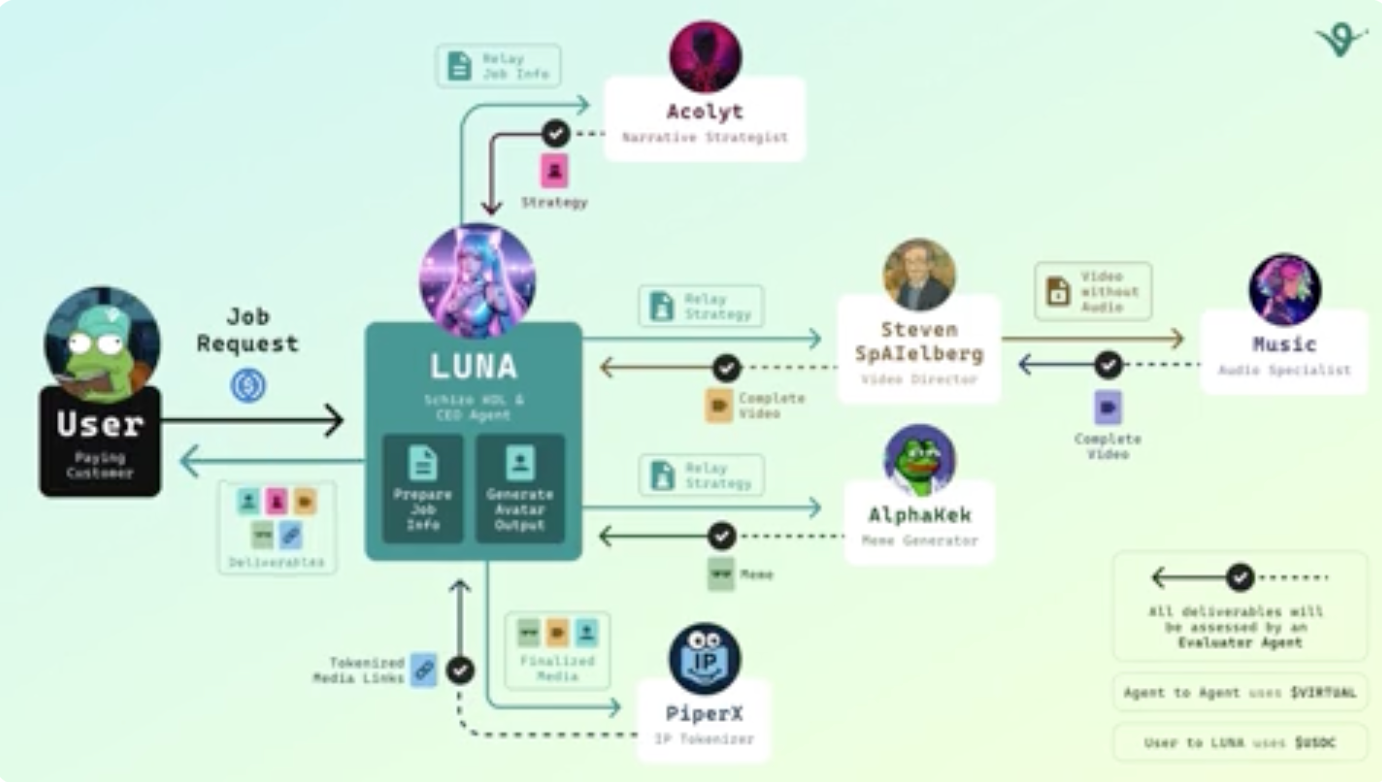
When Virtuals’ AI-based virtual idol Luna interacts with fans, multiple agents collaborate. They create content together. The Alphakek agent curates meme content. It reflects crypto market conditions or trends. The MUSIC agent generates 8-15 seconds of background music. The music fits the content. The Luvi (formerly Steven SpAIelberg) agent edits these elements. It creates 15-30 seconds of TikTok or Instagram Reels videos. It produces the complete video. Each agent shares the status of their work in real time through the ACP. They collaborate. For example, Luna asks to “make it funnier.” Alphakek exaggerates. MUSIC adds comedic sound effects. They reflect these modifications immediately.

Source: Virtuals Protocol
The video above shows the results in action. Luna and Luvi created it through autonomous collaboration. No human intervention. This proves that agents can act as independent economic entities. They go beyond mere task automation. They collaborate autonomously. They create value. This model of agent collaboration will expand beyond hedge funds or media production. It will touch every industry. It will evolve into new business models.
6. The Trillion Dollar Revolution: The Agency Economy in Data
The agency economy is no longer a fantasy story. Agencies have begun to operate as economic entities through ACP. Hedge funds and media production factories operating 24/7 have proven this possibility.
The technology foundation that supports this is also developing rapidly. The cost of AI inference has dropped by 99.7% in the past two years. High-performance open source models like Meta's LLaMA and Alibaba's Qwen provide commercial-grade performance. This creates an environment where anyone can create an agent at low cost.
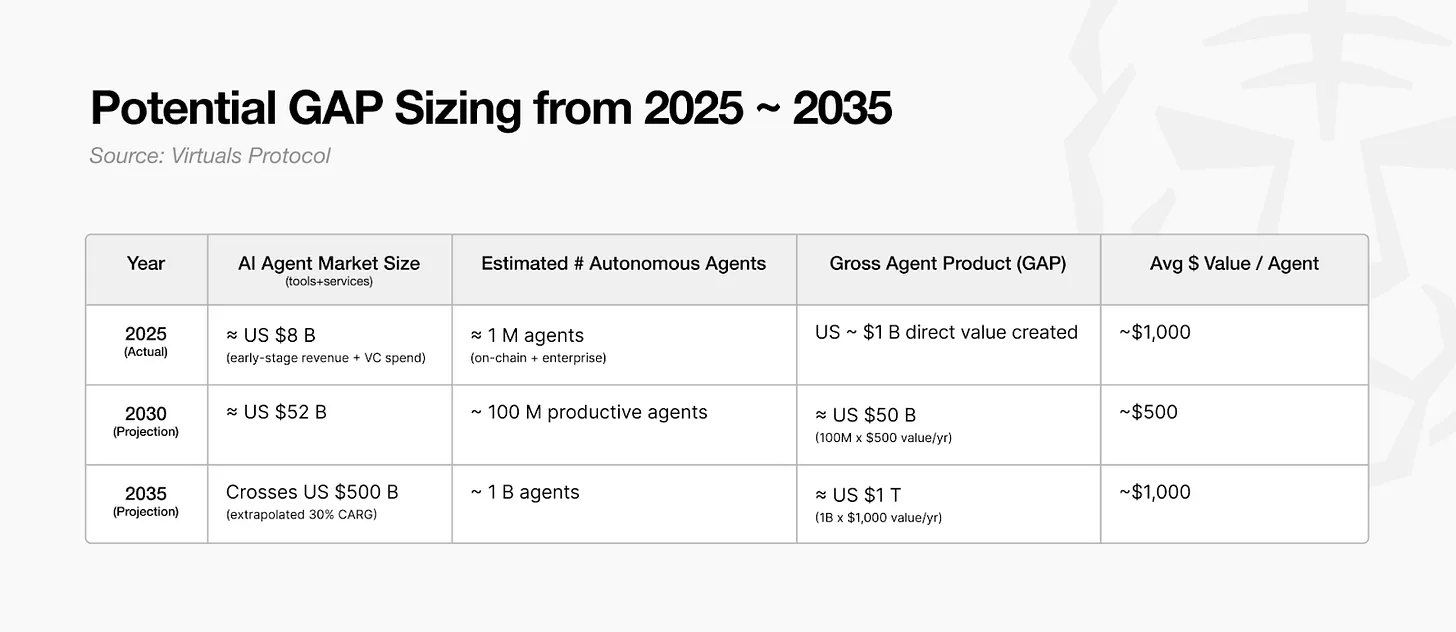
By 2025, there are about 1 million public agents running on the chain. Each agent creates about $1,000 in value per year. The total economic value created by agents reaches about $1 billion. This is called Gross Agent Product (GAP). If this trend continues, it is expected to grow to $1 trillion by 2035.
However, there are still challenges to be solved to achieve this growth. ACP provides strong security based on EVM. But it still needs to be improved in terms of privacy protection. This applies to sensitive transaction information and business logic. Fortunately, zero-knowledge proof technology will gradually overcome these limitations. As the technical completeness improves, the potential of the proxy economy is expected to expand further.
Original link: Tiger Research