Written by: Hazel Hu
With the recent explosion of AI payment supernovas, a protocol standards war surrounding "how AI agents spend money autonomously" is now inevitable.
In 1996, when Tim Berners-Lee and his team at CERN finalized the HTTP/1.0 specification, they left a blank in the list of status codes: 402 Payment Required.
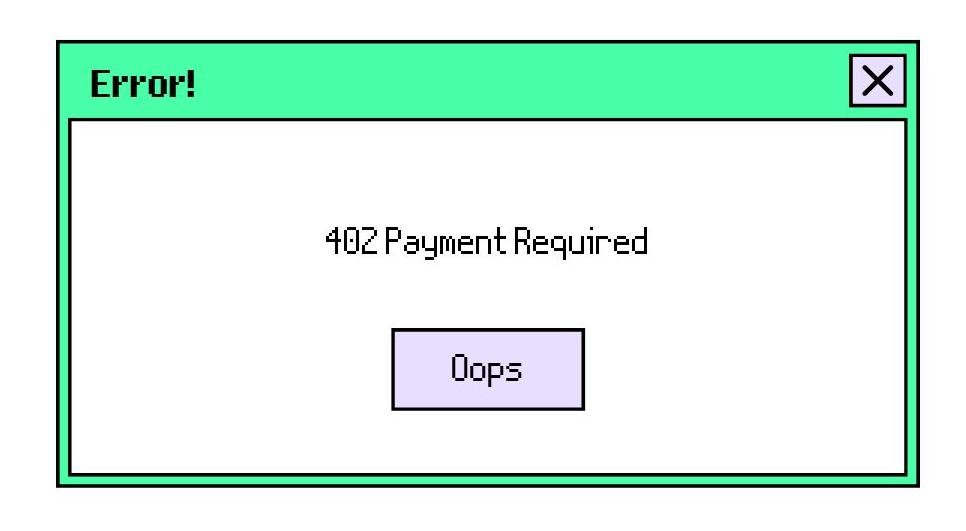
This is an interface reserved for future digital cash or micropayment solutions. The creators of the internet foresaw thirty years ago that a toll lane would eventually be needed on the information superhighway.
But the 402 error was never actually used. No browser supported it, and no server ever used it. Like a letter with the address written but never sent, it lay dormant in the corner of the HTTP protocol for thirty years.
Until the AI Agent arrived.
In the third week of March 2026, the payments industry saw four major developments within 72 hours. On March 17, Mastercard acquired stablecoin infrastructure company BVNK for $1.8 billion. On March 18, Tempo, a public blockchain incubated by Stripe and Paradigm, officially launched its mainnet and simultaneously released the Machine Payments Protocol (MPP). On the same day, Visa Crypto Labs released visa-cli, a command-line tool that allows AI agents to directly swipe cards at the terminal. Cuy Sheffield, head of Visa's crypto business, nicknamed it "Command-Line Commerce." Prior to this, the x402 protocol, jointly launched by Coinbase and Cloudflare, had been running for nearly a year.
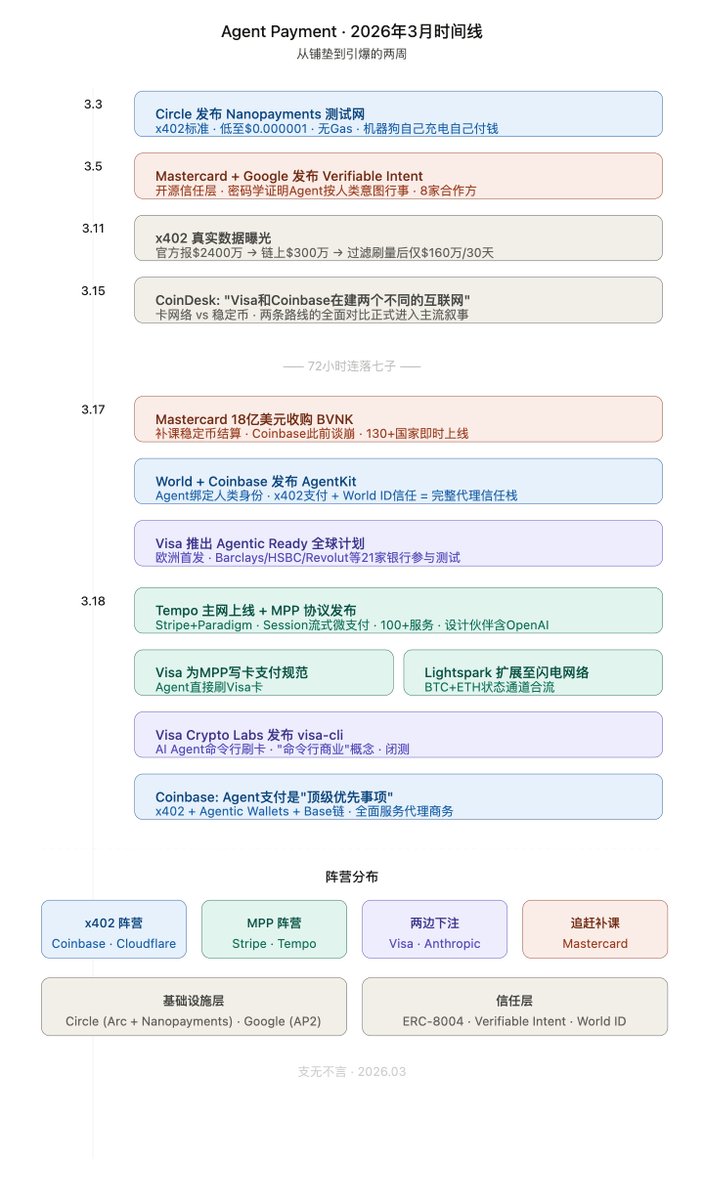
Four chess pieces, one card table. A long-awaited standard battle has officially begun.
The story begins with the 402 error. Marc Andreessen once called the internet's lack of native payment capability "the original sin of the internet." The HTTP protocol is inherently capable of transmitting text, images, and videos, but not money. This flaw gave rise to the entire advertising economy; since users were unwilling to pay for content, advertisers footed the bill. Thus, we have a free but monitored internet.
402 could have changed everything. Imagine your browser accessing a paid article, the server returning a 402 status code, your browser popping up a built-in micro-payment interface, you clicking confirm, a penny credited to your account, and the article unlocked. The whole process is as natural as loading an image.
But the technology of the 1990s couldn't deliver on this vision. There were no mature solutions for digital cash, no low-cost settlement channels, and SSL and TLS were just getting started. The 402 redirect became a placeholder that was ahead of its time.
Thirty years later, it was a Canadian who awakened it.
Erik Reppel, a graduate of the Computer Science Department at Victoria University, previously served as the Engineering Lead at the Web3 social company Zora before joining Coinbase. After joining Coinbase's developer platform, he began a project he described as "one that Coinbase has been exploring since 2015": designing a native payment standard for the internet.

One of his inspirations came from the Bitcoin payment gateway experiments conducted by Balaji Srinivasan, former CTO of Coinbase, during his time at 21.co. The underlying concept was sound, but it failed due to cost. Back then, the gas fee for each on-chain transaction was several dollars, making micropayments simply unworkable. However, by 2024, Layer 2 networks had reduced the cost per transaction to less than one ten-thousandth of a cent.
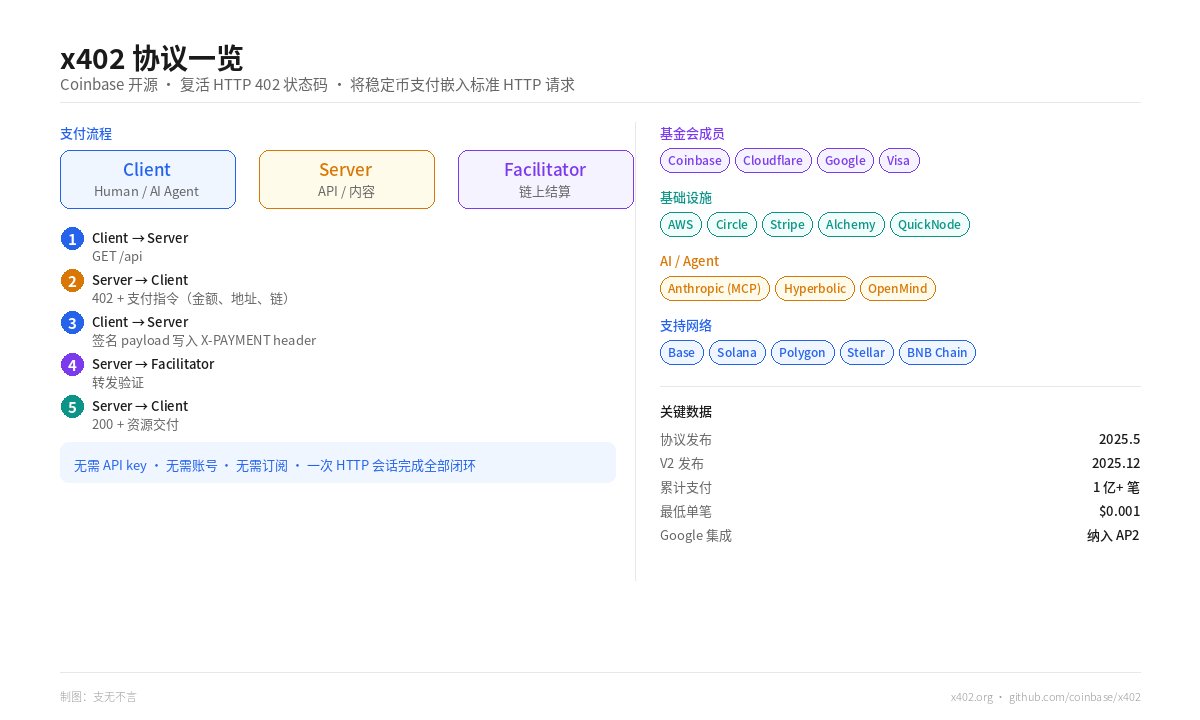
The time had finally come. In May 2025, Reppel, along with colleagues Nemil Dalal and Dan Kim, jointly published a white paper, officially launching the x402 protocol. Its logic is clean and straightforward: a client requests a resource, the server returns an HTTP 402 response and a JSON payload specifying the price, accepted tokens, and wallet address; the client signs the payment with their wallet, settlement is completed on-chain, and the server returns the resource. The entire process takes two seconds.
x402 chose the purest path: protocol-native, on-chain settlement, and no intermediaries. It's directly embedded in the HTTP layer, aiming to become part of the internet infrastructure, much like DNS and TLS. Coinbase and Cloudflare subsequently formed the x402 Foundation, entrusting protocol governance to a neutral foundation. What does Cloudflare's involvement mean? Approximately 20% of global internet traffic passes through Cloudflare's more than 300 data centers, and x402 is integrated into its Agents SDK and MCP server. This is a distribution advantage that is difficult for any competing protocol to replicate.
But another Canadian thinks differently.
Liam Horne, a graduate of the University of Waterloo, entered the Ethereum field in 2016. He was classmates with Vitalik Buterin at university (they both received the Thiel Scholarship). His initial attraction to blockchain was simple: direct transfers between two software programs could be made without the need for a bank.

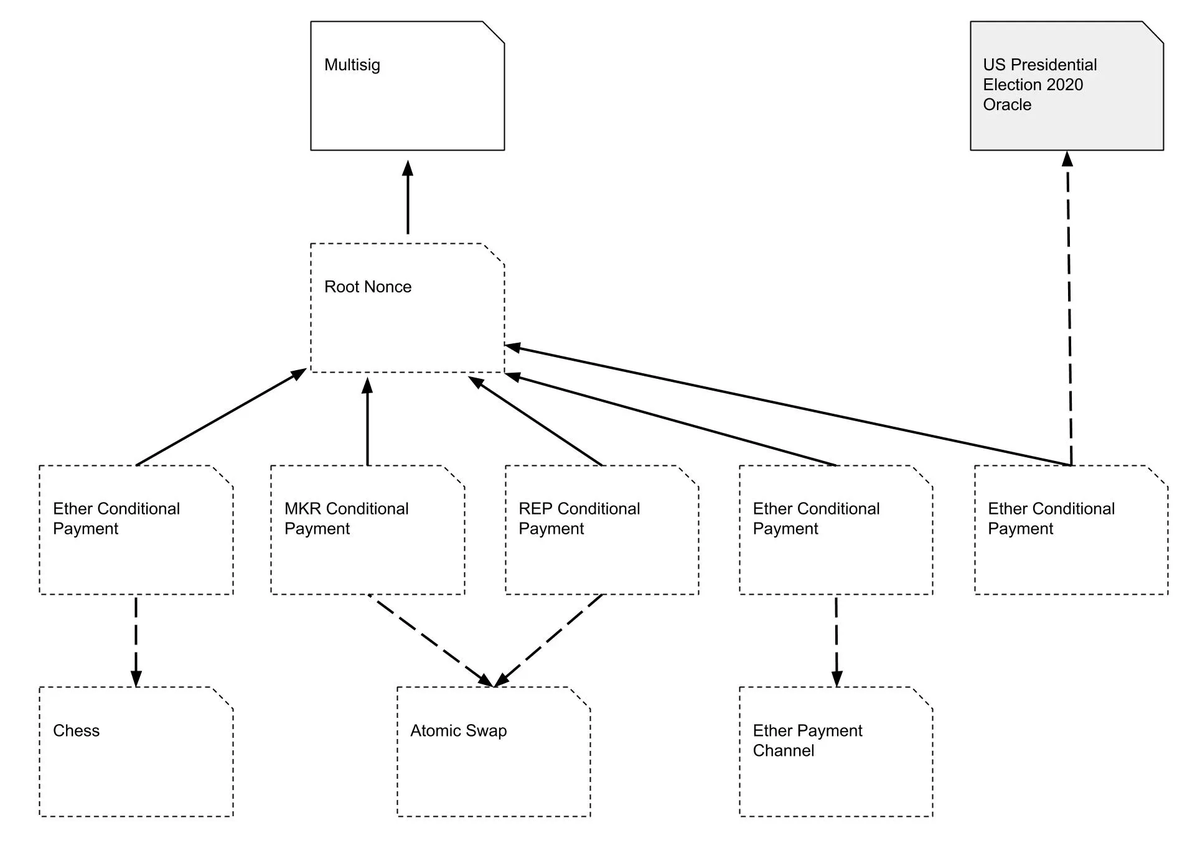
But Ethereum is too slow and too expensive. In 2017, Horne and Jeff Coleman proposed the concept of "generalized state channels" at L4 Ventures. Two parties lock their funds into a multi-signature contract, exchange signed transactions off-chain at any speed, and finally settle only the net result back on-chain. Zero fees, instant settlement, and theoretically, thousands of transactions per second are possible.
They also invented a technique called "counterfactual instantiation," which treats the contract as if it were already deployed, even though it never actually touches the chain. This idea directly inspired Vitalik to propose EIP-1014, which is the CREATE2 opcode that is now widely used for account abstraction and cross-chain deployment.
Horne's proudest demo was called Web3Torrent: a torrent download client where downloaders and uploaders pay tiny fees chunk by chunk via a state channel. Each downloaded file fragment incurs a small payment. Machines pay machines; no human intervention is involved.
But the problem is—nobody needs this.
From 2017 to 2020, the main theme of the Ethereum ecosystem was DeFi and transactions, not payments. State channels were technically feasible, but they couldn't find users. It was like a tollbooth that had been built, but there were no cars on the highway. Horne admitted that state channels had become "the solution without problems." Rollups became a more general solution for scaling, and he turned to Optimism.
At Optimism, Horne's career skyrocketed: Engineering Lead, CEO, expanding the team from 8 to nearly 70, spearheading the development of the OP Stack, and driving the collaboration between Superchain and Base. Base is Coinbase's L2 chain. These two threads converged for the first time here.
Horne later left OP Labs as a consultant and participated in the development of World Chain. In the summer of 2024, he began intensive research on stablecoins. Base's success made him realize one thing: the synergy between Coinbase, Circle, and Base almost replicated the stablecoin expansion path of Tether, Tron, and Binance outside the United States. Stablecoins are no longer a niche narrative; they account for 70% of all blockchain transaction volume.
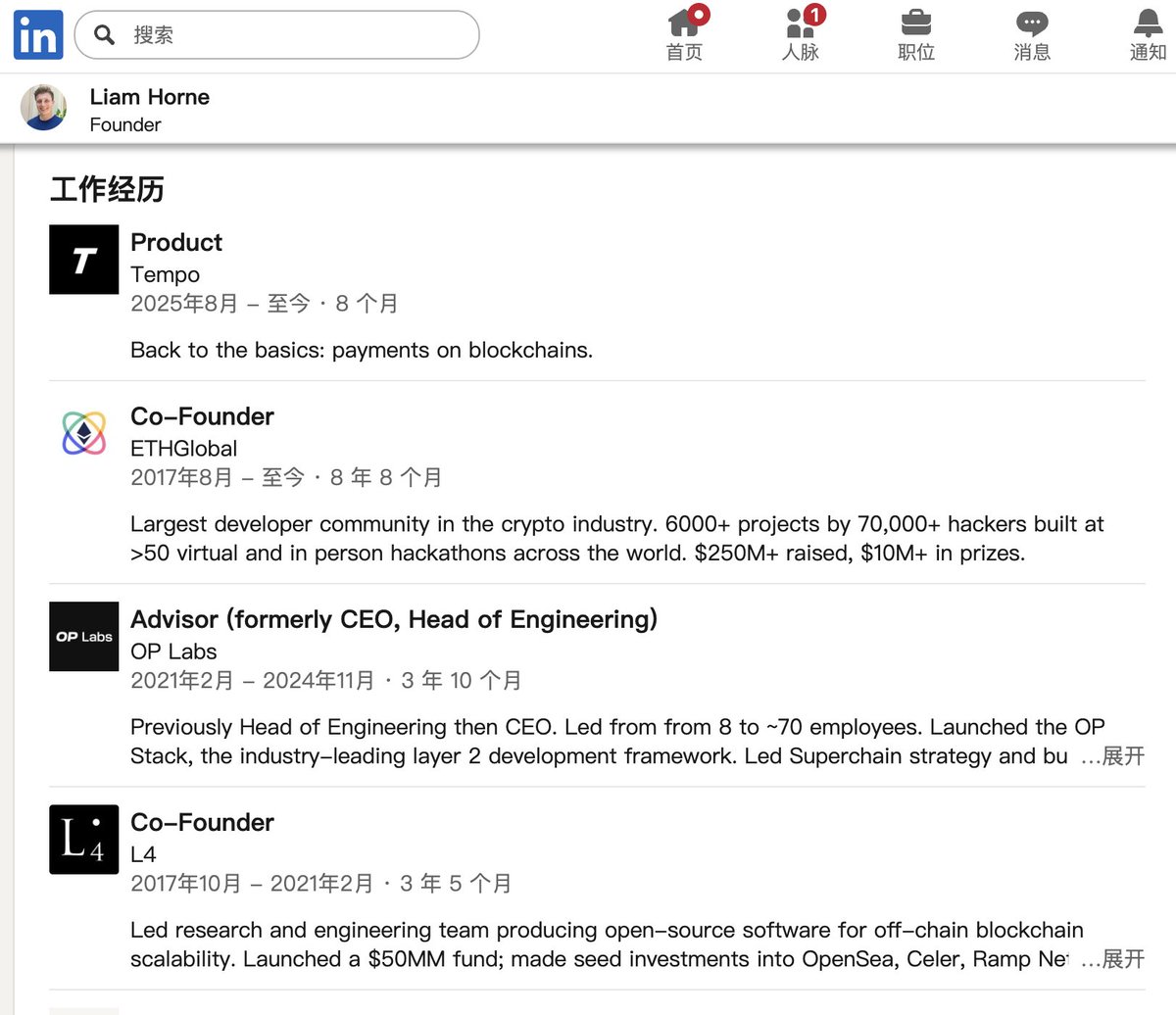
In September 2025, Tempo completed a $500 million Series A funding round at a $5 billion valuation, co-incubated by Stripe and Paradigm. Horne served as Head of Engineering. Paradigm's CTO Georgios Konstantopoulos and co-founder Matt Huang were also deeply involved.
Horne spent six years scaling Ethereum, first working on state channels, then on Optimism. Then he left to work on a decentralized L1 architecture backed by a large corporation. In the same week that Tempo's mainnet launched, OP Labs announced a 20% layoff, and Vitalik had previously publicly rejected the L2 route. His classmate and fellow scholarship recipient seems to have made his choice even earlier.
This is not the only example of personnel movement that is worth noting.
In February 2026, Dan Romero and Varun Srinivasan, the two co-founders of Farcaster, a decentralized social application strongly supported by Vitalik Buterin, announced their joining Tempo. Before founding Farcaster, Romero was Coinbase's 20th employee, joining in 2014 and rising through the ranks to become VP, responsible for international and consumer business. Srinivasan also came from Coinbase, where he was responsible for engineering and product.
Their departure from Farcaster was also quite dramatic. After Neynar acquired the Farcaster protocol, the founding team collectively resigned, and Romero announced that he would return all $180 million in funding to investors. He later wrote on X: "Stablecoins are a generation's opportunity."
But that's not all. Tempo also poached Dankrad Feist, one of the key architects of the Ethereum L1 scaling roadmap, from the Ethereum Foundation. This means that Tempo's core team includes at least two former Coinbase executives, a former CEO of Ethereum L2, and a former researcher at the Ethereum Foundation. Meanwhile, Coinbase is pushing hard for x402. In a sense, this battle for standards is not only a showdown between Coinbase alumni, but also a quiet split within the Ethereum ecosystem.
So, what exactly does Tempo's MPP do? And how does it differ from x402?
Horne's MPP protocol for Tempo can be summarized in one sentence: the session mode of state channels has been moved to the application layer.
In the x402 world, an agent needs to complete an on-chain transaction every time it calls an API. This is fine in low-frequency scenarios, but when an AI agent needs to call the interface thousands of times in a few minutes, each on-chain transaction means huge friction and latency.
The solution to MPP is Sessions: the agent performs a handshake authentication, sets a spending limit, and then freely calls hundreds or thousands of APIs within this session. All spending is packaged and settled in one go at the end of the session. In form, this is exactly the same as the state channels that Horne implemented on Ethereum nine years ago: locked funds, off-chain interaction, and one-time settlement.
Another key difference lies in payment methods. x402 uses purely on-chain stablecoin settlement, inherently decentralized but also inherently excluding fiat currency. MPP, on the other hand, takes a "payment track-agnostic" approach, supporting stablecoins, credit cards, and even the Bitcoin Lightning Network. Lightning Network integration is handled by Lightspark, which itself is a Bitcoin version of "state channels." It's worth noting that Lightspark's founder is David Marcus, the former president of PayPay and a core creator of Libra.
In the x402 architecture, there's another crucial role called the Facilitator. It's neither the buyer nor the seller, but rather a third-party validator sandwiched in between. After the Agent signs the payment, the money isn't directly transferred to the merchant. Instead, the Facilitator first verifies the signature, confirms the balance, and executes on-chain settlement before releasing the resources. This adds an extra hop, but that extra hop handles all the dirty work: fraud prevention, compliance checks, and settlement execution. The merchant doesn't need to worry about anything; they only need to know, "The Facilitator says OK, the money has arrived."
MPP eliminated this role. Horne's logic was: since agents and merchants are becoming increasingly intelligent, why is a middleman still needed? Verification, encryption, and settlement are all handled by the merchant's server itself. The chain is shorter, latency is lower, and there's no middleman taking a cut.
However, the cost is also direct. The encryption and decryption logic for card payments falls on the merchants, and the responsibility for PCI compliance is transferred accordingly. For large merchants like Shopify and DoorDash, which have already integrated with the Stripe system, this is not a problem. But what if future merchants are themselves AI agents—"zero-human companies" without compliance teams or legal departments—how will they handle these issues? MPP has not yet answered this question.
Visa has also developed card payment specifications for MPP. For merchants, integrating MPP is equivalent to integrating into the existing Stripe system. Tax calculation, fraud protection, and refund processing are all readily available. Stripe's advantage of having millions of merchants worldwide in a cold start is something x402 cannot match in the short term.
Since its launch in May 2025, x402 claims to have processed over 100 million payments. Bloomberg, citing data from x402.org, reported that the agent completed $24 million in payments within 30 days. However, raw data from on-chain analytics platform Allium Labs shows that the actual on-chain transaction volume during the same period was approximately $3 million. Analysts at Artemis Analytics further cleaned the data using a wash trading filter, flagging wallets that repeatedly transacted with themselves or circulated funds between addresses, ultimately arriving at a figure of $1.6 million.
This disparity doesn't necessarily indicate a failure of x402, but it at least illustrates how early the entire agent payment market is. What are agents actually buying? Almost entirely pay-per-use developer tools. Firecrawl charges one cent per web crawl query, Browserbase sells browser sessions, and Freepik sells AI image generation. Users aren't after cryptocurrency; they're after the convenience of "no account registration, no subscription, and instant wallet access." The author of that data analysis article calculated at the end: he spent a total of $0.47 using x402 to retrieve data from Allium to write the entire article.
$1.6 million isn't a huge number. But Stripe, Cloudflare, and Google aren't betting on a market of $1.6 million per month. They're betting on the number that will grow once agents become the default buyers. McKinsey predicts that agent payments will reach $3 trillion to $5 trillion by 2030.
Interestingly, the market did not take sides.
Almost all the leading players have chosen to bet on both sides. Stripe is both the drafter of MPP and an early integrator of x402. Anthropic is compatible with both protocols through MCP. OpenAI has a demo for MPP and is also present in the x402 ecosystem. Google didn't enter the market to develop its own settlement protocol, but instead created a licensing framework called AP2 and directly embedded x402 into it. This illustrates that the level of this battle is more complex than just "two protocols fighting."
This is a rational hedging strategy. Just like early internet companies supporting both HTTP and HTTPS, it wasn't because they couldn't distinguish between the two, but because no one wanted to make the wrong bet during the migration period.
But the underlying philosophical differences are real.
x402 believes in "protocol as infrastructure." It aims to be the TCP/IP of the payment field: permissionless, chain-agnostic, accessible to anyone, and independent of any commercial entity. Currently, the Ethereum, Base, and Solana ecosystems are fully integrating x402, making it a core payment channel in the Agent to Agent economy.
MPP's core belief is "Infrastructure as a Protocol." Backed by the business empires of Stripe and Visa, it first addresses the agent needs of the traditional payment world and then gradually expands onto the blockchain. Merchants are already using Stripe for payments; adding an MPP layer allows them to accept automatic payments from agents.
Some have compared them to TCP/IP and AOL in the early days of the internet. However, this analogy isn't entirely accurate. MPP is also open source and claims to be an open standard. However, as many developers have pointed out, MPP's documentation explicitly recommends Tempo as the settlement layer, and the SDK currently only supports TypeScript, while x402 already has support for multiple languages such as TS, Python, and Go. One assessment is quite accurate—MPP is "a vertically integrated, non-neutral version of x402."
But whichever protocol wins, they all need to run on-chain. However, the real foundation of stablecoins right now is not on any new chain.
The Ethereum mainnet, along with its rollups (Arbitrum, Base, Optimism), handles over $170 billion in stablecoin supply, with approximately $2.8 trillion circulating monthly. x402 currently primarily runs on Base and Solana, where agent micropayments actually occur. Further down the chain, Tron processes over $600 billion in stablecoin transfers monthly, almost entirely small cross-border remittances under a thousand dollars. While not part of the Silicon Valley narrative, it is the world's largest network in terms of stablecoin usage.
Building upon this existing landscape, two new blockchains "designed for stablecoins" have simultaneously entered the fray. Stripe has Tempo, and Circle has Arc. Both chains aim for sub-second confirmation, predictable fees, and compliant privacy, claiming to be the next generation of payment infrastructure. However, neither has yet undergone validation through large-scale real-world transactions; either they have just launched their mainnets (Tempo, March 18th) or are still on testnets (Arc, planned for mainnet launch in 2026).
Two new blockchains are challenging three established blockchains and their Layer 2 architectures; two protocols are vying for the standard position; and multiple payment giants are each vying for their own spots. The game is becoming increasingly crowded.
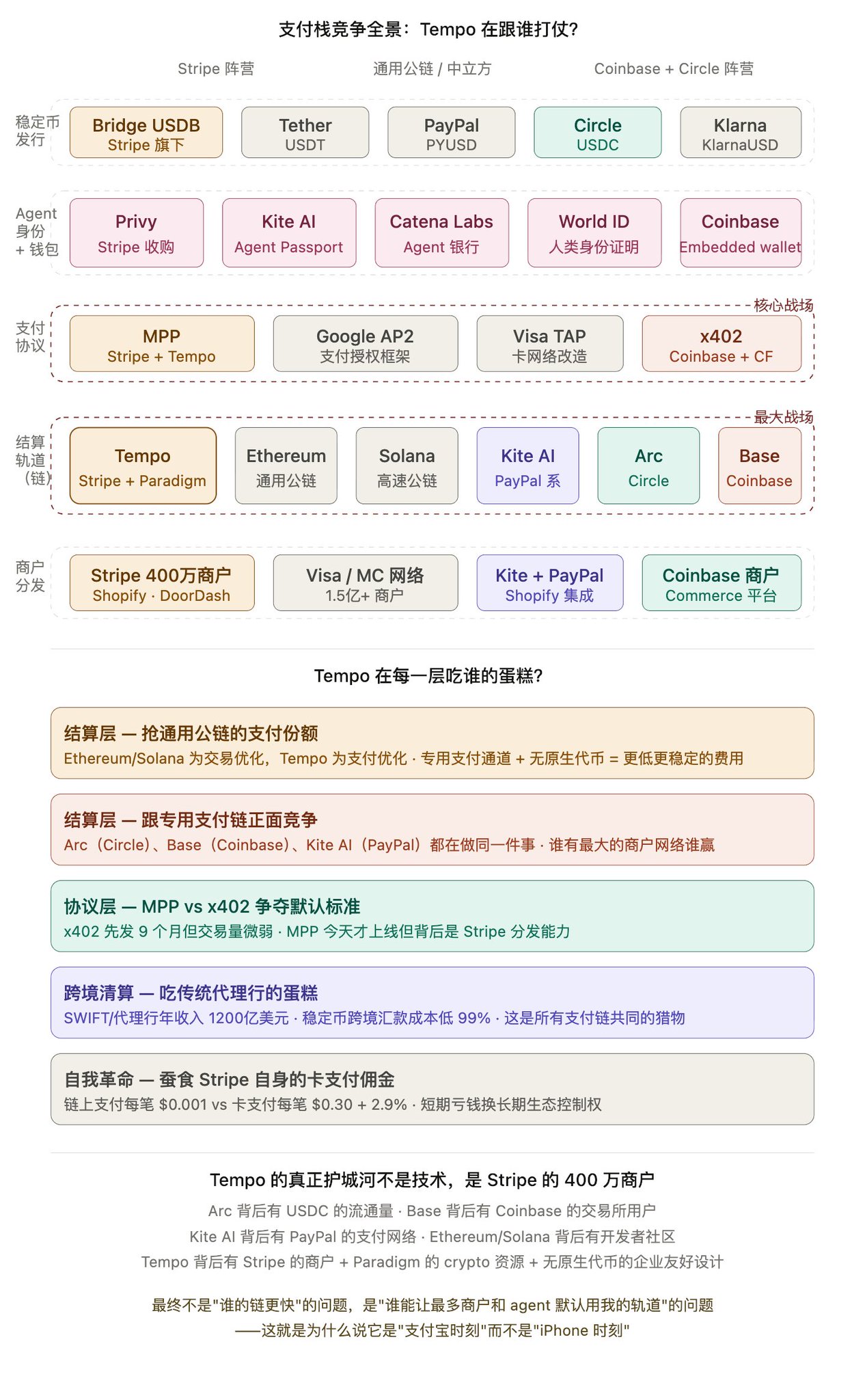
But at least, Agent Payments have made new entrants formidable competitors. Ethereum and Solana are designed for general-purpose computing; stablecoin payments can run on them, but they are not optimal. Gas fees fluctuate with network congestion, settlement certainty depends on the overall chain load, and compliance and privacy require additional infrastructure. What Agents need is precisely certainty: predictable fees down to the cent, millisecond-level finality, and a compliance framework that works out of the box. These three new chains were designed for these needs from the very first line of code, betting that the incremental market for Agent Payments is large enough to bypass the existing advantages of older chains and establish a foothold directly in this new arena.
The logic behind this bet is simple: the number of agents is likely to far exceed the number of humans. While a person might swipe their card several times a day, an agent might call the API hundreds of times per second, each call representing a micro-payment. Coinbase's Brian Armstrong has stated that the number of online agents will soon surpass the number of human users. However, today's agents hardly control wealth; they don't have their own wallets, independent budgets, and must consult with humans for every penny spent. The standards war is about capturing that critical point where agents transition from "running errands" to "spending money autonomously." Whoever lays the groundwork for this at that moment will capture this surge of traffic.
Tim Berners-Lee in 1996 could never have foreseen today's situation. He left an interface for payments in the HTTP protocol, like leaving a window in a white wall. For thirty years, that window remained closed, until an AI agent poked its head in from outside and said: I need to pay.
So multiple teams arrived simultaneously, vying to install the window frame. One was based on an open faith protocol, another on a business empire, and still others were vying to build a layer of trust between the two. Many of the people standing among them even shared the same name, having emerged from the same office and headed in opposing directions.
This battle for standards has only just begun. The outcome may not depend on the technology itself, but rather on who makes that window indispensable first. After all, in the history of the internet, it's never the most elegant protocol that wins, but the one used by the most people.
But one thing is certain: the 402 status code, dormant for thirty years, has finally awakened. And this time, it's not a person knocking on the door.