Author: Curry, Deep Tide TechFlow
The person who created this little fox doesn't want to build any more.
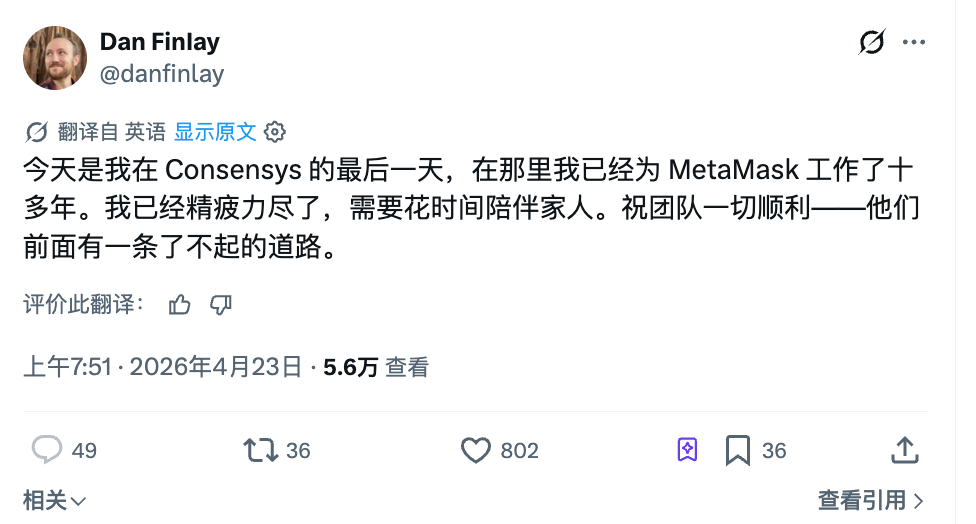
On April 23, MetaMask co-founder Dan Finlay announced his official departure from Consensys, ending his ten-year development career. The reason given was burnout and a desire to spend more time with his family.
MetaMask is perhaps the most recognizable product application in the crypto world. Its orange fox logo is instantly recognizable to anyone who has ever installed a crypto wallet. In 2016, Finlay and co-founder Aaron Davis created this browser plugin within Consensys, allowing ordinary users to interact with Ethereum without running a full node.
Over the past decade, according to statistics from multiple third-party platforms, the app has been installed over 100 million times globally, with approximately 30 million monthly active users. The swap function has generated over $325 million in transaction fees.
After reviewing public information, I found that Finlay has almost never given interviews in the past ten years. He used to write code at Apple, so at heart he's still an engineer, not someone who creates a persona.
When someone like that says they're tired, they usually really are. It's just that the timing of their departure makes it hard not to overthink it.
Just a few months ago, Consensys hired JPMorgan Chase and Goldman Sachs as IPO advisors, and according to Axios, it aims to go public as early as this year.
The company's last funding round was in 2022, when it was valued at $7 billion. Since then, it has undergone at least two rounds of layoffs. Meanwhile, the $MASK token has been touted as coming out since 2021, but five years later there has been no progress.
Issuing tokens through wallets doesn't seem so necessary, and what's even scarier is that the little fox doesn't seem so necessary for everyone anymore.
The default is the little fox, but it's not a required option.
In the past, many dApp development documents would begin with "Please install MetaMask first." It was the default wallet in the industry, much like the blue Internet Explorer browser on your Windows desktop ten years ago.
The problem is that default values and preferences are no longer the same thing.
Phantom initially focused on the Solana wallet but later expanded to Ethereum and Bitcoin. In January 2025, it raised $150 million in a Series C funding round, valuing the company at $3 billion.
According to whales.market's calculations based on on-chain data, Phantom's annualized revenue is approximately $108 million; in comparison, MetaMask's is about $46 million. That's more than double, and Phantom was launched five years later than MetaMask.
Phantom started on Solana in 2021 and has benefited from the entire process of the Solana ecosystem's recovery and explosive growth. According to Helius, Solana's DEX trading volume surpassed Ethereum's in 2024, and total on-chain application revenue reached $2.39 billion in 2025, a year-on-year increase of 46%. 725 million new wallets completed their first Solana transaction in 2025. Phantom was waiting at the door when these users arrived.
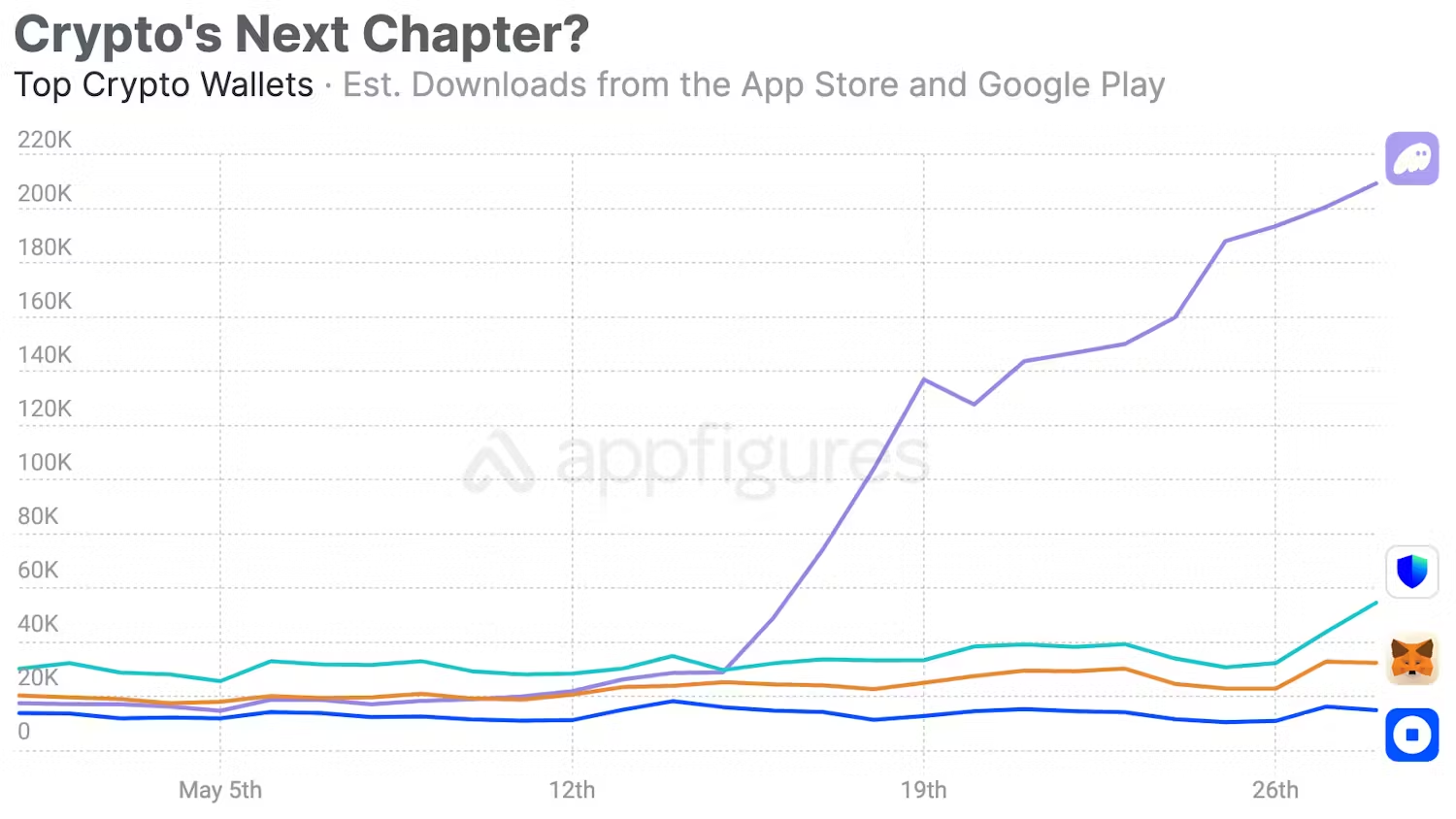
What about MetaMask? Native Solana support wasn't released until May 2025. Before that, users wanting to access Solana through MetaMask had to install a third-party plugin called Snaps, a process similar to installing a Chrome kernel on Internet Explorer...
Over the past five years, Solana has transformed from a blockchain that nearly collapsed due to the FTX collapse into one with the highest transaction volume. Phantom also saw its valuation rise, securing $150 million in Series C funding in early 2025, valuing the company at $3 billion.
In my opinion, MetaMask's slowness isn't due to technical limitations, but also to its identity. MetaMask is a direct descendant of Ethereum, and its parent company, Consensys, was founded by Ethereum co-founder Joe Lubin.
Supporting Solana is an expansion for Phantom, but a betrayal for MetaMask. By the time the growth rate of the Ethereum ecosystem slows down and cross-chain functionality becomes necessary, the window of opportunity will have long passed.
Of course, MetaMask still has the strongest compatibility in the Ethereum ecosystem. Almost all dApps on the EVM chain test it as the default option, and the 30 million monthly active users are not a lie.
However, this stickiness doesn't come from product strength, but from switching costs. And switching costs can only prevent old users from leaving, not new users from coming.
If someone only starts using blockchain in 2025, the wallet recommended by their friends will most likely no longer be MetaMask.
The little fox waiting for the best price
Products are falling behind, people are leaving, but Consensys is going public.
According to Axios, in October 2025, Consensys hired JPMorgan Chase and Goldman Sachs as IPO advisors, aiming for a listing as early as this year. If successful, this would be the first company deeply integrated with Ethereum's core infrastructure to list on the US stock market.
But in the same year that it hired an investment bank, Consensys experienced at least two rounds of layoffs.
In October 2024, the company laid off 20% of its workforce, approximately 160 people, citing macroeconomic pressures and regulatory uncertainty as the reasons given by CEO Joe Lubin. Another round of layoffs occurred in mid-2025, this time with the explanation of "driving profitability."
On Glassdoor, a well-known overseas job search community, employee reviews are worse than the layoffs themselves.
One person wrote that the company lays off employees at least twice a year, targeting only frontline contributors; management is never laid off. Another person said that after sharing their desire for promotion with their superiors, their name appeared on the layoff list in the next round.
It's unclear how much of these comments are driven by emotion and how much by fact. But a company laying off a large number of employees just before its IPO, while employee morale is at rock bottom, is itself a signal.
Then comes the story of the MASK token.
In 2021, Lubin tweeted "Wen $MASK?", causing a stir in the community. In 2022, he further explained that he wanted to combine tokens with a DAO to promote "progressive decentralization." In May 2025, Finlay was interviewed by The Block and asked when the token would arrive; his answer was "maybe."
For users, the MASK token is a carrot dangling in front of them, encouraging them to continue using the platform, interacting with it, and contributing on-chain data to MetaMask. For Consensys, the token is a card yet to be played before the IPO.
Launching too early diluted the valuation narrative, while launching too late caused the community to lose patience. Now the co-founder is gone, the tokens haven't been issued yet, but the IPO is already on the horizon.
MetaMask's product competitiveness is declining, a trend unlikely to reverse in the short term. However, MetaMask's brand recognition remains strong; its orange fox logo is still the most recognizable crypto logo in the world.
Brand value and product value decline at different rates; brand value declines more slowly.
For crypto companies, an IPO often sells not a product, but a brand and a narrative. "Ethereum infrastructure," "Web3 gateway," "world's largest self-custodied wallet"... these labels still work well on roadshow slides a few years ago. Lubin himself is a co-founder of Ethereum, a title that carries its own halo for traditional investors.
So Consensys's choice was to put MetaMask into a publicly traded company while the brand was still valuable, while the regulatory window was still open, and while Wall Street was still enthusiastic about crypto infrastructure, and let the secondary market determine its price.
Silence is not golden
The news of Finlay's passing has elicited a very muted reaction within the CT community. There were no lengthy farewell posts flooding social media, no sentimental pronouncements like "the end of an era," and most people didn't even seem to care about the news.
The question of whether Metamask's co-founders should stay or leave generated less buzz than a KOL's complaint at the Hong Kong conference about the reduced quality of merchandise.
This in itself speaks volumes.
MetaMask is a rare case in the crypto industry. It boasts one of the biggest brands in the industry, yet its founders have virtually no personal brand.
In an industry where the founders are the biggest marketing resource, MetaMask's two founders chose to remain hidden. The product spoke for them, until the product could no longer speak for itself.
In my opinion, the story of MetaMask is essentially a story about "default".
In the tech industry, being the default option is the most powerful competitive advantage, but also the most dangerous anesthetic. When you're the default, user growth happens on its own, without you having to do anything.
However, this growth can mask the fact that the product itself is aging. By the time you realize that users are churning, the churn has often been going on for a long time.
Internet Explorer, the default browser, lost to Chrome. Nokia, the default phone, lost to the iPhone.
Windows Media Player, the default media player, lost to everyone else. These products lost when they still had a high market share and strong brand recognition, but new users were no longer choosing them.
MetaMask is now in this position. It still has existing users and a strong brand, but its growth has gone elsewhere. Consensys' IPO plan, in essence, is about monetizing its existing user base.
When brand value exceeds product value, selling is indeed a rational choice.
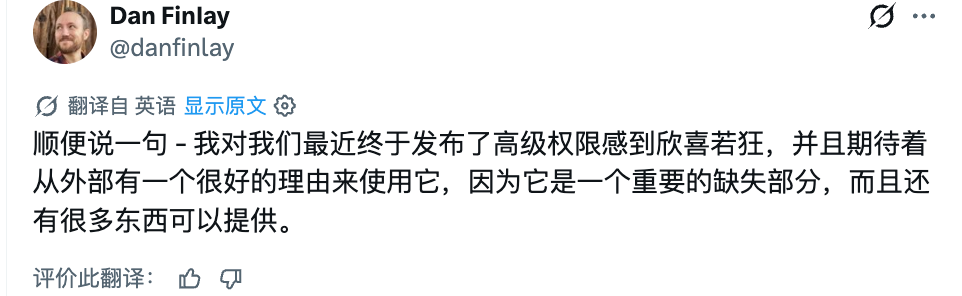
On the day Finlay left, MetaMask had just launched a new advanced permission feature called ERC-7715. He said he looked forward to experiencing it as a regular user in the future.
The creator of a product becomes its ordinary user; this is perhaps the most simple and quiet farewell in the crypto industry.
But for MetaMask, how many ordinary users will still be clicking on that little fox every day next year? Are you still using it?