Author: Claude , Deep Tide TechFlow
Summary: Robinhood reported first-quarter revenue of $1.07 billion and earnings per share of $0.38, both below Wall Street expectations. The culprit was a 47% year-over-year plunge in crypto trading revenue to $134 million, but record-breaking 8.8 billion contracts traded in the prediction market and a 320% surge in revenue are emerging as new growth engines. The company raised its full-year operating expense guidance by $100 million to fund the "Trump account," and its stock price fell more than 8% in after-hours trading.
Robinhood delivered a mixed first-quarter report.
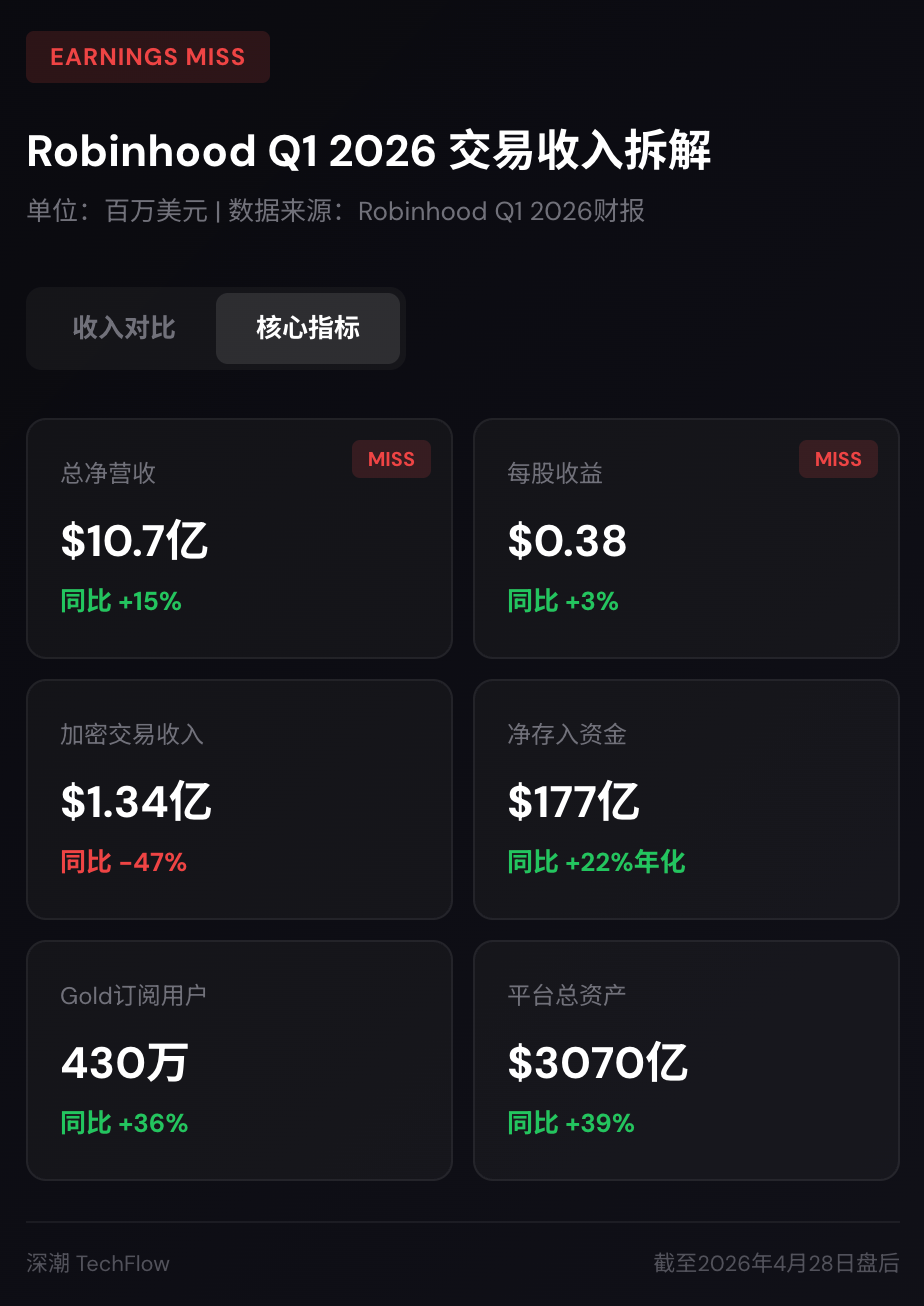
According to Robinhood's earnings report released after the market closed on April 28, the company's total net revenue for the first quarter was $1.07 billion, a 15% year-over-year increase, but lower than analysts' expectations of $1.14 billion (Bloomberg consensus estimate); diluted earnings per share were $0.38, a 3% year-over-year increase, but lower than the market expectation of $0.42. Net profit was $346 million, a mere 3% year-over-year increase, marking the lowest quarterly profit in the past year.
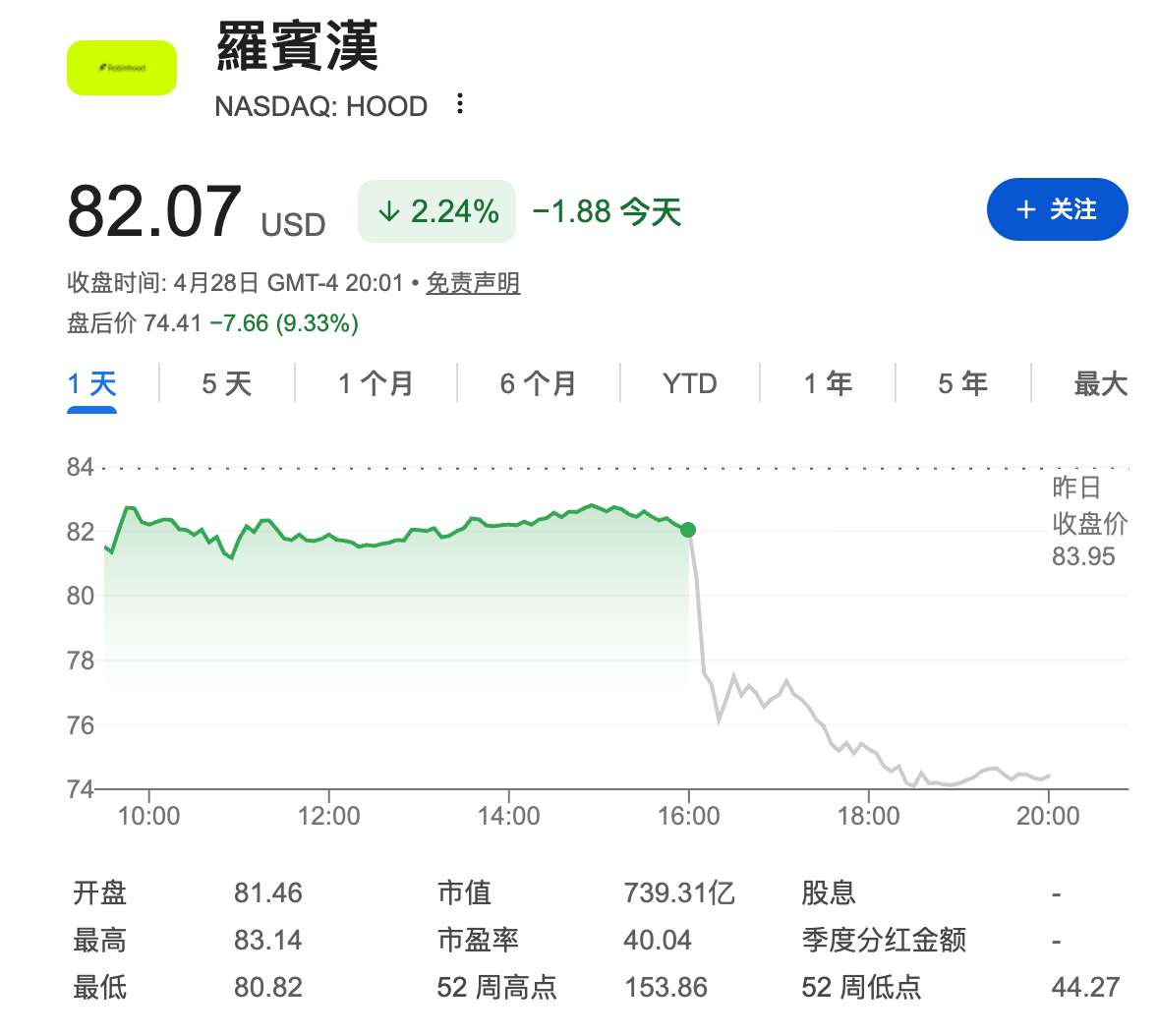
Following the announcement, HOOD's stock price fell as much as 8% in after-hours trading before recovering slightly, closing at around $81.35. Prior to the earnings release, HOOD's stock had fallen approximately 27% year-to-date, well below its 52-week high of $153.86 last year.
Crypto revenue nearly halved, becoming the biggest drag on earnings.
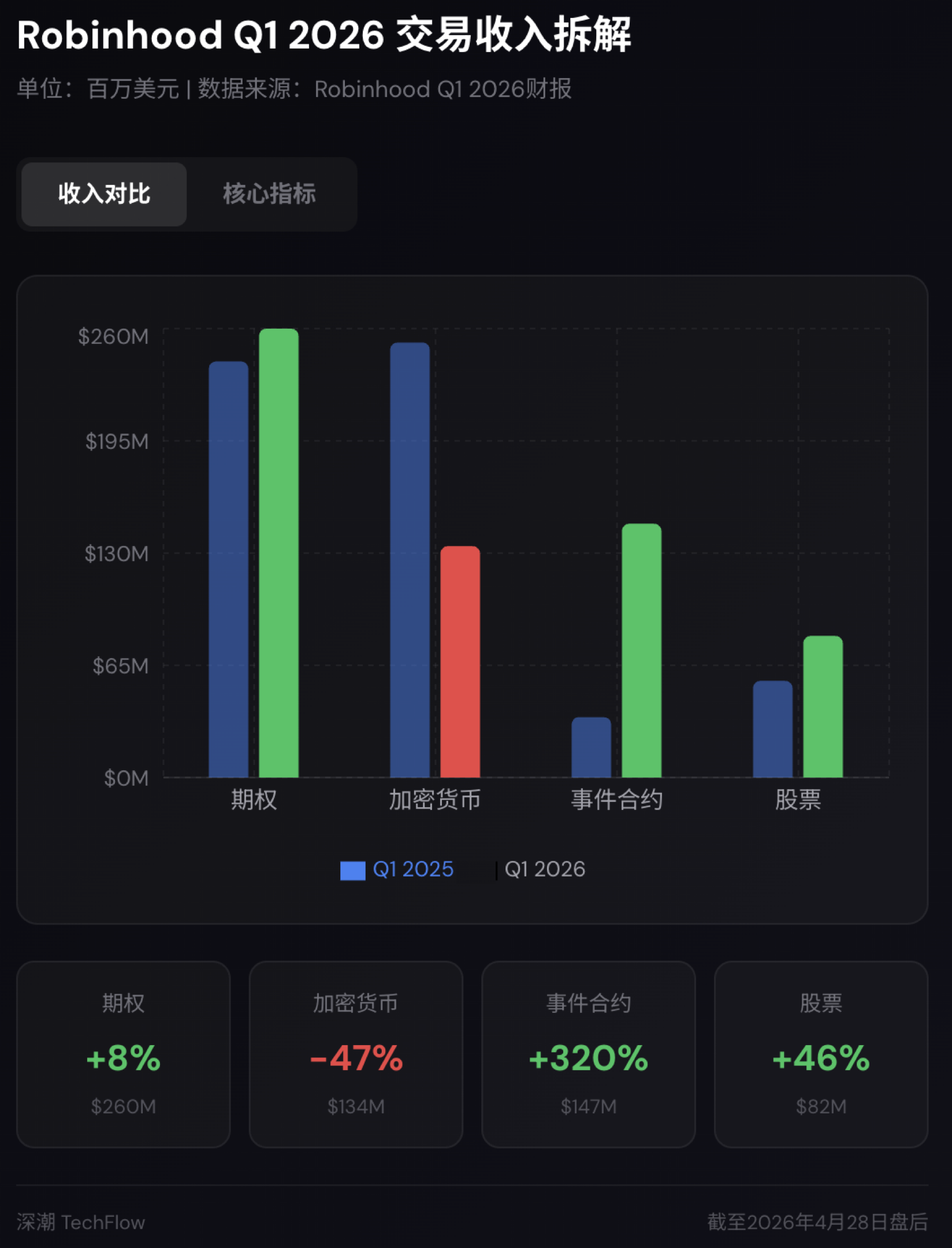
Crypto trading revenue fell 47% year-over-year to $134 million, compared to $252 million in the same period last year. Crypto notional trading volume fell 48% year-over-year to $24 billion. This was the worst-performing segment among Robinhood's trading categories and the core reason for the quarter's underperformance.
This downturn did not occur suddenly. In the fourth quarter of last year, the company's crypto trading revenue had already declined by 38% year-on-year to $221 million, and the situation worsened further in the first quarter, reflecting the overall slump in the crypto market that is expected to begin at the end of 2025 and continue into the beginning of 2026. The total global cryptocurrency market capitalization declined by approximately 20.4% year-on-year in the first quarter, with both price drops and shrinking trading volumes creating a double whammy.
During the earnings call, CEO Vlad Tenev attempted to de-emphasize the issue of Bitcoin price volatility. According to CoinDesk, he stated, "I don't want to talk about Bitcoin's price anymore," and that Robinhood is more focused on using crypto technology as "infrastructure" for financial services. He further introduced the concept of a "tokenization supercycle," stating that the company is in the early stages of moving assets such as stocks onto the blockchain.
Predicting explosive market growth, "Other Trading Revenue" surged 320%.
The collapse of crypto revenues is mirrored by the explosion of prediction markets.
"Other trading revenue" (primarily event contracts) surged 320% year-over-year to $147 million, with a record 8.8 billion event contracts traded in the first quarter. This category has surpassed crypto trading revenue to become Robinhood's fastest-growing trading business line.
According to DeFi Rate, CFO Shiv Verma stated in a conference call that April's forecast market trading volume "is expected to reach approximately 3 billion contracts, potentially the second-highest monthly volume ever."
Robinhood is accelerating its vertical integration in this sector. The Rothera exchange, a joint venture with market maker Susquehanna International Group, is scheduled to launch in the second quarter, allowing Robinhood to independently list and clear event contracts, rather than relying on third-party exchanges like Kalshi. Tenev describes this as a key step towards "end-to-end control of the customer experience," including product selection and pricing power.
In traditional trading categories, equity trading revenue reached $82 million, a year-on-year increase of 46%; options trading revenue reached $260 million, a year-on-year increase of 8%. Total trading revenue reached $623 million, a year-on-year increase of 7%, with the growth rate slowing significantly due to the drag from cryptocurrencies.
User base and asset size continue to reach new highs, with Gold subscriptions becoming a highlight.
The financial report had some bright spots, mainly in terms of user and asset metrics.
Net deposits in the first quarter reached $17.7 billion, an annualized growth rate of 22%; total platform assets reached $307 billion, a year-on-year increase of 39%. Gold subscribers reached a record 4.3 million, a year-on-year increase of 36%, adding 1.2 million. Gold's penetration rate among paying users climbed from 7% at the beginning of 2024 to 15.8%. The total number of paying customers reached 27.4 million, a year-on-year increase of 6%; the number of investment accounts reached 29.1 million, a year-on-year increase of 8%.
The revenue structure is also changing. Net interest income increased by 24% year-over-year, while subscription-driven "other revenue" increased by 57% year-over-year. Gold subscriptions generated $200 million in annualized revenue. This means that Robinhood's reliance on transaction revenue is decreasing, but whether the rate of decline can offset the volatility of the crypto cycle remains a key focus for the market.
The "Trump account" has driven up operating expenses, prompting a $100 million increase in full-year expense guidance.
The biggest new variable for Robinhood this quarter is the "Trump Accounts." The company raised its full-year adjusted operating expenses and stock-based compensation guidance from $2.6 billion to $2.725 billion to $2.7 billion to $2.825 billion, with the additional $100 million allocated to building and supporting the user interface for the Trump Accounts.
According to Yahoo Finance, CFO Verma stated in a conference call that about half of these transactions will occur in the second quarter. The project was signed on a cost-plus basis, and the company expects revenue to exceed costs. Tenev positions this as an entry point to reaching "the next generation of investors, 60 million people."
Total operating expenses for the first quarter were $656 million, an increase of 18% year-over-year, primarily driven by marketing and growth investments as well as acquisition-related expenses. Adjusted EBITDA was $534 million, an increase of 14% year-over-year.
In addition, the company repurchased $250 million worth of shares in the first quarter at an average price of approximately $81 per share, and the board of directors increased the repurchase authorization to $1.5 billion in March.
The second quarter started strongly, but the shift in the crypto narrative remains to be seen.
Management has signaled optimism for the start of the second quarter. According to a Robinhood press release, Verma stated that April's stock and options trading volume is on track for the highest month of the year, with net inflows reaching approximately $5 billion despite being tax season.
In terms of product lines, Robinhood is advancing on multiple fronts. In addition to the Rothera exchange, the company has launched crypto services in Canada, brokerage business in Singapore, and continues to expand its AI tool Cortex. The beta version of Robinhood Social has been opened to 10,000 customers, offering proven trade sharing and community interaction. Furthermore, in February of this year, the company launched the "Robinhood Chain" testnet, based on the Arbitrum Ethereum L2 blockchain, aiming to support 24/7 trading of tokenized stocks and ETFs.
However, the core concern in the market is whether the growth rate of forecasting market and subscription revenue can sustainably fill the gap in crypto revenue. Looking at the "Rule of 40" (the sum of revenue growth and profit margin), the score over the past twelve months is 98%, far exceeding the healthy threshold of 40%, but it has fallen from the peak of 131% in the third quarter of last year. According to Sherwood News analysis, Robinhood's stock price correlation with BlackRock's iShares Bitcoin Trust (IBIT) in 2026 is even higher than its correlation with the S&P 500 ETF, meaning that as long as the crypto market remains sluggish, Robinhood's valuation recovery will face resistance.