Author: Jia Yang. DeepTech.
In February 2026, bot.ai was sold for $1.2 million on the domain trading platform Sedo, marking the first publicly recorded seven-figure transaction for the .ai domain. The buyer's identity was not disclosed, but the seller is reportedly a domain investor named Philipp Michel. Previously, the domain's page only displayed the message: "Want to buy bot.ai?"
.ai is the country code suffix for Anguilla, a small island in the Caribbean with a population of 15,000. Anguilla is a British Overseas Territory whose economy relies heavily on high-end tourism and faces the challenge of hurricane season each autumn. In 2025, it earned $93 million from .ai domain registrations and renewals, representing 47% of its government budget.
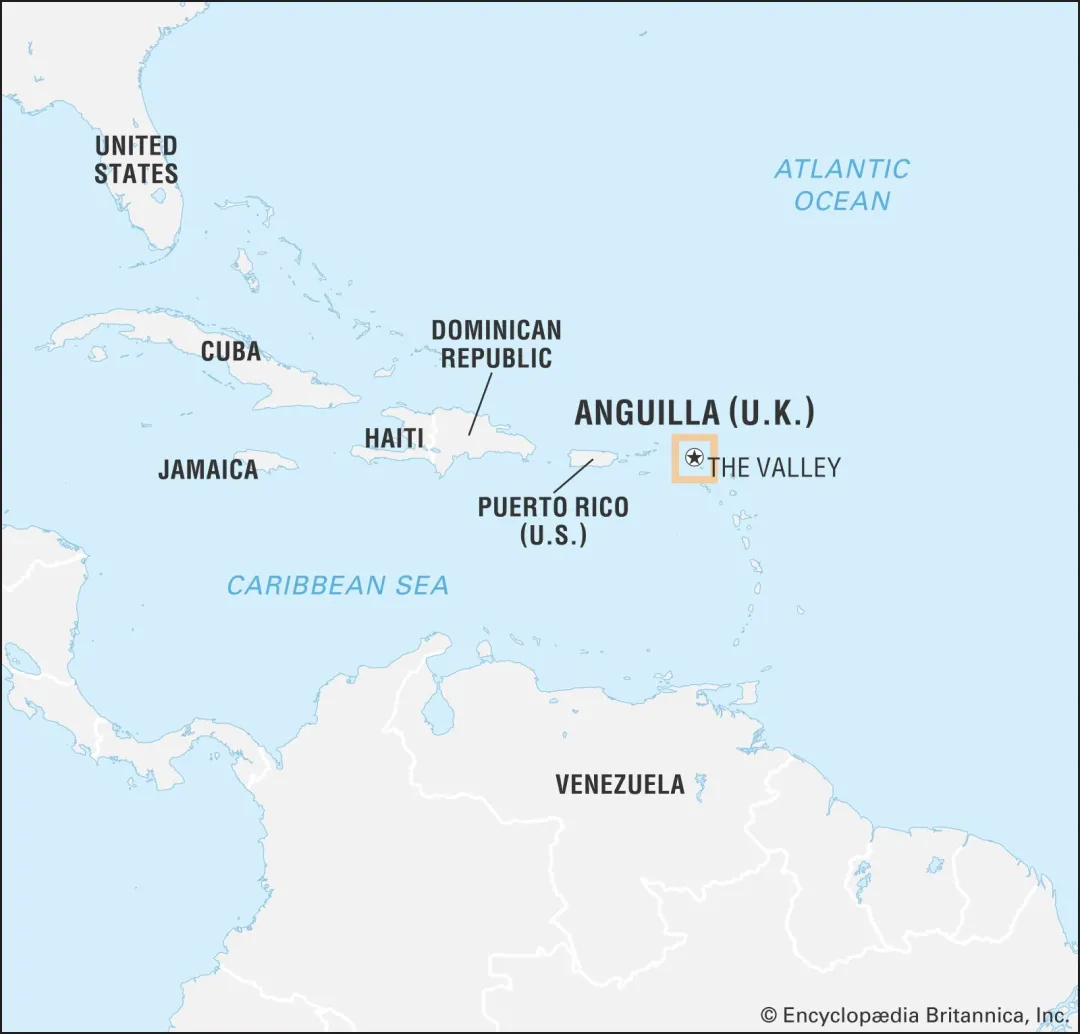
Image | Location of Anguilla (Source: Britannica)
In January of this year, an average of 2,008 new .ai domain names were registered globally every day, one every 43 seconds.
From less than 1% to 47%
In 1995, the Internet Assigned Numbers Authority (IANA) assigned a two-letter suffix to each country and region based on the International Organization for Standardization's (ISO) list of country codes. Anguilla was assigned .ai, and the neighboring island of Antigua was assigned .ag. At the time, no one imagined how much those two letters would later be worth. Former Anguilla Prime Minister Ellis Webster later repeatedly said, "It was pure luck."
In 2018, Anguilla.ai's registered revenue was $2.9 million, representing 4% of the national budget. In 2022, it was $7.7 million, or 6%. This figure remained relatively flat until November 2022, when OpenAI launched ChatGPT.
In 2023, .ai revenue jumped to $32 million, accounting for 21% of the budget. In 2024, it reached $39 million, or 23%. In 2025, it reached $93 million, or 47%. Within three years, it transformed from a marginal tax source into a fiscal pillar on par with tourism, which contributes 37% of GDP.
“Before AI truly takes off, .ai revenue accounted for less than 1% of national income. It will rise to 25% to 27% in 2023, and to around 47% by 2025,” Anguilla’s Minister of Infrastructure and Communications, Jose Vanterpool, summarized in the annual financial statement.
The surge in 2025 also had an additional factor. The minimum registration period for .ai domains is two years, and the registrants who flooded in after the ChatGPT wave in 2023 concentrated their first renewals in 2025. Domaintechnik founder Fabian Ledl explained that the .ai renewal rate is approximately 90%, meaning the registration surge in 2023 entered the fiscal books for the second time in 2025. Following the original projections, the Anguilla government predicted at the end of 2024 that .ai revenue would be 132 million Eastern Caribbean dollars (approximately US$48.84 million) in 2025, 138.6 million in 2026, and 145.53 million in 2027. However, the actual revenue in 2025 reached 250 million Eastern Caribbean dollars, almost double the government's own projections.
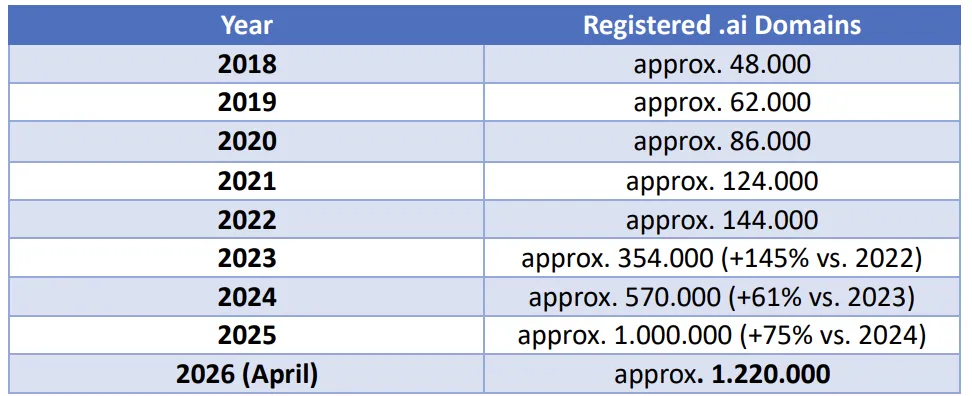
Figure | Registration volume of .ai domains (Source: Domaintechnik)
The transaction price in the aftermarket is also rising in tandem. The previous record for bot.ai was held by wisdom.ai, which sold for $750,000 in October 2025. Before that, it was you.ai, sold for $700,000, to Dharmesh Shah, co-founder of the American software company HubSpot. He told the media that he had "a product idea that allowed people to create digital avatars to do things for them."
Next up are cloud.ai at $600,000, blockchain.ai at $405,000, and law.ai at $350,000. Matt Barrie, CEO of Escrow.com, also revealed an even more outrageous story: a certain .ai domain name was sold for $300,000 and then sold for $1.5 million a few months later; the specific name has not yet been disclosed.
However, compared to other options, the value of .ai isn't particularly high. AI.com, which sold for $70 million in February 2026, has seen its highest publicly traded price (less than 2% of that) go to .ai. Dharmesh Shah himself has stated that in the long run, .com will maintain its value better and longer than .ai. He bought .ai primarily because it's a suboptimal option that still conveys the meaning of AI when suitable .com options are unavailable.
The entire .ai ecosystem is built on a "second-best" position. .com remains the default consensus for internet naming, while .ai is the alternative for AI companies when they can't get .com. This relationship makes the premium value of .ai more closely tied to the AI cycle.
The tuition fee Tuvalu paid
Tuvalu in the Pacific Ocean followed a similar path in 1998.
It acquired the ".tv" designation, which happens to be an abbreviation for television. Even before the rise of video streaming, these two letters were already a marketing asset. At the time, the Tuvalu government signed an exclusive agreement with a Canadian company that promised a one-time payment of $50 million, which was never received. The contract later passed to Idealab, Verisign, and finally to GoDaddy in 2021.
During the Verisign period, Tuvalu received a fixed fee plus sales commission: $2.2 million annually, plus a 5% commission on sales exceeding $20 million. The structure was stable with a low ceiling. Around 2010, Tuvalu's Finance Minister, Lotoala Metia, publicly complained that Verisign's pay was "peanuts." It wasn't until 2021, when they switched to GoDaddy, that their annual income approached $10 million.
Anguilla's contract structure is the opposite of Tuvalu's. In October 2024, it signed a five-year agreement with US domain registrar Identity Digital, explicitly stating a revenue-sharing model rather than a buyout. According to the BBC, Identity Digital's share is approximately 10%, with the remainder going to Anguilla's finances. In January 2025, Identity Digital officially took over the .ai registration business, moving all .ai domain servers from Anguilla's main island to its own global network. This was to prepare for hurricanes. Hurricane Irma in 2017 caused $320 million in damage to Anguilla, nearly paralyzing the island's power and communications.
This structure allowed Anguilla to reap the lion's share of the AI cycle. The auction business launched after Identity Digital took over contributed over $600,000 in additional revenue to the Anguilla government in its first year, with the daily auction mechanism alone increasing .ai's weekly revenue by 20%. Part of how the money was spent has been made public.
The 2025 fiscal statement outlines the following: repayment of national debt (approximately US$292 million by the end of 2025, representing about 19.9% of GDP, well below the Caribbean's 60% red line), expansion of airports and road networks, investment in renewable energy, and free healthcare for children under five and seniors over seventy. Airports are key, as Anguilla's tourism industry has long been hampered by a limited number of flights.
Cora Richardson-Hodge will receive this kind of financial handout when she takes office as Prime Minister in February 2025. She will be Anguilla's first female Prime Minister, and her United Front won 8 out of 11 seats in parliament in the general election, while Webster's Progressive Movement party was relegated to the opposition. Vanterpool, also a member of the United Front, will join the new cabinet.

Image | Cora Richardson-Hodge (Source: Anguilla Focus)
Bet on two letters
Before stepping down, former Anguilla Prime Minister Webster repeatedly warned on multiple occasions: You can't predict how long this will last. Our economy and projects cannot rely on it entirely, otherwise, once the winds change, we will have to make drastic cuts in a very short time.
This sounds discouraging in the face of a budget surplus in 2025, but it points to a very specific possibility.
The high premium of the .ai suffix is based on the premise that AI remains a worthwhile label for tech companies. When a technology transitions from cutting-edge to infrastructure, like electricity or the cloud, it transforms from a brand asset into a default attribute. No company will still call itself an electric company or a cloud company because those are already the defaults. If AI follows the same path in the next five to ten years, the marketing value of the .ai suffix will gradually depreciate, new registrations will slow, renewal rates will decline, and the secondary market will cool down.
Identity Digital once wrote in its external communications that whether AI-themed domain names can maintain their high prices depends on the capital cycle of the AI industry. They also know how fragile this is.
Conversely, the .ai extension might also take a different path. When AI companies collectively dominate the .ai domain, such as claude.ai, x.ai, perplexity.ai, and meta.ai, this collective dominance actually reinforces the meaning of the extension itself. The .com domain wasn't valuable because it's based in the US, but because the earliest entrants made it the industry default. Whether .ai can replicate the stability of .com remains to be seen, requiring at least two to three more AI cycles to observe.
Furthermore, if these revenues do indeed go into debt repayment, infrastructure, education, and healthcare (which the current spending structure does seem to suggest), then even if the .AI boom fades, these investments themselves will remain. Airport expansions adding more routes and debt falling below 15% of GDP won't disappear with the AI cycle. However, if the money is absorbed into recurring spending—civil servant pay raises and expanded benefits—then the year the boom ends will be very difficult.
As of April 2026, the total number of .ai registrations was approximately 1.1 million. Domaintechnik predicts that this number could reach 1.7 million by the end of 2026. More than 2,000 new domains are registered daily, each representing a sum of money flowing into Anguilla's coffers.
But every penny implies the same thing: somewhere in the world, a product manager still believes that adding ".ai" to the end of their product's English domain name will make users take a second look.
Nobody really knows how long this assessment can last.