Written by: Caitlin Ostroff, Katherine Long, and Neil Mehta, WSJ
Compiled by: AididiaoJP, Foresight News
John Pedersen, 33, is currently unable to work. A former Outback Steakhouse chef recovering from a car accident, his savings are dwindling. The prediction market platform Kalshi might be the quickest solution; he borrowed a floating-rate loan and started betting.
It started off well. Pedersen turned about $2,000 into nearly $8,000 by betting on the daily snowfall in Detroit (his city). He then invested the funds in sports betting, using AI-assisted strategies, eventually reaching $41,000, according to a Wall Street Journal review of his account records.
Then he made his boldest bet yet: wagering all $41,000 on a celebrity saying a specific word on television, and lost it all.
Pedersen is not the only one to go home empty-handed in markets where "anything goes," encompassing a wide range of content including sports, celebrities, and news.
Kalshi and its competitor Polymarket market themselves as tools to change the lives of ordinary people—implying that everyone has a fair chance to make a fortune. "I almost couldn't afford my rent, but through Kalshi's predictions, I earned two years' worth of rent," a woman excitedly said in a Kalshi ad on TikTok.
But for most users, the reality is quite different.
Conversely, according to the Wall Street Journal's analysis of platform data and interviews with traders, ordinary traders are consistently losing money, while a small group of experienced professional players—including trading firms with massive data resources—are eating up their funds.
The Wall Street Journal found that on Polymarket, 67% of profits flowed to just 0.1% of accounts. This means that fewer than 2,000 accounts collectively netted nearly $500 million. The Wall Street Journal analyzed 1.6 million accounts trading on Polymarket since November 2022. The platform has at least 2.3 million accounts in total.
The same applies to Kalshi; the number of losers far outweighs the winners. Spokesperson Elizabeth Diana stated that, based on data from the past month, there are 2.9 losing users for every profitable user. She said this ratio may change as the platform grows. The company does not disclose full data on user profits, nor does it disclose the total number of users.
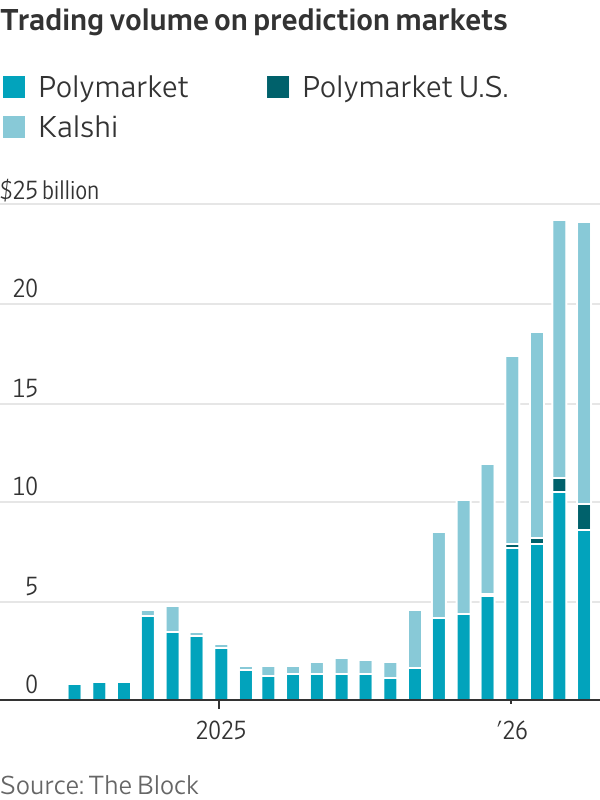
According to data analytics firm The Block, total transaction volume on the two platforms surged to $24.2 billion in April, compared to just $1.8 billion a year earlier.
Supporters argue that these markets are not gambling, but rather utilize collective intelligence to accurately predict future events. Research by the Federal Reserve shows that Kalshi is an effective tool for predicting economic trends.
Traders are paying for massive data streams provided by third parties to gain an edge. Computers use data and algorithms to predict price movements and manage risk far faster than any human. Professional players also leverage their scale to make frequent, strategic trades—sometimes tens of thousands a day—profiting from minute fluctuations, requiring a level of focus and discipline rarely seen in ordinary users.
"Retail traders have no chance," says Michael Bos, a former professional poker player with a background in statistics. He places 60 trades per minute on Kalshi and modifies his bids and asks 30 times per second.
Diana stated that many financial markets exhibit similar wealth concentration, and that more users make money on Kalshi than in day trading or traditional sports betting. She said Kalshi has stopped running "pay my rent" ads.
A Polymarket spokesperson declined to comment on the Wall Street Journal's analysis.
Polymarket has a data partnership with Dow Jones, the publisher of The Wall Street Journal, and this analysis uses only publicly available data.
Take Pedersen, the unemployed chef who lost everything, as an example. He fell into the category full of "suckers": mentioning the market (betting on whether someone will say a particular word).
Professional traders say they don't touch these kinds of bets because they are unpredictable and even millions of dollars' worth of data cannot provide a reliable advantage.
According to an analysis by The Wall Street Journal, the actual payout frequency of market bets is far lower than expected. Retail bettors are taking on more risk than they realize, partly due to the "unpopularity bias"—bettors overestimate low-probability events out of excitement.
Kalshi's mention market has seen monthly trading volume far exceeding Polymarket, experiencing explosive growth since mid-2025. These bets are popular with the platform's target young users—including influencers promoting them in social media live streams and other videos showcasing their victories.
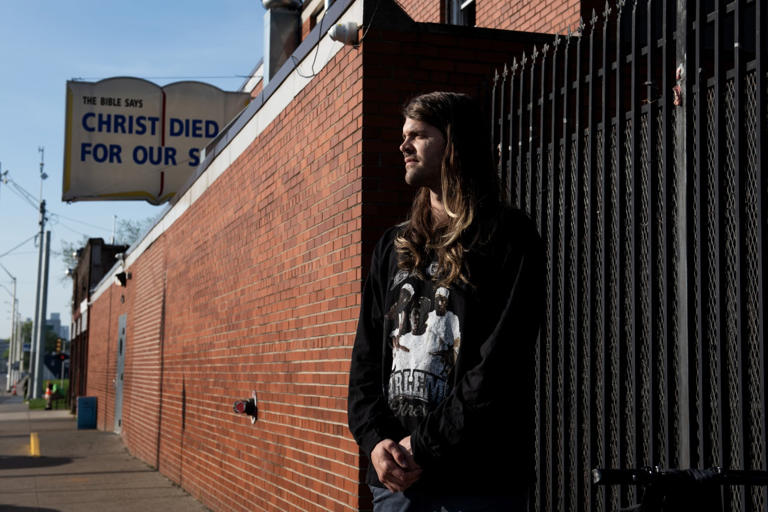
John Pedersen stands outside a homeless shelter in Detroit, where he has lived since losing money on his Kalshi investment. © Photo by Emily Rose Bennett for The Wall Street Journal
"People smarter than you"
For all types of betting, Polymarket and Kalshi's advertising is simple—users can monetize their existing knowledge and make money quickly—a claim that has swept the globe.
However, an analysis by The Wall Street Journal found that over 70% of Polymarket users were losing money. A working paper published last month by French and Canadian researchers reached a similar conclusion. They found that almost all the profits from prediction markets went to experienced traders, while all-in bettors and retail traders bore the losses.
An analysis of Polymarket trading data by The Wall Street Journal shows that average users lose between $1 and $100, while the worst-performing 10% of users lose an average of $4,000 each.
Some people make decisions based on emotions—going with their gut feeling or betting on information obtained through publicly available channels.
A Connecticut man who described himself as having a gambling problem lost $2,000 in a single day betting on the Super Bowl on Kalshi – all during the tense fourth quarter. A 31-year-old Indiana man described the trading as “like drugs,” having bet on sports almost daily on Kalshi in the first few months of the year, losing approximately $5,000.
In contrast, prediction markets are increasingly attracting companies with dozens of employees, spending millions of dollars on professional sports and financial data, and running trading algorithms. They aim to outperform the students, recreational gamblers, and other low-volume traders who make up the majority of their platform users.
In traditional gambling, the house sets the odds, accepts bets, and pays out to the winners. In prediction markets, there is no "house"; users trade with each other. The platform only charges transaction fees, which vary depending on factors such as contract price and market type.
In an office in Soho, a college dropout stares at a computer screen, watching the flow of millions of dollars that retail traders bet on the price of Bitcoin.
Samuel Wood-Solov dropped out of Princeton University this year and received a $500,000 check from Alliance Capital, a crypto startup accelerator backed by prominent Silicon Valley investors, including crypto entrepreneur Balaj Srinivasan. He took math classes at UC Berkeley in high school and took a year off before entering Princeton to trade cryptocurrencies. Now he and four friends have moved to New York to trade prediction markets full-time, betting on the future prices of sports, politics, and cryptocurrencies.
"Our only competitors are market makers," he said in an interview, referring to other companies like theirs that consistently provide buy and sell quotes. He declined to disclose the company's profits or losses but said it had deployed between $500,000 and $1 million in Polymarket, Kalshi, and other smaller prediction markets.
Former professional poker player Bos has earned over $668,000 on Kalshi, primarily from sports betting, a result of his serious trading since about three months ago. Besides his trading speed, he is also extremely meticulous in pricing his buy and sell offers.
He said, "You'll find that the easiest way to make money is through sports. Sports attract all the 'sick' young men, I think." He clarified that "sick" referred to gambling addicts.
He observed on Kalshi that a large number of retail traders were simply betting "yes" on what they hoped would happen. "This is completely different from people trading securities on crypto or stock exchanges."
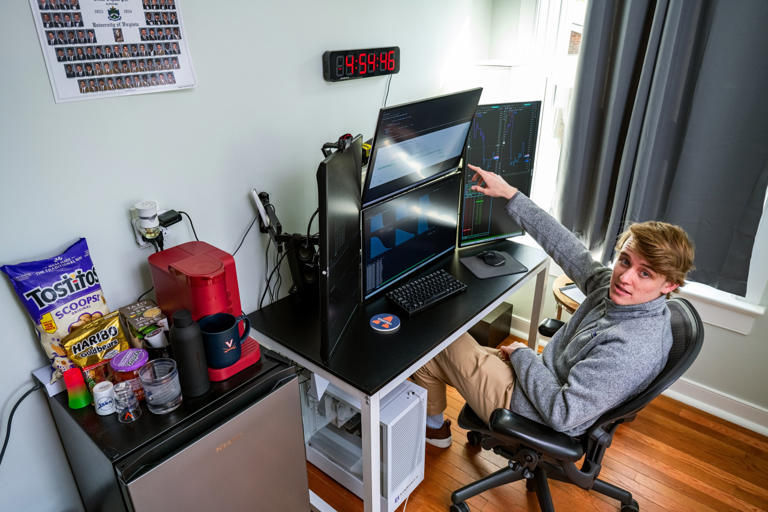
Jonathan Stoll-Ryan, a college student in Charlottesville, Virginia, runs a company that ranks among the top five in cryptocurrency price trading volume on Kalshi. © Laura Thompson for WSJ
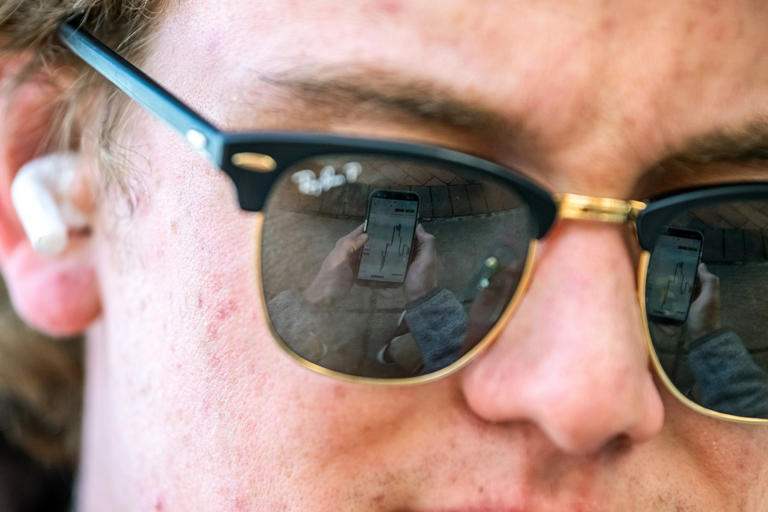
Stall-Ryan's company pays third parties to acquire real-time data and uses algorithms to execute tens of thousands of transactions daily. © Laura Thompson for WSJ
Jonathan Stoll-Ryan, founder of another company comprised of about 12 employees (all college students like him), is one of the top five cryptocurrency price bettors on Kalshi. His company spends over $200,000 annually on real-time data sources, AI coding agents, and servers, using algorithms to execute tens of thousands of real-time trades daily.
Stoll Ryan once saw a fellow fraternity member casually betting on Bitcoin prices on Kalshi while he was at the University of Virginia. He said he thought to himself, "That guy's going to lose money."
These professional traders mostly act as market makers. Kalshi and Polymarket say they rebate a portion of the market maker fees and sometimes even pay them to provide liquidity.
Quantitative trading firm Susquehanna International Group became Kalshi's first major institutional market maker in 2024. According to professional traders who monitor Kalshi's order book, the company trades hundreds of millions of dollars weekly through Kalshi. Its accounts are private, making specific profits unknown. Susquehanna declined to comment.
Another quantitative trading firm, Jump Trading, is active on Polymarket and Kalshi. In mid-April, Jim Esposito, president of Citadel Securities, stated at a Semafor event that the company was "closely monitoring" the development of prediction markets. Some traders who previously purchased high-risk options contracts are now flocking to prediction markets.
"All sports betting, all poker, all options trading, is essentially betting against people who are dumber than you," said Jeff Yass, co-founder of Susquehanna, on a sports betting podcast in 2020. In the same podcast, he described his role in supporting the development of prediction markets as a "mission from God."
On the one hand, he believes Americans should be able to legally bet on sports even if it's prohibited in some states; on the other hand, "I expect to make a lot of money."

Stoll-Ryan on the University of Virginia campus. His company employs about a dozen college students. © Laura Thompson for WSJ
Looking for easy money
The platform features contracts that allow users to answer "yes" or "no" to future events. Contracts are typically designed to pay $1 if the answer is correct and zero if the answer is wrong. The contract price reflects the trader's assessment of the probability of the event occurring. For example, if a contract for a certain event is priced at 41 cents, the prediction market assumes a 41% probability of that event occurring. If you win, the contract bought at 41 cents will pay $1; if you lose, you lose your principal.
Contract prices fluctuate constantly with the market forces of buyers and sellers before settlement. Traders profit from small price fluctuations, just like Wall Street traders.
Many naive market participants are repeating the mistakes of speculators seeking easy money in financial markets. Decades of research show that day traders rarely make money. In recent years, many retail traders, fueled by social media hype, have lost everything on highly volatile meme stocks.
Kalshi and Polymarket's U.S. operations (which recently rolled out to a small number of early users) are regulated by the Commodity Futures Trading Commission (CFTC) and state that their platform trading is similar to other regulated financial markets. The vast majority of Polymarket's activity takes place on its offshore platform, which is technically inaccessible to Americans but can be easily bypassed using a VPN.
Critics say these markets are prone to problems such as insider trading. Recent examples include alleged insider trading related to U.S. military operations in Venezuela, Google announcements, and congressional elections.
CFTC Chairman Michael Seliger defended prediction markets and clarified the federal agency's jurisdiction over these platforms. The agency has cracked down on suspected insider trading and hinted at increased government enforcement.
Polymarket stated that it has partnered with the Department of Justice to combat insider trading. Kalshi prohibits insider trading on its platform and has penalized several violators in recent months.
Adi Rajapurabakaran, a former Kalshi employee, referred to retail traders as "fish" (gambler's slang for novice traders prone to losses) on Substack last year. In an interview, he stated that while he generally believes this is true, he also believes the existence of unsuspecting traders in the prediction market strongly incentivizes more experienced traders to enter, resulting in more accurate predictions.
"Everyone believes they have the better information when placing bets," he said. "In the long run, the more informed people make more money. Nobody is forced to do it."
A bet of $41,000
Before venturing into the mention market, Pedersen's experience on Kalshi was relatively smooth. "I follow finance broadly," he said. "I'm always looking for ways to hone my acumen, if you'll call it that."
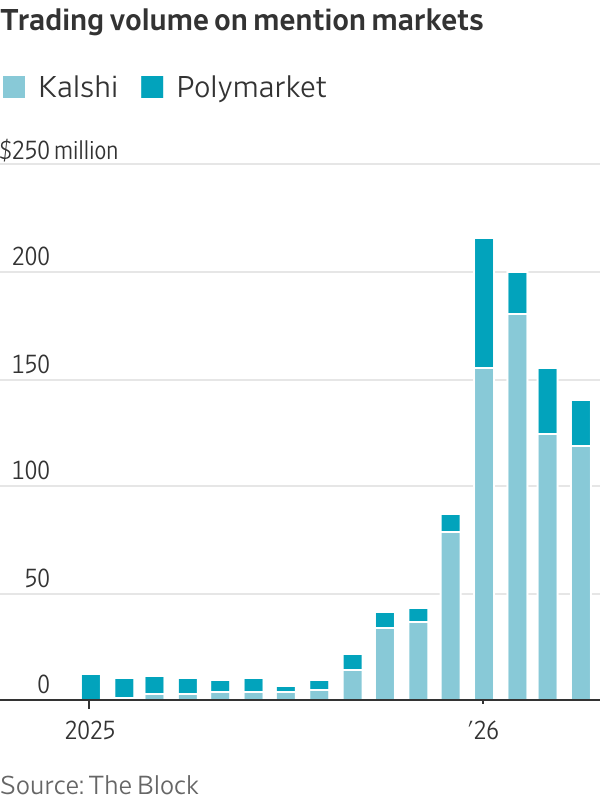
Mention market trading volume
The core question surrounding word betting in the mention market is this: Will a public figure utter a certain word? This year, Kalshi users wagered over $28 million on whether Trump would use words like "cartel," "Somali," or "hockey" during his State of the Union address. According to The Block, Kalshi users wagered nearly $181 million in the mention market in February alone.
An analysis of Kalshi data by The Wall Street Journal shows that the actual payout rate in the market is far lower than what bettors expected based on the odds listed.
The Wall Street Journal analyzed over 35,000 completed mentions on Kalshi and found that, on average, "Yes" trades priced with a 50% win rate had an actual payout rate of about 40%. Since the contract price should match the probability, these bettors were actually overpaying.
Analysis revealed that these market trades often exhibit long-shot bias and frequently result in losses. On average, traders who bet "Yes" on the first price they see in the market (a common pattern among retail traders) lose 11% of their wagered amount. According to research from the University of Nevada, Las Vegas, this return is worse than most Las Vegas slot machines.
Kalshi spokesperson Diana acknowledged that there was an expectation bias in mentioning the marketplace, but stated that mentioning the marketplace does not represent the platform's overall pricing and is not a suitable subject for such pricing analysis. She added that Kalshi's analysis showed that mentioning the marketplace's pricing was more accurate in the four hours leading up to the incident.
Kalshi encouraged market participants to livestream their trading during the event, with two livestreamers stating it was to increase market engagement. A Bank of America analyst wrote in an April market forecasting report, "Market livestreams mentioned on social media frequently go viral and boost Kalshi's brand awareness."
In January of this year, Pedersen bet all of his $41,000 earnings that rapper A$AP Rocky would say the word "rapper" on "The Tonight Show Starring Jimmy Fallon"—the star recently played a rapper in a movie. He had a chance to win more than $168,000.
However, the version broadcast on NBC cut that segment. According to Kalshi's market rules, only what is said in the television broadcast version counts.
In his own video, Pedersen stated that the rule section on the platform's website was not prominent, and he didn't see it. (Kalshi later updated the interface to make the market rules more visible.)
Pedersen has lost everything and has almost no other resources to rely on. He currently lives in a homeless shelter in downtown Detroit, though he says he recently received a job offer to sell mortgages.
He said that once he gets back on his feet, his goal is to enter the financial industry to support his music career. Will he return to prediction market trading? "Maybe," he said. "I'd rather spend my time in more regulated markets."