

Author | Asher, Odaily Planet Daily
Last night, the U.S. Department of Defense officially launched its UFO Files website and released its first batch of government documents related to UAPs, unidentified flying objects, and suspected extraterrestrial life . According to public reports, the first batch of released documents comprises approximately 160 items, including videos, photographs, mission logs, sighting reports, communications records, and historical archives, involving multiple U.S. federal agencies such as NASA, the FBI, and the Department of Defense.
These documents are not merely abstract government reports, but contain a wealth of specific images and historical records. Among them are images taken by Apollo mission spacecraft of three unusual points of light hovering above the moon, and Apollo 17 communications logs showing astronauts discussing mysterious objects approaching the spacecraft. Another batch of materials indicates that unexplained objects have appeared in the UAE, Greece, Iraq, and other locations.
Even more impactful are the unsolved cases documented in the document, which include specific images. A jellyfish-like object has been spotted over the UAE; some reports document what appear to be luminous spheres and unidentified flying objects resembling eight-pointed stars; the FBI has also photographed unusual targets near U.S. military aircraft. An image released by the U.S. Department of Defense also shows an unidentified object appearing over the western United States in September 2025.
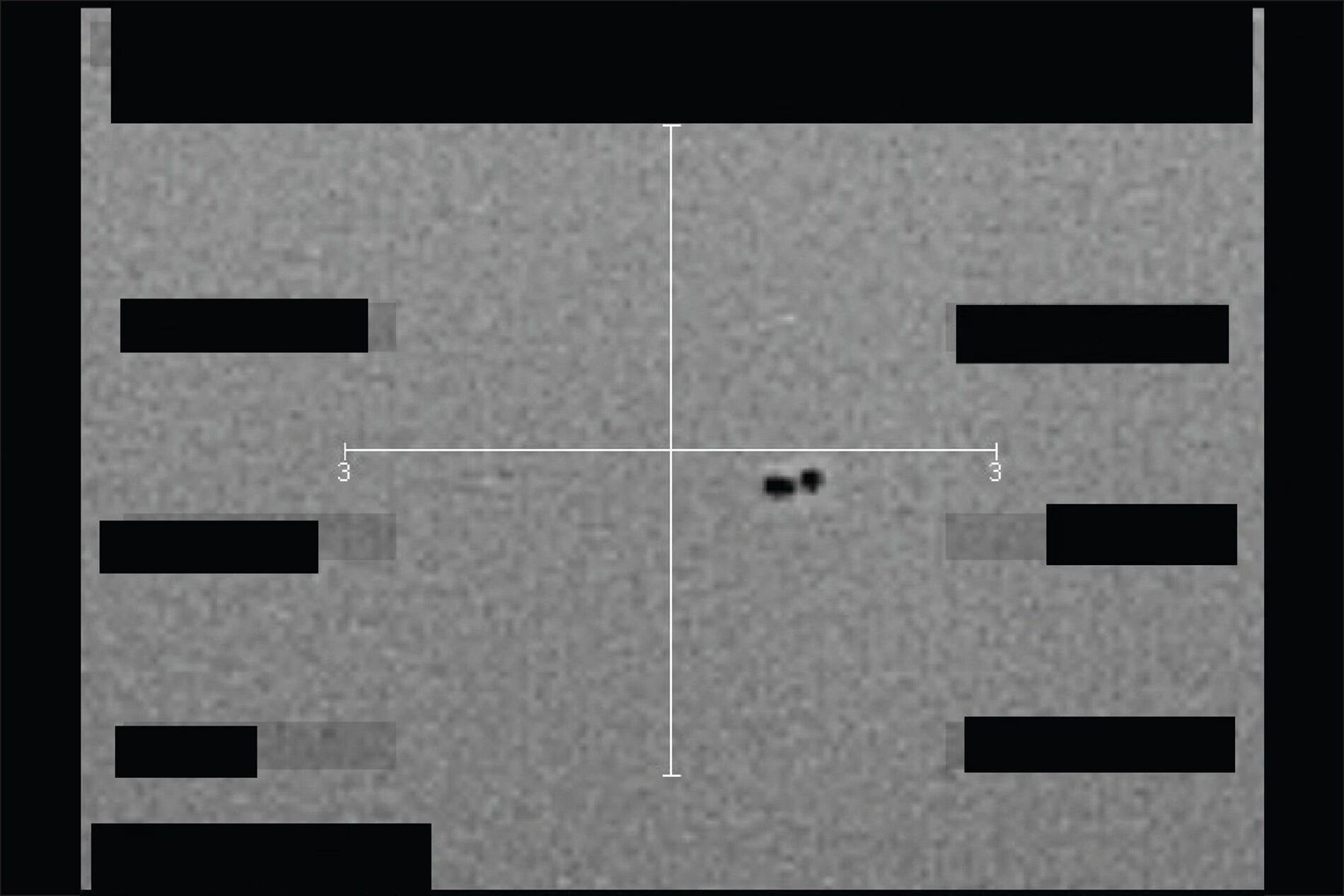
A photo released by the U.S. Department of Defense claims to show an unidentified object in the skies over the western United States in September 2025 (Image source: U.S. Department of Defense).
Compared to simple written reports, these images and eyewitness accounts make it easier for UFO discussions to spread rapidly, and make this public release look more like a concentrated display of "declassified files".
However, the prediction market's response was far more sober than that of social media. After the first batch of UFO documents were released, the probability of the prediction market predict.fun confirming the existence of extraterrestrials on December 31, 2026, did not increase significantly due to this explosive news. The market did not directly interpret this disclosure as "the United States is about to confirm the existence of extraterrestrials," and the probability remained at only 20% .
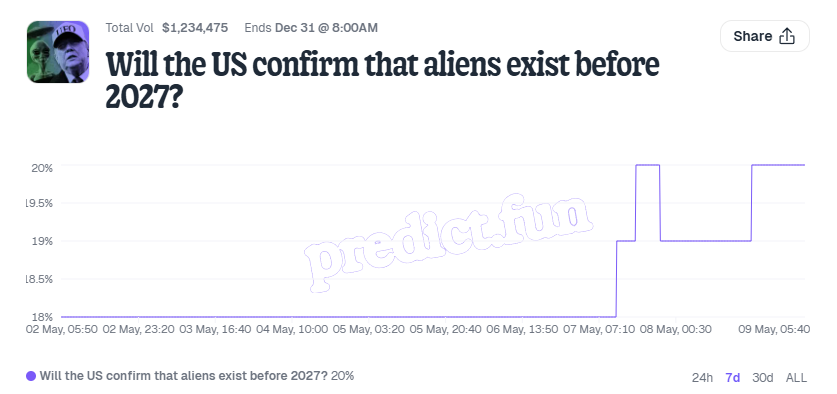
Image source: https://predict.fun/market/will-the-us-confirm-that-aliens-exist-before-2027
So why didn't the release of these UFO documents significantly change the prediction market's judgment?
The prediction market isn't betting on whether aliens exist, but rather whether the US government will acknowledge them.
Many people, upon seeing a 20% probability, might immediately think that the market believes there is only a 20% chance of extraterrestrial life. However, this actually misunderstands the market itself.
The real transaction in markets like predict.fun isn't whether extraterrestrial life exists in the universe, but rather whether the US government will explicitly confirm the existence of extraterrestrial life or technology before 11:59 PM ET on December 31, 2026. According to the market's settlement rules, the market will only settle as "Yes" if the US President, a member of the US Cabinet, a member of the Joint Chiefs of Staff, or a US federal agency explicitly states this; otherwise, it will settle as "No." The primary source of settlement information is official US government information, while also considering consensus formed through credible media reports.
This rule is crucial. It means that a video of a UFO isn't enough, a blurry photograph isn't enough, an astronaut's communication record isn't enough, and even the military's admission that some phenomena are temporarily unexplainable isn't enough. What truly triggers a "Yes" is for the US government to state clearly enough that it acknowledges the existence of extraterrestrial life or technology.
The release of documents merely presents more material to the public, while official confirmation implies government endorsement of the conclusions. The former generates discussion, while the latter triggers settlement. Between the two lies a line that is difficult to cross.
Making the archives public does not mean the answer has been revealed.
This release of UFO documents is certainly not a routine information update. The U.S. Department of Defense released the materials centrally through a dedicated website and stated that more documents will be released in batches. For the public, this means that UFO and UAP data, previously scattered across different agencies, eras, and archival systems, are being consolidated into a single official portal. This makes discussions more focused and allows the outside world to more easily track what materials the U.S. government actually possesses.
However, based on the information disclosed so far, these documents seem more like presenting historical eyewitness accounts, unusual footage, mission logs, and old files to the public, rather than offering a unified interpretation of these materials. The U.S. Department of Defense has not directly told the outside world "what this is," but rather released more unresolved cases, leaving the interpretation to the public .
This puts the public disclosure in a delicate position. It increases transparency without changing the nature of the event. The UFO discussion has thus gained more material, but this material is more about expanding the issue itself than pushing the unidentified phenomenon towards extraterrestrial confirmation.
For prediction markets, this document release is more of a new starting point for observation than evidence sufficient to rewrite the odds. It brings the UFO issue back to the forefront and gives subsequent document updates trading value; however, the initial materials are still mainly historical records, eyewitness reports, and unsolved images. What the market is really waiting for is a key signal from a higher level, one that is more difficult to avoid and closer to an official characterization.
Is 20% an underestimation or an overestimation?
From a sentiment perspective, 20% might be too low. After all, the release of UFO documents has entered the official phase, and more materials will continue to be released. If clearer military videos, higher-level internal records, or a more direct assessment from a federal agency emerge in the future, the price of "Yes" could be quickly reassessed.
However, from a market pricing perspective, 20% isn't low. This is because the issue being traded isn't indefinite, but rather has a specific deadline. The market is assessing not only whether the US will confirm the existence of extraterrestrial life or technology, but also whether such confirmation will occur before the end of 2026.
Time itself is a hurdle. Even if more documents are released and more unresolved cases come to public attention, it doesn't mean the US government will complete its evidence review, internal coordination, and political assessment within a few months, and arrive at a sufficiently clear conclusion. For the official system, continuing to disclose materials is one thing; completing a definitive characterization in a short period is quite another.
Therefore, the current 20% probability is more like a tail-end pricing with a time discount. It doesn't deny that subsequent documents could continue to create volatility, but it also indicates that the market doesn't believe the initial release of materials has changed the fundamental assessment of the event. For traders, the release of documents itself isn't scarce; what's truly scarce is a key signal that can push for an official conclusion before the end of the year. Until such a signal appears, it's unlikely that the Yes price will be pushed up again simply by document updates.
When UFOs entered the prediction market, the truth began to have a price.
The most noteworthy aspect of this incident is no longer just a single photograph, video clip, or jellyfish-like object. UFOs have long been a subject of debate, caught between emotions, beliefs, and conspiracy narratives. Believers glean more clues from each released document, while skeptics continue to emphasize insufficient evidence, misjudgments, and technical noise. This debate has raged for years, yet neither side has truly convinced the other, because they are often discussing different issues.
Prediction markets have brought this question a step closer to reality. Instead of attempting to answer whether other life exists in the universe, they've narrowed the question down to a more concrete level—whether the US government will explicitly acknowledge the existence of extraterrestrial life or technology by the end of this year. This transforms what was once a difficult concept to realize into an event that can be traded, settled, and constantly adjusted as information changes.
Therefore, this approximately 20% probability is not a final judgment on the existence of extraterrestrial life, but rather the market's assessment of whether the US government will soften its stance before the end of this year. It truly reflects traders' comprehensive judgment of the chain of evidence, official statements, and the timeframe.
When the oldest human mysteries enter the prediction market, the truth is no longer just something to wait for and discuss, but also something to be priced. UFOs may still be hovering in the sky, but when they will be officially confirmed, when they will go from being an unknown phenomenon to a confirmed fact, has already fallen into the hands of the market makers.

