
Author: Azuma, Odaily Planet Daily

The cryptocurrency bear market continues, but some highly indicative moves have emerged in the primary market.
On May 4, Haun Ventures, a venture capital firm founded by former U.S. federal prosecutor Katie Haun, announced the completion of a $1 billion funding round . The early-stage and late-stage funds will each allocate $500 million, which will be primarily invested in cryptocurrency and blockchain startups over the next two to three years, while also expanding into cross-sectors such as AI agents, fintech, and alternative assets.
Just one day later, a16z officially announced that its fifth cryptocurrency fund, Crypto Fund 5, had completed fundraising, securing $2.2 billion in committed capital. The fund will continue to focus on the cryptocurrency market, concentrating on those segments most easily overlooked during cyclical shifts but most capable of creating long-term value, transforming next-generation infrastructure into products people use every day.
If you rewind the timeline further, you'll find that this isn't a coincidence, but rather more like a "collective consensus" among top VCs.
In February of this year, Dragonfly's Fund IV completed a $650 million fundraising round; at the end of February, multiple media outlets reported that Paradigm was seeking to raise up to $1.5 billion for its next fund; in March, ParaFi officially announced that it had completed a $125 million fundraising round; in late April, sources revealed that Blockchain Capital was raising $700 million for its two funds... In less than three months, the aforementioned six VCs alone have quietly accumulated more than $6 billion in funding.
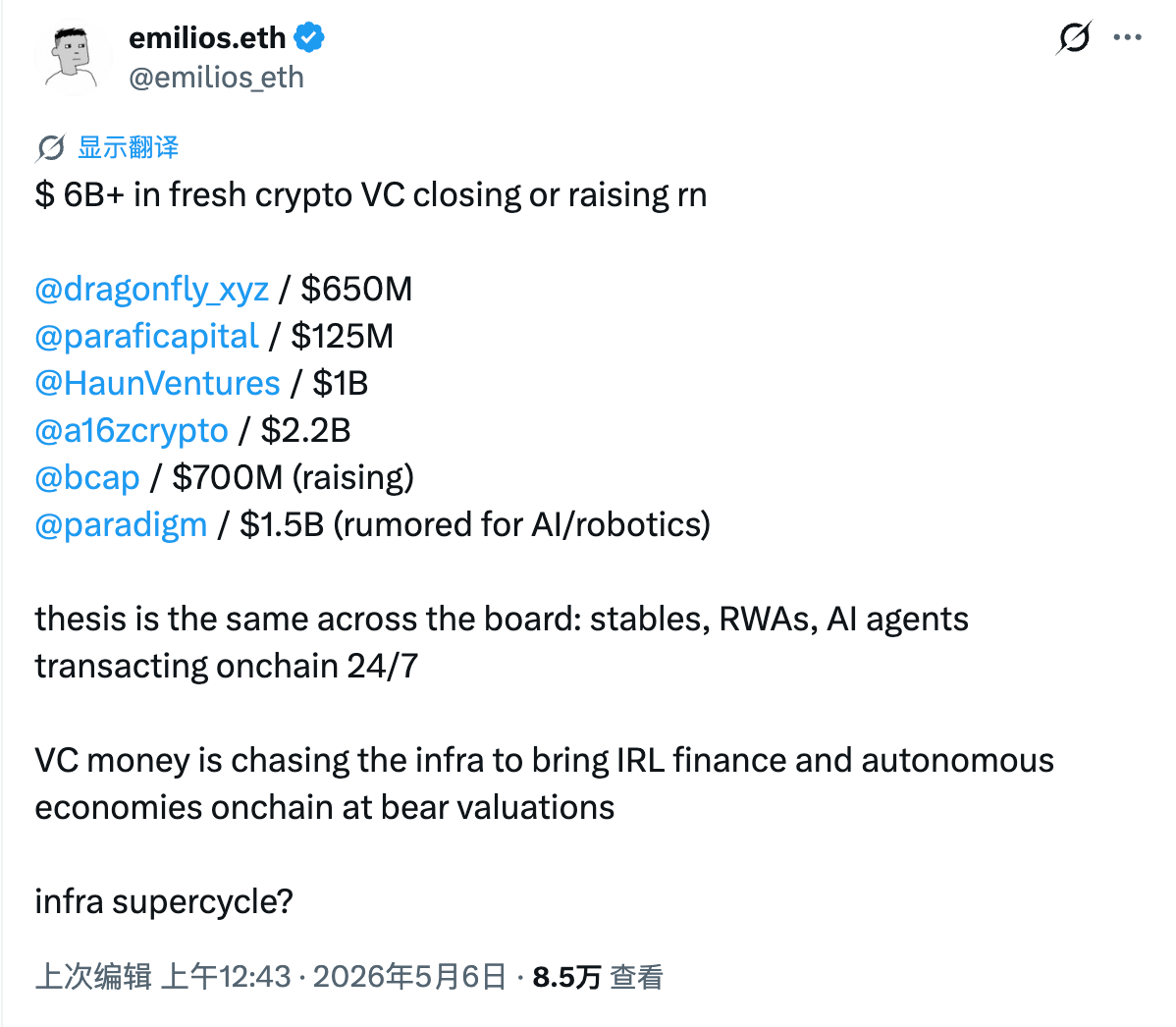
More importantly, this round of fundraising did not occur during the market's hottest period, but rather during a bear market characterized by a liquidity crunch in altcoins, declining valuations in the primary market, and persistently low industry sentiment. As Chris Dixon, a partner at a16z, stated, "We are in a relatively quiet phase," which is not a case of capitalizing on bullish sentiment but rather a typical counter-cyclical strategy.
The primary market is becoming increasingly differentiated.
Focusing solely on the $6 billion raised could easily create the illusion that the primary market is recovering, but the reality is far more complex. A review of the current situation of top-tier and smaller VCs reveals a clear divergence within the primary market.
For most small and medium-sized VCs, this cycle has been far more difficult than anticipated. The continued slump in altcoins (almost missing out on the entire bull market), coupled with tightening liquidity in the secondary market, has severely hampered fund exit channels. Positive returns on paper often gradually shrink or even turn negative as the unlocking period lengthens. Lower-than-expected returns have directly led to a decline in LP confidence, making fundraising for new funds increasingly difficult.
As a result, we see that most small and medium-sized venture capital (VC) firms have had to passively shrink during the bear market: some have chosen to reduce fund size and lower their investment frequency; some have converted into pure secondary funds; and others have simply disappeared from the market altogether. Many small and medium-sized VC firms that received a lot of exposure during the last bull market have now vanished from the market.
In stark contrast are the top-tier VCs that are still raising funds aggressively. Although their investment pace has slowed as the market turned bearish, their dominant role in the primary market is actually strengthening due to their structural advantages.
As for the so-called structural advantages, firstly, top-tier VCs often have stronger resource monopoly capabilities , enabling them to more effectively capture rare high-quality projects (typical examples include Kalshi's investors such as a16z and Paradigm, Polymarket's investors such as Dragonfly and ParaFi, and Blockchain Capital's investments in Coinbase and Circle); secondly, top-tier VCs can cover a more complete investment cycle , from early-stage pre-seed and seed rounds to later-stage Series A and Series B rounds, providing more opportunities to catch up or amplify returns; thirdly, top-tier VCs have greater room for trial and error , as larger asset management scale means they can tolerate a relatively higher failure rate and bet on longer-term narratives; and fourthly, the brand effect of top-tier VCs means stronger bargaining power , and even in the same round of financing, top-tier VCs often obtain more favorable terms than small and medium-sized VCs.
This structural difference in advantages and disadvantages ultimately leads to market differentiation, with the Matthew effect becoming increasingly prominent. In a bull market, small and medium-sized VCs can still achieve a comeback with a few lottery-level investments, but in a bear market, this trend will only become more and more obvious.
What are those $6 billion all for?
According to the disclosures of these six VCs, the $6 billion raised in this round will be used to invest in the following sectors and directions.
- Dragonfly: Bullish on the trend of crypto-financialization, highlighting stablecoins, prediction markets, agent payments, on-chain privacy, and tokenization of real-world assets;
- Paradigm: In addition to encryption, it extends to AI, robotics and other cutting-edge technology fields;
- ParaFi: Stablecoins, asset tokenization, institutional-grade on-chain financial products;
- Blockchain Capital: Focuses on early-stage and growth-stage cryptocurrency startups;
- Haun Ventures: Bullish on next-generation financial infrastructure, including stablecoins, asset tokenization, and prediction markets, while also bullish on the agent economy;
- a16z mentioned financial infrastructure such as stablecoins, DeFi, prediction markets, and asset tokenization, and also believed that in the era of AI explosion, the original characteristics of encrypted networks can still be used to solve the problems of software transparency and verifiability.
By putting the public statements of the six VCs together, it can be seen that although the different VCs still have some differences in their focus, the overall approach has become significantly more convergent.
The core consensus is undoubtedly on the next generation of on-chain financial infrastructure, represented by stablecoins, tokenized assets (RWA), prediction markets, and on-chain payments. Haun Ventures, a16z, Dragonfly, and ParaFi have all repeatedly mentioned these keywords in their new fund investments. To some extent, this also signifies a shift in the investment logic of the crypto industry. Compared to the sentiment-driven investments of the previous cycle, this round of leading VCs are placing greater emphasis on infrastructure projects that have already demonstrated genuine demand and have the potential to sustain traditional financial flows in the long term.
In addition, leading VCs are also significantly increasing their investment in AI-related areas . Paradigm has explicitly stated that it will allocate some of its funds to AI and robotics, while Haun Ventures and Dragonfly have also mentioned agent-related areas. The reasons behind this trend are not complicated. On the one hand, AI has become the most certain theme in the global technology industry, and top VCs cannot afford to be absent. On the other hand, the crypto industry is also trying to prove that it is not just an old narrative marginalized under the AI hype, but can become part of the underlying infrastructure of the AI era —especially after the gradual rise of the agent economy, the original openness, composability, and permissionless characteristics of crypto networks are beginning to show value again.
Raising funds during a bear market is essentially betting on the next cycle.
For venture capitalists, bear markets are often the stage that truly determines the future landscape.
While funds are easiest to raise during a bull market, project valuations and entry barriers are often higher. Only when market sentiment is low, liquidity is depleted, and industry narratives are ineffective can VCs truly amplify their opportunities to capture excess returns through their judgment.
Looking back at past cycles, bear markets don't kill off truly high-quality projects; instead, they accelerate market consolidation, allowing "gold to shine faster." This is why, even with current market sentiment remaining low, top VCs are still raising funds aggressively against the cycle.
Because what they are really betting on is never "now," but rather who will become the new Circle, the new Hyperliquid, or the new Polymarket once the next cycle begins.