Compiled & translated by: Deep Tide TechFlow
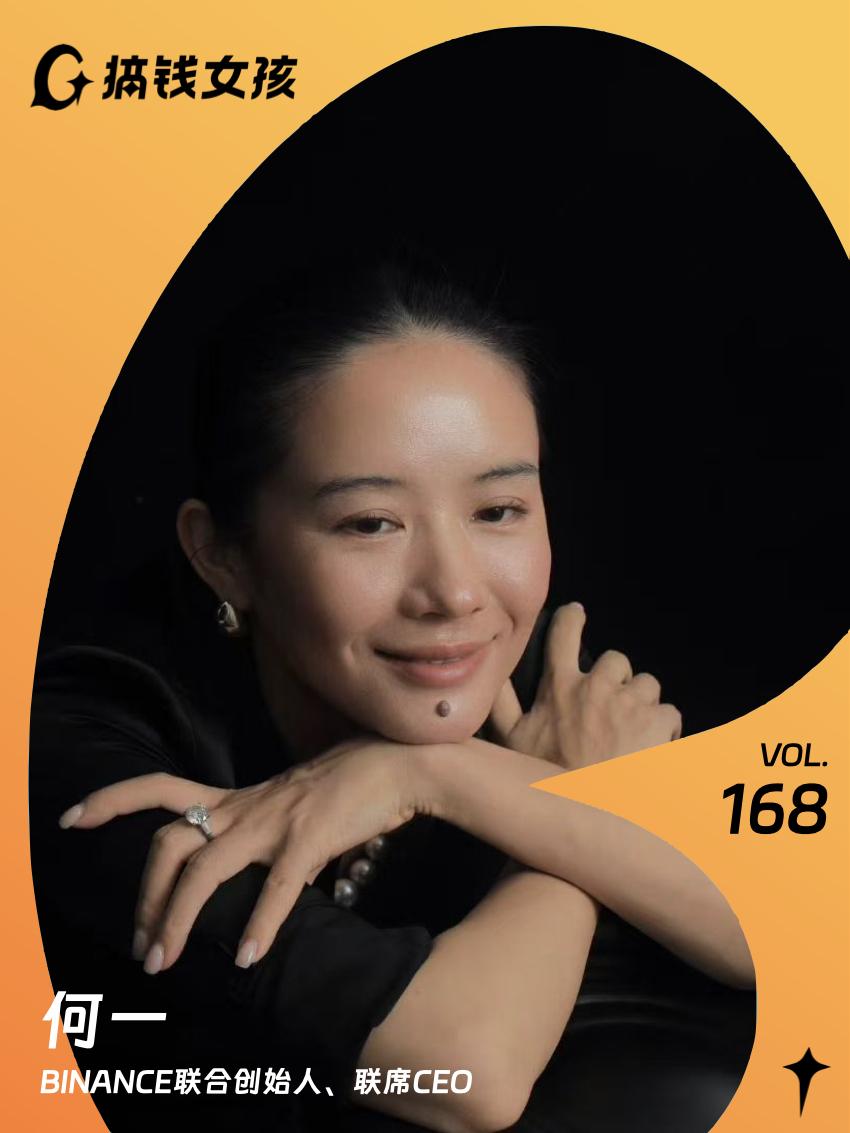
Guest: He Yi, Co-founder and Co-CEO of BINANCE
Host: This is Xiaohui, founder and host of the podcast "Money Girl".
Podcast source: Money Girl
Original title: He Yi: My ambition is to have a world worthy of me!
Broadcast Date: May 14, 2026
Key points summary
In this episode of "Girls Who Make Money," the host and He Yi, co-founder and co-CEO of BINANCE, discussed everything from childhood, growth, and career choices to ambition, cognition, execution, and how women can empower themselves. He Yi recalled how, as the second child in her family, she learned to be proactive: insisting on going to school at age four, reading martial arts novels and Yi Shu (a famous Chinese author) during her teenage years, and being unwilling to return to her hometown to teach during her teacher training—experiences that shaped her strong sense of agency. She also discussed why she went all-in on Bitcoin during the peak of her hosting career: Bitcoin made her rethink "what money really is" and allowed her to see a financial future based on global consensus and trust networks. For ordinary people, her answer is not complicated: first understand the costs, then bravely try; iterate your understanding through execution—life is either about gaining or learning.
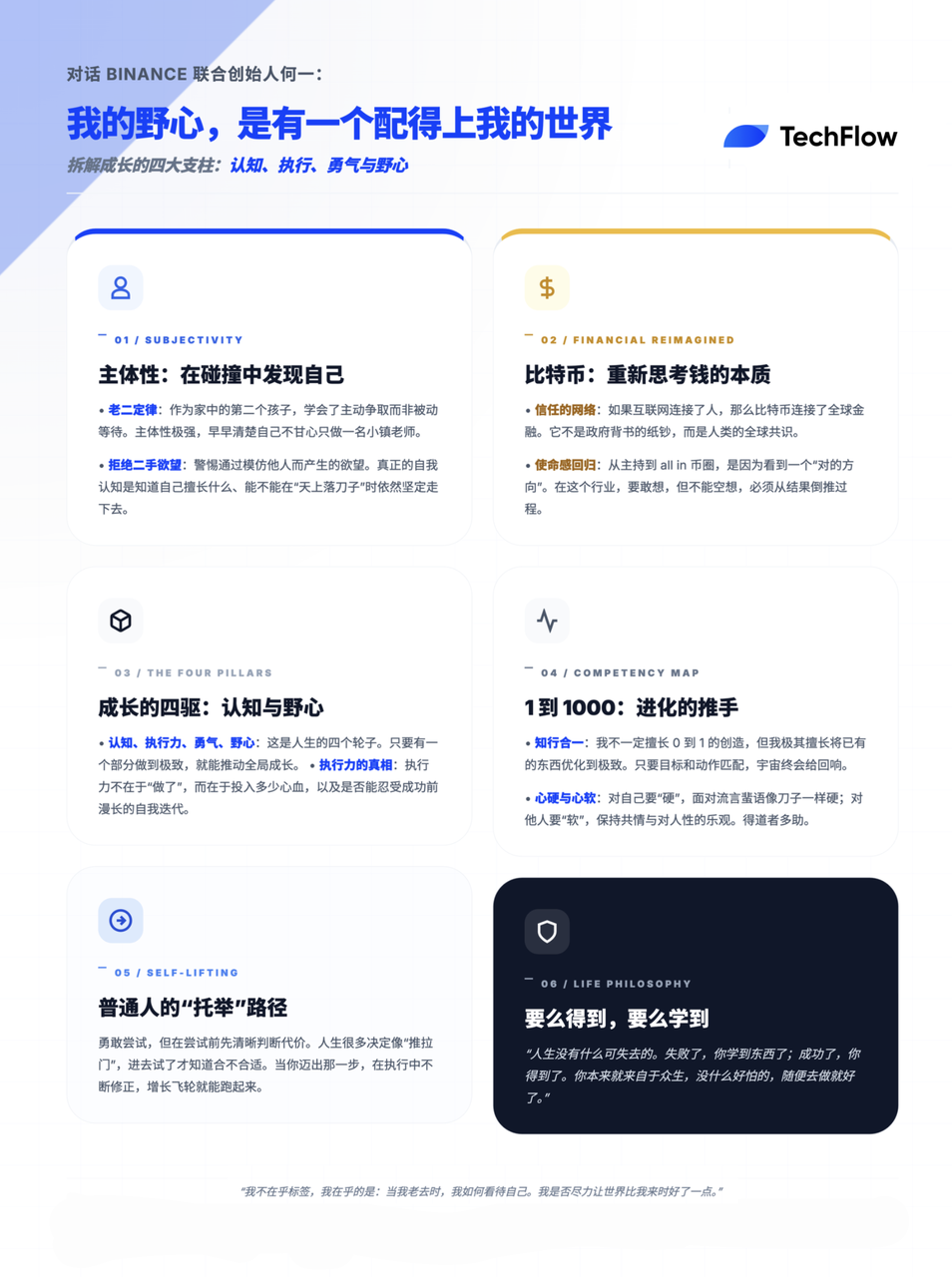
Summary of key viewpoints
On Subjectivity and Self-Awareness
- "Humans do not exist in isolation. We discover who we are through every encounter with the world. You understand yourself better through each interaction, through how you face and deal with it."
- "I think from a young age, in today's terms, I was very assertive and knew exactly what I wanted."
- "Why is it that only city kids can like beautiful things, like flowers and plants? Why can't I?"
- "Do you truly know what you have and what you don't have, what you're good at and what you're not good at, and can you firmly stick to that path, even if knives fall from the sky?"
On ambition and a bigger world
- "I've probably always been a little ambitious, always felt that I needed a world worthy of me."
- "When you see that there are still many parts of the world that you would like to try to change, you will yearn for a bigger world and want to try it out."
- "Often, our desires are secondhand desires; we simply see others doing something and then imitate them."
- "You must dare to dream, but not just daydream. Don't set limits for yourself at first, then work backward from the result to deduce the process."
On cognition, execution, courage and ambition
- "The so-called four pillars are cognition, execution, courage, and ambition. If one of these four aspects becomes exceptionally strong, it will drive the growth of another aspect. If two aspects grow, it may further propel you forward."
- "Understanding yourself means being able to objectively judge whether this is the optimal solution for you, and whether you truly enjoy doing it, even if it doesn't make money, and are willing to continue doing it."
- "A person's execution ability isn't just about what you do, but how much time and effort you spend on it. Are you truly dedicated? Are you truly willing to endure the grueling process of self-renewal before achieving success?"
- "Many people think they know a lot, but they're just unlucky, yet they may not even have the courage to take that first step."
- "If you truly love something, you'll find that doing what you love is effortless."
On Bitcoin and the Reshaping of Financial Perceptions
- "Bitcoin made me rethink what money really is, and that's what moved me the most."
- "If the internet can connect people all over the world, then it's also possible that a trust-based network could connect global finances."
- "It is not a banknote printed based on the credit endorsement of a particular country or government, but a consensus of humanity."
- "The moment I saw Bitcoin, I felt this was the right direction, and I wanted to get into this industry and do this."
On Choice, Mission, and Boundaries of Capability
- "I have confidence in myself. If I join BINANCE, I can see what I can do, and I can turn it into a top global platform; it's just a matter of time."
- "I may not be the best at creating something entirely new from scratch, but I am very good at continuously optimizing and iterating something that already exists to its maximum potential."
- "The universe will ultimately respond to whatever kind of person you want to become and where you want to go, as long as you align your knowledge with your actions and your goals with your goals."
- "Many decisions in this world are like sliding doors; you can take them back afterward. It's okay to try. You might lose an opportunity, but you'll learn a lot."
On success, mindset, and supporting ordinary people.
- "Being hard-hearted doesn't mean being cold-blooded towards others; it means being able to stand firm and defend yourself when faced with differing opinions or when someone throws a knife at you."
- "I'm tough on myself, but soft on others."
- "If there truly is a God's Hand in this world, it would be better for those who genuinely love this world."
- "This world has black and white, light and darkness. You must accept that it is part of the world, but that doesn't mean you should choose to become part of the darkness."
- "Life is about either gaining or learning; just do whatever you want, there's nothing to lose."
Strip away all social labels, who are you?
Xiao Hui: Today, Xiao Hui is interviewing a woman in Hong Kong who can be described as legendary. She was born in a rural area of Yibin, Sichuan, and later became an on-location host for Travel Channel by chance. After that, she became "Customer Service Xiao He" in the mouths of many users in the blockchain industry. Now, her latest title is co-CEO of BINANCE, the world's largest blockchain trading platform and ecosystem.
Life can be so unbelievable, I'm really curious about how she came to be. Today, please welcome He Yi, Co-CEO of BINANCE.
He Yi :
Hello everyone, I'm He Yi from BINANCE, and also your customer service representative, Xiao He.
Xiao Hui: Most people imagine a CEO or female president to be domineering and charismatic, but you have a very gentle and approachable aura. So today I'm also very curious and want to go back and see how "Xiao He" gradually became the top female CEO she is today.
There's a popular way to introduce yourself lately: If you removed all social labels, how would you introduce yourself?
He Yi :
I think first and foremost, she is a mother, a daughter, and someone who is constantly pushing her own boundaries.
Xiao Hui: This is a very simple way of expressing myself. As for me, it seems I need a lot of external judgment and perspectives. If I can't define myself, I start wondering how others will define me. For example, I've probably received a lot of feedback saying that Xiao Hui is also a very approachable person, because I do interviews, and people say I'm good at getting people to open up. But that's how others see me. I seem to really need others' confirmation of who I am.
He Yi :
That might indicate that you're in the process of exploring life. Humans don't exist in isolation; we discover who we are through every encounter with the world. Through each interaction, through how you face and handle it, you'll increasingly understand who you are. It means you're still young, still vibrant.
The "second-place rule" taught He Yi to take initiative from a young age.
Xiao Hui: Before I came here, I did my research and found that my older sister and I have something in common: you have three children in your family, you are the second oldest, and I am the youngest. There is a concept in psychology called the "second-born law," which reminded me of my second older sister.
My second sister's personality is very different from yours. She's quite domineering, flamboyant, and mischievous, which gives our parents a lot of headaches. I'm more obedient, more like the "daughter." I wonder if, looking back, this situation as the second child in the family has left any mark on your personality?
He Yi :
I think it's quite obvious. Because I have three children myself now. Generally, when the first child is born, parents pay a lot of attention, and they get very anxious about the slightest thing, so the first child receives all the love and the most love. When it comes to the second child, people often say, "Follow the book to raise the first child, let them be more relaxed with the second," so parents are not as worried. If the child gets sick or has a fever, they know how to handle it and are not as anxious.
The third child is usually the youngest in the family, and everyone dotes on them; they're all the apple of everyone's eye. So from childhood, parents will almost always tell the older sister, "Give way to your younger brother." Even if you don't fight for anything, they'll reflexively tell you to give way to your brother. The eldest child has guaranteed love, the third child has guaranteed love, but the second child needs to actively fight for it, otherwise they'll feel forgotten.
Moreover, sometimes what children call rebellion is actually a way of asking for help. Relatively speaking, they may also become more independent and self-centered.
The earliest awakening of self-awareness: 4 years old and already insisting on going to primary school, ultimately being admitted "exceptionally".
Xiao Hui: At what moment did you realize that I had to fight for these things myself?
He Yi :
My earliest memory is probably when I was 4 years old and had to go to school. My older sister is 6 years older than me, and she was in elementary school when I was 4. I wondered why my sister could go to school but I couldn't. So every day at home I would make a fuss about wanting to go to school, which annoyed the adults so much that they eventually sent me to school.
My elementary school homeroom teacher was a friend of my parents. He asked my parents how old I was, and they lied and said I was six. They didn't check my ID card or have my household registration book with them, so they just said they'd figure it out later, and if my grades weren't good, I could repeat a grade. So I was sent to school. Later, I never repeated a grade, and my grades were actually quite good.
Xiaohui: Because you can do well what you want to do. This might be the underlying characteristic of your personality: you are very assertive in expressing what you want. If the current environment isn't what you want, you'll feel the need to find a more suitable one.
He Yi :
I have another childhood memory that's very vivid. Because my family lived in the countryside of Sichuan, where wildflowers and weeds abound. When I was in elementary school, I would pick wildflowers every day, and my mother would laugh at me, saying, "How can a country kid like you love these flowers and weeds?" To them, wildflowers and weeds were common and not worth their attention; they probably thought it was a privilege reserved for city kids.
But I have a very clear memory of that time: I disagree with your point of view. Why can only city kids like beautiful things, like flowers and plants? Why can't I?
I think this might be a manifestation of my proactive change, or rather, my proactive insistence on being myself. In today's popular parlance, I have a very strong sense of self and my self-awareness awakened very early; I guess I'm just naturally rebellious.
Xiao Hui: I have a similar experience. I've been left-handed since I was little, and I write with my left hand. When I was little, my parents wanted to change me to right-handed for a period of time, but I was lucky. My kindergarten teacher was quite open-minded and said it was okay, let her be, and that she wrote quite well anyway, so there was no need to deliberately change her. There's also a folk belief that left-handed people are smarter, so the teacher protected my preference, and my parents accepted it.
But I remained firm throughout; I refused to change. They told me to change, but I didn't. However, they didn't use any harsher methods on me. For you, were your parents more hands-off, or was there some environmental pressure?
He Yi :
My mom is very strict. But I think I've always been quite independent and self-aware since I was little, to use a modern term.
A really outrageous thing happened to me when I was a kid: I gambled before I was 10. Kids gambled for a dime, with older kids. Later, I lost a lot of money, and since I didn't have any pocket money, I lost 5 yuan. When my mom found out, she beat me severely with bamboo branches from Sichuan; it hurt a lot. After she finished, she asked me, "Do you want me to hit you again?" I said no.
But then I thought about it and realized something was wrong; I still owed them money. A person should have integrity; what could I do if I owed someone 5 yuan? So I switched to a different group of people to continue betting, but my mom found out again and beat me up again. But by then, I was already paying off my debt and had started slowly winning it back. I continued betting until I paid off all my debt, and then I never begged again.
Before I was 10, I understood gambling: if you lose, you want to win it back; if you win, you want to keep winning—it's endless. Therefore, I had absolutely no interest in gambling; I was probably trained to do so before I was 10.
Xiao Hui: When you were very young, you were enduring beatings from your strict mother while also trying to pay off your debts. How many beatings did you ultimately endure?
He Yi :
It wasn't that much. Besides gambling, another thing was reading novels. There was a scrap collector in our village who had a lot of books at home. I would go to him to take books to read, and later I would also rent novels. When I was in junior high school, I was only a little over 10 years old, and my mother found out again.
Xiao Hui: What do you read, like Qiong Yao or something?
He Yi :
I don't actually read much Qiong Yao literature; I read a lot of martial arts novels and some semi-classical Chinese works, like *Strange Tales from a Chinese Studio*. Back then, there weren't many choices; you read whatever books the recycling center received. Later, I rented novels, and I read quite a few by Li Bihua and Yi Shu. These two Hong Kong writers had a significant influence on me.
Li Bihua is a genius with a rather eccentric air. I still remember one of her quotes: "Sixteen-character mantra for navigating the world: A life for a life, a debt for a debt, accept your losses, and bear your own profits and losses." I used to put it in my QQ profile.
Yi Shu's novels may contain a lot of sentimentality, after all, they are works written by young people, but ultimately, she has a very important theme: buying flowers for oneself. They are all portrayed as strong female protagonists. This is how works from the 70s and 80s were, so I feel that the independence and subjectivity of Hong Kong women existed very early on, and these seem to have become part of the underlying character of me.
Xiao Hui: Let's go back to your career path after growing up. When I was watching, I also felt that your life was very unconventional. It seems like you got an opportunity, wanted to do it, and just did it without much planning. The first thing I'm curious about is that before you became a host, your dream when you were young was to be a model. I remember you saying in the media that you wanted to be a model before you were 16.
He Yi :
Yes. I went to teachers' college because my parents were teachers, and they thought it was a good choice. After graduating, I became a teacher. When I was in school, teachers would say, "It's a pity you're not a teacher." I would tell the teacher in front of the whole class, "I think it's a pity I'm a teacher."
During her time at teachers' college, her ambition awakened: "I feel it's a waste that I'm a teacher."
Xiaohui: You're truly born rebellious and defiant. But because your grades are good, the teachers don't pay much attention. Why did you realize back then that you weren't suited to be a teacher?
He Yi :
It's not that I feel I'm not suited to be a teacher; it's just that I'm not content with being just a teacher.
Xiao Hui: Why? Because it was a good job back then.
He Yi :
Perhaps it's because I read a lot that I've seen a broader world, not just the one in front of me. I attended Yibin University; if I went back, I'd probably just be a teacher in my village. I'm not willing to accept that.
When I read Li Bihua's novels and Yi Shu's novels, and saw more descriptions of this world, I felt that it should have a broader world, and I wanted to go and see it.
"Secondhand Desire": Often our desires stem from imitating others.
Xiao Hui: So you didn't want to be a teacher back then, but later you wanted to be a model?
He Yi :
This is a bit embarrassing to say. I once read a book called "The Desire to Imitate." For example, when you see someone carrying a Hermès bag, you might feel like you want one too; when you see someone buying art, you might feel like you want to buy art as well. But is that really your true desire?
Often it's a secondhand desire. You just see others doing it, so you imitate them; that's called the desire to imitate.
When I was a child, I was more like someone who didn't know who I was, or what potential or talent I had. In junior high, my deskmate was the best speaker in the whole school, something I had never tried before. Later, when I went to teachers' college, I gave it a try and found it quite good; I also won first place in my first speech competition.
Another classmate next to me dreamed of becoming a model. Seeing that she could do it, I thought I could too, so I decided to give it a try. That's why I, at less than 1.6 meters tall, signed up for a modeling competition in Sichuan. Honestly, I felt they were just after my registration fee; any normal person would know I wasn't tall enough. But they had a print modeling category, probably because girls in Sichuan love beauty. Back then, photo studios were popular, and they would take some print photos, so that was my first step into the television industry.
"Ambition" is not a negative word; I want a world worthy of me.
Xiao Hui: Speaking of this imitative mentality, adolescence is indeed a time of confusion and uncertainty. If you find that someone around you who is similar to you can accomplish something, your human nature might stir, and you might feel a little envious, thinking, "If he can do it, can I too?"
He Yi :
I think this is just one of our most primal desires and ambitions, and there's nothing wrong with that. Often, Chinese people, especially women, are ashamed to talk about the word "ambition." It seems like ambition is a very negative word. But I've always been a little ambitious, and I've always felt that I need a world worthy of me.
Xiao Hui: I still wouldn't dare say something like that. Often, after I receive something, I feel unworthy, like I don't deserve it, and I try hard to make myself worthy. But very few people would say, "I want the world to deserve me." It actually implies a certain dissatisfaction with reality.
He Yi :
Yes. I'm very reluctant to say that I'm where I am today because of my family or my background. I feel like I've truly been blessed by God, that I'm God's favorite, God's chosen one. But in this process, when you see that there are still many parts of this world that you want to try to change, you'll yearn for a bigger world and want to give it a try.
I think this might be the earliest form of primal ambition: I am not content with the status quo.
Xiao Hui: You've made many leaps or crossed boundaries in your life, each time stepping out of your comfort zone to enter a completely new field. For example, how you became an on-location host for Travel Channel is a story that's often told, like an option that just fell into your lap.
He Yi :
Actually, it's not entirely a complete disaster. The reason many people can't step out of their comfort zone is that they have ideas but haven't actually tried to do them, or when they do, they don't seriously think about how to improve every day.
Like when you were making a podcast, the original title was "Voluntary Confession," which sounded a bit pretentious. But when you changed it to "Money-Making Girl," firstly, "making money" is a proactive behavior, and secondly, "girl" is a niche. If you hadn't spent time building up your knowledge beforehand, you probably wouldn't have realized that the original approach wasn't working and that you needed to find new ways to iterate and optimize. That's how "Money-Making Girl" came about.
Many people think, "I'll give it a try, and if I fail in three days, I'll think I'm hopeless. " But a person's execution ability isn't just about doing something; it's about how much time and effort you put in, whether you're truly dedicated, and whether you can truly accept the arduous process of self-renewal before achieving success.
The four pillars of personal growth: cognition, execution, courage, and ambition.
He Yi :
I believe the four pillars are cognition, execution, courage, and ambition . If one of these four aspects reaches an exceptional level, it will drive the growth of another. If two aspects grow, it may further propel you forward.
This isn't my theory; I saw it online, but after reading it, I felt it was a very good summary.
Xiao Hui's mindset is like the four wheels of a car: cognition, execution, courage, and ambition. If any one of them moves, the car can start moving, or at least move forward a little.
He Yi :
I think you need courage and ambition, and then you can try it out and iterate your understanding as you go.
Many people believe : "I know a lot, from astronomy to geography, and I can handle international politics with ease. I think I'm better than those celebrities, those who have already achieved great things. I'm just unlucky; others must have succeeded by doing something shady." But they may not have even taken that step , or even had the courage to do so. So they're just standing on their self-perceived understanding, not on the actual path to success.
Xiao Hui: I want to go back to the level of execution, because it's the most crucial. We often say, "Proactive people enjoy the world first," which is essentially a matter of execution. For example, when I was making podcasts, there were no ads for the first six months, and the number of fans grew steadily. During those six months, I didn't feel that the show had become popular or a hit; I just received some small feedback that it was better than my previous show, which allowed me to continue.
Back then, I was still working a regular job and didn't necessarily expect to make money from it. Later, as it grew, I gradually felt the push from the traffic, the momentum of the times, and I continued to think about how to do it better. But it took me two years to commit to it full-time. If I had given up at any point in between because of a lack of advertising or data, I wouldn't be where I am today.
I'm grateful for this kind of execution in myself. But I'm also curious about when to decide whether to persist and when to give up. We often say "falling on the night before dawn," and sometimes I see friends around me who were also doing self-media, some even having more followers than us when we started this account, but they've stopped now. Maybe they just had to hold on a little longer. How do you seize that moment?
He Yi :
People often need to understand themselves, but most people don't. Understanding yourself means being able to objectively judge whether a situation is the optimal solution for you, and whether you truly enjoy doing it, even if it doesn't make money, and are willing to continue doing it.
Most people might think they're doing this because others are doing it, that they don't actually like it that much, and that they've only heard it can make money. So it's easy for them to give up. But if you truly love something, you'll find that doing what you love is effortless.
Xiao Hui: I'm actually the kind of person who can endure anything that requires effort, as long as I enjoy it; I'm quite resilient. But if you insist that I rationally analyze the SWOT and identify strengths and opportunities before doing anything, I don't think I'm that kind of person.
He Yi :
Like how I worked as an assistant therapist before becoming a TV host. I also tried being a university teaching assistant. In these experiences, you'll find that the life you're living isn't what you imagined; it's not the life you want. But once you try it, you know it's not what you want.
When we watched "Infernal Affairs" before, Kelly Chen sat there, and it seemed like I was chatting with her. After the chat, you give me the money. It looked like a high-quality job that earned money through intellectual labor, and it seemed pretty good at the time. But when I actually started doing patient reception and triage, I realized that this industry might not be viable in China in the short term.
You'd be sitting there doing reception and triage, calculating the consultation fees. You'd also be seeing the top psychological experts in all of China—because I was at the Institute of Psychology, Chinese Academy of Sciences—meaning you could meet the best psychological experts in the country, see what their lives were like, what their daily routines were like. I felt, this isn't the life I wanted.
Sometimes we don't need to know the whole picture, or what things will be like in five or ten years. As long as it's within the foreseeable future and you're certain it's not what you want, you can make a choice. I never imagined that the kind of success that people define for me in the conventional sense today might be completely beyond my imagination back then.
Awakening of Understanding After Getting Involved with Bitcoin: Discovering the Nature of Money and the Trend Towards Decentralized Finance
Xiaohui: Let's go back to the four keywords we just discussed: cognition. We mentioned earlier, "You can't earn money beyond your understanding." But many people say, "How do I improve my understanding?" I'm already trying to catch up on my knowledge, how do I do that? Even when you transitioned from being a host to blockchain, you had to learn a lot. I remember a very interesting scene: you were promoting someone else's product, recommending Bitcoin on your WeChat Moments, and even wrote an article about it. I thought, "How dedicated this person is! If I were them, I would just casually share it." In the process of learning, what kind of future did you see in this industry?
He Yi :
I am a very curious person, and I tend to spend some time researching things. So my understanding of the world is probably not like that of many experts who go all the way up to a doctorate and become experts in a certain field; I am more like a generalist.
In this process, you suddenly realize that everyone used to think making money was very important. Back then, we didn't really talk about making money; we just thought money was important. But when I started researching what Bitcoin actually was, I didn't want to be a free advertisement for others. I didn't get paid; just forwarding it to my WeChat Moments felt irresponsible.
So I spent time researching what Bitcoin was and even wrote an article about it. Not a report, just a short piece, but at least I figured out what Bitcoin actually is. That was at the end of 2013.
The most meaningful aspect of this process, for me, was that my understanding was reshaped in that instant. Before that, I was probably just told by others that money was important, but what exactly is money? Bitcoin made me rethink what money truly is in that moment, and that's what moved me.
It was in that instant that I realized that if the internet can connect people all over the world, then there could also be a global, trust-based network connecting all of the world's finances. You can think of it as the money of the whole world, not just banknotes printed with the credit of a particular country or government; it's a global consensus.
At the time, I felt that Bitcoin was truly an amazing thing, so I resolutely went all in and quit my job as a host.
Xiao Hui: Was your hosting career on the rise at that time?
He Yi :
Actually, it got better with each step. When I first started hosting, I had no experience on location; I didn't know where the camera was or where the lights were. Sometimes my partner and I would even block his shot. Gradually, I accumulated experience from scratch and had some film and television opportunities, such as shooting short dramas, or companies approaching me to sign me. But I always felt that something wasn't quite right; it wasn't something I truly liked, something I was passionate about.
At the time, I thought being a host was great—there were mountains and rivers, and I could get a salary. But after two years of doing it, seeing the world and all kinds of people, you start to wonder, how many more years can I keep doing this? So when I saw Bitcoin, I knew it was the right direction, and I wanted to get into this industry and do this.
I chose to resign during the peak of my hosting career because I yearned for a bigger world.
Xiao Hui: It's like you've seen a grand vision, a kind of inspiration, and you get very excited.
He Yi :
Yes. I might be a rather emotional person, and I often make choices based on feelings and intuition. If something excites me and I really want to do it, I might try it first, even before I'm sure if it will be good or bad in the future; if it doesn't work out, I'll test it again.
Xiao Hui: I feel that when you make choices, you tend to rely on the idea that "I have a very accurate intuition".
He Yi :
However, I later discovered that Yang Zhenning has a theory that says human intuition actually stems from a faster processing system than logical thinking, allowing for quicker conclusions. My understanding after digesting this is that human intuition is often very accurate because it's based on your cognition and existing knowledge structure, enabling you to quickly reach conclusions and make judgments. But everyone's cognition, knowledge structure, and existing knowledge base are different, therefore everyone's intuition is also different.
Xiaohui: How do you improve this kind of acuity, or so-called insight? When you see the value of Bitcoin, you interpret it as a promising future industry, but some people may find it too abstract and not want to look at it.
He Yi :
Maybe it's because I'm curious. I believe the world has reached where it is today because, throughout human history, many people have done things that others dared not even think of or try. Just like Elon Musk building rockets; before he built rockets, no one dared to imagine that rockets could be built like that, nor did anyone dare to imagine that rockets could be recovered.
First, you must dare to think big and set no limits. Then, work backward from the result to deduce the process. What are the necessary metrics in the process to achieve this goal? Is there an optimal solution based on current technology? If not, which existing technologies can be used, and which can be skipped?
Xiaohui: I also want to ask, because you recognized the value of this industry back in 2013 and later resigned to join it. But you left again in the middle, and then returned. When you returned, you used the phrase "returning to where your mission lies." So I'm curious, why is this connected to your mission? What is your mission?
He Yi :
I joined my previous blockchain company in 2014, and left in 2015 due to some internal conflicts within the management team. I was unemployed for about five or six months, chatting with friends who were starting their own businesses, and realized that none of these ventures seemed to be what I wanted to do.
At that time, mobile video was just emerging, Miaopai had just come out, and the Ice Bucket Challenge was very popular. So Yixia Technology talked to me for several months. I felt that this was indeed a direction for technological development, so I said, "Why don't we give it a try?" and that's how I joined the Yixia Technology industry.
Back in 2017, CZ was working on BINANCE and asked me to be a consultant. When we talked, I was already thinking that in China, I had already made live streaming quite popular in a relatively short period. At that time, the live streaming wars were fierce. I thought I should challenge myself to a bigger goal: what is it like to be a top company globally? You have to dare to dream, but you can't just daydream.
Xiao Hui: Was your sense of mission at the time more about yourself, about going to a bigger stage and becoming a better version of yourself? Or was it about helping more people and influencing more people?
He Yi :
The idea of influencing more people is kind of funny. When I was young and naive, I was chatting with my girlfriends. One day she suddenly called and asked me, "What kind of person do you want to be?" I thought about it seriously and said, "I want to be someone who influences the world." She immediately said, "You're crazy."
Xiao Hui: What is this girl doing now?
He Yi :
She's now in the crypto world, introduced to it by me. She said she wanted to find a handsome guy who was good to her and had some money, but not too much. And she achieved that.
Therefore, I believe that the universe will ultimately respond to whatever kind of person you want to become and where you want to go. You just need to align your knowledge with your actions, and match your goals with your goals.
Xiao Hui: But it's really difficult. Many people don't know how to realize their ambitions. There are actually several missing pieces between thinking and doing. We may see your results, but every choice you make along the way is quite important.
You just said you were lucky, and I was wondering, are there any lessons we can learn from your luck? How can we increase our chances of being lucky when making choices? Going back to that moment of choice, you were already doing well at Xiaokaxiu and Yixia Technology—a certain, worldly success; at the same time, there was an uncertain future, perhaps one that seemed more promising to you, but it was still an uncertain new industry. Two offers, two paths, were presented to you. Did you choose the latter simply because you believed it would open up a bigger world?
He Yi :
I should say I'm confident in myself. Besides the BINANCE opportunity, other people have approached me. For example, Erbao asked me, "ICOs are really hot right now, do you want to raise money for a project? I can raise a hundred million US dollars for you, and I'll just charge you a management fee."
I seriously considered what I would do if I had a hundred million dollars in my hands. I couldn't think of anything. But if I joined Binance, I could imagine what it would become. My marketing skills at Binance could transform it into a top global platform; it was just a matter of time.
I excel at optimizing and iterating existing things to their maximum potential.
Xiaohui: So you might be better suited to be a facilitator, rather than someone who creates something from scratch. You're more suited to going from 1 to 100, or from 1 to 1000.
He Yi :
Possibly. Asking me to start from scratch and create something new doesn't seem to be my forte. I'm not talking about turning something from nothing into something, but I think I'm very good at continuously optimizing and iterating something that already exists to its maximum potential.
Xiaohui: This is a very rare skill. Especially in the AI era, it's easy to create something, but it's quite difficult to grow and iterate on it.
He Yi :
I feel that path is visible. I can imagine what I will do, the first step, the second step, the third step, roughly what the process will be like, and then it will lead to the image of success in my mind.
To turn your ambitions into reality, try more things.
Xiao Hui: I'd like to return to a topic related to women: how exactly do women achieve their ambitions? In reality, on the one hand, you have to overcome many structural limitations, including the fact that there are already few women in the cryptocurrency industry, and even fewer in senior management positions. So you must have overcome various obstacles and limitations to get to where you are today.
In every choice you made, as you just mentioned, there was an ambition to achieve greater things and reach a bigger stage. Of course, you may have been practicing this since childhood, so ambition comes naturally to you. But for someone like me, even as a woman, there's often a lack of confidence and a feeling of unworthiness. I feel that I need to accomplish something first before daring to increase my efforts or try to level up. I won't start by saying, "I want to achieve the highest goal," and then work backward to achieve it; I'm more of a stability-seeking person.
He Yi :
I think you should give it a try. There are many decisions in this world, like sliding doors, that you can change your mind afterward. It's okay to try; you might lose an opportunity, but you might learn a lot.
The first thing is to try, don't be afraid. But before you try, you need to be clear about what kind of decision it is and what the cost will be. For example, many people think that finding a big shot in the crypto world will make them like He Yi. There are many emotional broadcasters in China who talk about male versus female competition, trying to label me: am I a male or female competitor? If you ask me this question, I think most big shots in the crypto world would say I'm a male competitor, but those who have actually dealt with me and cooperated with me would say I'm the most outstanding among male competitors.
But if many online relationship advice hosts talk about how He Yi achieved success, they'll think I'm the most competitive of all. I'm saying that this is truly beyond my comprehension.
These are all other people's interpretations, and they're not important. The essence is whether you truly know what you have and what you don't have, what you're good at and what you're not good at, and whether you can steadfastly walk down that path. Even if knives fall from the sky, you can withstand them.
Xiao Hui: But you only know if you can handle it when you actually experience the pain. Before you do it, you might think you can bear it, but that's not necessarily true. Even when I'm doing self-media, I get a lot of different comments. For example, some people say my Mandarin isn't perfect, while others say it's good; some of the questions I ask are just out of curiosity, but some listeners think they're stupid. There are many such comments.
At first, I thought I could handle it, but some people were really harsh with their criticism, and seeing that made me sad too. So I think you really have to feel pain to know where your bottom line, limits, and boundaries are. But the good thing is that this is something you're determined to do, so you're able to get through it.
He Yi :
Everyone has to be prepared for hardship. You did such a good job with "Money Girl," only you know the difficult moments you went through.
Does achieving success harden or colden one's heart?
Xiao Hui: So I'm also very curious, is it true that for a person to achieve success, there is a process where their heart hardens and they become cold-blooded?
He Yi :
Not entirely. Everyone has their own talents, and everyone has their own strengths. I think one of my talents is that I'm relatively empathetic. I'm actually quite a soft-hearted person.
Xiao Hui: But wouldn't that make you more vulnerable to being manipulated in male-dominated industries? Because you just said "the competition among the most powerful," which sounds very dignified and tough to me.
He Yi :
The essence of competition is that in business, if you cry and whine when someone insults you, then you should just give up and go home to sleep.
So being tough means being able to firmly deflect differing opinions and the knives others throw at you. I think I'm quite tough on myself, but soft on others.
Because I truly believe that if this world were a simulation, if a real, all-powerful God existed, it would be better for those who genuinely love this world. If you were God, among the pawns of humanity, who would you place in a higher position, wielding more resources? Certainly, it would be the one who bears greater social responsibility and shoulders more of the public's suffering. Those who act justly will find abundant support.
Xiaohui: I'm starting to understand why you've gotten this far. One reason is your respect for your goals and ambitions, pushing yourself to this point; another is your magnanimity—you can embrace so many people. That's why you're so dedicated to customer service. If it were me, I'd find it incredibly annoying; I just want to do my own thing and not get involved in other people's lives. But your core quality is your willingness to consider the well-being of all.
He Yi :
You originally came from among all living beings. I came from the bottom, so I know the diversity of this world. I think we should have an extremely optimistic view of human nature. This world has black and white, light and darkness, so you must accept that it is part of the world, but that doesn't mean you have to choose to become part of the darkness.
Xiao Hui: People often say that growing up is like a boy who slays a dragon eventually becoming the dragon himself.
He Yi :
It's not necessarily a rule like that; it's just a matter of perspective. It depends on your point of view.
Xiaohui: One last question: How can ordinary people support themselves? Especially for girls from ordinary families, what do you think is the most important thing to pay attention to, or what advice do you have for them?
He Yi :
Be brave and try. But before you try, you need to have a clear understanding of the matter. Once you take that step, and continuously iterate your understanding during the execution process, your growth flywheel will start running.
"There's nothing to lose in life; you either gain something or you learn something new."
Xiao Hui: What if we fail?
He Yi :
You failed, but you learned something. You have nothing, so what's there to be afraid of?
So, to conclude, I'll borrow a quote from a previous guest: Life is about either gaining or learning. Just do whatever you want; there's nothing to lose. You either gain something or you learn something.