
Podcast source: Ark Invest
Podcast compilation: BitpushNews
Foreword:
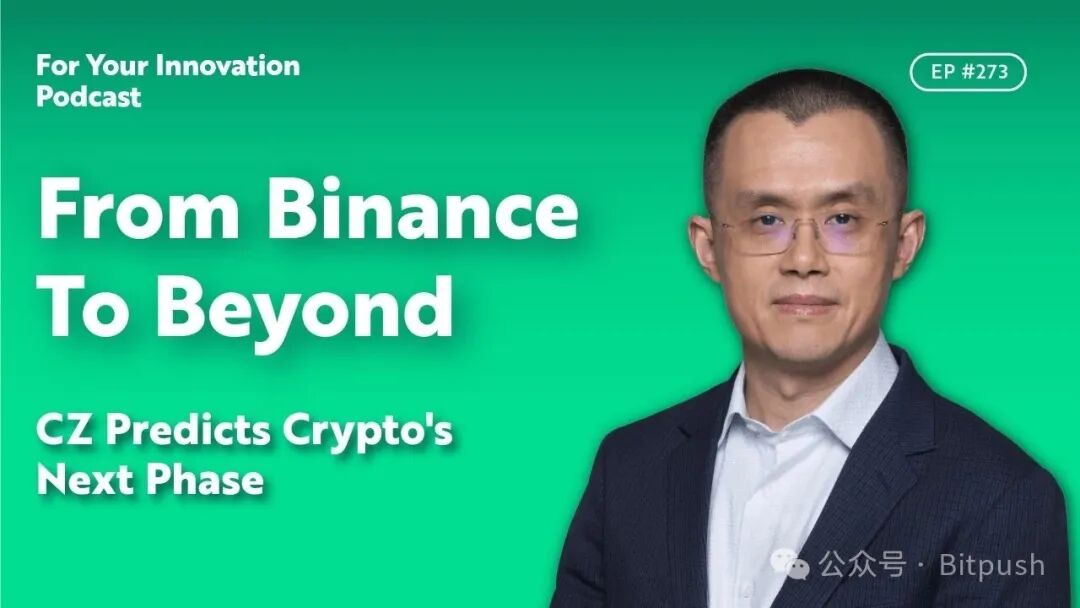
In the FYI podcast, Lorenzo Valente of ARK Invest and Cathie Wood interviewed Binance founder Changpeng Zhao ( CZ ). The conversation began with CZ's personal experiences and expanded to Binance's rise, regulatory challenges, stablecoin competition, the integration of AI and blockchain, the risks of quantum computing, and his assessment of Bitcoin and the future of global finance.
I. From Rural China to the World's Largest Crypto Exchange
Lorenzo: CZ, could you take a few minutes to tell the audience about your early experiences? Including how you got into the crypto industry and how you later founded Binance.
Cathie Wood:
I've read your story of growing up, and I found it very inspiring.
CZ:
Thank you. I was born in a small village in China, then moved to a slightly larger city, and later went to Canada when I was 12. I spent most of my teenage years in Canada, where I also played a lot of volleyball. After that, I went to McGill University.
After graduation, I worked in Tokyo for a few years before moving to New York to work as a development engineer at Bloomberg. At Bloomberg, I worked my way up from developer to team leader, initially managing about 60 people, and later the team expanded to around 80.
In 2005, I returned to Shanghai to start a fintech business, which I ran until 2013. In 2013, I discovered Bitcoin, found it very interesting, and decided to dedicate myself to it. I left my original startup and tried several jobs in the crypto industry.
By 2017, I felt the time was right to create a cryptocurrency exchange, so I founded Binance. That year coincided with the ICO boom, and many projects were issuing ERC-20 tokens on Ethereum. Existing exchanges, mainly Bitcoin exchanges, didn't offer enough support for these new tokens. We also issued our own BNB, which was also an ERC-20 token at the time, so we naturally supported many ERC-20 assets.
Binance grew rapidly. We protected our users, provided excellent service, had a fast matching engine, and prioritized security. Five months later, we became the world's largest cryptocurrency exchange by trading volume, a position we held for many years.
We went through several crypto cycles and also experienced a crypto winter. In 2022 and 2023, we dealt with issues with the U.S. Department of Justice. I personally pleaded guilty to one BSA-related charge, and Binance reached a similar agreement. The judge sentenced me to four months in prison, and Binance paid a $4 billion fine. I'm out now, and fortunately, Binance is still the world's largest cryptocurrency exchange and hasn't collapsed.
Now I mainly spend my time helping other founders, making investments through YZi Labs , and also running Giggle Academy. Of course, I still interact with everyone on X and remain in this industry.
Cathie Wood:
Your full story is also written in your new book, *Freedom of Money*. For the audience, that book offers a more complete understanding of your story from the very beginning to the present. While you still love crypto, you've also started venturing into other areas, including multi-omics and robotics, which overlap significantly with ARK's long-standing focus on innovation. I'm delighted to see you investing capital in these areas because these innovations have long been undervalued in the public markets, and now the opportunities are exploding.
CZ:
Yes. The transition from builder to investor has been a learning process for me as well. You've been doing this for a long time, and I have a lot to learn from you.
II. Crypto Industry: Which sectors are developing rapidly, and which are lagging behind?
Lorenzo:
You've been in this industry for over a decade. Looking back from 2026, what things have progressed faster than you expected? What things have progressed slower than you anticipated?
CZ:
Many things are different from what I initially imagined. For example, I originally thought that payments would have taken shape by now, but in reality, most people still don't pay directly with cryptocurrency. There are crypto cards now, allowing users to pay with crypto assets, but merchants are still seeing traditional systems like Visa or Mastercard.
To my surprise, over the past year or so, especially in the United States, institutional participation in encryption has accelerated faster than I anticipated. A year and a half ago, the US was generally quite anti-encryption, with some even openly launching a so-called "war on encryption." I myself was imprisoned during the Biden administration. Therefore, the subsequent 180-degree turn in the US surprised me greatly.
This also demonstrates the resilience of the US Constitution and its institutions. Presidents can be replaced every four years, and even if there is a period of strong policy repression, it can be quickly reversed.
However, the suppression of the environment over the past few years has indeed had consequences. Many large crypto projects have been sued by the SEC, the number of developers has decreased, and much funding and attention has shifted to Memecoin, resulting in less development of truly practical applications. Now, if US regulation shifts towards supporting crypto, I hope to see more real-world applications built.
III. AI will become a new accelerator for crypto innovation
Cathie Wood:
When we wrote the first Bitcoin white paper in 2014, we didn't fully foresee the scale stablecoins would reach today. AI is also developing rapidly, especially Agentic AI. Do you think AI will drive a new wave of innovation in the crypto industry?
CZ:
Absolutely. AI will help the crypto industry in many ways.
First, AI agents will conduct far more transactions than humans in the future—potentially 10 times, 100 times, or even 1000 times more. AI is unlikely to primarily rely on traditional systems like Swift or Visa. They may use some traditional financial infrastructure, but cryptocurrencies will be far easier for interacting with people or systems on the other side of the globe.
Second, AI will accelerate development. AI-powered coding has already significantly assisted developers. While it cannot completely replace humans yet, it will allow us to build applications faster. We can create new crypto applications more quickly, more user-friendly wallets, more secure wallets, and faster blockchains.
Therefore, AI will not only bring new trading entities, but also accelerate the technological development of the entire industry.
CZ:
Stablecoins are something I never expected to become so big. When we supported Tether in 2017, I thought it was just a temporary tool to allow users to hold fiat-pegged value briefly during market downturns. But it has since developed far beyond my expectations.
Another surprise is the surge in gold trading activity on crypto exchanges. Binance, which launched gold relatively recently, has already become one of the largest gold trading venues outside of traditional markets. Gold even accounts for a significant portion of Binance's futures trading volume. Now, Binance has also launched oil. Traditional assets are entering crypto trading platforms, and this integration is happening faster than I initially imagined.
IV. Traditional finance and crypto finance will eventually converge.
Cathie Wood:
Why do you think these traditional assets have suddenly become so large? Larry Fink said a few years ago that "everything will be tokenized," did that give the traditional financial world a big boost?
CZ:
Larry's influence is undoubtedly significant. He wields considerable power in traditional markets and can influence numerous policymakers and financial institutions globally. When BlackRock's CEO declares a direction important, many national leaders, financial institutions, and institutional investors take it seriously.
He was indeed forward-thinking, believing that everything would be tokenized. Frankly, although I also worked in traditional finance, I was more of a technical person back then, and my understanding of areas like the money market couldn't possibly be as deep as Larry's. His understanding of traditional finance and his public support for tokenization are both very important.
We are now seeing Wall Street and the crypto industry converging. Ultimately, it shouldn't be two separate industries, but rather one, simply using old or new technologies to enable trading and financial services.
Binance now boasts over 300 million users, while the crypto industry has lacked a sufficient number of high-quality assets over the past few years. If users could only trade Meme tokens, it was just one category. Now, with traditional assets like gold, oil, and tokenized stocks entering crypto platforms, global crypto investors have more choices. Geopolitical tensions have also led to volatility in assets like gold and oil, further driving trading demand.
Cathie Wood:
When we were researching Bitcoin in our early days, traditional financial leaders like Larry Fink and Jamie Dimon were actually strongly opposed to it. Now that traditional financial players are joining this trend, we're certainly happy. My question is, are they embracing crypto now because they see it as a way to reduce costs and friction in the financial system, or because they realize this technology will stimulate more financial activity?
CZ:
I think it's both. They see the trading volume on Binance, other exchanges, and on-chain, and naturally they see the business potential.
At the same time, new technologies do reduce fees and costs. In the short term, this may reduce their profits; but if fees decrease, trading volume will increase. Ideally, if fees drop by 50%, trading volume could increase by 2, 5, or even 10 times.
Moreover, even if one organization doesn't lower its fees, other competitors will. Those who don't lower their fees will lose market share. You can insist on high fees, but in the end, you might lose business. Therefore, they will be forced to adopt new technologies, reduce costs, and charge customers lower fees to gain more customers.
Cathie Wood:
In an era of technological disruption, traditional industries typically resist new technologies. However, the financial industry seems to be embracing crypto more quickly this time, perhaps because failing to do so would mean losing market share. Historically, pure technology companies have often been the winners because they are unburdened by traditional systems. How do you think this will unfold?
CZ:
It's a very delicate balance. Some CEOs of traditional financial companies may only look at the next two years. They feel that how the company will be two years from now is no longer their concern; they just want to get their bonuses this year and next. Such people won't proactively change.
However, some CEOs may look five or ten years ahead and want their companies to have a longer-term strategy. Publicly listed companies are usually bound by quarterly financial reports and have to submit results every three months, so there is always a tug-of-war between short-term thinking and long-term thinking.
However, in the long run, short-sighted companies will suffer. Native crypto companies, unburdened by the traditional financial system, can directly utilize new technologies. Private companies are also generally better positioned to make long-term decisions than publicly traded companies.
Overall, those who adopt better technology, reduce costs, and improve efficiency will win. Those who don't will suffer. Even if a traditional financial CEO doesn't make changes for the next two years, he will have no choice but to change if his business significantly declines after that.
Cathie Wood:
Moreover, blockchain and AI are rapidly converging. AI is developing faster than any technology we've ever seen before. Therefore, the phenomenon of "falling behind if you don't keep up" will happen sooner than ever before in history.
CZ:
Completely agree. The pace of change is accelerating, and response times are shrinking. A CEO might think they have two more years, but without AI and blockchain, they could be fired in a year. Today, a CTO of a financial company who doesn't consider AI might be fired; soon, they might be fired if they don't consider blockchain.
V. Why has Binance been able to maintain its number one position for so long?
Lorenzo:
There isn't enough of a story about Binance from the outside world. Why have you been able to maintain your number one position for so many years? Is it due to cultural factors, structural factors, or other reasons?
CZ:
There are several reasons. First, we have always prioritized user protection over revenue and profits. Whenever something happens, we prioritize user protection. Users know this.
Secondly, we have a more global footprint. Over the past decade, regulatory uncertainty has been significant. Many exchanges have their own "home countries"—they thrive in countries that support crypto, and their growth is limited in countries that don't. Binance's strategy is to leave countries that don't support crypto and expand in those that do. Each friendly market contributes a portion of users, which adds up to a substantial user base.
Large scale leads to better liquidity. Better liquidity means better trading prices and lower costs for users, attracting more users to the platform. This creates a network effect.
Third, we've always kept costs low. We have some small offices, but no really luxurious or expensive buildings, and many people work remotely. I want Binance to maintain a startup feel. Although the team is quite large now, this low-cost, entrepreneurial culture keeps us competitive.
Fourth is trust. Centralized exchanges rely heavily on trust. We have long been number one in terms of trading volume and security record, which all contribute to building trust.
In contrast, some US platforms are too costly and expensive. US users have limited choices, but if the US market were to open up to global competition, prices would decrease, and consumers would have more options, which could actually increase encryption penetration in the US and potentially benefit US-based platforms in the end.
6. "All Exchanges": The Boundaries of Trading Platforms are Disappearing
Cathie Wood:
What are your thoughts on the future of exchanges? We hear a lot of discussion about "everything exchange," such as Coinbase's ambition to allow users to trade all asset classes. There are also prediction markets like Kalshi and Polymarket . How do you foresee this evolution?
CZ:
I think everyone wants to be the "exchange for everything," which is normal and will likely happen to a large extent.
Binance is now trading assets like gold and oil, something I never imagined a year ago. Coinbase will likely do something similar, and other exchanges will follow suit. Binance recently integrated prediction markets, and I believe other exchanges will do similar things, some even launching their own prediction markets if licensed.
New technologies reduce intermediaries. A single platform can eliminate many intermediate layers, reducing the need for users to use multiple platforms. This leads to a kind of consolidation, which, although disliked as a term, can also be termed centralization or network effects.
At the same time, there will also be regional and user differences. When ordinary users first enter the crypto industry, they may prefer to use centralized exchanges because decentralized exchanges still involve dealing with wallets, addresses, and a bunch of random numbers, which non-technical users do not like.
However, as users become more sophisticated and self-custodied wallets become easier and more secure, they may shift to decentralized exchanges (DEXs). Therefore, whether centralized or decentralized exchanges will grow faster in the future depends on the speed of user adoption and the pace of tool improvements.
If 10% to 20% of the global population suddenly enters the crypto industry, centralized exchanges will grow rapidly. Decentralized exchanges, however, may grow even faster if users enter gradually and become familiar with self-custody and DEXs.
The US regulatory stance is also changing. The SEC is more positive about DEX UI, and the CFTC seems very supportive of prediction markets. Therefore, the US may now have a regulatory advantage, which is completely different from a year and a half ago. Exchanges in certain regions may experience faster growth due to more favorable regulations.
VII. The competition among stablecoins has only just begun.
Cathie Wood:
There are still some issues regarding US regulations that need clarification, especially regarding rewards—specifically, whether stablecoins or related products can share profits with users. What are your thoughts on this? Also, the market has long believed that Binance and Tether have a close relationship. What are your views on the competition between Tether and Circle?
CZ:
First, a small correction: Binance and Tether do not actually have a business relationship. Binance listed Tether early on, which helped it grow; Tether is also important to the industry's development. But we have no equity relationship, no revenue sharing, no business contracts, and not even a formal business agreement.
Cathie Wood:
It's probably because you both started out early and supported each other that the outside world gets the impression that you have a very close relationship.
CZ:
Yes. I personally believe that stablecoins should generate returns for users. I also agree that Tether is unlikely to do so in the short term. It has already achieved dominance without sharing returns, but this has also left room for competitors. New stablecoins can attract users by offering returns.
You might say you can't pay interest, but businesses will find other ways to reward users. These could include activity rewards, account types, staking mechanisms, or other forms of incentives. If a business wants to reward its users, there are always many ways.
Of course, I understand that regulators don't want to completely disrupt the traditional financial system and need to give traditional institutions time to react. But I believe that soon, both in the US and abroad, stablecoins that offer users good returns and are easy to trade will emerge. Such stablecoins will win.
Tether is strong right now, but USDC is also significant, USD1 is growing rapidly, and stablecoins from other countries and regions are also growing. Stablecoins are just one part of the crypto industry. Any business that prioritizes users and offers lower fees or better returns will have an advantage.
Lorenzo:
Some worry that allowing stablecoins to distribute their yields to users could lead to a flow of bank deposits into stablecoins, potentially triggering bank runs. Do you think this is a legitimate concern, or just a panic narrative from a bank CEO?
CZ:
This concern has some merit. The problem is that stablecoins can work if they simply store assets in relatively safe places, such as US Treasury bonds or government bonds, and generate returns. However, once competition for returns begins, some might invest in riskier assets in order to offer higher returns.
However, compared to banks, which operate on a fractional-reserve basis and lend or invest the vast majority of their funds without necessarily being able to recover them promptly, bank runs are extremely dangerous. Cryptocurrency exchanges and stablecoin issuers, at least the better players in the industry, typically emphasize 1:1 reserves, and some even undergo audits.
Personally, I believe the crypto industry shouldn't undermine this. Exchanges and stablecoin issuers should maintain a 1:1 peg and 100% reserves. This is an advantage not so prevalent in traditional finance, but one that the crypto industry should uphold.
Even with 100% reserves, there are still ways to generate returns. As long as returns can be generated, I encourage companies to pass them on to users. Of course, if the laws of a particular country don't allow it, then it can't be done in that country. But stablecoins issued in other countries may do so and attract more global users.
Cathie Wood:
Stablecoins exhibit strong network effects, meaning that ultimately only a few big winners may emerge. However, we see new stablecoins appearing almost daily. Do you think it will ultimately be a winner-takes-all scenario, or a long-term coexistence of multiple currencies?
CZ:
In the long run, a situation where "the winner takes the lion's share" may emerge. But in the short term, I think we will see more competition rather than immediate consolidation.
Issuing stablecoins has been difficult in the past. Before the Trump administration, many countries were quite hostile towards cryptocurrencies. Tether didn't disclose its bank accounts for a long time because doing so could have led to their closure. Maintaining bank accounts and a large amount of assets in that environment is a remarkable feat. To this day, I still don't know how it did it.
This barrier has been lowered. Many people can issue stablecoins, find bank backing, get audits done, and maintain 1:1 backing. The barrier to entry is much lower than before. The challenge now isn't issuance, but adoption: how to get people actually using your stablecoin.
Moreover, our current discussion primarily focuses on USD stablecoins. Other countries will also want to issue stablecoins backed by their own currencies. USD stablecoins have strengthened the global dominance of the dollar and indirectly helped the US sell its Treasury bonds to global crypto users. Other countries also want to promote their own currencies and sell their own government bonds. Therefore, we will see more stablecoins in the short term.
8. Why haven't non-USD stablecoins taken off yet?
Lorenzo:
Why haven't we seen many local currency stablecoins yet? For example, Euro stablecoins are small, and Mexican Peso stablecoins haven't really grown significantly. Is it because deposits and withdrawals aren't efficient enough, or because users themselves prefer US dollars?
CZ:
Based on my limited understanding, the main reason is that they are too expensive. Take Euro stablecoins as an example. I'm not an expert, but I've heard from other stablecoin projects that developing Euro stablecoins is very costly, requiring substantial insurance arrangements and capital allocation. For startups, it's difficult to invest hundreds of millions of dollars upfront, while market demand hasn't fully materialized yet. This becomes a chicken-and-egg problem.
Mexico's issue might be related to banking channels. There are also those interested in creating stablecoins for the Chinese yuan, but bank support is complex. Hong Kong recently issued stablecoin licenses to HSBC and Standard Chartered; we can see how they proceed. However, banks are generally more cautious and slower, and may not be as flexible as crypto-native companies.
Therefore, other local currency stablecoins have not yet seen significant growth. This, in turn, gives dollar-denominated stablecoins a huge advantage. However, other countries will continue to catch up.
9. Quantum computing: Not an unsolvable problem, but requires community coordination.
Lorenzo:
You have some interesting insights into quantum computing and Bitcoin security. Binance is also a major holder of many crypto assets. What's your view on the timeline of the quantum threat? Is the market overly worried, or not worried enough?
CZ:
First of all, I am not an expert in this field. My understanding mainly comes from news reports and conversations with some tech-savvy friends.
My intuition is that Bitcoin and other cryptocurrencies will be upgraded appropriately. As for what to do with the so-called "Satoshi coins," the community will figure it out. They might give the relevant addresses a year or two to move the assets; if not, before an attack actually occurs, the community might discuss freezing, burning, or other solutions. This is more of a philosophical question and a matter for community voting.
I also believe there's a certain element of hype in the claims made by companies like Google regarding quantum progress. Researchers typically overestimate what can be achieved within a year but underestimate what can be achieved within a decade. The timeline given by the quantum team may be overly optimistic. However, this also serves as a reminder for the industry to take action.
I'm not too worried because this isn't an unsolvable problem. Quantum-resistant cryptographic algorithms already exist; the key is migration and coordination. Some more centralized chains with faster governance will likely upgrade first, such as Ethereum, Tron, and BNB Chain. Bitcoin might be slower because its community prioritizes decentralization, but it will eventually address this issue as well.
10. Sister Mutou clarifies: The margin call on October 11th was not triggered by Binance.
Cathie Wood:
Before we conclude, I'd like to hear your thoughts on Bitcoin right now. Is it still in a four-year cycle? Are we experiencing a cyclical correction before preparing for the next upward move?
Additionally, I'd like to clarify something I said on a news program before regarding Binance. That was around the time of the margin call on October 11th. We know there was indeed a software glitch at the time, but Binance did not trigger that margin call. I hope everyone understands this: we know Binance did not cause that crash.
At the time, there was a lot of tariff-related turmoil in the market, and the market itself was very tense and volatile. Binance-related issues may have exacerbated that volatility, but it wasn't the trigger. We believe the ripple effects of that event have largely subsided.
So I want to ask you, do you think Bitcoin will reach new highs? Are you still bullish on Bitcoin?
CZ:
First of all, I appreciate your clarification. You may not know that your previous statement was widely quoted in Chinese media. Your photo is everywhere in Chinese media, and many people used that video to say that Binance caused the crash on October 11th. So I'm glad you've clarified that now.
Cathie Wood:
Oh my god, I had absolutely no idea.
CZ:
I guess so. When people are doing podcasts or appearing on shows, what they say is easily taken out of context and quoted out of context. You can't possibly repeat every disclaimer in every sentence. But that video has indeed been widely used in the Chinese community. But that's okay, I think we've moved past that stage.
11. CZ remains bullish on Bitcoin: Institutional funds are changing the cyclical structure.
CZ:
Regarding Bitcoin, I believe there are currently two forces at play.
On the one hand, looking at a four-year cycle, Bitcoin did indeed decline somewhat after entering 2026. 2021 was a bull market, and 2025 was also a bull market, so a correction in 2026 is consistent with the four-year cycle framework.
However, there are also two very positive factors. First, President Trump values stock market performance and will do his best to boost it. If the stock market performs well, the crypto market usually performs well as well. When the stock market rises, people have more wealth and cash, and they will allocate some of their funds to crypto assets.
Secondly, geopolitical tensions have made gold more active. Gold has already surged and become highly volatile, and Bitcoin should also be active in this environment. Although we have seen Bitcoin decline, it has recently returned to around $74,000 to $75,000.
Therefore, I believe that a strong stock market performance will have a positive impact on Bitcoin and the entire crypto market. Furthermore, it makes sense that Trump will likely try his best to boost the market before the midterm elections. I don't know him personally, nor have I spoken to him, but the US market has a significant influence on global and crypto markets.
I still hope this year's recovery will be different from historical bear market recoveries, and perhaps even faster. Bitcoin has already touched the $60,000 area, which is close to the support level near the last all-time high. I hope the worst is over. Of course, this is not investment advice.
Cathie Wood:
We must repeatedly emphasize that this is not investment advice. However, I believe a key factor supporting Bitcoin right now is institutional backing from the traditional financial world. Institutions have been hearing about the "four-year cycle" for a long time and are trying to understand it. So they may have been waiting for this pullback. From our fund flow observations, they seem to be entering the market more aggressively now than in the past few years.
CZ:
You're right. Institutional decisions are slow; they usually involve committees making decisions collectively. Once they enter the market, they don't exit within a month. They might spend a month buying a billion dollars worth of shares, but they won't sell them within a month; instead, they'll hold them for many years.
Therefore, institutions entering the market through ETFs aim to stabilize prices and hopefully drive them up. I remain very optimistic.
Cathie Wood:
We share this optimism. And thank you so much for joining us for this episode of FYI. I think it will be one of our best episodes ever.
CZ:
I'm also very happy to participate. Thank you for inviting me. We hope to invest more in the United States in the future and look forward to your support.
Lorenzo:
Of course. Finally, where can everyone buy your new book, *Freedom of Money*?
CZ:
Amazon, Amazon is great. This book is published by Amazon itself.