Author: Claude, Deep Tide TechFlow
Deep Dive: On-chain data shows that on May 18, Wintertermute and Auros Global simultaneously and significantly withdrew liquidity from Hyperliquid for major cryptocurrencies such as BTC and ETH, totaling nearly $100 million.
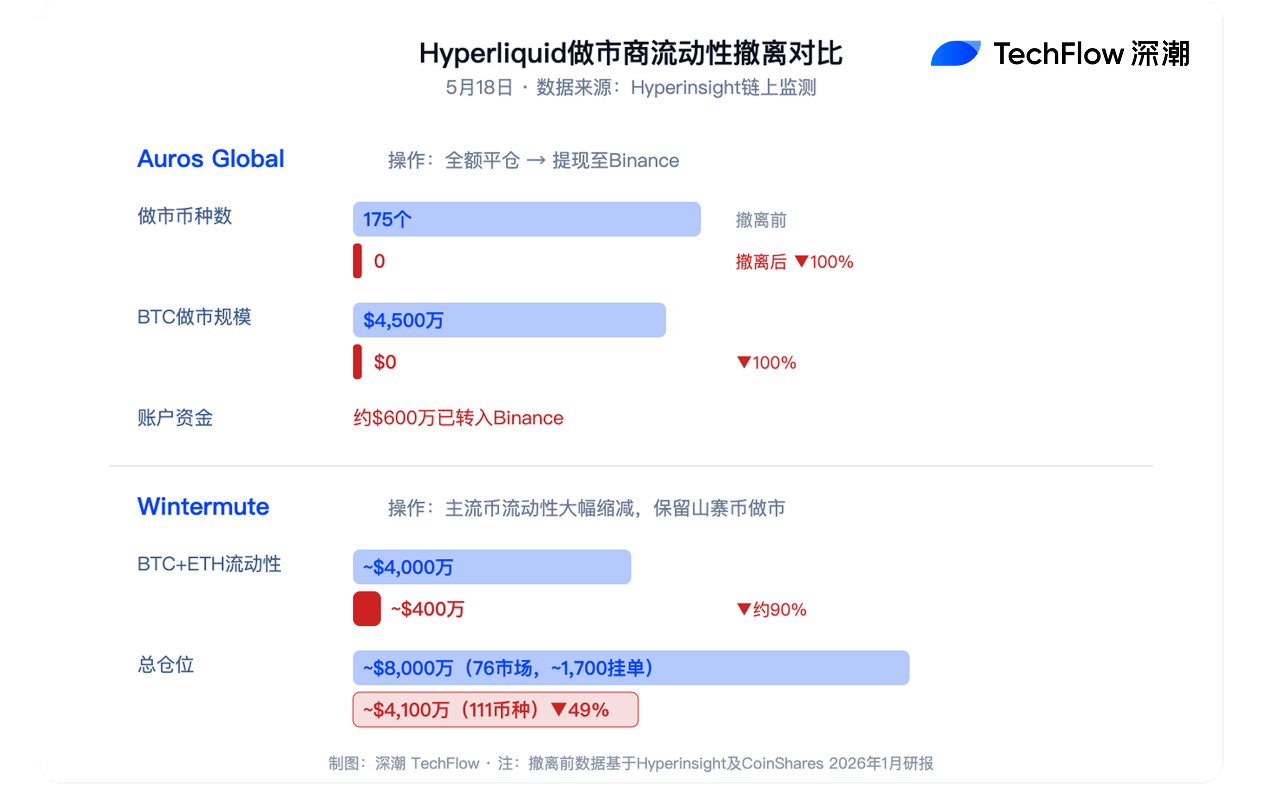
Auros has fully liquidated its positions and withdrawn funds to Binance, resulting in a sharp drop of approximately 90% in BTC+ETH liquidity on Windtermute. This exodus comes just three days after CME and ICE jointly pressured US regulators to investigate Hyperliquid, and the fund movements of market makers may be a leading indicator of a regulatory storm.
Hyperliquid is experiencing a rare liquidity withdrawal event.
According to data monitored by the on-chain intelligence platform Hyperinsight, on May 18th, two major market makers on the Hyperliquid platform, Windemute and Auros Global, simultaneously and significantly reduced the liquidity supply of mainstream cryptocurrencies within a few hours, with a combined withdrawal of approximately $100 million. Multiple independent on-chain analysis accounts have cross-confirmed the above data through address tracing, and there are currently no obvious contradictions.
The timing of this move is intriguing. Just three days earlier, Bloomberg reported that CME Group and Intercontinental Exchange (ICE) were jointly lobbying the U.S. Commodity Futures Trading Commission (CFTC) and members of Congress to impose stricter regulations on Hyperliquid. Whether the rapid withdrawal of these two major market makers is a routine compliance and risk control measure or a harbinger of a regulatory storm is being closely watched by the market.
Auros liquidated its entire position and withdrew from Binance; liquidity on Windtermute plummeted by 90% for major cryptocurrencies.
Hyperinsight's on-chain data shows that the two market makers' exit paths were completely different but their pace was synchronized.
Auros Global (sometimes labeled Oros Global on-chain) provided liquidity for 175 cryptocurrencies on Hyperliquid before its withdrawal, with market making for BTC alone reaching approximately $45 million. As of the morning of May 18, Auros had fully liquidated its positions, with approximately $6 million withdrawn to Binance. The holdings and withdrawal records of the relevant addresses can be publicly viewed on HypurrScan.
Wintermute's operations were somewhat restrained but equally aggressive. Its BTC plus ETH liquidity plummeted from approximately $40 million to about $4 million, a drop of about 90%; its overall position was slashed from nearly $80 million to $41 million. Wintermute is currently maintaining orders for 111 cryptocurrencies, but the order book depth for major cryptocurrencies has significantly thinned.
The addresses of the two companies are as follows:
0xecb63caa47c7c4e77f60f1ce858cf28dc2b82b00
0x023a3d058020fb76cca98f01b3c48c8938a22355
For Hyperliquid, which relies on on-chain order book matching, the simultaneous withdrawal of the two major market makers means that the bid-ask spread for core trading pairs such as BTC and ETH will widen, slippage will increase, and the execution cost of large transactions will rise significantly.
Three days ago, CME and ICE jointly exerted pressure, targeting Hyperliquid oil price perpetual contracts.
The window of opportunity for market makers to withdraw coincides closely with an escalating regulatory battle.
On May 15, Bloomberg reported that CME Group and ICE warned the CFTC and members of Congress that Hyperliquid's anonymous trading environment could distort global oil price benchmarks and provide channels for market manipulation and sanctions circumvention. The two exchanges have required Hyperliquid to register with the CFTC, meaning the platform must implement customer identification procedures and transaction monitoring mechanisms, directly conflicting with its current anonymous trading model.
According to CoinDesk, CME and ICE's core concerns are focused on Hyperliquid's HIP-3 market. This mechanism allows users to gain synthetic exposure to stocks and commodities through on-chain contracts. In March of this year, perpetual contracts tracking WTI crude oil on Hyperliquid recorded over $1.2 billion in 24-hour trading volume during a surge in traditional market oil prices, directly impacting traditional exchanges' concerns about pricing power.
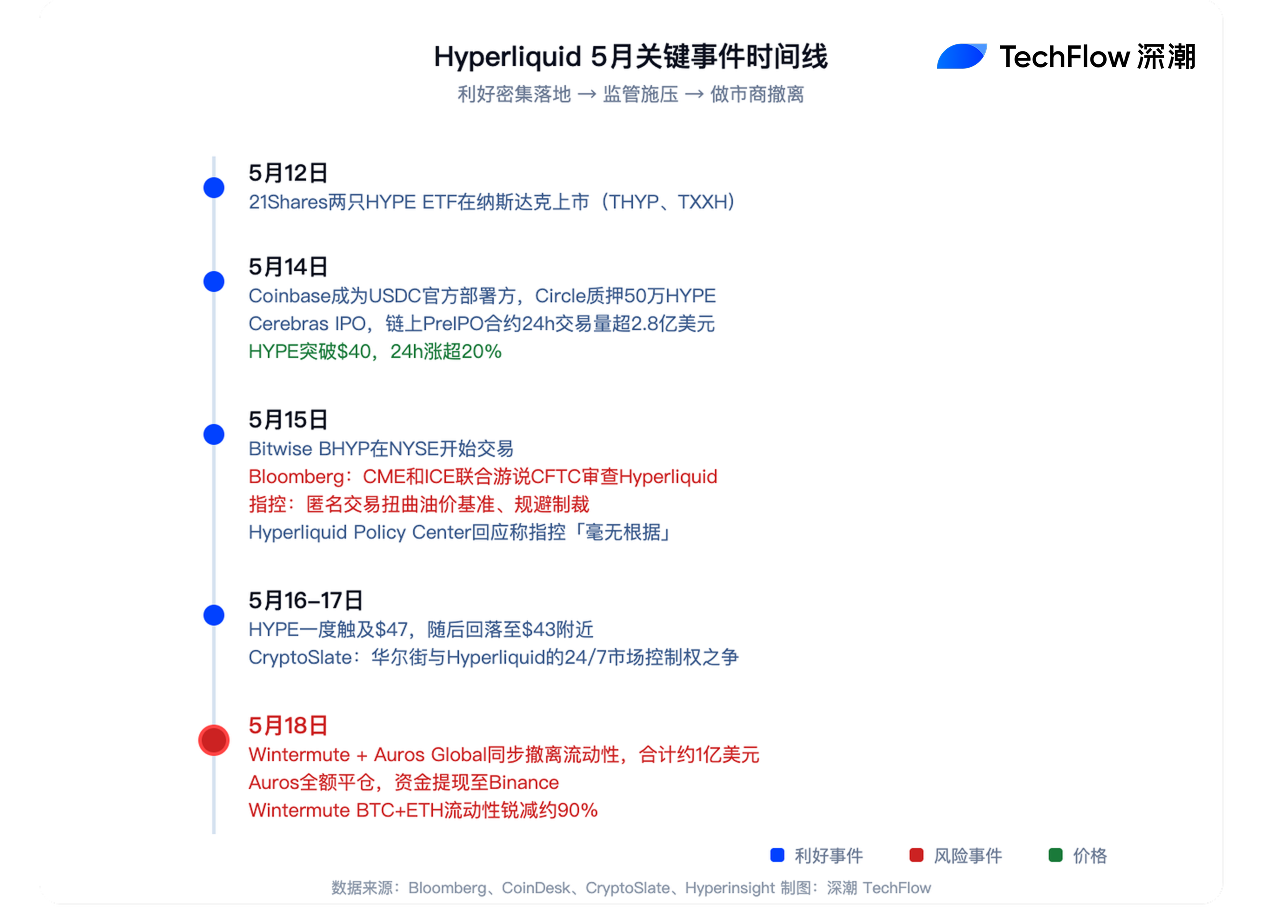
Hyperliquid Policy Center subsequently issued a statement calling these concerns "unfounded" and emphasizing that the on-chain transparency of public blockchains actually provides a more effective tool for regulatory enforcement. According to U.Today, the advocacy group has met with the CFTC to seek to establish a legal framework that allows U.S. users to participate compliantly.
However, the market makers' calculation logic differs from the public relations statements of the agreement parties. Wintermute and Auros Global are both regulated institutional entities, and reducing exposure is a standard risk management response when compliance uncertainty increases. During the flash crash in October 2025, Wintermute desktop strategist Jasper De Maere told Decrypt that when the reliability of hedging tools cannot be guaranteed, the only thing market makers can do is withdraw.
Cerebras' pre-IPO success has heightened Wall Street's vigilance.
One of the catalysts for escalating regulatory pressure is that Hyperliquid's expansion into traditional financial markets has far exceeded expectations.
On May 14, AI chip company Cerebras Systems went public on Nasdaq, with an IPO price of $185 per share and an opening price of $350, representing a nearly 90% increase. This became the largest US tech IPO since Uber in 2019. Weeks before the IPO, pre-IPO perpetual contracts on Hyperliquid began pricing CBRS, and trading volume exceeded $280 million in the first 24 hours of trading.
BitMEX co-founder Arthur Hayes posted on the X platform that he estimated the opening price of CBRS using Hyperliquid's grey market contracts. According to U.Today, the daily trading volume of Cerebras' pre-IPO contracts on Hyperliquid once exceeded $230 million, while Nasdaq's official pre-market trading was only about $30 million. The screenshots shared by professional traders on social media referenced charts from on-chain DEXs, not traditional trading terminals.
This phenomenon has made Wall Street realize that Hyperliquid is no longer just a crypto-native derivatives exchange; it is encroaching on the core territory of traditional finance. As of May 2026, Hyperliquid controlled 53% of the fee revenue in the on-chain derivatives space, with open interest reaching $2.45 billion.
How the liquidity gap evolves in the short term depends on the pace of regulation.
Currently, Wintermute still maintains some market-making activity on Hyperliquid (111 cryptocurrencies), but liquidity for mainstream cryptocurrencies is far lower than before. According to an analysis by 0xLoris on GitHub in January 2026, Wintermute previously maintained approximately $199 million in total notional value of orders across 76 markets on Hyperliquid. The current withdrawal means that this figure has shrunk significantly.
For traders, the key short-term focus should be on changes in the bid-ask spreads of BTC and ETH perpetual contracts and slippage of large orders. Hyperliquid's on-chain order book structure means that the withdrawal of market makers will be reflected more directly in the trading experience than on centralized exchanges.