
Written by: Sanqing, Foresight News
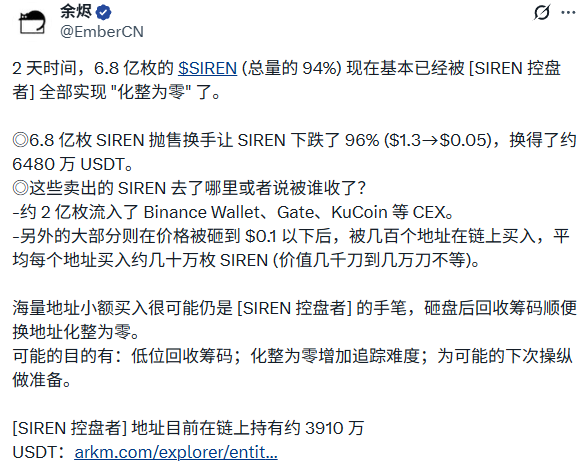
From June 13th to 15th, the AI Meme token SIREN on the BNB Chain plummeted from approximately $1.30 to $0.05 within two days, a drop of about 96%. On-chain analyst Ember's monitoring shows that the same controlling entity sold off approximately 680 million SIRENs during this period, representing about 94% of the total supply, and cashed out approximately 64.8 million USDT.
SIREN is an AI narrative token on the BNB Chain, launched through four.meme. It features a dual-personality AI trading assistant: the stable Golden and the aggressive Crimson. Its combination of meme and AI-powered narratives is precisely what attracted early investment and enabled multiple rounds of price increases.
This is the fourth round of manipulation of SIREN recorded by Ember. According to GMGN data, SIREN's current market capitalization is approximately $53 million. Price, liquidity, and the actions of a single entity are highly correlated, rather than being driven by product fundamentals.
Absolute control is the starting point of this business.
The manipulator's actions can be traced back to the end of June 2025. At that time, it purchased a large number of tokens through hundreds of wallets at a low price of about $0.045, spending approximately $21.8 million. These scattered addresses were later consolidated to prove that they belonged to the same entity.
Accumulating shares at low prices is the prerequisite for all subsequent operations.
From the beginning of 2026 to March, SIREN surged approximately 26 times from $0.08 to $2.1 in about a month and a half. Following the surge, the manipulators consolidated 66.5% of the total supply (approximately 484.6 million coins, worth about $1.04 billion at the time) from hundreds of wallets into 48 addresses within hours.
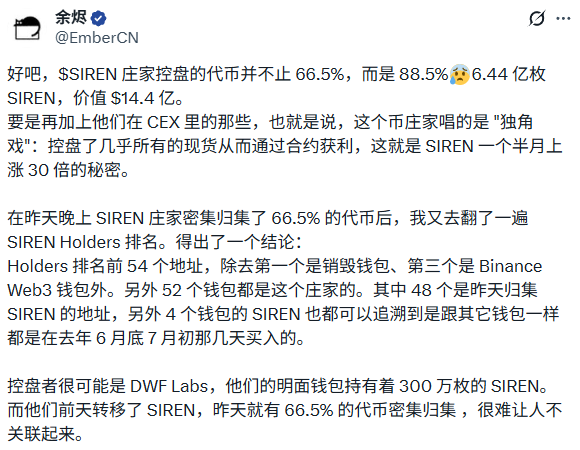
Ember later corrected: the actual control ratio was as high as 88.5%, about 644 million coins, with a peak value of about $1.44 billion. In addition, the portion deposited into the exchange was almost a one-man show.
When an entity holds 90% of the physical goods, the candlestick chart is no longer the market, but a script.
The pull-and-smash cycle is a repeatedly verified cash flow phenomenon.
Once they have absolute control, the controllers have turned the "pull up the price to lure in more buyers, dump the shares and kill them all at once, buy back shares at a low price, and then pull up the price again" strategy into a replicable cash flow model.
In early April, the manipulators first drove the price down from about $2 to $0.13, a single drop of 94%; then they withdrew about 30.07 million SIREN from the Binance Alpha wallet and redistributed them, restoring their control to over 93%; then they surged 185% within 24 hours, pulling the price back up to $2.18.
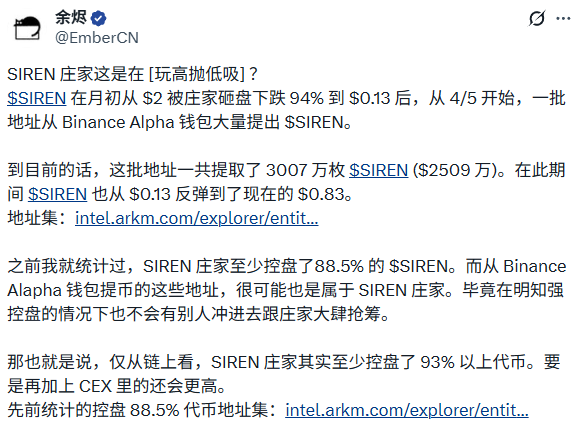
The chips that were dumped were bought back by the investors themselves, while the liquidation of retail investors became the profit of the opposing side.
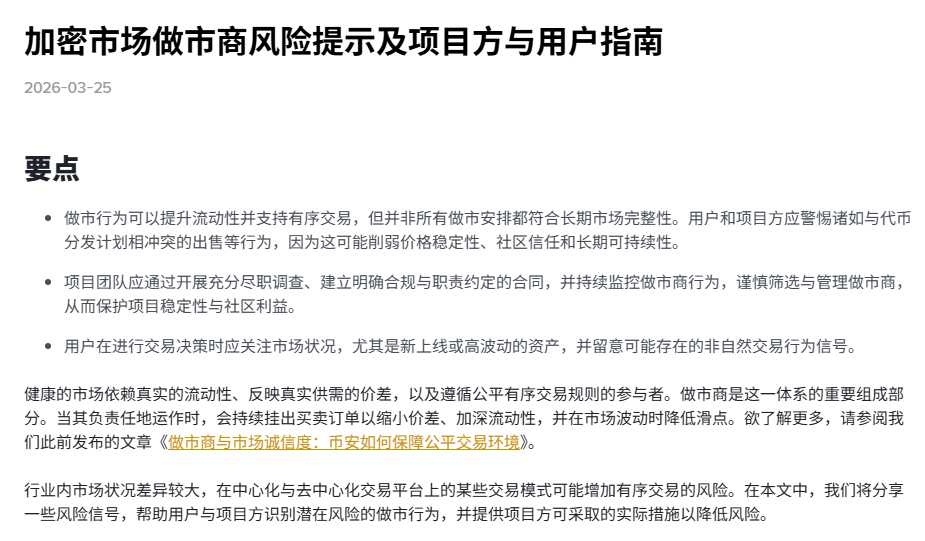
This strategy relies on the correlation between spot and futures prices: driving up spot prices attracts long positions, then dumping them triggers a chain reaction of liquidations. The manipulator profits from the spot price difference and further profits through futures price movements and funding rates. Binance simultaneously issued a risk warning for market makers, which was interpreted by the market as a warning against similar practices.
By June, the model had completed four full cycles of operation.
Breaking down the whole into smaller parts is a foreshadowing of the next round.
On June 13, the manipulators sold approximately 17 million tokens through multiple addresses within two hours, causing the price to plummet from $0.47 to $0.23. At this point, on-chain holdings still accounted for approximately 94% of the total.
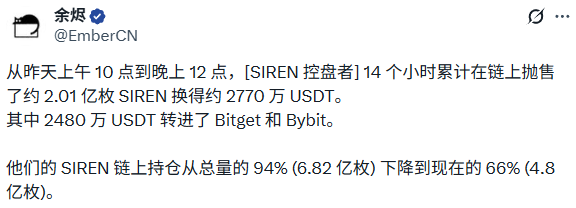
On June 14, approximately 201 million tokens were sold within 14 hours, yielding approximately 27.7 million USDT. Of these, approximately 24.8 million USDT flowed into Bitget and Bybit, reducing on-chain holdings from 94% to 66%.
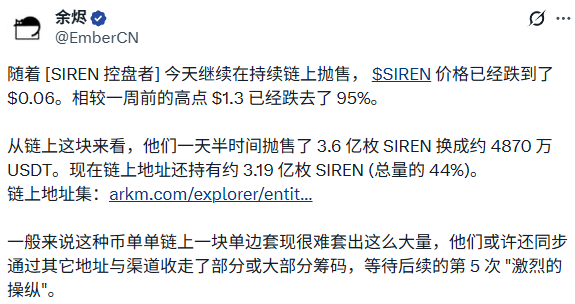
A total of approximately 680 million coins were sold over two days, with about 200 million coins flowing into Binance Wallet, Gate.io, KuCoin, and other platforms.
What we should really be wary of is where the remaining chips go.
After the price fell below $0.1, hundreds of small on-chain addresses began making small purchases, with each address buying an average of hundreds of thousands of coins, worth thousands to tens of thousands of dollars. Yu Jin believes that these purchases are most likely the work of the manipulators, whose purpose is to buy back at low prices, break down large amounts into smaller ones to increase the difficulty of tracking, and prepare for the next round of manipulation.
The "same entity" is an on-chain inference based on the high consistency of wallet clustering, fund flow and behavior patterns. There were early discussions about its association with DWF Labs, but its specific identity has not been confirmed.
The addresses of those controlling the market kept changing, but their behavior remained consistent. They concentrated their funds in a few wallets during accumulation phases, and dispersed them to a large number of new addresses during dumping phases, repeatedly using exchanges to conceal their activity.
Currently, the entity still holds approximately 39.1 million USDT on its blockchain. Ember believes this may be preparing for the fifth "intense manipulation" that is yet to come.
This article is based on publicly available analysis and does not constitute investment advice. The Meme market is extremely risky, and highly manipulated coins are particularly vulnerable to being exploited. Please participate rationally and manage your positions carefully.