
Author: Yan Wai Zhi Yi, Wall Street CN
On June 22, 2026, NBC reported news that surprised no one: former Federal Reserve Chairman Alan Greenspan passed away at the age of 100 from complications of Parkinson's disease.
He had been out of the public eye for a long time. But what he left behind has never, for a single moment, left the markets.
More than half of the pricing logic in today's global financial markets still bears his fingerprints. The statement "The Federal Reserve will provide liquidity" after the "Black Monday" crash of 1987, the global stock market shock triggered by that single question about "irrational exuberance" in 1996, and the creed traders have recited for 30 years—"Don't Fight the Fed." These are not history; they are the code running right now.
And just days before Greenspan's death, current Federal Reserve Chairman Kevin Warsh had just launched a comprehensive review of the Fed's operating methods. The timing of this coincidence almost seems like a deliberate metaphor: one man exits the stage, and the rules he personally wrote are being dismantled and rebuilt by another.
The Birth of the "Greenspan Put"
To understand what Warsh is changing, one must first understand what kind of system he inherited—a system almost entirely crafted by Greenspan.
On August 11, 1987, the 61-year-old Greenspan, nominated by President Reagan, succeeded Paul Volcker as Chairman of the Federal Reserve. It was a rather unexpected appointment. Greenspan was not an academic economist by background; his doctoral dissertation took decades to complete (he finally received his Ph.D. from New York University in 1977, at the age of 51). His foundation was as a Wall Street consultant—in 1954, he and his lawyer partner Nathan Wolff co-founded "Townsend-Greenspan & Co.," specializing in providing economic forecasting services for corporations and financial institutions. His sense for data and business cycles was honed in the process of making money for clients, not derived from a blackboard.
This experience profoundly influenced his subsequent 19-year career at the Federal Reserve.
Just 69 days into his tenure, on October 19, 1987, "Black Monday" struck. The Dow Jones Industrial Average plummeted 22.6% in a single day, the most brutal single-day crash in the history of U.S. capital markets. Program trading triggered chain reactions, the market fell into a liquidity black hole, and no one knew where the bottom was.
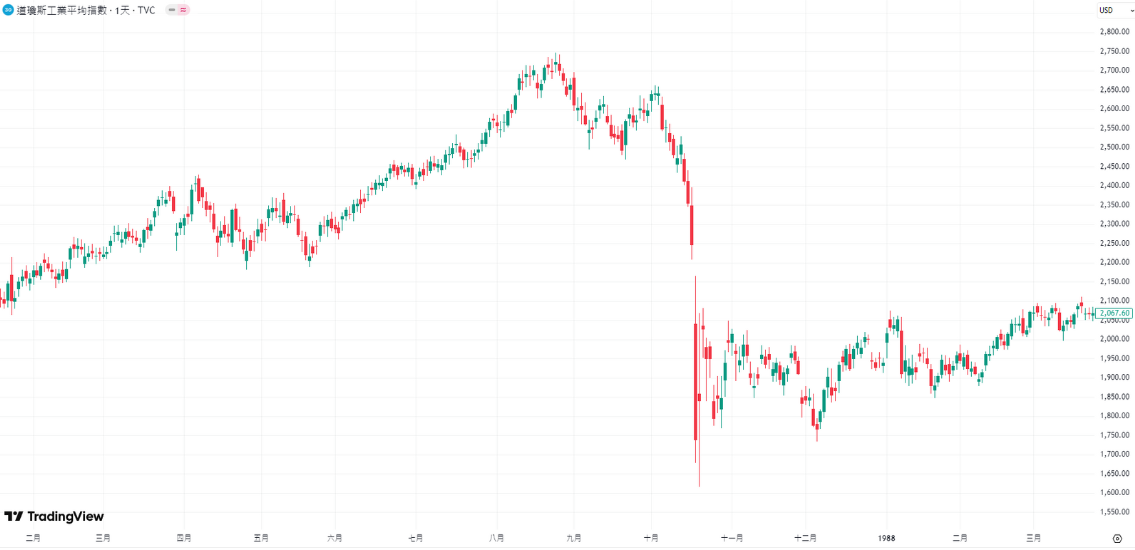
Greenspan's response defined the behavioral paradigm of the Federal Reserve for the next 30 years. He did not wait for the market to clear itself—that was the textbook answer of classical economics—but quickly issued a statement: the Fed would "provide liquidity to support the economic and financial system," and tacitly allowed banks to expand loans to brokers. This statement stabilized the market.
This logic was later condensed by the market into one term—the "Greenspan Put." It meant: when the market falls deep enough, the Fed will definitely step in to support it, effectively giving all market participants a free put option. Once this expectation formed, it could never be undone.
"Irrational Exuberance" and the Power of Language
Greenspan shaped the market not only through actions but also through language.
On December 5, 1996, in a speech at the American Enterprise Institute (AEI), he tossed out a seemingly casual rhetorical question: "How do we know when irrational exuberance has unduly escalated asset values..."
The sentence itself was a question, containing no policy hint whatsoever. But the market's reaction was almost instantaneous: the Tokyo stock market opened down 3% the next day, and global markets followed suit.
This was the power of "Fedspeak." His linguistic style was later summarized by himself, with some pride, as a kind of "purposeful ambiguity"—using four or five increasingly obscure sentences to evade questions he didn't want to answer, making the questioning congressman think he had received an answer and then contentedly move on to the next topic.
But "irrational exuberance" was not ambiguous language; it was as precise as a scalpel. It sent a signal: I think the stock market is too expensive. That alone was enough to trigger global shockwaves. And the market soon discovered that the statement itself had not changed any policy—interest rates didn't move, liquidity wasn't withdrawn. After a brief dip, stocks continued to rise, all the way to the peak of the dot-com bubble in March 2000.
This actually reinforced the credibility of the "Greenspan Put": if even a verbal warning wasn't accompanied by a real tightening of monetary policy, then he must be on the side of the bulls.
1994: The Forgotten "Hard Hand"
Today, when people remember Greenspan, it's mostly for the "Put"—thinking he was always on the market's side. But what happened in 1994 tells a completely different story.
In early 1994, Greenspan judged that inflationary pressures were building and decided to act preemptively. Defying market expectations of a moderate stance, he rapidly raised the federal funds rate from 3% to 6% within a year. This move was not fully communicated to the market in advance and was dubbed a "sneak attack" by the market.
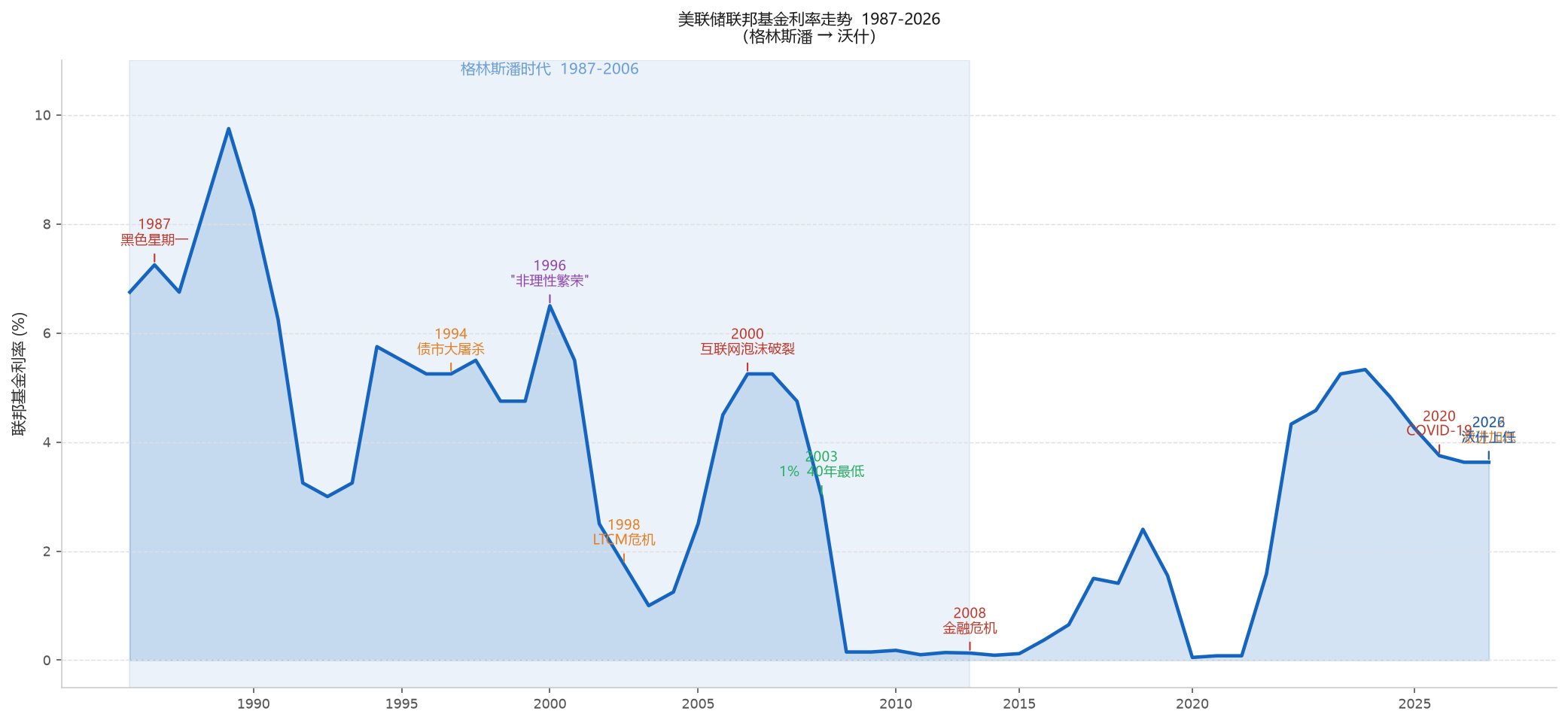
The result was a disaster—a bond market "massacre," with bond portfolio losses reaching as high as $1.5 trillion. Orange County, California, went bankrupt due to massive losses in bond derivatives, and Greenspan's approval rating in the financial markets plummeted to rock bottom.
But the outcome of this event paradoxically solidified Greenspan's market credibility. Because he proved: he was not afraid to offend the market. His true priority was controlling inflation, not pleasing Wall Street. This credibility allowed him to maintain relatively low interest rates in the late 1990s without triggering a de-anchoring of inflation expectations—the market trusted him, trusted that he would act when necessary.
This was the prerequisite for the "Greenspan Put" to hold: the market believed Greenspan had the ability to manage inflation, and therefore believed he would provide a floor during a crisis. These two are two sides of the same coin.
1998: LTCM and the Precedent of "Too Big to Fail"
In 1998, two crises erupted almost simultaneously: the Russian sovereign debt default, and the near-bankruptcy of Long-Term Capital Management (LTCM)—a hedge fund staffed by Nobel laureates in economics.
Greenspan's response once again shaped market expectations. He decisively cut interest rates and personally took the lead in organizing a private bailout of LTCM by Wall Street investment banks (the Fed did not directly contribute money but coordinated private sector intervention).
The historical significance of this event is often underestimated. It is one of the key origins of the modern financial market's "Too Big to Fail" logic—when the collapse of an institution is enough to trigger a systemic meltdown, whether it's a bank, an investment bank, or a hedge fund, someone (the central bank or the government) will organize a rescue.
At this point, the "Greenspan Put" expanded from the stock market to the entire financial system. The market began to systematically expect that the risks of systemically important institutions were ultimately backstopped by the monetary authority.
Greenspan himself was not averse to this role. He wrote in his memoir: "The duty of a central banker is not to prevent every bubble from forming, but to ensure the financial system does not collapse when the bubble bursts." This sounded prudent, but the market's interpretation was: "So I can stay in the bubble a little longer, since the Fed will take care of it when it pops."
The Dark Side of the Legacy: 1% Interest Rates and the Questions of 2008
The dot-com bubble burst in 2000, followed by the September 11 terrorist attacks in 2001. Greenspan's response was to slash the federal funds rate from 6.5% in mid-2000 all the way down to 1% by mid-2003—the lowest federal funds rate in the U.S. in over 40 years, and it was maintained for a full year.
Cheap money flooded into the real estate market. From 2000 to 2006, U.S. home prices rose cumulatively by more than 80%. Subprime mortgages—loans made to borrowers with extremely weak repayment ability—expanded wildly during this period. Wall Street packaged these subprime loans into CDOs (Collateralized Debt Obligations) and used complex mathematical models to convince themselves these products were "safe."
In 2008, it all collapsed.
Critics pointed their fingers directly at Greenspan: by pushing rates down to 1% in 2003 and keeping them there for a year, you were using cheap money to inflate the housing bubble. You are the culprit behind the 2008 financial crisis.
Greenspan's defense was equally forceful. In a 2007 interview with USA Today, he said: "This one, I'm innocent." In his memoir, "The Age of Turbulence," he shifted the blame to the "Global Savings Glut"—emerging markets, represented by China, investing massive trade surpluses into dollar-denominated assets, which pushed down long-term interest rates. This, he argued, was the most fundamental source of the loose monetary environment, not the Fed's short-term interest rate policy.
This debate remains unsettled to this day. In 2016, a working paper from the Bank for International Settlements (BIS) concluded through econometric analysis that the excessively low rates maintained late in Greenspan's tenure did significantly push up housing prices. But other economists have pointed out that U.S. inflation was actually quite low from 2003-2005, the "neutral interest rate" itself was declining, and Greenspan's rate cuts were not entirely without justification.
Regardless, the 2008 crisis fundamentally challenged the logic of the "Greenspan Put": when the market firmly believes the central bank will rescue it in every downturn, moral hazard accumulates to a level of systemic danger. This is precisely the legacy that the next three Fed chairs—Bernanke, Yellen, and Powell—all had to confront: how to provide crisis support without further reinforcing the market's moral hazard expectations.
Later Years: From "Economic Czar" to Controversial Figure
On January 31, 2006, Greenspan ended his 19-year tenure as Federal Reserve Chairman. When he left, his public esteem was at its zenith—the U.S. economy had experienced one of the longest expansion cycles in history, inflation was suppressed at low levels, and the stock market had gone through an epic bull run in the 1990s.
But the financial crisis arrived two years later, and Greenspan's reputation collapsed with it. In October 2008, he appeared at a congressional hearing and admitted he was "shocked, couldn't believe" that the free market could malfunction so badly. This statement was interpreted by the media as "Greenspan's public confession of his faith in free markets," becoming the iconic moment of his public image's fall from grace.
After stepping down, Greenspan did not completely fade from public view. He founded the consulting firm Greenspan Associates, continuing to provide economic advisory services to financial institutions. He occasionally spoke out in the media—in 2018, he warned investors on CNBC to "Run for cover," because the U.S. Treasury yield curve had inverted, which he saw as a strong signal of an impending recession. In 2024, he also co-signed a statement with other former Fed and Treasury officials condemning a criminal investigation into Fed Chair Powell, calling it "an unprecedented attempt to undermine the independence of the Federal Reserve through prosecutorial attack."
His private life was also quite newsworthy. His first marriage (to painter Joan Mitchell) ended in divorce in less than a year. In 1997, the 71-year-old Greenspan married Andrea Mitchell, NBC's chief foreign affairs correspondent, in a ceremony officiated by Supreme Court Justice Ruth Bader Ginsburg. This marriage lasted until his death.
Greenspan also had a little-known early career identity: a jazz saxophonist. He attended the Juilliard School as a teenager and later actually played in Woody Herman's jazz band. This experience might explain his natural preference for "improvisation" and "ambiguity"—whether in dealing with monetary policy or reporters' questions.
After Greenspan's Death, What is Warsh Changing?
When news of Greenspan's death broke, the five Task Forces of current Federal Reserve Chairman Kevin Warsh had just been launched less than a week earlier.
Warsh is not an outsider to the Federal Reserve. From 2006 to 2011, he served as a Fed governor, witnessing the early Bernanke era after Greenspan's departure. After leaving the Fed, he went to the Hoover Institution at Stanford University and began systematically criticizing the Fed's post-crisis "ultra-loose monetary path" — especially the balance sheet ballooning from less than $900 billion before 2008 to a peak of over $9 trillion. He argued that asset purchases on this scale distorted asset pricing and created a pathological market dependence on central bank intervention.
This is exactly the first thing he set out to do upon taking office.
On June 17, 2026, Warsh chaired his first FOMC meeting. Holding rates steady was expected, but the format change in the post-meeting statement was striking: Warsh placed the "rate decision" at the very front of the statement, rather than discussing the economic assessment first and then announcing the decision, as had been the convention since 2009. This detail signaled a move back toward the statement format of the late Greenspan era.
A bigger move was the establishment of five special working groups: to re-examine the Fed's communication strategy, data framework, inflation theory, balance sheet size, and the impact of new technologies such as artificial intelligence on the monetary policy transmission mechanism. Warsh's instruction to these working groups was to "start from first principles" — in other words, not to take any existing framework for granted.
The most intriguing aspect of this is that "Forward Guidance" may be weakened or even eliminated. Warsh does not buy into the communication convention the Fed has developed over the past 15 years of "explicitly telling the market what we intend to do next." In his first post-meeting statement, he removed all guiding language about the future policy path. Former Cleveland Fed President Loretta Mester had a precise analogy for this: the Fed has long had a "Hotel California problem" — once a sentence is written into the statement, it can never be removed. Warsh is conducting a long-overdue "reckoning."
If this really happens, the "Greenspan put" will lose its most important transmission vehicle. Over the past 15 years, the primary source of information the market relied on to price "when will the Fed save me" has been the forward guidance in FOMC statements and the chair's press conferences. If that information is deliberately made ambiguous, or even removed, the meaning of "don't fight the Fed" will fundamentally change — the Fed may not appear when you expect it, nor in the way you expect it.
Epilogue: The End of a Paradigm
Greenspan lived to be 100, long enough to witness his own legacy questioned by the 2008 financial crisis, amplified by quantitative easing, and distorted by average inflation targeting.
He represented an era of confidence that "the Fed can manage the market."
During his 19-year tenure, the U.S. experienced one of the longest economic expansions in history, inflation was kept low, and "don't fight the Fed" became a mantra on every trader's lips. He himself was called "In Greenspan We Trust" by Fortune magazine and hailed as "Maestro" in Bob Woodward's biography.
What Warsh faces is an era of doubt over "whether the Fed can still control inflation expectations." Global supply chain disruptions, geopolitical fragmentation, and challenges to dollar credibility — these problems extend far beyond what monetary policy alone can address. And the way he has chosen to respond is by rewriting the Fed's DNA itself.
On June 22, 2026, Greenspan passed away. The playbook he left behind — the "Greenspan put," the art of ambiguous yet powerful language, the expectation management of using central bank credibility to backstop the market — officially became history at that moment. And the Fed, without the guidance of a "Maestro," now faces alone a world far more complex than that of 1987.