
Author: Chloe, ChainCatcher
Bitcoin failed to hold the key psychological support level of $100,000, briefly falling below $97,000, hitting its lowest point since May of this year, before recovering to $97,612 at the time of writing. Ethereum plunged even more sharply, dropping 8% to $3,167, its lowest point since July. This cryptocurrency crash is not an isolated event, but rather the result of multiple structural pressures erupting simultaneously in the US market.
The Coinbase premium index remains deeply negative, with the US market driving the sell-off.
According to on-chain data from XWIN Research, US retail investors are the main driver of the current decline. The Coinbase premium index has been deeply negative for several weeks, with Bitcoin trading at a lower price on Coinbase than on other global exchanges. This indicates that selling pressure in the US investment market far outweighs buying pressure in Asia or Europe, consistent with a recurring market pattern: Bitcoin rebounds during Asian trading hours but then reverses sharply during US trading hours in the evening.
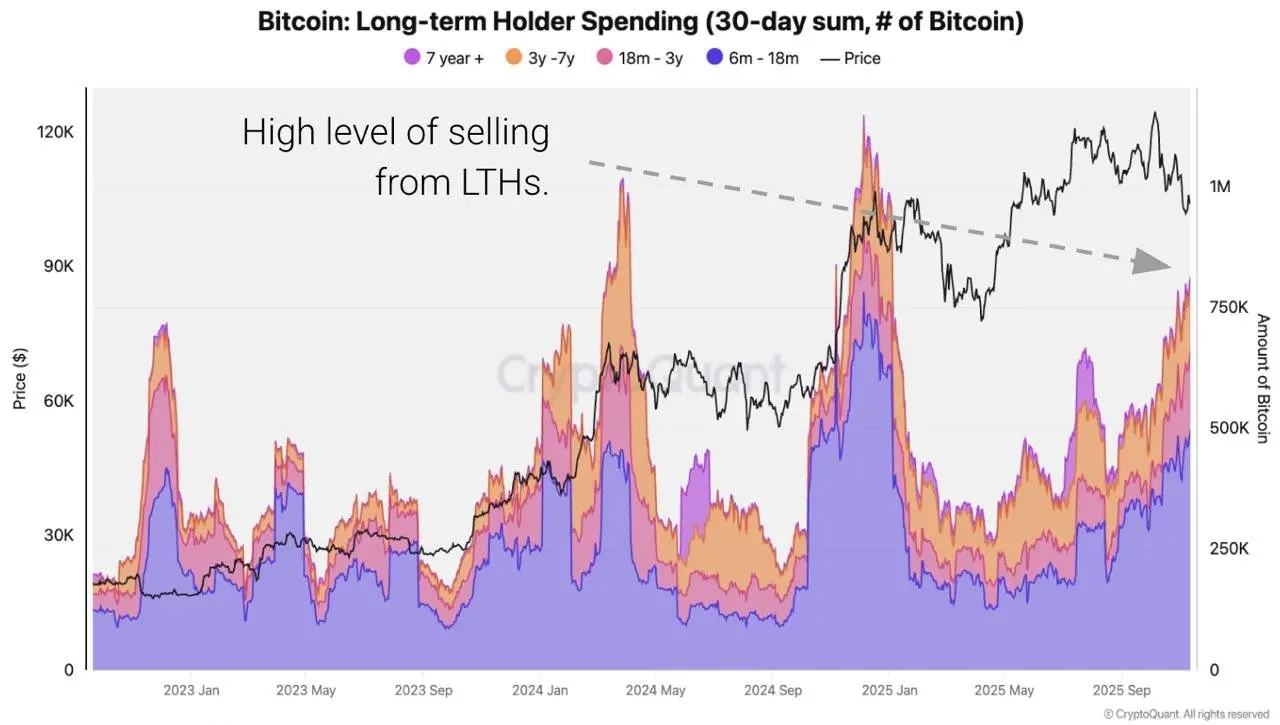
Furthermore, long-term holders across all age groups are simultaneously selling Bitcoin. Research by analysts including Will Clemente, co-founder of Reflexivity Research, shows that the selling pressure is not concentrated in a specific group, but is widely distributed among holders of 6 months, 18 months, 3 years, and even 7 years. This phenomenon is extremely rare. Fidelity has also confirmed that many long-term holders in the United States are taking profits before the end of the year to complete their investment portfolio adjustments for the year.
The lack of data during the government shutdown may reduce the probability of a Federal Reserve rate cut.
From a macroeconomic policy perspective, although the nearly two-month-long government shutdown has ended, the market is concerned that the lack of key data due to the shutdown may strengthen the US government's case for maintaining interest rates.
White House Press Secretary Karoline Leavitt revealed on Wednesday that some October economic reports may not be released. National Economic Council Representative Kevin Hassett also confirmed to Fox News that the government will not release October unemployment data because "no household surveys were conducted in October, so we'll only have half the jobs report." According to CME Group's FedWatch tool, traders are currently pricing in a 51% probability of a Fed rate cut in December, down from 69% a week ago.
In addition, the US government shutdown severely impacted market liquidity. The federal government's halt in spending resulted in a rare fiscal surplus, effectively withdrawing billions of dollars from the market. Under the dual pressure of tightening market liquidity and profit-taking by long-term holders, traders' expectations for a December rate cut by the Federal Reserve cooled significantly. According to CME Group's FedWatch tool, the current pricing in a rate cut is 51%, down from 69% a week ago.
This decline is mainly attributed to three factors: market concerns about the Federal Reserve's next move, tightening market liquidity, and profit-taking by long-term holders.
Additionally, the Nasdaq tech index plunged 2.3% on Thursday, with crypto-related stocks falling 10-20%. Palantir CEO Alex Karp expressed concerns about the profitability of AI in an interview at Yahoo Finance's Invest event, stating that not every AI application can "create enough value to justify the actual cost." This further fueled market concerns that the US economy might be entering a period of weakness, with Palantir (PLTR), Intel (INTC), and CoreWave (CRWV) all seeing their share prices fall by 6% or more in a single day.
Finally, Cointelegraph points out that this selling pressure does not necessarily indicate that large Bitcoin holders are cashing out. Crypto analyst PlanB also believes that the current long-term selling pressure mainly comes from holders who entered the market between 2017 and 2022. Market data shows that traders are not particularly bearish on Bitcoin itself, nor has any specific major event triggered panic; this decline reflects more the uncertainty of the overall economic environment.