01 Two-city chess game: 16 trillion yuan cake and misaligned competition
When Boston Consulting Group predicted that global tokenized assets would reach $16 trillion by 2030, the two major financial centers in Asia had already taken completely different RWA (real world asset tokenization) paths:
1. Physical anchor point in Hong Kong: 9,000 charging piles under Longxin Technology issued income rights certificates through Ant Chain, and the financing cost of small and medium-sized operators dropped from an annualized 15% to 6.8%
2. Singapore’s financial genes: BlackRock BUIDL Fund issues tokenized bonds on Ethereum, 75 wealthy people hold 93% of the shares, with a minimum subscription threshold of US$5 million
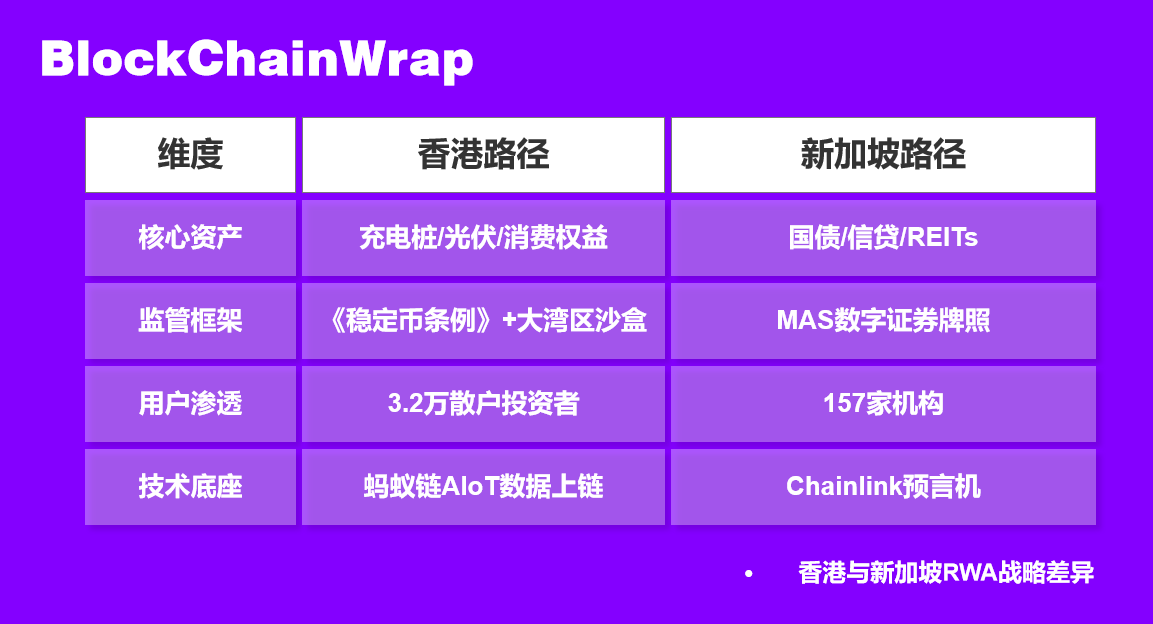
The essence of this competition is the battle for the right to speak in finance. In 2024, Singapore's wealth management scale surged by 42%, attracting Goldman Sachs and Citi to set up RWA centers; Hong Kong launched a combination of measures: the Stablecoin Ordinance, which came into effect on August 1, allows commercial paper reserves, and Web3 concept stocks such as Boyaa Interactive surged 7% in a single day.
02 Charging Pile Revolution: Ant Chain’s Offensive and Defensive Battle for Physical Assets
Longxin Technology's charging pile asset securitization has opened a new chapter in RWA empowering the real economy. Ant Chain's blockchain technology adds a "financial brain" to each charging pile: current data is uploaded to the chain in real time, power generation revenue is distributed by the second, and investors can trade revenue rights at any time through digital wallets.
Hitting the pain points of the industry: 85% of China's public charging piles are operated by private enterprises, of which 82% of operators have less than 10 charging stations. Traditional financial institutions refuse to lend due to scattered assets and high assessment costs. Ant Chain's "AIoT+Blockchain" solution will reduce due diligence costs by 90%.
"We issue a digital ID card to each charging station." Ant Chain engineers revealed the key technology:
l Dynamic confirmation of ownership: Identify equipment status through current fluctuations and automatically freeze assets if downtime exceeds 48 hours
l Revenue penetration: Charging fees go directly to the on-chain account to avoid misappropriation of funds by operators
Risk classification: The annualized return of piles in the city center is 12%, and in remote areas it is 19%.
The first batch of 9,000 charging piles on the blockchain raised 100 million yuan in financing, and the financing cycle of small and medium-sized operators was shortened from 3 months to 72 hours. A Zhejiang operator said with emotion: "In the past, I could only get a loan of 500,000 yuan by mortgaging my property, but now I can get 1.2 million yuan with 6 charging piles."
03 Regulatory secret war: Sandbox showdown and compliance blitzkrieg
While the Hong Kong Monetary Authority was testing bond tokenization, the Monetary Authority of Singapore suddenly tightened the approval of digital securities licenses - this regulatory game has escalated from a policy competition to a technological war.
Hong Kong's blitzkrieg tactics:
- The “regulatory sandbox green channel” was opened to Alibaba Group, and the Langxin project took only 27 days from application to approval.
- Commercial paper is allowed to be used as stable currency reserves, and Ant Xinneng photovoltaic power station tokens are approved for issuance
Singapore’s countermeasures:
- Require RWA projects to embed a real-time audit system, and reserve proofs on the chain must be updated every hour
- A 35% penalty tax is imposed on projects that do not open source contracts, targeting ZKsync’s $2.2 billion “shadow bank”
The deeper competition lies in the legal framework: Hong Kong, relying on the judicial cooperation in the Greater Bay Area, allows mainland courts to directly retrieve evidence stored on the chain; Singapore has introduced variable smart contracts, which can automatically freeze assets when encountering sanctions. When the EU MiCA regulations require RWA projects to submit compliance reports every day, the legal conflict between the East and the West broke out on the chain ahead of time.
04 Ant Matrix: Alibaba RWA Ecosystem Closed Loop
Behind Ant Chain, Alibaba has built a "parent-child matrix" covering the entire cycle of physical assets:
lLongxin Group (holding 10.75%): charging pile income rights tokenization hub
l Jida Zhengyuan (holding 10.48%): Providing quantum encryption for government data on-chain
l Xinkaipu (holding 30%): Campus card system imports 210 million student consumption data assets
l Junzheng Group (holding 15.6% of Tianhong Fund): Opening up the capital channel for 800 million Alipay users
This closed loop is swallowing up more physical scenes:
l GCL Energy converts photovoltaic panel power generation into dynamic income certificates
l Yuanlong Yatu promotes the copyright splitting transaction of the Winter Olympics "Bing Dwen Dwen" IP chain
l Shibei Hi-Tech tries to turn Shanghai's 20 million population data into compliant assets
"Ant's ambition is to put China's real economy into the blockchain." A director of an investment bank pointed to the curve on the screen - after the Alibaba RWA project was launched, the stock prices of related companies outperformed the Hang Seng Index by an average of 31 percentage points.
05 Final Game: A 16 Trillion Market under the Collision of Two Civilizations
When Citi predicted that the scale of tokenized securities would reach 5 trillion US dollars in 2030, the war between Hong Kong and Singapore had gone beyond the competition for financial centers and evolved into the ultimate collision between the digitization of physical assets and the on-chainization of traditional finance.
Singapore’s fatal temptation:
- BlackRock BUIDL Fund has an annualized return of 5.3%, but 75 wealthy people account for 93% of the shares
- Maple Finance's credit pool yields 10%, with Vietnam's real estate bubble loans as the underlying
Hong Kong’s breaking point:
- Charging pile tokens attracted 32,000 retail investors, with an average investment of only 3,100 yuan per person
- Relying on the Guangdong-Hong Kong-Macao Greater Bay Area, transforming manufacturing capacity into RWA targets
The more far-reaching impact is at the level of monetary sovereignty: Hong Kong allows RWA to be pegged to the RMB, and Singapore sticks to the US dollar standard. When Trump signed the GENIUS Act requiring stablecoins to be 100% anchored to US debt, the Eastern camp is using charging piles, photovoltaic panels, and liquor delivery rights to build a de-dollarized value network.
On June 15, 2025, the Monetary Authority of Singapore announced the approval of the entry of the first Chinese RWA fund. On the same day, a new slogan was lit up on the giant screen of Hong Kong's Central Exchange Square: "What is on the chain here is not numbers, but the productivity of 1.4 billion people."