Author: Dyme
Compiled by: Deep Tide TechFlow
Currently, the crypto market appears to be undergoing a significant "rules-of-the-road" shift. The previous market frenzy was exciting, but the reality is that the real challenges are just beginning.
wait.
All signs point to Bitcoin being in "safe-haven" mode, and echoes of 2021 are resurfacing: Bitcoin surged ahead of the stock market's peak, while the stock market's performance over the past few months has been lackluster.
As of this writing, Bitcoin's price has fallen approximately 30% from its all-time high. We reached our anticipated market high in early October. Some people successfully sold or took profits above $100,000 (well done!), but now, the inevitable question remains: "What's next?"
Unlike in April of this year, I am not in a hurry to set up a long-term position (although I currently hold a long position with a target of $95,000 to $100,000).
I know many readers use Bitcoin as their core asset and may also dabble in some altcoin trading. You might be wondering, "Where is the bottom?" or "When to buy?"
The correct answer is that no one can be completely certain. However, there are many strategies that can help you maximize your returns while ensuring you don't miss the next market move. My goal is to provide you with insights to help you form your own market judgment and understand when market rules might shift again. I am a "left-brained" trader and don't delve into complex data like order books.
I'm a "market sentiment" expert and a data simplification advocate. Here's what I've learned:
First, the core assumption of this article is that Bitcoin will reach a new all-time high and that the market cycle remains valid. Based on all current information and market reactions, we should consider this as the basis for our view.
This article also acknowledges that Bitcoin is an excellent savings technique for patient investors, but a "wealth-destroying" tool for those who lack patience or over-leverage.
This article will focus on Bitcoin because, frankly, over the past 36 months, aside from Solana and a few short-lived hype, 90% of your altcoins have performed virtually nothing. We have another one to two years to wait for a new altcoin narrative to emerge, at which point you can choose whether to bet on these opportunities.
Next, we will explore the following aspects:
- Investment Strategy
- Periodic expectations and time nodes
- Where funds are held during the waiting period
- Key indicators of market bottom
Investment Strategy
When I say "strategy," I mean your attitude and approach to buying, selling, and holding. There are multiple ways to enter and exit this market, and the final choice is yours.
Your strategy ultimately boils down to one question: "Are you confident in accurately timing the market?" and able to execute your market judgments? If not, what other viable options are there?
Currently, there are several time-tested methods for investing in Bitcoin, among which HODLing (long-term holding) is the most popular.
HODLing is one of the earliest investment tenets in the Bitcoin community. If you are confident in Bitcoin's long-term prospects and your daily monetary needs are already met, this strategy may be very attractive to you.
In addition, HODLing is a highly tax-efficient investment method because you don't have to pay taxes as long as you don't sell the investment.
Some investors can withstand the pain of an 80% drawdown in their portfolio and tactically add to their positions every time the market declines. If your fiat currency needs are met and you can stick with this approach for many years, it can almost certainly lead to intergenerational wealth accumulation over a sufficiently long period.
This strategy is particularly suitable for those who want to grow their wealth over time and gradually increase their Bitcoin holdings. Of course, this method demands a great deal of patience; some people can do it, while others cannot. But if you are patient enough, it is indeed feasible.
HODLing was my starting point when I entered this field, but obviously, my strategy has changed over time.
Dollar-cost averaging (DCA) aligns well with the HODL (Hold for the Long Term) mindset, but it's not limited to it. Some people buy Bitcoin every day, regardless of price; others choose to buy weekly, monthly, or during market fluctuations.
The goal of dollar-cost averaging
- Continue to increase your Bitcoin holdings while minimizing upward pressure on your average cost.
- If you bought in at a high price, you can also reduce your holding cost through dollar-cost averaging.
For example, I bought Bitcoin at its peak in 2013 and then dollar-cost averaging until the price dropped to $200. Ultimately, this strategy proved successful.
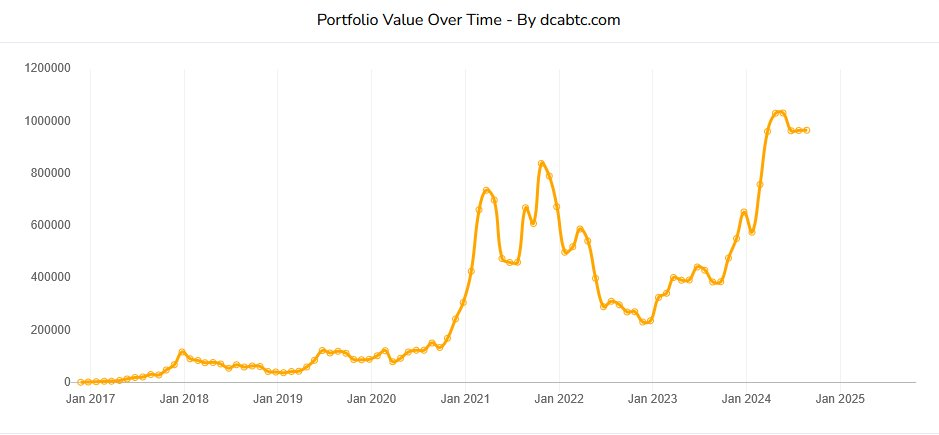
Chart: Investing $1,000 per month will reach a peak of $1 million after 9 years.
The chart above illustrates a typical example of dollar-cost averaging (DCA). While the result is clearly based on hindsight, it clearly demonstrates that investors who consistently purchased Bitcoin regularly still achieved wealth growth despite this month's market correction, and paid no taxes whatsoever.
If you have a good understanding of the market, adjusting your dollar-cost averaging strategy at the right time can significantly amplify your unrealized fiat currency gains.
Of course, you don't need to be completely mechanical when it comes to investing; you have many more options these days. But for investors who want to "set up and forget about it," there are some simple tools that can help achieve that goal.
Platforms like Coinbase, Cash App, and Strike offer automatic purchase options, which you can turn on or off as needed. However, these services each have different trade-offs, fees, and limitations, so thorough research is recommended before setting them up. In particular, transaction fees can accumulate into a significant expense if you run automatic purchases for months or even years.
You can set up a low-frequency, small-scale plan, or a large-scale, aggressive plan with a short execution time. If you are good at judging market timing and believe that the bottom is about to arrive, but do not know the specific time, I would prefer to choose the latter.
You can also skip third-party platforms and manually invest. Place orders through your preferred exchange when you believe Bitcoin is "discounted," or even set up tiered buy orders based on your own market analysis and technical indicators. It's entirely up to your personal preference.
Whether it's automated or manual operation, as long as a certain consistency is maintained, the final result is the same.
The core idea behind Dollar-Cost Averaging (DCA) is that "time in the market" is better than "trying to time the market precisely," and data usually supports this view.
Whether you choose to hold long-term (HODL) or dollar-cost averaging (DCA), you can flexibly adjust the size of your investment based on your financial situation. The market may fall deeper or bottom out faster than expected, so finding the right balance for you is crucial.
Not everyone can be completely categorized into the HODL or DCA framework. Many investors prefer a hybrid strategy that falls somewhere in between:
- You don't try to time the market perfectly, but you also don't buy blindly.
- Your buying decisions are based on liquidity conditions, a surge in volatility, or a complete collapse in market sentiment.
This approach is an effective strategy that often transcends either extreme approach because it respects both patience and opportunity. It can be viewed as a rule-based accumulation rather than simple blind guessing.
Another rarely discussed aspect is the choice between buying in one go and entering the market in batches.
From a purely expected return perspective, in a market with a long-term upward trend, a one-time purchase often yields better returns. However, most people cannot withstand the emotional impact of a one-time "all-in" bet.
Entering the market in stages can reduce regret and make it easier to stick to the investment process. If you have a considerable amount of cash on hand, using a portion of it for the initial purchase and gradually investing the remaining funds in stages is a more realistic option for ordinary investors.
You need to take your liquidity discipline seriously. One of the biggest reasons for forced selling is that people confuse their daily operating funds, emergency savings, and Bitcoin investments, putting them in the same "mental account."
When life inevitably throws unexpected financial curveballs your way, Bitcoin can become an "ATM" you never imagined. To avoid this, diversify your cash holdings for different purposes so you don't have to sell assets in vulnerable or desperate moments. This in itself is a competitive advantage.
In addition, your investment strategy needs to have a certain sense of proportion. People aren't "liquidated" because Bitcoin is falling, but because they:
- The position was increased emotionally;
- Turn to altcoins (Alts) for short-term gains;
- Using leverage to try to "make up for lost money".
The harshest punishment in a bear market often targets overconfident investors. Maintain a rational portfolio, be wary of narratives that "sound too good to be true," and always stay grounded.
Bitcoin Cycles and Timing: Will Cycles Get Shorter?
I've talked about Bitcoin's "cyclicality" many times, but what's slightly worrying now is that everyone seems to know all about these cycles. So, will this cycle be shorter? I don't know.
A simple explanation for those unfamiliar with it:
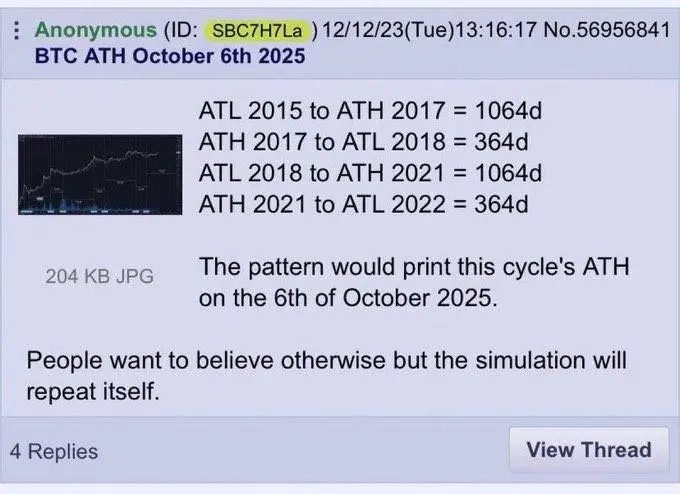
Bitcoin, for better or for worse, is a time-based cyclical asset whose price fluctuations are closely related to halving cycles.
So far, Bitcoin's price movements have continued to follow these cyclical patterns. As mentioned before, we should assume for now that this regularity will continue. If the cycles continue to work, then we may see a macro bottom in early Q4 2026.
However, this doesn't mean you should wait until the first day of the fourth quarter of 2026 to start buying; rather, it provides a reference point indicating that it might be too early now. Of course, the cycle may have already ended, and the bottom might have come as early as this summer, at which point other technical analysis (TA) and signals would need to be reconsidered.
In general, I don't believe Bitcoin will return to a long-term bull market before the end of 2026 or 2027. Of course, I'm happy to see it happen if I'm wrong.
Where should funds be invested while waiting for market opportunities?
As interest rates continue to fall, "safe but boring" returns are becoming less attractive. However, we still have a few months to enjoy yields above 3% before Federal Reserve Chairman Jerome Powell takes action. Here are some options to consider for those who have already withdrawn some funds from the market and are waiting for the right opportunity. Be sure to research these options yourself.
SGOV and WEEK offer the simplest monthly and weekly dividend options, holding uninteresting but stable government bonds.
Other options include ultra-short-term Treasury ETFs, such as SHV and pure short-term Treasury funds, or longer-term bond ETFs, such as ICSH or ULST. SHV offers almost the same exposure as SGOV because it holds very short-term Treasury bonds, behaving like a cash alternative, but with a small yield boost.
WEEK falls into the same category, but is structured with weekly payouts, making it suitable for investors who need more frequent cash flow. However, the trade-off is that weekly payouts may fluctuate with interest rate changes.
If you are familiar with on-chain operations, although DeFi yields have declined, there are still some options available:
AAVE
- Currently, AAVE offers a yield of approximately 3.2% against USDT.
Kamino
- Kamino offers a higher-risk but higher-return option, with returns typically exceeding the "risk-free" rate, but also accompanied by additional risk factors.
It's important to note that while these on-chain platforms are options, they are not suitable for all-in investment. If you choose the DeFi path, it's recommended to diversify your investments to reduce risk.
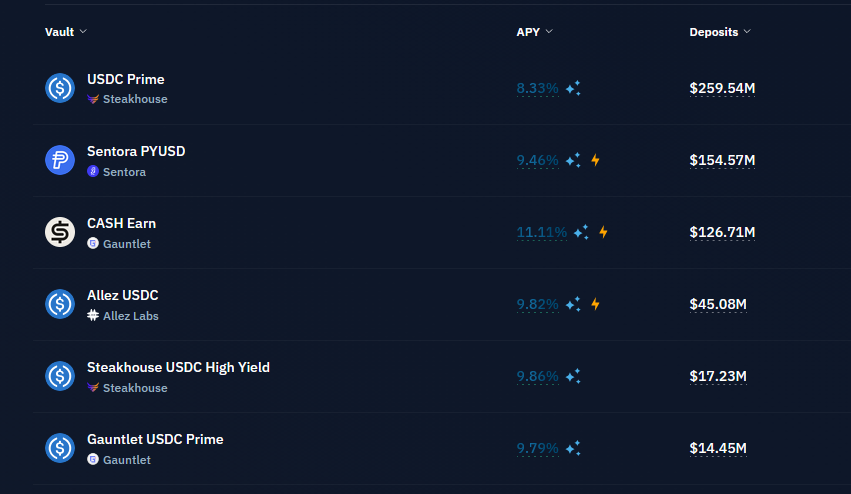
Chart: Higher returns come with higher risks.
Many exchanges (such as Coinbase) offer rewards for parking USDC on their platforms. Robinhood also offers a 3%-4% yield if you have a Gold membership.
In an economic downturn, you don't need to overthink things; the goal is very clear: protect your purchasing power while fighting inflation.
How to determine the market bottom?
Suppose it's nine months from now, and the market has experienced multiple adverse factors, perhaps Bitcoin's price has approached $50,000. In this scenario, how do we determine if it's nearing its bottom?
It's important to note that market bottoms are never determined by a single signal. Using the following indicators to create a multi-faceted investment logic (THESIS WITH CONFLUENCE) can help you enter the market with more confidence and wait for returns.
1. Time
How long has it been since the all-time high (ATH)? If it's been more than 9 months, it might be time to start considering buying.
2. Kinetic energy (Momentum)
Bitcoin typically peaks when momentum runs out and vice versa. Buying Bitcoin when the weekly RSI (Relative Strength Index) is below 40 is often a good strategy.
Broaden your perspective and combine it with your commonly used momentum indicator scripts to find an analysis method that suits you.
3. Market Sentiment
Cycles are often accompanied by certain catastrophic events that trigger extremely unsettling market sentiment. Examples include the FTX crash, the COVID-19 pandemic, and the Terra Luna incident.
When the market is shrouded in darkness and no one is willing to buy Bitcoin, that is your opportunity to act boldly, especially when you can get resonance from multiple signal sources.
For example, at the bottom of the last cycle, we saw some unknown online influencer promoting a mattress. If you bought Bitcoin then, you should be very happy now.
4. It's not necessary to buy at the bottom.
You don't need to be fixated on buying at the market's lowest point. If you want to be more conservative, you can wait for Bitcoin to climb back above the 50-week exponential moving average (50W EMA) or the 365-day volume-weighted average (VWAP), which are good confirmation signals.
5. Bitcoin's risk appetite indicator (Beta)
If Bitcoin-related stocks like MSTR (MicroStrategy) regain their 200-day simple moving average (SMA), it could signal a return of market interest in Bitcoin and a premium for the stock.
My goal is to help some people lock in profits at market peaks, and hopefully this article can help you prepare for the future.
Disclaimer: This article is for informational and educational purposes only and does not constitute any financial, investment, or legal advice. Always conduct your own research and consult with a licensed professional before making any financial decisions. Markets are risky; invest with caution. Remember, "There are no tears in the casino."