Everyone is (over)using AI. From students writing homework in ChatGPT, startups rushing to release the next hit AI agent, to companies using AI to make reports instead of PPT - we are living in an era where artificial intelligence is not just a tool, it has become a habit, an instinct, and even a way of life.
The Age of Overuse: AI is Everywhere
AI is no longer limited to certain scenarios. It has become pervasive—perhaps even a little too pervasive. Here are some examples of how AI has become deeply embedded in our daily lives:
Students and educators: AI writes essays, grades assignments, and develops teaching plans, sometimes even starting work earlier than teachers.
Startups and creators: AI builds websites, writes prototypes, creates business plans, and even generates investor videos.
Companies and teams: Human resources use AI to screen resumes, marketing departments use AI to write copy and run A/B tests, and sales staff use AI to summarize call content, suggest follow-up actions, and automatically fill in CRM.
Consumers and ordinary users: AI recommends music for you to listen to, helps you write emails, edit photos, and match clothes. Soon, it may also help you order groceries and negotiate rent.
In this environment, a person may interact with AI more times a day than with real humans.
The future of humans and AI
What will the future look like?
If the current trend continues, AI will become more than just an “assistant”, it will become a “predictor”. Before you even open your mouth, it’s already giving advice, influencing your decisions, and unknowingly integrating with your thoughts.
But here comes the question: In a future where AI is everywhere, the real key is not “who uses it best”, but rather – who is feeding the AI?
Behind every "intelligent" AI, there is more "intelligent" data. AI does not think for itself, it learns from humans. And the more models humans develop, the more data is needed - and it must be real, rich, authorized, and labeled.
This paved the way for a completely new kind of labor market.
What will be the most popular profession in the future?
In the next few decades, data contributors may replace coders and become the most valuable profession.
CZ seems to have foreseen this:
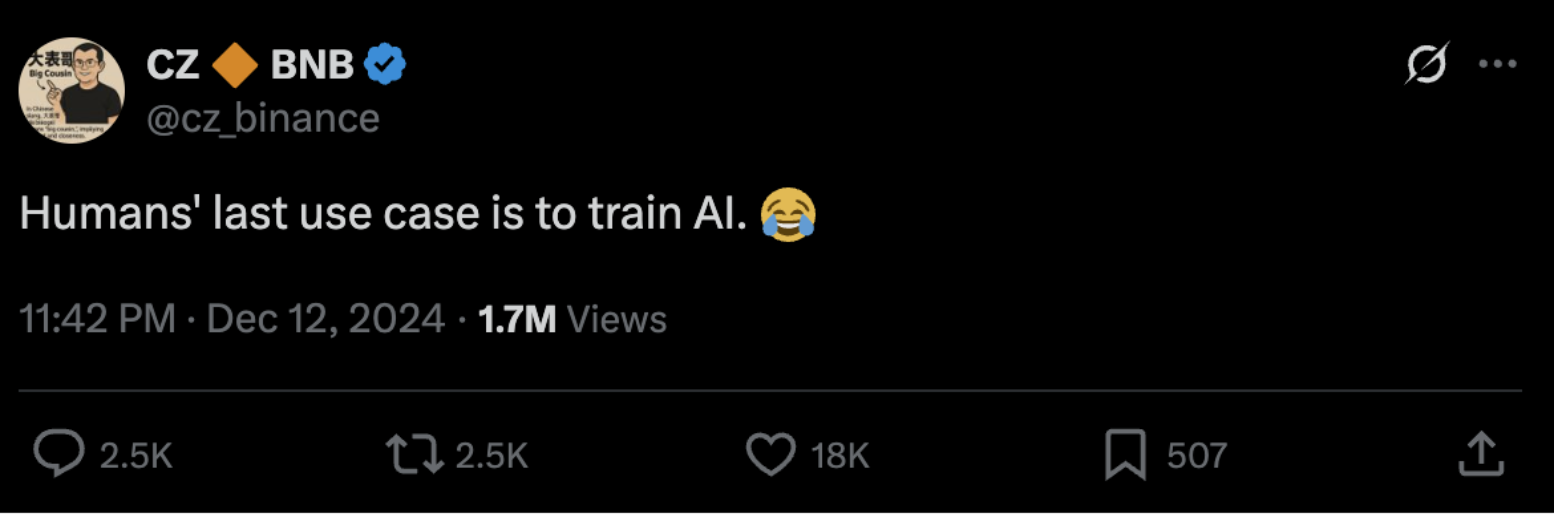
(“The final application scenario for humans is to train AI”)
https://x.com/cz_binance/status/1867233451226911060?lang=en
Just think about it: every AI model, from self-driving cars to virtual therapists, relies on real-world data points. Not junk data from the internet, but data proactively provided by humans, carefully curated, and with clear context.
These tasks can be envisaged:
Driving instructor trains AI to handle extreme traffic conditions
Local narrators help AI learn dialects and cultural context
Health data volunteers contribute anonymous sensor data to train diagnostic models
Creative testers guide and correct AI in specific industries (fashion, finance, etc.)
These jobs won’t be marginal roles. As AI becomes part of social infrastructure — powering our cities, hospitals, transportation, and digital spaces — the people who train it will be as important as the people who develop it.
More importantly, this will no longer be the kind of data labor that was exploited behind the scenes in the past. With the right tools, especially the support of decentralized platforms, data contributors can be paid transparently and own the value of the data they create.
Therefore, the core of the next wave of AI revolution may not be who uses AI best, but who provides the most meaningful, real and diverse data for AI.