
Author: arndxt
Compiled by: Tim, PANews
When the Federal Reserve deliberately extends the maturity of its holdings of Treasury bonds to suppress long-term yields (the so-called Operation Twist and QE2, QE3), it foreshadows an economic downturn and quantitative easing occurring simultaneously.
Powell's analogy of "driving in the fog" applies not only to the Federal Reserve but also to the global economy today. Policymakers, businesses, and investors are all navigating through a fog with zero visibility, struggling to move forward by relying on liquidity reflexes and short-term profit-driven motives.
The new policy framework is characterized by limited visibility, fragile confidence, and liquidity-driven distortions.
1. The Federal Reserve's hawkish rate cut
This "risk management" move of lowering the interest rate range by 25 basis points to 3.75%-4.00% is less a sign of easing policies and more a way to reserve options for the future.
Amid the opposing views of the two members, Powell effectively sent a clear signal to the market: the pace of policy slowed and policy visibility had completely disappeared.
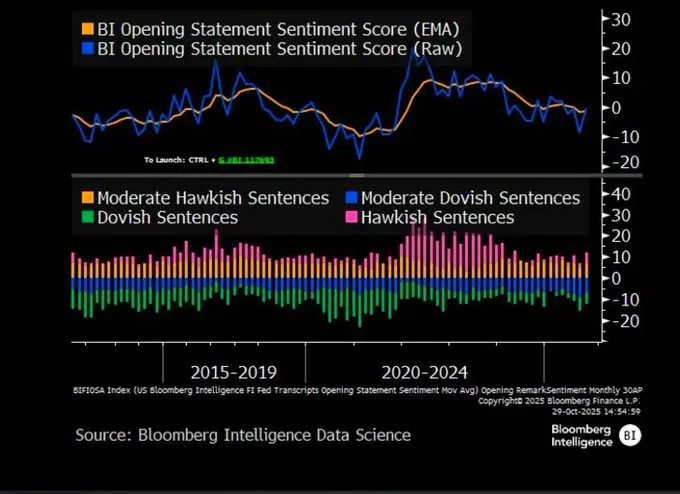
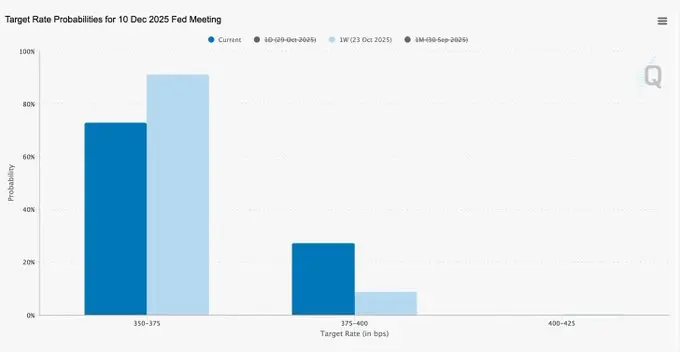
The economic data disruption caused by the government shutdown put the Federal Reserve in a precarious position, and Powell's message to traders was clear: there was no guarantee of a rate cut in December. As the market gradually digested the shift in policy stance from "data-dependent" to "prudent in a data vacuum," the probability of a rate cut dropped sharply, and the front-end yield curve flattened.
2. Liquidity Game in 2025
The central bank's repeated bailouts have normalized speculative behavior. Liquidity, rather than productivity, is now determining asset performance, a dynamic that, while pushing up valuations, is accompanied by weak credit in the real economy.
The discussion extends to a sobering understanding of the current financial architecture: the centralization of passive investing, algorithmic reflexivity, and retail options frenzy.
Passive cash flows and quantitative trading dominate liquidity; volatility is now determined by positions rather than fundamentals.
Retail investors' buying of call options has caused artificial price fluctuations in the "Meme" sector, while institutional funds are concentrated in leading stocks with an increasingly narrow scope.
The show's host called it the "Financial Hunger Games": a system in which structural inequalities and policy reflexivity are forcing retail investors to turn to speculative survival strategies.
3. 2026 Outlook: Capital Expenditure Boom and Risks
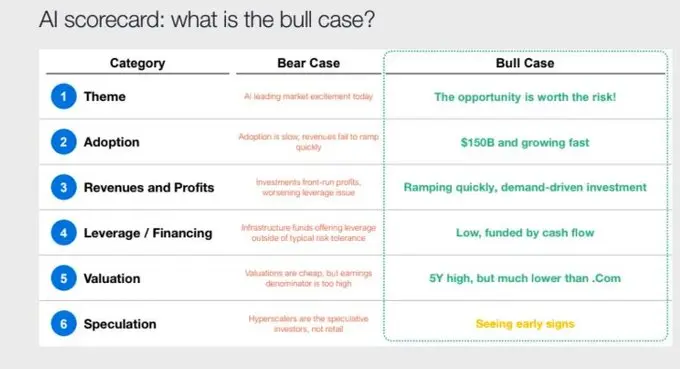
The surge in AI capital expenditures reflects the industrial transformation at the end of the tech giants' cycle: currently supported by liquidity, but in the future constrained by leverage sensitivity.
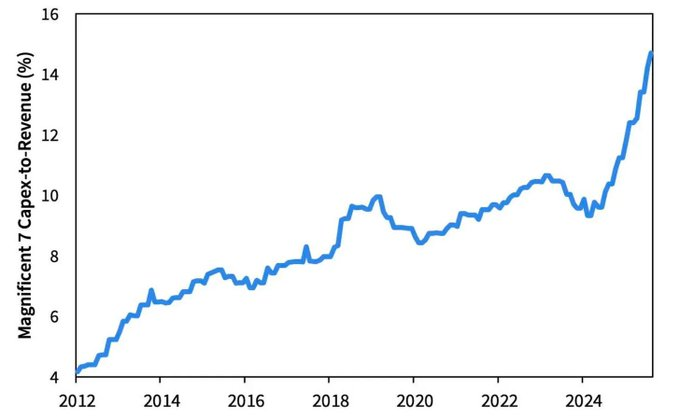
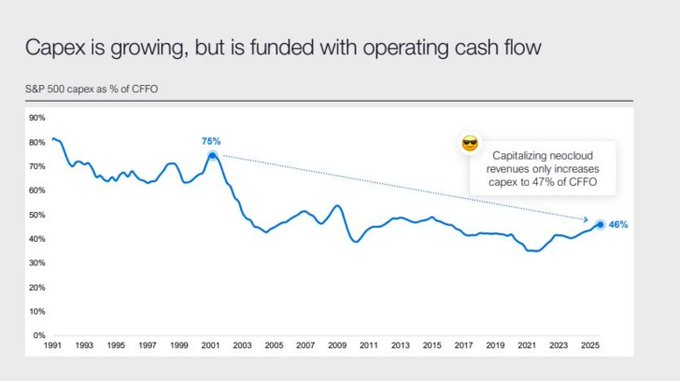
While corporate profits remain impressive, a historic transformation is underway at the underlying level: tech giants are shifting from asset-light cash cows to asset-heavy infrastructure operators.
Artificial intelligence and data center construction initially relied on cash flow support, but now they are turning to record debt issuance (such as Meta's $25 billion oversubscribed bonds).
This transformation means compressed profit margins, increased depreciation expenses, and ultimately, refinancing pressures, setting the stage for a shift in the next credit cycle.
4. Economic Structure Review: Trust, Inequality, and Policy Cycles
From Powell's cautious tone to his reflections after the last podcast episode, a common theme gradually becomes clear: the concentration of power and the erosion of trust.
Continued policy bailouts for large institutions have exacerbated wealth concentration and eroded market integrity. The coordinated actions of the Federal Reserve and the Treasury, shifting from quantitative tightening to Treasury bill purchases, have further reinforced this trend, resulting in persistently abundant liquidity at the top, while ordinary households struggle to survive under the dual pressures of stagnant wages and rising leverage.
The decisive macroeconomic risk now is no longer inflation, but systemic fatigue. Markets appear to be booming, but trust in fairness and transparency is eroding, which is the real systemic problem of the 2020s.