

There have been some new developments in the recent judicial disposal of virtual currencies involved in cases (hereinafter referred to as "judicial disposal"). In particular, after the Beijing Municipal Public Security Bureau's Rule of Law Team officially announced a new model (see Lawyer Liu's previous article: " What is the "new channel" for the disposal of virtual currencies involved in cases by the Beijing Municipal Public Security Bureau? Is it now open for disposal? "), Lawyer Liu has received inquiries from domestic judicial organs and disposal companies. The core issue that everyone is concerned about is: What is the "Beijing Stock Exchange" model? Does domestic judicial disposal have to go through an intermediary institution like the Beijing Stock Exchange? There are also requests for Lawyer Liu to evaluate the future judicial disposal trends in mainland China, etc.
Today we will write this short article to analyze the above issues one by one.

1. Analysis of the “Beijing Stock Exchange” model
The full name of "BJEX" is Beijing Equity Exchange. According to its official website, its controlling shareholder is Beijing State-owned Assets Management Co., Ltd. The authorized qualifications of BJEX include "the national online judicial auction platform selected by the Supreme People's Court for courts at all levels, the platform for the disposal of property turned over to the state treasury involved in criminal proceedings selected by the Beijing Municipal Finance Bureau", etc. In the "Auction Announcement" column published on its official website, the focus is basically on the disposal of traditional property involved in the case, and there are no virtual currency disposal projects.
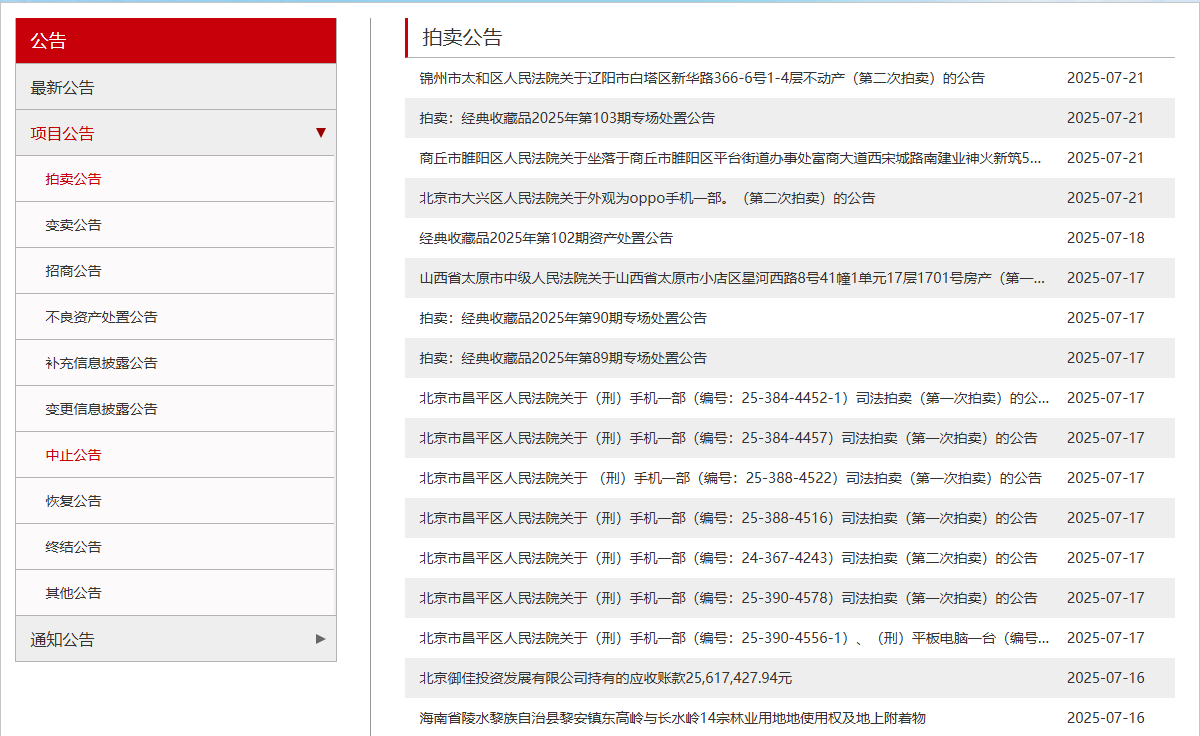
(Photo source: Beijing Stock Exchange official website)
In the field of judicial disposal of virtual currencies involved in the case, according to public information online, after the Beijing Stock Exchange and the Beijing Municipal Public Security Bureau signed a commissioned disposal agreement (that is, the "Framework Agreement on Cooperation in the Disposal of Virtual Currency Involved in the Case" mentioned on the official account of the Beijing Municipal Public Security Bureau's Law Enforcement Corps), the Beijing Stock Exchange transferred the entrustment to a domestic third-party disposal company (a lawyer's article mentioned that the specific disposal company is "Beijing Zhongtianfeng Security Protection Technology Co., Ltd."), and the third-party disposal company carried out disposal and realization, fund settlement and other work overseas.
It can be seen from this that the Beijing Stock Exchange model does not actually have any substantial innovation or breakthrough, and is still mainly based on the domestic + overseas joint disposal model in the "Disposal 3.0 era".
2. Does domestic judicial disposal have to go through an intermediary institution like the Beijing Stock Exchange?
So is there a need for an intermediary institution like the Beijing Stock Exchange to exist? In the opinion of Lawyer Liu, according to the current regulatory provisions on virtual currencies in my country, domestic third-party disposal companies already exist as a "temporary compromise" for judicial activities, and there is actually no need to introduce the "intermediary structure" of third-party disposal companies.
The main reason why there are different controversial views on the domestic judicial disposal of virtual currency cases is that according to the "9.24 Notice" (the "Notice on Further Preventing and Dealing with the Risks of Virtual Currency Trading Speculation" jointly issued by the "Two High Courts and One Ministry", the People's Bank of China, the State Administration of Foreign Exchange and other ten national ministries and commissions on September 15, 2021), there is such a provision:
Virtual currency-related business activities are illegal financial activities . Carrying out legal currency and virtual currency exchange business , virtual currency exchange business, buying and selling virtual currency as a central counterparty, suspected illegal issuance of token tickets, unauthorized public issuance of securities, illegal futures business, illegal fundraising and other illegal financial activities are strictly prohibited and resolutely banned in accordance with the law . Those who carry out related illegal financial activities that constitute a crime shall be held criminally liable in accordance with the law.
As you can see, there are no exceptions in this regulation, which means that no entity in mainland China (including judicial organs) may conduct virtual currency and legal currency exchange business. The disposal and realization of the virtual currency involved in the case inevitably directly involves the need to dispose of the virtual currency involved in the case and realize it into RMB.
Therefore, from 2018 to now, the disposal and realization of the virtual currency involved in the case has gone through the process of the public security organs directly looking for a third party to realize it domestically, and then the public security organs entrusting a third party to realize it overseas. The main purpose is to avoid the domestic entities in the "9.24 Notice" directly participating in the exchange business of virtual currency and legal currency.
Under the current "domestic + overseas joint disposal" model, at least at the business level, it does comply with the supervision of the "9.24 Notice" (although there are still different voices in practice, such as the view that the virtual currency involved in the case should not be liquidated, as long as it is liquidated, it violates the regulatory provisions of mainland China on virtual currency, and advocates that all the virtual currencies involved in the case should be destroyed in a black hole address); then when the introduction of an intermediary structure similar to the Beijing Stock Exchange does not actually optimize the current judicial disposal business model, the disposal process should be simplified as much as possible, and no unnecessary entities need to be added. That is, follow the principle of Occam's razor: do not add entities unless necessary.

3. How will the judicial disposal of virtual currencies involved in the case develop in the future?
Lawyer Liu has been traveling a lot recently. In the process of handling cases, he learned that judicial authorities in different parts of the country have different modes of handling virtual currencies involved in the case. So far, there is still the original mode of "Handling 1.0": that is, the mainland judicial authorities (mainly the public security organs) entrust domestic entities (individuals or companies) to directly cash out the virtual currencies involved in the case in the mainland. This primitive "handing over money on one hand and handing over coins on the other hand" not only violates the mandatory provisions of the "9.24 Notice" prohibiting the exchange of virtual currencies and legal currencies in the mainland; the greater risk is that the public security and judicial authorities have no control over the legality and compliance of the counterparty's funds, and can only rely on the reputation of the counterparty to guarantee it. At this time, once a sum of money involves stolen money (such as black and gray industries, electronic fraud funds, etc.), the public security organs themselves have objectively carried out money laundering activities; of course, in practice, some people also use this business to carry out illegal exchange, illegal foreign exchange trading and other illegal business activities other than money laundering activities. This primitive disposal model brings not only legal risks to the public security and judicial authorities, but also political risks and public opinion risks.
Even though there is a relatively compliant "Disposal 3.0" model, many judicial organs or disposal companies are not aware of it; or in the actual disposal business, the client considers many factors, and compliance may be only one of them. However, as a lawyer who has conducted in-depth research in the field of judicial disposal of virtual currencies involved in the case, Lawyer Liu believes that as long as it is a non-compliant disposal, it is equivalent to burying a time bomb in judicial activities. It may not explode in a short period of time, but it will be ignited sooner or later. For details, please refer to the criminal case involving the collapse of a disposal company in Zhejiang, which was known as the largest in the country in 2024.
Among the multiple research topics initiated by the Supreme Court in the first half of 2024, "judicial disposal of virtual currencies involved in the case" is also included, indicating that the Supreme Court has also paid attention to the complexity of the disposal of virtual currencies involved in the case and the urgent need for unification in judicial practice.
As for the future development direction of the judicial disposal of the virtual currency involved in the case, Lawyer Liu believes that there may be three options: First, on the premise that the "9.24 Notice" is not modified or abolished, continue to maintain the current disposal model (mainly the compliant "Disposal 3.0 Disposal" model, and sporadic non-compliant disposal will inevitably occur); second, modify the "9.24 Notice" to allow judicial organs to enter the market alone and dispose of and realize virtual currencies overseas; third, modify the "9.24 Notice" to establish a unified disposal platform in the country (central or provincial platforms, domestic disposal entities can be banks, traditional judicial auction platforms, such as JD.com, Alibaba, local property rights or data exchanges and other institutions) to provide disposal services for local judicial organs.


