

introduction
Recently, it was reported that a Zhejiang resident named Chen did not actively declare and pay taxes for profits from trading virtual currencies, and was pursued by the Zhejiang Provincial Taxation Bureau of the State Administration of Taxation (hereinafter referred to as the "Zhejiang Provincial Taxation Bureau") to collect a total of 127,200 yuan in personal income tax and late payment fees. On March 26, 2025, there was indeed a message on the official website of the Zhejiang Provincial Taxation Bureau. What is more interesting is that it says: "After the policy guidance of the tax authorities, the taxpayer actively cooperated to explain the situation..."
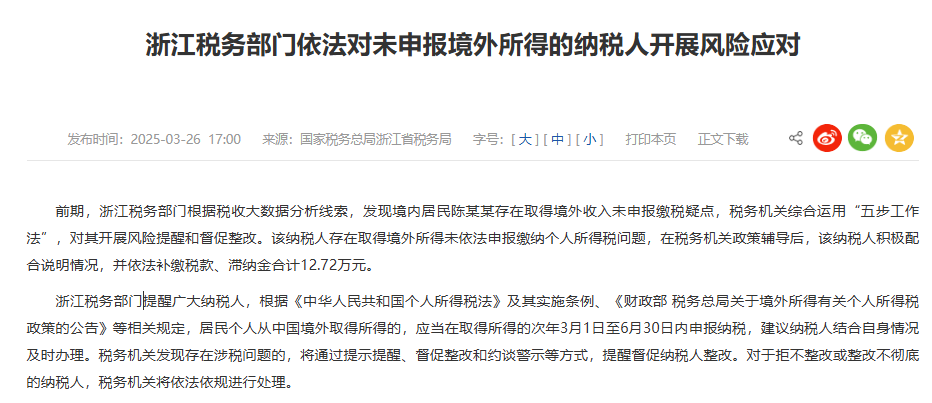
(Screenshot source: Zhejiang Provincial Taxation Bureau official website)
As a mainland lawyer who has been involved in the web3 field very early, Lawyer Liu really doesn't know what clear and practical policies there are in the country regarding the taxation of virtual currencies.
Of course, before we officially discuss whether mainland China can impose taxes on virtual currency transactions, we need to first confirm whether Chen Moumou in this announcement from the Zhejiang Provincial Taxation Bureau actually conducted virtual currency transactions. After all, the official website does not specify whether Chen Moumou conducted USDT or other virtual currency transactions.
1. Was Chen subject to tax because of his profits from trading virtual currencies?
According to Wu's tweet, the source of the news that Chen was taxed for profiting from trading virtual currencies was actually disclosed by a company called "Sanchifa Technology", and the author Zhang Qingqing is also the company's CEO. The article mentioned: "I paid capital gains tax in Singapore for trading virtual currencies, so why did the Chinese tax bureau ask me to pay the additional tax?"
Then the case of Chen was listed, and the original text described it as:
"Don't believe 'it's safe because you've paid taxes in Singapore'! China does not recognize the legality of virtual currencies, and overseas taxes cannot be deducted. Chen from Zhejiang made 636,000 yuan by speculating in USDT, but he paid 100,000 yuan in Singapore and still owed 127,200 yuan in taxes in China. The correct approach is to trade through a licensed exchange in Hong Kong, keep transaction records, and proactively declare 20% to avoid being identified as 'tax evasion' and receiving a fine."
In Lawyer Liu's opinion, this passage is still a bit out of touch with current currency-related practical operations, laws, and tax practices.
First of all, China strictly prohibits virtual currency speculation and currency-related business activities (qualified as illegal financial activities ), but China's regulatory policy on virtual currency has never said "not recognizing the legality of virtual currency", but only not recognizing the legal currency attributes of virtual currency. In the "Notice on Preventing Bitcoin Risks" on December 3, 2013 and the "Announcement on Preventing Virtual Currency Trading Speculation Risks" on May 18, 2021, Bitcoin and virtual currency were respectively qualified as "virtual commodities"; in current judicial practice, especially in criminal judicial practice, China's judicial organs fully recognize the property attributes of virtual currency (especially mainstream currencies), which are protected by China's criminal law.
Secondly, few people in the cryptocurrency circle speculate on USDT because USDT is a stable currency. Of course, there may be a small price difference between stable currencies such as USDT and USDC between different exchanges or other platforms, which may give some people arbitrage space, but it is difficult for ordinary people to profit from it, so I won’t go into details.
Finally, the "correct approach" provided by the author is extremely difficult for the general public. To put it simply, mainland residents cannot even open an account in a licensed exchange in Hong Kong, let alone trade on it.
Finally, let’s get back to the topic. Whether Chen Moumou made a profit from trading virtual currency and was subsequently pursued by the Zhejiang Provincial Taxation Bureau, there is currently no official and authoritative organization to explain, so we cannot be completely sure of the authenticity of this news.
2. Does our country’s law have any regulations on taxation of virtual currency transactions?
Even if Chen did pay additional taxes due to cryptocurrency speculation, according to the announcement of the Zhejiang Provincial Taxation Bureau, it was based on my country's "Personal Income Tax Law" and "Personal Income Tax Law Implementation Regulations", "Announcement on Personal Income Tax Policies Concerning Overseas Income" (Ministry of Finance, State Administration of Taxation) and other relevant regulations, which did not specify the imposition of taxes on virtual currency transactions.
On September 28, 2008, the State Administration of Taxation issued a reply to the Beijing Municipal Taxation Bureau: "Reply on the Collection of Individual Income Tax on Income Obtained by Individuals through Online Trading of Virtual Currency", which stated: "Income obtained by individuals who purchase virtual currency from players online and sell it to others after adding a markup is taxable income for individual income tax and should be calculated and paid under the ' property transfer income ' item."
However, everyone in the cryptocurrency circle must know that Bitcoin, the leading virtual currency in the current context, only officially mined the "Genesis Block" in January 2009. When the State Administration of Taxation issued this reply, Bitcoin had not yet been born. This reply is definitely to regulate centralized virtual currencies such as QQ coins. As for whether this reply can be extended to the current virtual currency field, this involves the issue of the legality of virtual currency transactions in mainland China.
 3. Is virtual currency trading legal in mainland China?
The main reason why some friends are very interested in the taxation of virtual currency transactions is that once the government officially imposes taxes on virtual currency transactions, does this prove that the government has officially recognized virtual currency transactions?
As we all know, according to the "9.24 Notice", the current virtual currency policy in mainland China is a strong regulatory attitude, prohibiting cryptocurrency speculation, virtual currency and legal currency exchange business, currency exchange business, buying and selling virtual currency as a central counterparty, etc., and prohibiting any virtual currency exchange from operating in mainland China. These activities or businesses are collectively referred to as "illegal financial activities" .
4. Can current tax authorities impose taxes on virtual currency investment transactions?
Similarly, according to the "9.24 Notice", mainland entities (legal persons, natural persons, and non-legal organizations) investing in virtual currencies and their derivatives are at their own risk and are not protected by Chinese law. In this case, it is certainly difficult for mainland tax authorities to form a self-consistent logic, legal, and regulatory policy for taxing cryptocurrency speculation.
However, in practice, it is not ruled out that some tax authorities, because they do not understand my country's current regulatory policies on virtual currencies, only see that mainland web3 nomads have made money by speculating in cryptocurrencies (referring to the money that is cashed out and transferred to their own mainland bank accounts; the tax authorities have no way of knowing the profits from the virtual currency investment simply by holding the currency), and then ask for the tax to be paid back; they have never seen these people being beaten by some mainland judicial authorities, having their cards frozen by exchanges, being prohibited from withdrawing money, or not being compensated after bankruptcy (FTX).
As for what to do if you encounter the situation of Chen at the beginning of the article in the past, present, or future, you can send a private message to Lawyer Liu, because this falls into the field of knowledge payment for lawyers (advertising for myself).


