
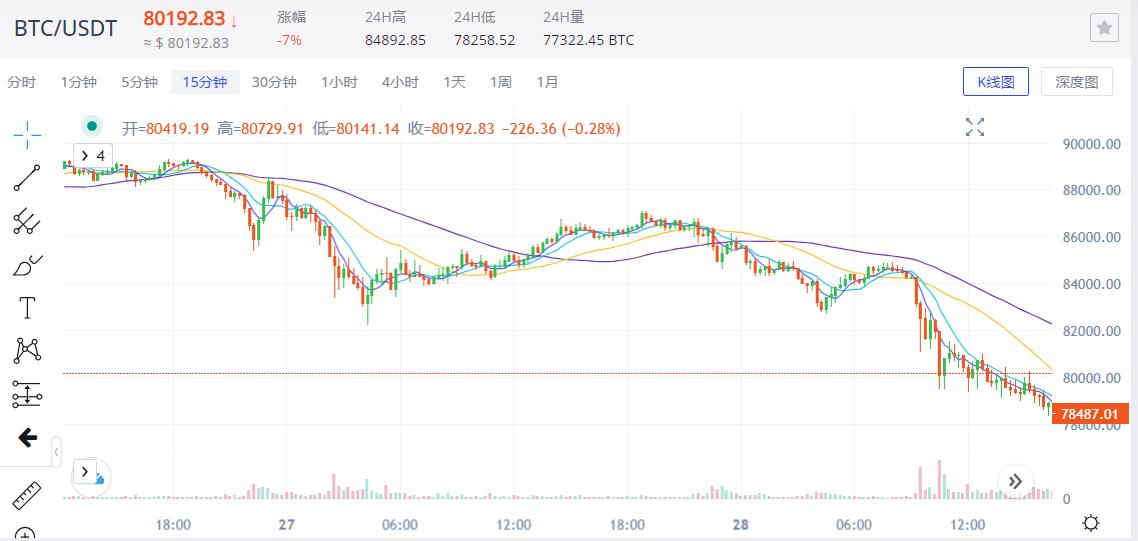
Since Bitcoin fell below the $90,000 mark on February 25, the crypto market has plummeted across the board. Today, Bitcoin fell below $79,000, hitting a new low since November 12, 2024; Ethereum also fell below $2,100, and the price returned to the level of November 2023. As market sentiment continues to be in a state of "extreme panic", despite the huge decline in Bitcoin and Ethereum, there is still no sign of stopping the decline, and the market is suffocating.
U.S. recession fears grow
The sharp market adjustment this time is directly related to the deterioration of the macro environment. As the US economy shows signs of weakening, recession concerns have returned again.
Data showed that U.S. consumer confidence fell sharply in February, the largest drop since August 2021. Consumers are reducing their spending on various items. Data released on Thursday showed that the U.S. existing home sales index fell 4.6% month-on-month in January, far exceeding expectations and hitting a record low. In addition, the retail giant Walmart's financial report predicts that its performance growth will slow significantly in fiscal 2026. As an important indicator of U.S. consumer spending, it has caused investors to worry about the consumption outlook.
At the same time, the pace of economic expansion in the United States slowed to near stagnation in February. This month, the US composite PMI hit a 17-month low, and "business activity is close to stagnation." Even more pessimistic data is that the huge service industry activity, which is crucial to the US economy, hit a new low since January 2023, entering the contraction range for the first time in more than two years.
In a reflection of recession fears, the 10-year Treasury yield fell below the 3-month Treasury yield, inverting the yield curve, a classic recession warning signal in past decades.
A series of weak macro data, coupled with Trump's confirmation that tariffs on Canada and Mexico will take effect as scheduled, and his threat to impose tariffs on the European Union and more countries, constitute the core logic for the sharp rise in expectations of "stagflation" in the US economy in recent days. Based on this, investors' risk appetite has rapidly decreased, US stocks have been sold off for many consecutive days, and popular star technology stocks have plunged from highs, with cumulative declines ranging from 10% to 35%. For example, Nvidia has fallen 14.18% this week, and Tesla, which is often regarded as a barometer of the "Trump deal", has fallen 20.18% this week, and has fallen nearly 40% since it peaked after Trump's election.
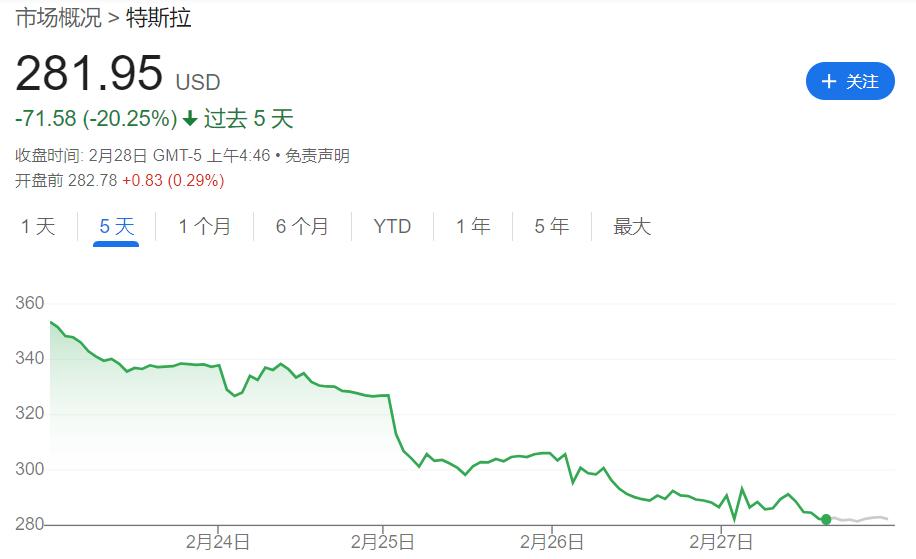
Due to the strong correlation between Bitcoin and technology stocks, Bitcoin has fallen sharply in tandem with the US stock market. In addition, the review process of US state-level Bitcoin-related bills has also begun to be blocked. The passage of the Bitcoin bill does not seem to be as smooth as the market imagined, which to some extent weakens the market's confidence in the Trump administration's "Crypto-friendliness" and the country's Bitcoin reserve commitment.
Funds continue to withdraw
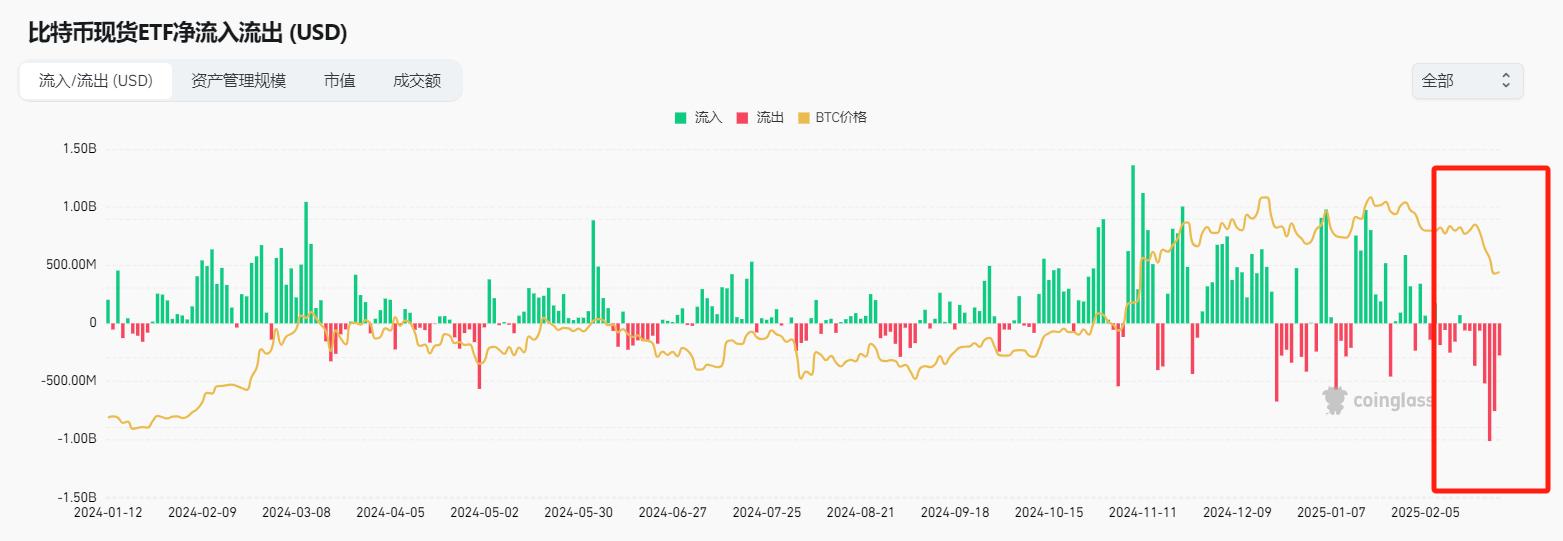
Since February this year, Bitcoin spot ETFs have experienced a serious "bleeding effect". As an important inflow channel for institutional funds, its capital flow data is also one of the key indicators affecting market confidence. However, throughout February, Bitcoin spot ETF funds were almost net outflows.
According to Coinglass data, the U.S. Bitcoin spot ETF experienced net outflows for eight consecutive days from February 18 to 27, Eastern Time. On February 25, the net outflow was as high as US$1.14 billion, setting a record for the largest single-day net outflow since its launch, reflecting institutional investors' pessimistic expectations for short-term price trends.
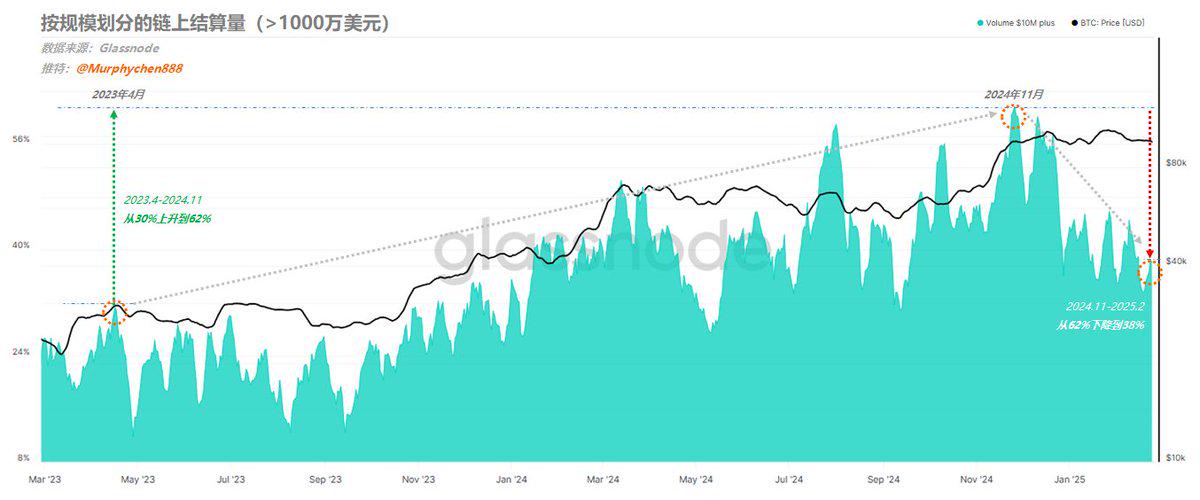
On-chain data also shows that the liquidity of the Bitcoin market is also shrinking at an accelerated pace, especially the withdrawal of large funds. According to data from Murphy, a well-known V in X, the whale group (transaction amount greater than 10 million US dollars) that dominated the market's rise in the past, from April 2023 to November 2024, its liquidity share increased from 30% to 62% and then began to drop sharply. By February this year, it had dropped to 38%. High net worth groups (transaction amount of 1 million to 10 million US dollars) also reduced their holdings in January, and their liquidity share dropped from 36% to 30%. At the same time, the proportion of retail investors is increasing, which shows that when retail investors enter the market under the continuous fomo sentiment of Bitcoin breaking through $100,000, large funds are gradually withdrawing.
Further data shows that the withdrawal of large funds is highly correlated with profit realization. Whenever wallets holding 1,000-100,000 BTC begin to take profits on a large scale, the upward trend of Bitcoin is nearing its end. This phenomenon was clearly reflected in 2017, 2021 and 2025, which is highly consistent with the time when whale funds withdrew. The current market is experiencing a typical pattern of capital flow: large funds leave the market with profits, and retail investors take over after realizing it.
Is it time to buy at the bottom?
The market continued to fall, with Bitcoin falling below $79,000 and plummeting by more than 18% in the past week. With such a huge short-term drop, the market began to wonder whether it was time to buy at the bottom.
At present, the cryptocurrency market is caught in a vortex of multiple unfavorable factors: the shadow of economic stagflation covers all risky assets, the sell-off of technology stocks has put downward pressure on Bitcoin through the risk preference transmission mechanism, and the internal capital structure of the crypto market is seriously unbalanced - institutional capital continues to outflow, whale accounts accelerate profit-taking, and retail investors' momentum is exhausted. These factors have jointly created the depth and fierceness of this decline. Historical lessons reveal that when market liquidity shifts from institutions to retail investors, it often indicates that the critical critical point of the bull-bear transition is just around the corner.
Although short-term oversold prices may trigger a technical rebound, investors should be highly alert to the risk of a "bottom-fishing trap" given the uncertainty of Trump's policies, the unclear outlook for the Federal Reserve's monetary policy, and the fact that there is still half a year before news on the country's strategic reserve of Bitcoin, the biggest positive in the cryptocurrency world.