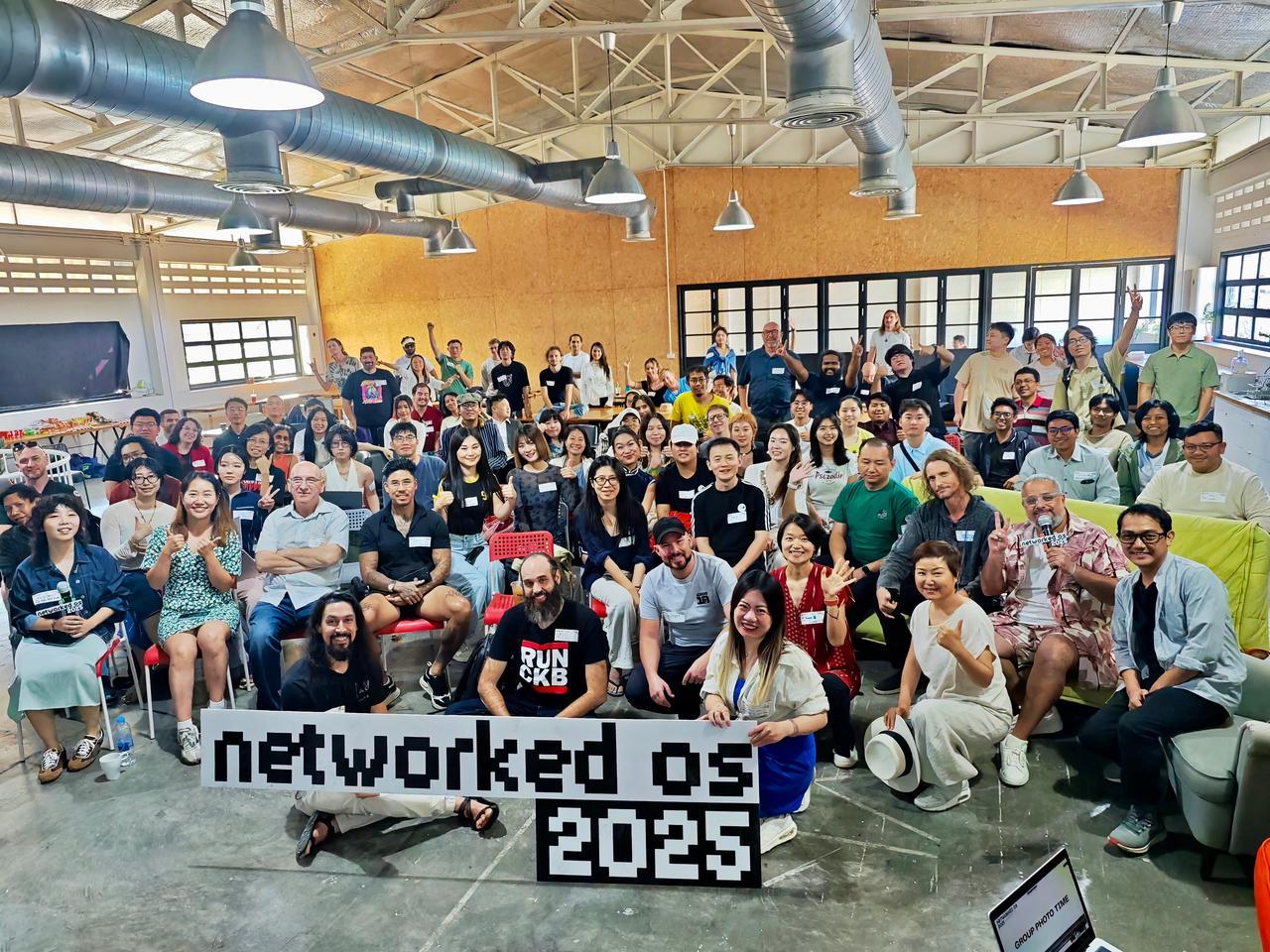
On December 6th, the Networked OS Summit was successfully held at Punspace Tha Phae Gate in Chiang Mai, Thailand, attracting nearly 200 cross-border developers, entrepreneurs, and community builders from China, Southeast Asia, Europe, and the United States. This summit focused on "Symbiosis and Value Creation in Global Mobility," exploring the underlying logic reconstruction of digital nomadism, Web3, and cross-border entrepreneurship.
Redefining Globalization: From Cosmo-Localism to Regenerative Collaboration
At the start of the summit, Grace, co-founder of Networked OS, raised a core question: When "people who move" also become "people who build," has the underlying logic of how the world operates changed? She pointed out that Networked OS is not a specific product, but a new operating logic—how to transform global connectivity into real value when people, products, and communities cross boundaries.
Michel Bauwens, founder of the P2P Foundation, hits the nail on the head with the concept of "Cosmo-Localism": the modern economic system protects knowledge as a scarce commodity while plundering tangible resources as an unlimited supply. The correct path should be the opposite—allowing knowledge to flow freely globally and allowing production to return to local communities. He uses the FarmHack community as an example: farmers globally share farm tool designs and manufacture them using local materials. This is not "anti-globalization," but a more mature form of globalization.
Michel quotes historian Toynbee's theory: "We are at a turning point in civilization. Just as Christian monasteries became the seeds of a new civilization when the Roman Empire declined, today's Makerspaces, digital nomad communities, and Web3 projects may be the monasteries of the next generation of civilization."
Whom does technology serve? The dual challenges of infrastructure and trust.
Network School instructor Ramiro Ramirez posed a pointed question: Has technology over the past 20 years enhanced human autonomy or made people more controlled by systems? He believes the future will be more chaotic, and the key lies in whether people are willing to return to the physical world and rebuild real connections.
Matt Quinn, Executive Director of the Nervos Foundation, added from an infrastructure perspective: The technology is in place; the real question is, who are these tools actually serving? Blockchain should not be confined to financial narratives but should serve real needs such as renewable energy, community land trusts, and organic agriculture.
Christoph Huebner, co-organizer of the Nomad Summit, focused on "trust": "Having operated digital nomad communities for many years, the biggest challenge is not technology, but trust. One-on-one interpersonal trust across time zones and cultures cannot be replaced by AI or automated by smart contracts—it is the most enduring infrastructure."
Builder Practice: From Exploration to Sustainable Lifestyles
Zhou Mo, co-initiator of the China Digital Nomad Conference, shared a detailed data landscape of China—digital nomad profiles, community maps, and popular destinations. She pointed out, "The Chinese digital nomad market is still in its exploratory stage; most people are looking for calling and considering how to transform nomadism into a sustainable lifestyle."
The story of Xiao Pan and Xiao Ding, founders of the Nomad Community, touched the audience: they quit their jobs in 2019, bought a motorhome, and went to Mexico; during the pandemic, they were forced to learn remote work; after traveling through South America and Europe, they founded a Chinese online community in 2022, which now has over 600 members. Xiao Pan emphasized, "Nomadism is not just about romance and freedom, but more importantly, 'sustainability.' The community allows people to find others like themselves—this connection makes freedom no longer lonely."
Sea Ansley, founder of Singapore's AISA (who started his internet business in 1984), believes the core of remote teams is Fractional Health, buying "a few hours of world-class experience" at a lower cost. However, he warns: "If work is just about interacting with machines, the anxiety will only deepen. Stepping out of the room and establishing real connections is the only way to combat AI anxiety."
SaaS growth consultant Kris Escaño shared Hunter.io's global growth path, while Builders such as Darren, co-founder of AGI Villa, and Nicholas, a core contributor to 4seas, discussed how to find a balance between "cutting-edge technology" and "real life" from the perspective of the relationship between the body, technology, and community.
Community Power: Localism Practices in Chiang Mai's Local Ecosystem
At the end of the event, local and regional communities in Chiang Mai shared their experiences. Songping, co-founder of Networked OS, specifically pointed out that the success of this event was inseparable from the tremendous support of the local community in Chiang Mai. "Whether it's coworking communities like Punspace, Yellow, and 4Seas, communities providing coliving services, or numerous purely online communities, they are all using their own methods to provide resource connections and support for Chiang Mai's digital nomads," Songping said. "These communities are true practitioners of Localism—they not only provide physical space and infrastructure for mobile populations, but more importantly, they create an ecosystem that deeply integrates global knowledge and local resources."
The CMI community insists on all activities being free and non-commercial, and hosts a variety of community events every week. Digital Nomad Club from Myanmar shared: "Our country is experiencing civil war and an economic crisis, and many professionals want to stay but the environment is difficult. Therefore, we established this community to share knowledge about AI, marketing, and freelancing every Sunday—creating a safe space for mutual growth."
Songping added, "Chiang Mai has developed a unique network of communities, and the collaboration and complementarity among these communities perfectly validates Michel's concept of 'global-localism'—that globally mobile talent and knowledge find fertile ground for take root and regenerate within local communities."
The entire event lasted nearly five hours. During the tea break, a Chinese developer and a German designer decided to collaborate on the spot, and a long queue formed after Michel's presentation to continue the dialogue. One participant commented, "This was the least conference-like event ever—no business cards exchanged, just genuine communication."
Networked OS: Building the "Soft Infrastructure" for Cross-Border Builders
Networked OS is not just the name of a conference, but a set of practical pathways that are taking shape. In the overseas market, Networked OS will provide Chinese developers and entrepreneurs with "soft infrastructure"—not just "how to translate products," but understanding the underlying culture, user psychology, and growth strategies of different markets. The cross-border growth knowledge base currently under construction will include real-world case studies and pitfall avoidance guides, while a regionalized Meetup network covering Bangkok, Chiang Mai, Singapore, Tokyo, and other locations will connect with proven local partners.
On the inbound front, Networked OS will build a "connection bridge" for overseas products entering the Asian market. The operating logic of WeChat, Xiaohongshu, and Douyin in the Chinese market is completely different from that of Western social media. Payment systems, user habits, and content preferences all require a deep understanding. Networked OS will help overseas builders find reliable localization teams and understand the core logic that "entry into the market is not about replicating overseas models, but about maintaining the core of the product while being rooted in real local needs."
Four major ecosystems support sustainable development
Networked OS announced four key initiatives to build a sustainable ecosystem:
- Networked Podcast : Monthly conversations with global creators, sharing cross-border building practices.
- Regional Meetup Networks : Connecting Communities in Everyday Life
- Networked Fund : Supports early-stage projects that demonstrate "translating global coordination capabilities into local value".
- Networked OS Alliance : Connecting like-minded organizations, products, and communities into a network.
In his speech, Michel emphasized: "We are not just building tools for a borderless world. We are building the world that makes borders irrelevant."
Cooperation opportunities and application channels
Networked OS is reportedly seeking like-minded partners.
- Chinese developers and startups looking to expand overseas
- Overseas Builders Looking to Enter the Asian Market
- Organizations and projects that are attempting cross-border collaboration
- Builders who believe that "mobility should bring about regeneration rather than drifting"
📋Apply to join : https://forms.gle/LuDTh9NSzv18AfSn8
🌐Learn more : www.networkedos.com
✉️For collaboration inquiries : contact@networkedos.com