Written by: Web3 farmer Frank
What is the core competitiveness of the stablecoin business?
"Credit".
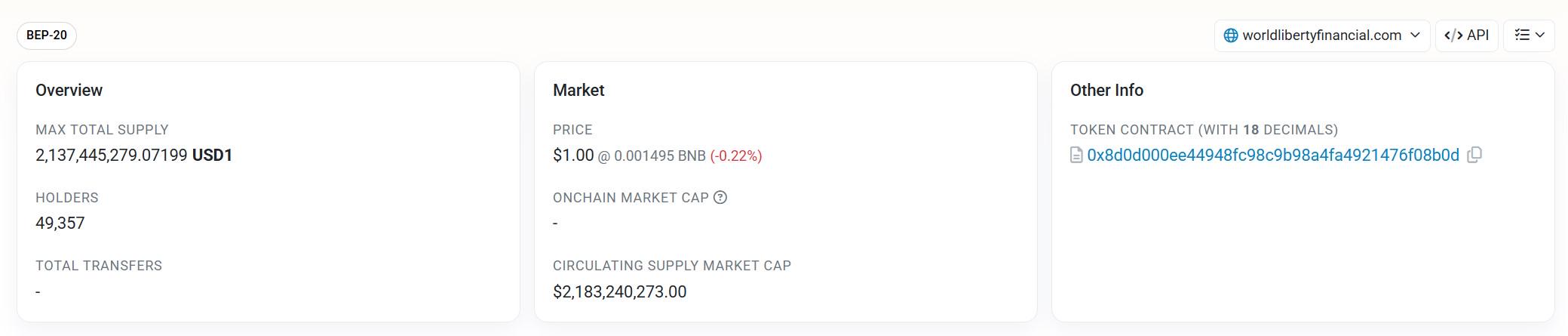
The reply from Charles, the founder of StakeStone, was straightforward and naked. In the battle of stablecoins, the typical embodiment of "credit" is the credit endorsement of the Trump family, such as USD1. Less than 100 days after its birth, USD1 has achieved a phenomenal growth from "0 to 1" and full coverage of top exchanges:
From March to date, the issuance volume has soared to US$2.1 billion, surpassing FDUSD and PYUSD to become the world's fifth largest stablecoin (CoinMarketCap data), and has been fully launched on top CEXs such as HTX, Bitget, and Binance. In contrast, PYUSD, which has been backed by PayPal for two years, is still struggling to advance its penetration.
In Charles' view, "the essence of currency issuance is credit". The stronger the credit, the faster it will be adopted. Therefore, he is certain that USD1 will be the stablecoin with the greatest growth potential in 2025.
So, why did StakeStone get the first ticket?
"The development logic of USD1 is very different from that of USDT/USDC. " USD1's unique credit endorsement makes its promotion in the real world more cross-domain and resource-integrating than traditional stablecoins.
Therefore, the biggest growth potential of USD1 is not in the Web3 circle, just like the current larger proportion of applications of USDT and USDC are also in the traditional financial field, including but not limited to: large financial institutions, cross-border trading companies, small and medium-sized enterprises, individual operators (such as freelancers, content creators), and financial service underdeveloped areas. These fields will greatly benefit from the popularization of this round of digital stablecoins (Digital Money).
The widespread adoption of USD1 on the chain must be achieved through a full-chain liquidity hub. Therefore, according to Charles, as early as the second half of 2024, StakeStone started negotiating with World Liberty Finance (WLFI), the issuer behind USD1, on cooperation on full-chain liquidity.
The key factor that really prompted WLFI to choose StakeStone was the multi-chain operation capabilities demonstrated by StakeStone in a series of previous products such as Berachain, especially the functional performance in the "full-chain liquidity distribution" that has always been built - so in the ecological landscape of USD1, StakeStone actually plays a dual role: the official casting channel and the full-chain liquidity hub. This provides USD1 with a one-stop portal covering everything from casting to the entire chain and all scenarios.
From this perspective, StakeStone's decision to take the lead in USD1 is a tacit understanding between WLFI and USD1. This interview also hopes to understand the cooperation logic between WLFI/USD1 and StakeStone through Charles' perspective, and what fundamental changes are taking place in the stablecoin landscape in his eyes, so as to uncover the key pieces of this new stablecoin narrative.
Why did WLFI choose StakeStone during the negotiations at the end of last year?
When asked about the reason why StakeStone became the first DeFi minter of USD1, Charles first disassembled the issuance mechanism of USD1:
After institutional users complete KYC certification and other compliance processes, they need to deposit US dollars into a designated custodial bank account. After WLFI verifies the arrival of funds, the institution can mint USD1 in units of at least US$100 . However, the USD1 balance during this process remains in the account system and has not yet been put on the chain. It must enter the public chain world through "withdrawals". Currently, USD1 officially only supports Ethereum and BNB Chain (and the latter accounts for more than 98% of the total issuance).
In other words, in the current on-chain environment, USD1 has not yet achieved native multi-chain deployment. If USD1 is to be circulated and used on other chains, there are currently only two ways. One is to rely on the official cross-chain bridge, but this is far from enough. It can only solve the "cross-chain existence" of assets, but cannot build a complete application scenario; the other is to build an independent full-chain distribution system through partners.
StakeStone cuts in at this critical link, using its own multi-chain distribution and scenario operation capabilities to distribute USD1 to more than 20 chains, realizing native implementation and application in multi-chain DeFi scenarios.
According to Charles, StakeStone and the WLFI team have had multiple rounds of contacts since the end of 2024. The other party finally decided to cooperate, which is inseparable from the asset distribution system that StakeStone has established in the multi-chain ecosystem. At the same time, it also values its rich experience in integrating blue-chip asset returns, which can quickly introduce USD1 into real DeFi application scenarios. This also means that from the beginning of the birth of USD1, StakeStone is not just a "casting party", but more like its strategic partner in the multi-chain ecosystem - not only as a core hub to achieve the full-chain distribution of USD1, but also responsible for building interest-bearing products on various DeFi chains, providing income certificates, and creating the on-chain soil for USD1. In the future, it will realize the integrated connection of "fiat currency deposit → casting → multi-chain distribution → on-chain and off-chain scene docking", and build a real one-stop liquidity closed-loop service for USD1.
The following are relevant interview questions:
Frank: We see that StakeStone is the "official full-chain liquidity support partner of USD1 stablecoin". Can you introduce the specific content of the cooperation with WLFI and what core support and services will StakeStone provide for USD1?
Charles: Currently, we are not only the minting service provider of USD1, but also deeply involved in its governance ecosystem, taking on the task of building full-chain liquidity. Future cooperation plans include:
- Payment products: Launch a collection tool based on USD1, support global companies to directly receive USD1 through Visa/Mastercard, and connect to the traditional banking system after the stablecoin becomes legal;
- Full-chain DeFi yield product: Launch USD1 LiquidityPad Vault, a one-stop full-chain yield product for USD1 on the chain;
- CeDeFi products: Build USD1CeDeFi products that combine traditional financial institutions’ USD wealth management products and quantitative trading returns;
- Compliance channel construction: Apply for payment licenses in multiple countries, open up a one-stop exchange path from fiat currency to USD1, and gradually replace the OTC channel;
Frank: Currently, USD1 has very high qualifications for Mint service providers. Why did WLFI choose StakeStone as the first DeFi protocol minting service provider? What opportunity led to the cooperation between the two parties?
Charles: Our cooperation with the USD1 team began in its private placement stage at the end of last year (Q4 2024). We participated in its technology path planning at an early stage. Based on our successful experience in liquidity distribution in multiple projects, the USD1 team recognized our capabilities in building a multi-chain ecosystem, and the two parties eventually reached a strategic partnership.
Frank: StakeStone has never launched any business or products directly related to stablecoins before. Does this in-depth cooperation with USD1 mark StakeStone's official entry into the field of compliant stablecoins?
Charles: We did not have stablecoin products before. This cooperation is our first step into the stablecoin infrastructure. In the future, we will definitely develop a whole set of products around USD1, including USD1's LiquidityPad full-chain liquidity distribution vault, USD1's minting and stable interest-bearing products, etc.
These are actually what StakeStone is already good at, but before we mainly served blue-chip assets or public chain assets. Now we will provide a complete set of "stablecoin as a service" solutions for USD1.
Frank: As the "first DeFi protocol minter of USD1", will ordinary users be able to directly mint or cross-chain redeem USD1 through StakeStone in the future?
Charles: We definitely hope to encapsulate this mechanism well. For example, users can use the StakeStone front-end to bind their bank cards and directly deposit fiat currency. Then the system backend will mint USD1 through our institutional account, and then bridge to the target chain selected by the user. This will achieve a one-stop experience for the entire process from deposit, minting to distribution.
We are currently planning to develop compliance licenses in this area, especially in Singapore and Hong Kong, where compliance licenses are relatively clear, to open up payment channels. In the future, users may be able to deposit and exchange USD1 through credit cards, SWIFT, wire transfers, etc.
"USD1's greater application scenario is not in the cryptocurrency circle", the new growth paradigm of full-chain liquidity × global liquidity
“USD1’s greater application scenarios are not in the cryptocurrency world.”
StakeStone is also preparing payment products based on USD1 to provide compliant and efficient global aggregated acquiring products for small and medium-sized enterprises, digital nomads, self-employed individuals, etc.
He believes that the market pointed to in this direction is the second half of the larger stablecoin that cannot be ignored. StakeStone not only provides full-stack support for "stablecoin as a service" for USD1, but also tries to promote its evolution into an "on-chain dollar API" that serves real settlement and global circulation.
The following are relevant interview questions:
Frank: The full-chain stablecoin distribution product may be a bit abstract to understand. Can you give an example of how ordinary users can use USD1 across the entire chain, participate in different ecosystems and earn income through StakeStone?
Charles: It can be simply understood as a "three-step" process. The user first deposits USD1 into StakeStone's liquidity vault. StakeStone issues interest-bearing stablecoin certificates. The user then participates in the target chain blue-chip DeFi scenarios (such as Morpho, Pendle, etc.) through the interest-bearing certificates held to earn income.
At the same time, StakeStone will distribute the underlying USD1 into the full-chain ecosystem and participate in the deployment of cross-chain multi-interest strategies.
Finally, users can receive full-chain benefits without worries through the interest-bearing certificates they hold.
Frank: From the perspective of ecological cooperation, how do you evaluate the synergistic value of StakeStone × USD1? Does this mean that the two parties will form a long-term alliance of stablecoin + liquidity protocol to jointly penetrate multi-chain and cross-regional markets?
Charles: In the future, we will be a one-stop portal for USD1 from minting to distribution.
In the crypto field, we have launched a dedicated LiquidityPad vault for USD1 to help it expand multi-chain DeFi scenarios. We will also release RWA+CeDeFi products based on USD1 to provide it with stable interest-bearing services. In the traditional financial field, we are promoting the application and cooperation of payment licenses, with the goal of enabling users to directly mint USD1 from fiat currency in a compliant and low-friction path, truly opening up the entrance to off-chain funds.
For this closed loop to be truly implemented and run smoothly, it still needs to rely on the promotion of three key variables: first, regulatory progress. For example, whether policies such as the US "Stablecoin Act" can be successfully implemented will directly determine the legitimacy of USD1's fiat currency channel; second, scene penetration capabilities, that is, whether small and medium-sized enterprises, cross-border freelancers, and global trade institutions adopt USD1 as a payment tool on a large scale; finally, the ability to expand interest-bearing products, that is, whether USD1's on-chain income can be further expanded to off-chain assets such as RWA and treasury bonds, CeDeFi, etc.
The biggest Alpha in 2025 is "legal stablecoin", and the actual implementation of the closed loop depends on the joint drive of the three pillars of supervision, scenarios and products.
What’s the next step?
“The stablecoin industry has entered the second half, and the focus of competition is shifting from volume and traffic to compliance capabilities and scenario penetration.”
In addition to product cooperation, Charles also shared his understanding of the future of the industry with stablecoins. He believes that legal stablecoins are a watershed moment for the crypto industry. Specifically:
- The emergence of legal stablecoins will gradually erode the market share of traditional fiat currencies in cross-border payments, because it is obvious that crypto stablecoins have lower ledger security maintenance costs and lower global access costs.
- The emergence of legal stablecoins will end the existing P2P deposit and withdrawal structure and will eventually be replaced by legal foreign exchange license companies in various countries.
- The emergence of legal stablecoins will gradually blur the business boundaries between traditional banks and Web3 stablecoin asset management projects. In the future, the two will only have different bookkeeping methods (centralized database bookkeeping vs. on-chain bookkeeping) and regulatory requirements, and their business boundaries will become closer and closer.
Therefore, StakeStone will firmly embrace the stablecoin market in 2025, especially emerging stablecoins such as USD1 that have the greatest potential to become legal stablecoins.