
Author: Mars_DeFi
Compiled by: Chopper, Foresight News
In the early days of cryptocurrency development, many people believed that fraud was an inevitable price to pay for innovation, and that "project collapses" or "exit scams" were limited to a small number of criminals in unregulated corners of the internet.
But over the years, independent investigative journalists like ZachXBT have gradually revealed a disturbing truth: cryptocurrency scams have become globalized.
Between 2022 and 2025 alone, ZachXBT documented 118 cases of financial fraud of various types, ranging from multi-million dollar NFT scams to sophisticated cross-chain money laundering networks. His investigative reports exposed fraudsters across continents: from Memecoin projects endorsed by Silicon Valley influencers to Telegram scam groups in Mumbai and pump-and-dump schemes in Istanbul.
The consistency presented by the data is alarming: no country or region is immune to scammers.
The Myth of Regional Fraudsters
The location display feature recently added to the social platform X, intended to improve transparency, has sparked discussions related to xenophobia.
Many users have begun attacking others based on the account's country of origin, particularly targeting accounts related to India, Nigeria, and Russia, labeling all people in these countries as "fraudsters."
But ZachXBT's survey tells a completely different story. Here is a brief summary of ZachXBT's survey data from the past three years:
Of the 118 verified fraud cases:
- Approximately 41% originated from Asia (India, China, Southeast Asia).
- Approximately 28% originated from North America
- Approximately 15% originates from Europe.
- Approximately 10% involves Africa.
- Approximately 6% remain anonymous due to the untraceable nature of the mixer or privacy coin.
The geographical distribution of fraudsters in these 118 reports is also noteworthy:
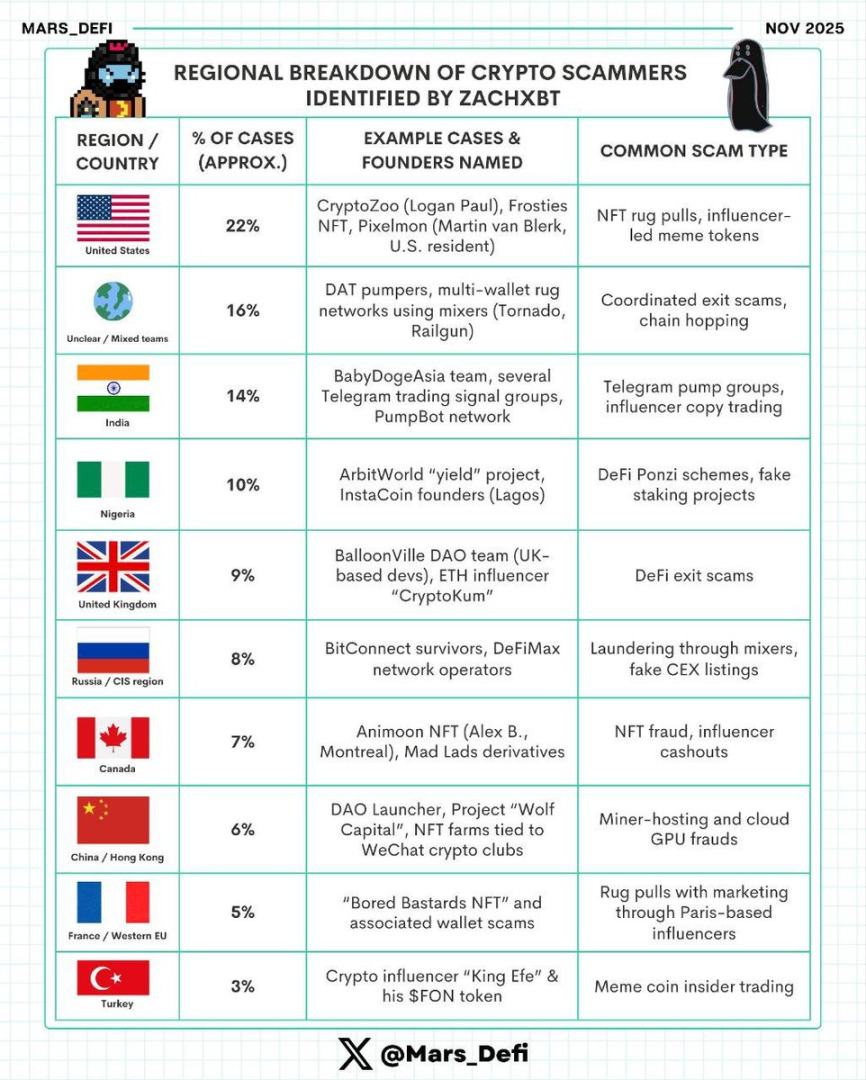
Geographical distribution of cryptocurrency scammers identified by ZachXBT
The data reveals not just a problem region, but a global moral deficiency.
The data above reveals a key fact that is often overlooked in online discussions: despite the frequent and unfair labeling of Africans (especially Nigerians) as cryptocurrency scammers, the reality is quite the opposite.
This shows that cryptocurrency scams are not limited to a particular region, but are a global problem that transcends borders, languages, and cultures.
Examining Cryptocurrency Scams from a Macro Perspective
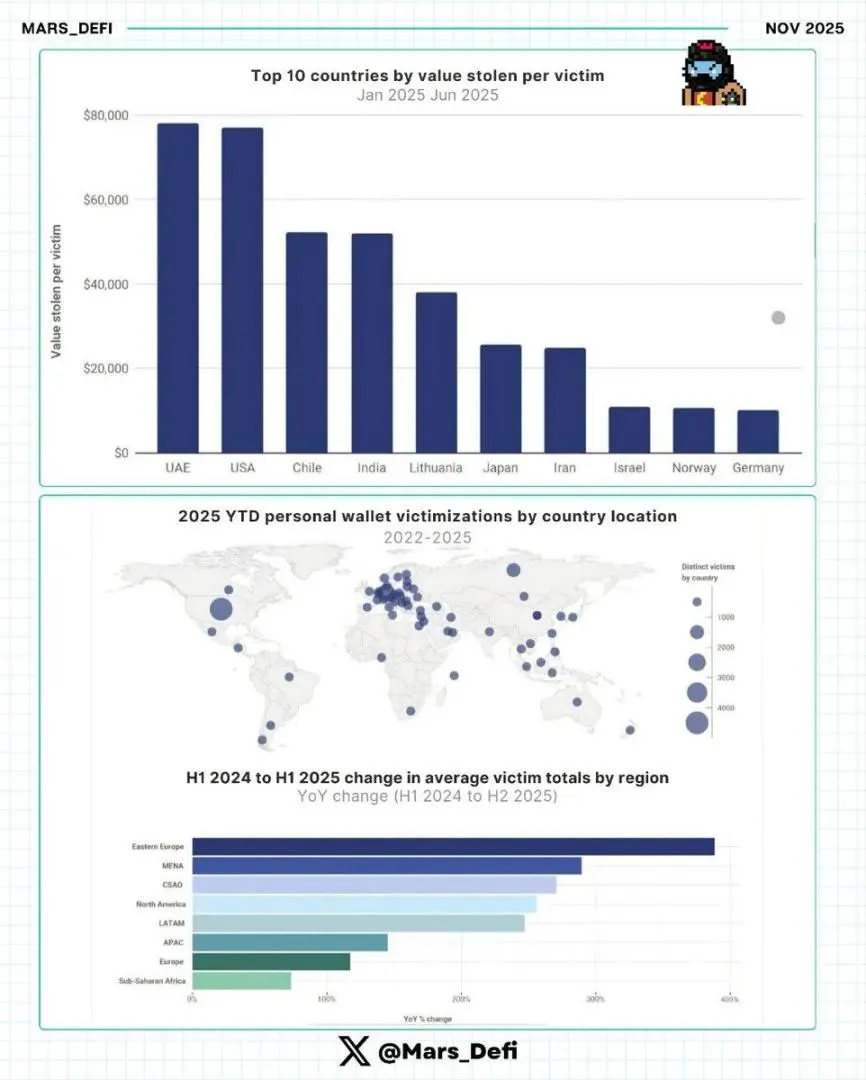
1) The country with the highest amount of money stolen from each victim between January 2025 and June 2025.
For those who blindly blame Nigeria or India, the first chart is shocking enough. The 10 countries with the highest average amount stolen per victim are:
- UAE – Approximately US$78,000
- United States – Approximately $77,000
- Chile – Approximately US$52,000
- India – Approximately US$51,000
- Lithuania – Approximately US$38,000
- Japan — Approximately US$26,000
- Iran – Approximately $25,000
- Israel – Approximately US$12,000
- Norway – Approximately US$12,000
- Germany – Approximately US$11,000
Did you notice? Nigeria isn't even on this list, while the UAE, the US, several European countries, and several Asian countries are prominently featured.
If those stereotypes were true, Nigeria or India should be at the top of this list, but that's not the case.
2) Global Wallet Victim Map (2022-2025)
The geographical distribution becomes clearer when we broaden our perspective to include the total number of victims worldwide. Victims are located in North America, South America, Europe, the Middle East and North Africa, and Asia.
Regions with a high number of victims include: Western and Eastern Europe, North America, parts of Asia, the Middle East, and North Africa.
What about Africa? Compared to Europe, the Americas, and Asia, the total number of wallets lost in Africa is far fewer. This is not my subjective judgment, but an objective fact presented by the map.
3) Regions with the fastest growth in cryptocurrency scam victims (2024-2025 year-on-year comparison)
The third chart shows the regions with the most rapid increase in fraud, with the year-on-year growth rate of victims in each region as follows:
- Eastern Europe – approximately 380%
- Middle East and North Africa – Approximately 300%
- Central Asia/South Asia and Oceania – Approximately 270%
- North America — Approximately 230%
- Latin America – Approximately 200%
- Asia-Pacific region – approximately 140%
- Europe (as a whole) – approximately 120%
- Sub-Saharan Africa – Approximately 100%
To reiterate, Africa's growth rate ranks last. Meanwhile:
- The growth of victims in Europe and the Middle East and North Africa is among the highest in the world.
- North America and Latin America followed closely behind.
- The Asia-Pacific region and the region where India is located are at a medium level.
- Africa is the least affected region in the entire dataset.
If Nigeria were the global center of fraud, Africa would certainly not be at the bottom of this ranking.
The truth is: cryptocurrency scams are not a problem in Nigeria or India, but a global problem.
Data completely shatters stereotypes:
- The country with the highest amount of money stolen from a single victim is not an African or Indian country.
- The region with the fastest growth in fraud is not Africa or India.
- Africa has the lowest year-on-year growth rate of victims.
So why are Nigerians and Indians unfairly labeled as "scammers"? Because people often judge based on emotions rather than evidence; because a viral scam in one region can become a collective label for 200 million people, and online prejudice spreads much faster than the truth.
According to the data:
- Nigeria is not one of the countries with the highest losses.
- Africa saw the lowest increase in the number of victims of fraud.
- The statistics for Europe and North America are even worse.
- Asian regions such as the UAE and India are facing high-value thefts.
If a region has the most scammers, then the victims in that region will also be very numerous (scammers tend to operate in places they are familiar with). However, Africa and India do not exhibit this pattern at all.
If Nigerians and Indians were to generalize like others, they could easily point the finger at Europe, the United States, South America, the Middle East, and North Africa.
But they didn't do that because responsible people understand that scammers are everywhere—in every race, every region, and every country; and that victims of scams are all over the world; and that no group should be labeled because of the actions of a few criminals.
Recent posts by @TheQuartering and others criticizing "Indian scammers" (x.com/TheQuartering/status/1992098997281194375) vividly demonstrate how xenophobia exploits people's real suffering. Portraying an entire country or community as criminals only exacerbates the harm.
ZachXBT's investigation also uncovered scams perpetrated by US YouTube bloggers, European DeFi developers, and Asian marketing groups. Cryptocurrency scams are not determined by nationality, but rather by a combination of unchecked anonymity, greed, and regulatory indifference.
How can we do better?
For cryptocurrencies to mature, they need not only regulation but also a collective ethical shift. This can be addressed through the following approaches:
- Replace nationality bias with transparency: require project founders to undergo public audits, complete KYC, and disclose on-chain information, rather than making arbitrary judgments based on nationality.
- Support investigative journalism: Investigators like ZachXBT and small communities of detectives have helped prevent potential losses of millions of dollars. We should disseminate their work, not nationalist noise.
- Always be cautious: Treat every project as a potential scam until it is proven to be reliable.
- Report, don't mock: When you discover a suspicious account, use verification channels or reporting resources instead of spreading hatred.
summary
Cryptocurrencies were born from the ideals of decentralization and freedom, but in the absence of accountability, these ideals have been distorted into tools of global exploitation. Every region has scammers, and every region has victims. Let's stop "on-chain xenophobia."