

Source: Talking about Li and other things
In recent days, the market seems to have lost some of its emotional heat. Bitcoin continues to fluctuate in the high range, and the overall trend seems relatively stable. Most people (funds) may still continue to wait and see or wait for some important news, and the daily discussions of the partners in the group are mainly focused on some hot news topics:
(1) The ancient BTC whale that has been dormant for 14 years has awakened
I took a quick look and found that the news was originally from a tweet released by Lookonchain, which said that a Bitcoin holder with at least 80,000 BTC began to wake up after 14 years of silence and gradually transferred his Bitcoin holdings. As shown in the figure below.
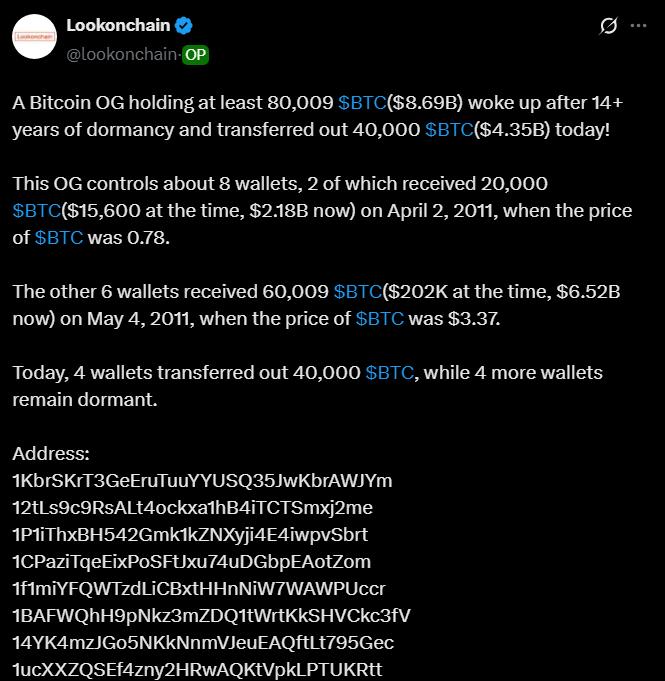
Afterwards, this news began to spread rapidly in major crypto media and self-media platforms, followed by various speculations. For example, some people said that this ancient whale was an independent miner in 2011, some said that it was a Chinese national who was released from prison after serving his sentence, and some said that it was a super main force testing the market's reaction...
As for who these 80,000 bitcoins belong to, what is the purpose of their sudden awakening at this time, is it to deal with the potential huge selling pressure in the market? Or is it just a test of the super main force? We don’t know these for the time being, but judging from the price trend of bitcoin in the past two days, it seems that there is no sign of funds rushing out because of this incident.
I am relatively indifferent to this kind of news. If you are interested, you can use on-chain data tools such as Arkham to monitor the transfer trends of those Bitcoin addresses in real time.
Now that we are talking about whales, let’s also take a look at the overall dynamics of Bitcoin whales at different levels:
By observing the on-chain data, Shark wallets (i.e. wallets holding 100–1K BTC) are still actively increasing their holdings, while Whale wallets (i.e. wallets holding 1K-10K BTC) and Humpback wallets (i.e. wallets holding >10K BTC) have been in an overall selling trend in the past year, as shown in the figure below.
Through this data, we can further speculate that Bitcoin seems to be entering a structural redistribution of funds in the past year. Early whales have begun to withdraw, and some medium-sized players such as institutions/funds have begun to take over and gradually build positions. I think that in the medium and long term, whale selling is not necessarily a bad thing. Bitcoin becoming more decentralized can reduce the risk of whale price manipulation to a certain extent. In other words, in the short term, whale selling may suppress the price of the staged market, but as long as medium-sized players can continue to complete the accumulation of funds, then in the medium and long term, the market is still worth looking forward to. It’s just that in this game of human wealth migration, the ones who will be hurt more in the end may be Crabs (i.e. wallets holding 1-10 BTC) or Shrimp (i.e. wallets holding <1 BTC).
(2) The U.S. House of Representatives voted to pass the "Big and Beautiful" bill
In last month’s article, we highlighted two bills, namely The GENIUS Act (full name: Guiding and Establishing National Innovation for US Stablecoins Act, which can be referred to as the Stablecoin Act, and some people simply call it the Genius Act) and The CLARITY Act (full name: Crypto Legal Accountability, Regulation, and Transparency for Innovation in Technology Act, which is the Crypto Technology Legal Accountability, Regulation and Transparency Innovation Act). Both of these bills are closely related to the crypto market. The former is an important bill to regulate and legalize the stablecoin industry, and the latter will formulate clear rules to classify digital assets as commodities or securities.
Although the One Big Beautiful Bill that has been passed now seems to have no direct relationship with the crypto market, as a US fiscal bill, its passage means that (the Trump administration) will continue to launch a more radical fiscal expansion plan.
We can look at this from two perspectives: In the short term, the series of related measures brought about by the Big and Beautiful Act will certainly have the effect of increasing employment, stimulating consumption, and revitalizing the stock market to a certain extent. But in the long term, it may also bring the risk of debt imbalance and lead to the continuous depreciation of the legal currency.
However, looking at these bills as a whole, it seems that they are actually beneficial in the long run for scarce assets like Bitcoin, and will further enhance the properties of Bitcoin as digital gold.
(3) Does FTX’s compensation plan not include Chinese users?
Regarding the FTX compensation, we have discussed and tracked it several times in previous articles. Many people have waited for a long time and finally got the compensation, which is something worth looking forward to. However, news came out in the past two days: creditors in 49 jurisdictions including China may lose their claims. The claims of creditors in these regions account for 5% of the total funds, worth about US$825 million (based on the total compensation assets of US$16.5 billion), of which 82% belong to Chinese creditors, and the claimed assets are worth about US$676.5 million.
Many people probably still remember the collapse of FTX in 2022. After a long wait of more than three years, the promised bankruptcy liquidation may ultimately result in a "legal robbery", and those Chinese users who were excluded from the legal system have nowhere to appeal. It seems that they can only try to get the compensation they deserve through special methods (such as transferring the claims to entities owned outside of China, transferring the claims in the name of trustees or other entities outside of China). This is indeed a tragedy.
What is more painful than losing money in trading is that your money is taken away by others without you being able to do anything about it.
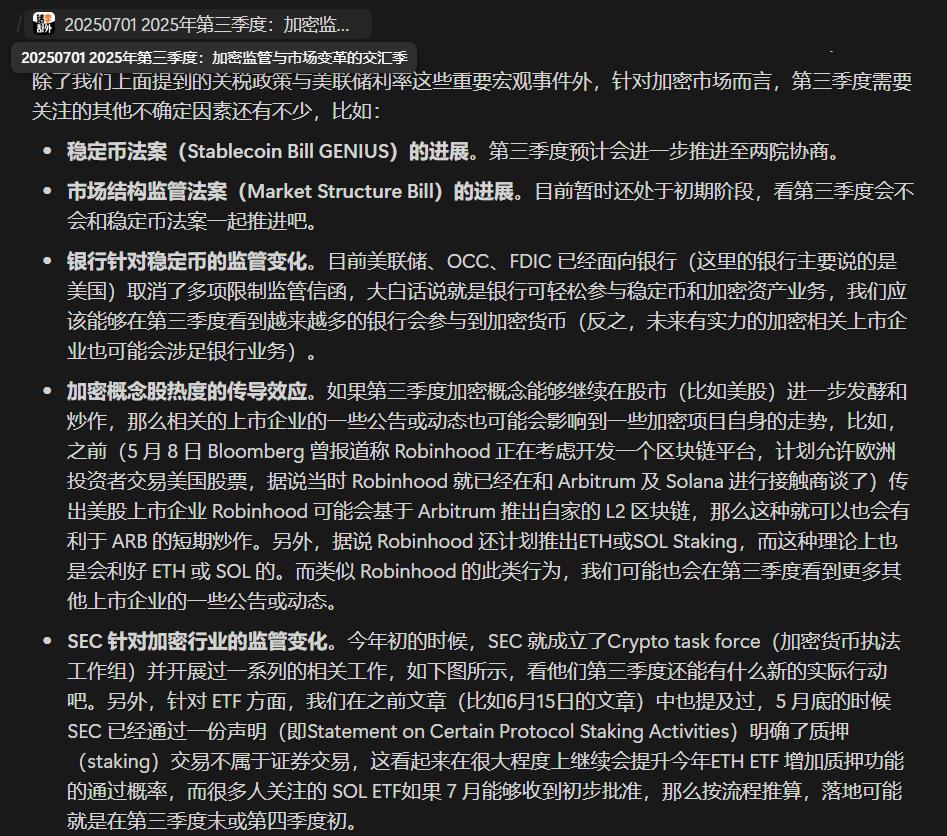
In short, there are always various news that can attract people's attention in this market. The market does not seem to make us too lonely. Whenever the market is boring, we can often see some very interesting news such as the above. However, for the overall market trend in the future, we still maintain the main viewpoints (guesses) in the previous article. Although there are still many uncertain factors in the future, if the script remains unchanged, we are likely to continue to see Bitcoin break new historical highs in the third quarter (or postponed to the fourth quarter).
Again, if you are looking at long-term opportunities, just continue to accumulate more Bitcoin according to your trading plan. If you are looking at short-term opportunities, now is the time to continue paying attention to and looking for the periodic opportunities of those stable projects. There is no need to spend all your energy on various news reports and bring yourself extra FUD.
So, how can we discover periodic opportunities better and faster?
(1) Based on the technical level
For example, many people pay attention to K-line every day, but it is estimated that most people just stare at the price on the K-line. If we can use the K-line to discover some price advances and lags, we can quickly identify some potential Alpha opportunities.
We have previously briefly sorted out some basic knowledge about K-line in the public account (Hua Li Hua Wai DAO), such as breakthrough structure, moving average golden cross, MACD, RSI, volume-price resonance, etc. We will not go into details here. Friends who are interested in this aspect can look back at historical articles.
But here we need to remind you that you should pay attention to the time period you use (hourly, daily, weekly), and identify the trading volume/deepth of the token. In particular, the K-line of small currencies or local dog currencies is actually not very meaningful for reference (the dog dealers can draw it however they want, without any bottom line).
(2) Based on the data level
Starting from this cycle, it has become relatively difficult to make substantial profits directly through altcoins, because tens of thousands of new coins are launched in this field every day, and liquidity is more dispersed than ever before. In addition, it has become popular to put stocks on the chain (tokenized US stocks) recently. Although stocks on the chain can currently bring some new liquidity and attention, they will also further dilute the existing liquidity.
But as long as the volatility of the market remains and narrative hype can continue, then using some corresponding tools to study and track data and thereby discover some possible opportunities is still an effective way or method.
As for data tools, we have included quite a few in the "Huali Huawai Toolbox" before, and we have shared some in the e-book "Blockchain Methodology" last year (2024). Here we briefly recall a few:
For example, Dexu is a data platform based on on-chain and social analysis, which provides a series of data such as popular narrative rankings, narrative price performance, industry analysis, project analysis, market signals, etc. As shown in the figure below.
From the above figure, we can see that the three fastest growing narratives in the past 7 days are L1, Crypto Stocks and Sweet-spot. Among them, the top three projects in L1 price performance are PLUME, CELO and ETH, and the top three projects in Sweet-spot price performance are PENGU, AAVE and HYPE. This seems to be more in line with the recent market performance, because the hype of the Crypto Stocks concept has been quite hot recently, and L1 carries the integration of technology, and Sweet-spot carries the landing of the ecosystem. These are all the support for the good price performance of such projects and one of the reasons for being hyped.
Let's talk more about Crypto Stocks. Many people now see Crypto Stocks as a big negative for the crypto market because it will lead to the diversion of existing liquidity. This is definitely correct in theory, as we mentioned above. But I think that Crypto Stocks are historic for the development of the crypto industry. We don't need to be pessimistic about the entire crypto industry because of this incident. We need to give it some time to practice. And for Crypto Stocks, compared with the traditional stock market, there are actually some interesting things, such as:
- People can invest in unlisted private companies like OpenAI and SpaceX through platforms like Robinhood, which was difficult for retail investors to do before (although this form of participation does not currently represent true shareholder rights).
- If the related Crypto Stocks can be used without permission in DeFi, this actually has great potential.
Currently, the global stock market value is approximately $122 trillion (data from WFE reports), while the market size of Crypto Stocks is only $425 million, as shown in the figure below.
Let’s imagine that in the near future, people can directly use protocols such as Pendle to bet on future dividends of US companies, or use protocols such as AAVE to pledge stocks on the chain for lending, and even continue to trade stocks on the chain when the traditional stock market is closed. Compared with traditional stock trading, on-chain trading can achieve lower fees, better trading experience, and higher capital utilization. Isn’t this interesting? Of course, Crypto Stocks will also face regulatory issues, but with the advancement of (mainly US) regulation and related bills on the crypto industry, there will definitely be corresponding solutions in the future. Let the bullets fly for a while.
Another example is Artemis, which is a comprehensive on-chain data analysis platform that provides data analysis in various dimensions, including data comparisons of different chains, data comparisons of different protocols, stablecoin data of each chain, developer activity of each chain, comparison of on-chain capital inflows and outflows, etc., as shown in the figure below.
From the above chart, we can see that the three chains with the largest net capital inflow in the past 7 days are Ethereum, Polygon and Unichain. Ethereum may be mainly based on the recent hype of the RWA topic (currently a large number of RWA projects are built on Ethereum), and it may also be related to the expectation of ETH ETF staking. Polygon may benefit more from the recent popularity of the Crypto Stocks concept. As for Unichain, UNI, as a typical sweet-spot, may also be sought after by some funds recently.
Due to limited space, we will simply list two data tools, Dexu and Artemis, here. Friends who are interested in more on-chain tools can directly view them through the "Hua Li Hua Wai Toolbox" we compiled earlier. In addition, in addition to the technical level and data level listed above, you can also make auxiliary judgments based on various dimensions such as the macro level and the news level. These all need to be selected according to your own capital size, investment cycle plan, and personal risk preference.
Of course, the above example does not mean that we should blindly buy related project tokens based on certain past or recent data performances based on some dimensions. The main purpose of using data and other dimensional tools is actually to help us identify narratives and projects that are worthy of further research. After all, there are now more than 200 narratives (tracks) in the encryption field. We cannot and do not have so much time and energy to study them all. Data and other dimensional tools are used to help us make directional choices.
On the basis of this directional trade-off, if we want to invest in one or several projects, we need to continue to observe from certain angles, including the token economics of the project (such as the distribution of tokens, the utility of tokens, whether there has been any large-scale unlocking in the near future, etc.), the community activity, the product experience, the product data performance (such as Fees/TVL/Revenue, etc.)... In short, you need to study the aspects that you care about most, DYOR, and only consider investing after it meets your preferences.
And the above are all basic research. The price performance factors in the market are often determined by many factors. Especially in an obvious upward trend, the price trend does not seem to care much about the fundamentals of the project. Emotional and capital speculation can directly make a token (represented by MemeCoin) take off, but in the long run, investing in projects with good fundamentals will definitely be safer than investing in those dog projects, especially under the overall severe market environment. Tokens with good fundamentals will at least be relatively comfortable to hold.
However, when it comes to choosing this kind of thing, our advice remains the same: newcomers should first add and then subtract, while veterans should directly subtract, because learning is a process from more to less, and the same is true for most people's investment experience. On the premise of mastering the necessary basic knowledge, in the actual transaction execution process, we don't actually need to establish a too complicated trading system or trading strategy, let alone participate in the transaction of too many projects. Instead, we should learn to do subtraction for ourselves. As long as we find or form a few core indicators that are most suitable for ourselves, and then maintain a certain degree of patience, we can basically be ahead of more than 90% of ordinary investors in this field.
That’s all for today. The sources of the images/data cited in the text have been added to Notion. The above content is only personal opinion and analysis, and is only for learning records and communication purposes, and does not constitute any investment advice.