
According to Wu Blockchain, some mainland Chinese users recently received cryptocurrency fund promotion ads on the Alipay Fund homepage, with the content showing "Global investment, cryptocurrency soaring, 10 yuan investment, get on board now." After verification, the fund is Huabao Overseas Technology C (QDII-FOF-LOF), which has a limit mechanism and each person is limited to purchasing 1,000 yuan per day.
Given the important position of Alipay in China's Internet industry, many people in the circle have forwarded the news, speculating whether this is a precursor to the mainland's relaxation of policy restrictions on cryptocurrencies. Previously, Liu Honglin and Bai Zhen from Mankiw Law Firm wrote an article analyzing "Web3 Lawyers: Can Chinese Investors Legally Invest in Crypto Assets through QDII?" , which may be able to answer questions that some practitioners are concerned about.
The following is relevant content.
Undercurrent
The booming crypto asset market has had a huge impact on the traditional financial market. As the most popular crypto asset in the world, the surge in Bitcoin prices has not only attracted the attention of individual investors, but has also gradually become an asset allocation option for institutional investors. In the European and American markets, Bitcoin-related financial derivatives, such as ETFs and trust funds, have been introduced to the market and are widely welcomed.
But in China, the policy direction is completely different. Since the country issued a policy in 2021 to completely ban virtual currency mining and trading , investing in crypto assets has almost become an "impossible task." Behind this policy is the prevention of financial risks, the maintenance of social stability, and the management of RMB foreign exchange. Domestic regulators are concerned that virtual currencies may lead to money laundering, illegal fundraising and other issues, and are also worried about their negative impact on energy consumption and environmental protection. This has resulted in a comprehensive blockade of any channel that directly contacts crypto assets, and the legality review of related links, from banking services to payment interfaces, has become more stringent.
For ordinary investors, it is almost impossible to invest in crypto assets directly through formal channels, and it is not easy to try to open an account overseas. This operation not only requires overcoming the technical and information barriers of opening an account overseas, but also faces China's strict foreign exchange controls, as well as compliance and tax risks that may arise when cross-border funds flow. These restrictions mean that although domestic investors' demand for crypto asset investment exists, it can often only be carried out through "gray" or even illegal channels, further increasing legal and financial uncertainties.
Even so, market demand still exists. For many Chinese investors, allocating crypto assets is not just about pursuing short-term returns, but also a need for global asset diversification. So, can we legally invest in crypto assets through the officially recognized QDII mechanism? This is not only about the feasibility of investment, but also touches on the contest between policy bottom line and market reality.
The mechanism and restrictions of QDII: It allows you to go overseas, but it does not necessarily give you "freedom"
The Qualified Domestic Institutional Investor (QDII) mechanism has been an important tool for Chinese investors to legally participate in overseas markets since its launch in 2006. This mechanism is an important attempt to gradually open up China's capital account, aiming to provide domestic investors with channels to legally invest in overseas markets through specific institutions, while achieving optimal use of foreign exchange reserves and orderly management of cross-border capital flows.
QDII allows qualified financial institutions, including banks, fund companies, securities companies and insurance companies, to design and sell financial products that invest in overseas markets. Through these products, domestic investors can indirectly participate in the investment of various asset classes such as overseas stocks, bonds, funds and financial derivatives. The core of QDII operation is that investors do not need to directly access overseas financial markets, but can achieve global asset allocation through the professional management of domestic institutions. This mechanism not only reduces the risks and costs of direct investment overseas by individual investors, but also ensures the legality and compliance of capital flows.
However, QDII is not a "master key". Its operating mechanism and restrictions determine that its investment scope and compliance are strictly controlled. Although it is a "window", it is not a completely open "door".
The investment scope of QDII is jointly stipulated by the State Administration of Foreign Exchange and the China Securities Regulatory Commission, and all investment targets must comply with the requirements of legal overseas markets. Traditional QDII products mainly involve stocks, bonds and traditional funds, which have certain risk control attributes. However, QDII currently does not explicitly allow emerging market assets, especially crypto assets. In particular, crypto-related ETFs or trust funds, even if they are legal in the European and American markets, may still be rejected by domestic regulators from being included in the QDII investment scope due to the "policy sensitivity" of the underlying assets. This uncertainty makes it impossible for QDII to fully meet investors' demand for crypto assets.
QDII implements total quota management, and the State Administration of Foreign Exchange allocates quotas to specific institutions every year based on market and foreign exchange reserves. In recent years, due to the slow pace of capital account opening, QDII quotas have been in short supply. Financial institutions tend to use these precious quotas for traditional asset classes with lower risks and stable returns, rather than crypto assets with high policy uncertainty and huge market risks.
In addition, the core design concept of QDII is to provide a stable overseas investment channel, which is obviously incompatible with the high volatility of crypto assets . The crypto asset market is known for its violent price fluctuations and greater market manipulation risks. It is not uncommon for the rise and fall to exceed 20% in a short period of time. For the stable-oriented QDII investment products, this risk characteristic is not suitable.
The launch of QDII products requires multiple rounds of approvals, and must comply with multiple regulatory requirements from product design to final launch. Especially in the context of the current high pressure on virtual currencies by domestic regulators, whether financial institutions are motivated to develop QDII products related to crypto assets is still a huge question mark.
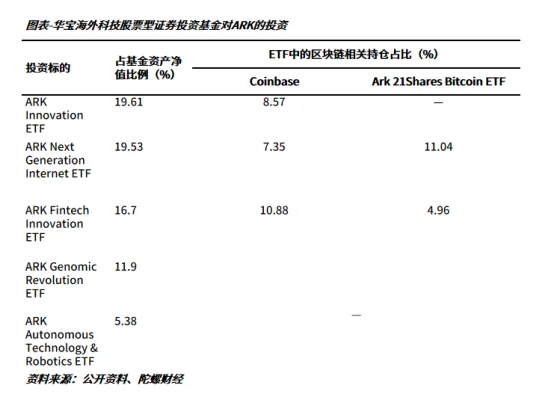
The fund product mentioned in the Alipay advertisement in this news event is QDII. Simply put, domestic retail investors can indirectly participate in overseas asset investment by investing in the above-mentioned QDII funds and then using QDII funds as the main body for overseas layout. According to the 2024 Q3 report of Huabao Overseas Technology Equity Securities Investment Fund (QDII-LOF), in the investment strategy column, it is written that "this fund mainly invests in overseas technology-themed funds (including ETFs) and ultimately invests in stocks that use technology as a support for the long-term development of enterprises."
What is the investment proportion of crypto assets in the fund? According to professional analysis by the media, Huabao Overseas Technology's investment includes about 4.93% of Coinbase stocks and 2.98% of Ark 21Shares Bitcoin ETF, totaling 7.92%. Considering that the latest fund size of Huabao Overseas Technology C is 406 million yuan, crypto assets do not dominate in terms of amount or proportion. Therefore, whether the fund can be considered a crypto fund may have to be tested by time.
Feasibility and risks: theoretical possibilities, practical difficulties
Although in theory it is not completely impossible to configure crypto assets through QDII, in practice this path is full of complex policy restrictions, institutional concerns and investment risks.
In China, the legal status of crypto assets has long been in a "policy gray area". Although the government has banned the trading and mining of virtual currencies, its specific attitude towards indirect investment in crypto assets is unclear. In particular, the legal nature of participating in the crypto asset market through legal mechanisms such as QDII is still controversial.
On the one hand, Chinese regulators are very strict about risk management of financial products, and crypto assets are considered high-risk due to their high volatility and potential market manipulation. Even if crypto asset investments are indirectly participated in in the form of ETFs, trust funds, etc., the underlying asset attributes of these products may still be considered "not in compliance with domestic policy requirements" and thus be rejected from being included in the QDII investment scope.
In addition, the stability of domestic regulatory policies is also a potential risk. Even if a QDII product is approved, subsequent policy changes may lead to the suspension or even liquidation of the product, which is a major uncontrollable risk for investors. The instability of policy direction makes the allocation of crypto assets through QDII more like a "high-risk policy test."
Even if the policy is relaxed, whether financial institutions are willing to develop QDII products related to crypto assets is still a major problem. This is mainly related to the high compliance costs. Designing a compliant QDII product requires a lot of time and resources, including multiple rounds of communication with regulatory authorities, strict screening of investment targets, and the design of risk control plans. For crypto assets, which are highly volatile and highly policy-sensitive investment directions, compliance costs will be further increased.
In addition, financial institutions also need to bear reputational risks and legal responsibilities. Once the crypto asset market experiences drastic fluctuations, causing investors to suffer significant losses, financial institutions may face investor complaints or even legal action. In addition, the reputation of institutions may be affected by product design issues, especially when the policy environment is still unclear, this risk is more prominent.
The crypto asset market has long been known for its violent fluctuations. For example, the price of Bitcoin once fell by more than 30% in a month, and then rebounded by more than 40% in a short period of time. This market characteristic places extremely high demands on the design of QDII products. The extreme distribution of returns and risks, the investment returns of crypto assets are highly uncertain. Even if the price rises for a period of time, the subsequent rapid decline may make investors' returns "vanish into thin air." This extreme risk distribution makes it difficult for institutions to design products that can attract investors and control risks. In addition, the crypto asset market is a highly complex and information-asymmetric field for ordinary investors. Many investors generally lack knowledge of this market, and this information gap may bring the risk of blind investment.
Lawyer Mankiw concludes: Compliance path is expected, but difficult to achieve in the short term
In theory, allocating crypto assets through QDII is a compliant method worth exploring, but under current policy and market conditions, the possibility of implementation is still low . Whether it is policy ambiguity, institutional concerns, or immature market risks and investor cognition, this road seems bumpy.
For ordinary investors, a more practical strategy is to gradually understand and participate in the crypto asset market through other compliant means before the regulation is clear. At the same time, relevant policies should be further improved to create conditions for the possibility of QDII investing in crypto assets in the future. In the future, when the policy is clear and the market matures, QDII may become an important tool for Chinese investors to enter the crypto asset market, but for now, all this still needs to wait.