
I don’t know if you have heard of the hot news in the cryptocurrency circle recently. Lawyer Mankiw would like to call it the “Bitget VOXEL contract incident.”
Here I borrow the timeline of X platform user Crypto Monkey (@monkeyjiang) (the picture is well done).
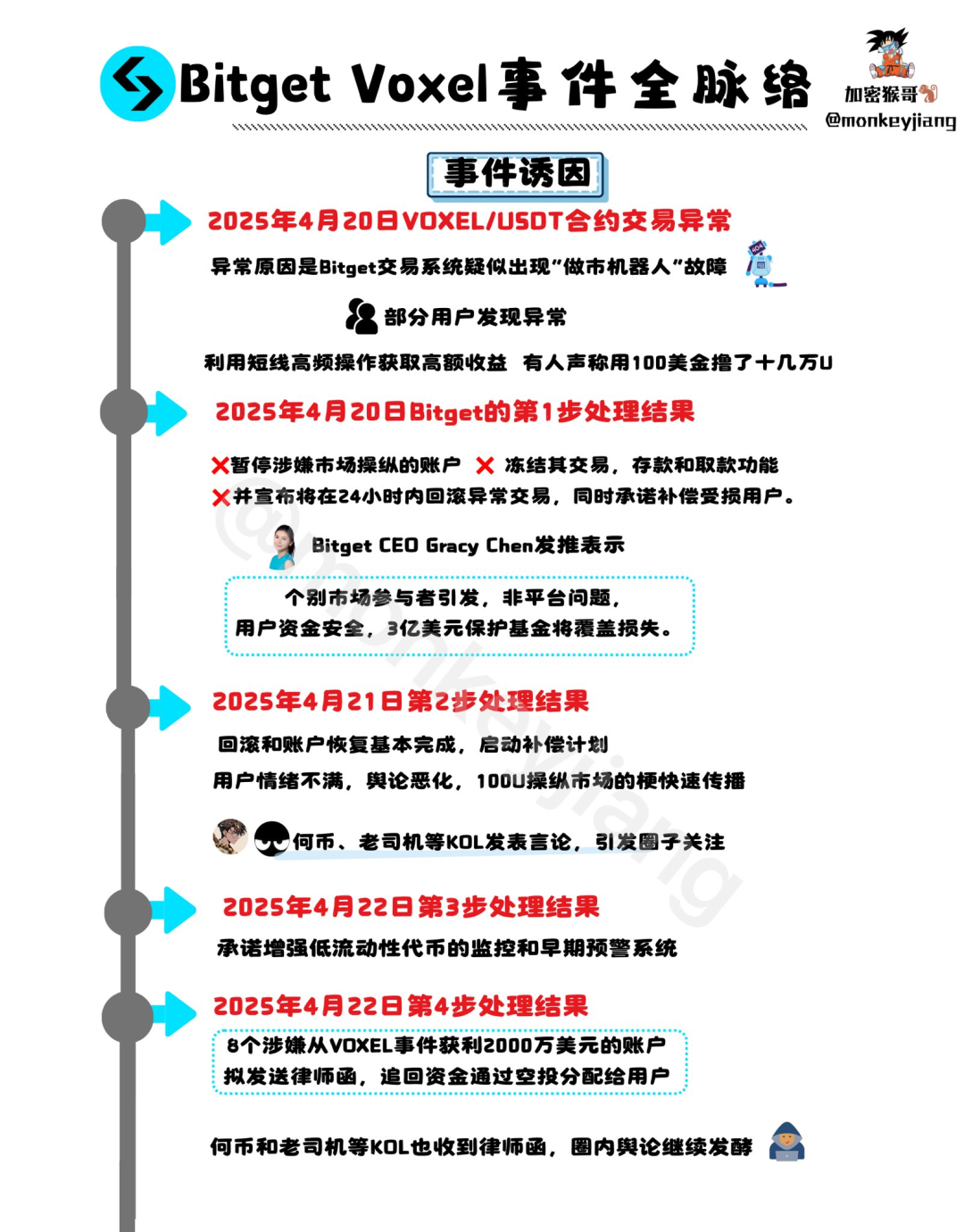
To put it simply, on April 20, the VOXEL/USDT contract transaction was abnormal, causing some users to earn a total of more than 40 million US dollars through short-term operations, especially one of the teams, that is, the 8 people who received the lawyer's letter from Bitget (hereinafter referred to as BG), who made more than 20 million US dollars (BG said they were suspected to be a professional profiteering team, while the other party claimed to be a professional market maker. We don’t know who is real and who is fake).
Afterwards, BG began to recover losses by rolling back transactions, freezing accounts, and sending lawyers' letters. This series of actions directly pushed the incident to the forefront of public opinion.
Players in the cryptocurrency circle have taken sides. Web3 KOLs represented by Hebi (@hebi555) and Coin Circle Old Driver (@SEFATUBA3) accused BG: I make money by manipulation, and you BG are playing rogue when you lose. Can't you afford to play? Another small number of KOLs believe that BG did the right thing, and it is wrong to use the bug to make a profit; in addition, BG said that the recovered 20 million US dollars will be airdropped to users, which is good.
Passersby, such as attorney Mankiw, have been surfing the Internet and watching the show quietly these days.
However, in addition to enjoying the melon, Attorney Mankiw also saw the hot questions on social media. Today, let’s talk about the five hottest and most controversial questions from the perspective of Chinese law.
Q1: Bitget calls user arbitrage “theft”, is this statement valid?
Judging from the lawyer’s letter sent by BG, the platform or the lawyer’s side said that the user took advantage of the system bug to make arbitrage and was suspected of theft, so the lawyer’s letter was sent as a warning.
So the question is, does exploiting system loopholes for arbitrage constitute theft?
First of all, in the Criminal Law, theft is explained as "the act of secretly stealing public or private property in large amounts for the purpose of illegal possession." A simple understanding of it is to secretly take other people's money.
Arbitrage, on the other hand, is to make a profit from the price difference when seeing a price mismatch in the open market. It is essentially a market behavior, not done behind anyone's back, but rather an aboveboard transaction. It is far from theft.
However, please note that if you know that the other party's system has problems and use the bug to arbitrage, it is not as simple as arbitrage. In the content of Juzuo's official account, bg made such an analogy:
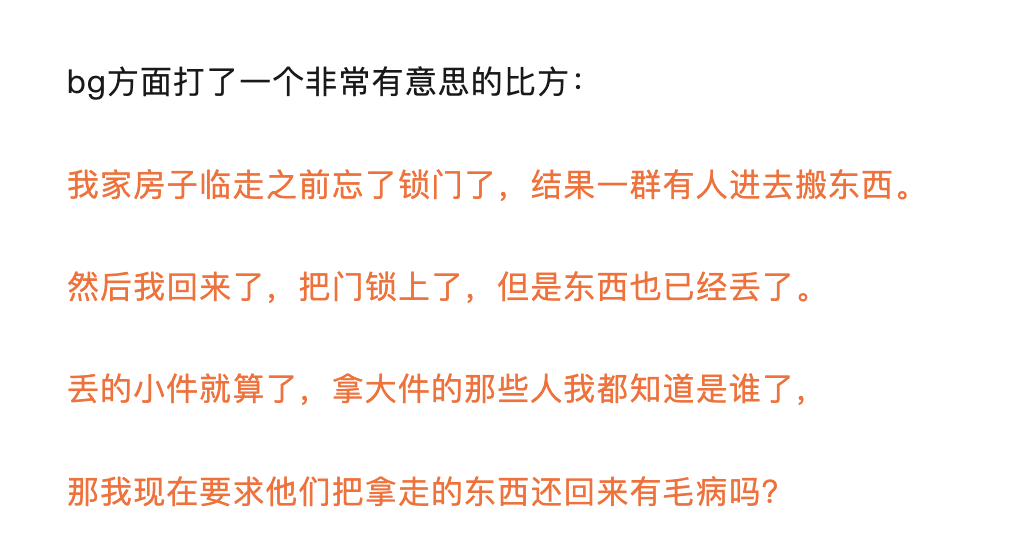
In fact, when handling traditional criminal cases, our lawyers often encounter cases in the Web2 industry where outsiders exploit system bugs to make money, which the court ultimately finds to be theft or even fraud. If insiders exploit system loopholes to make a profit, it is considered embezzlement.
Therefore, we still need to look at the evidence for this behavior, that is, whether these people knew about and exploited the system bug and caused financial losses to BG.
Judging from the current public opinion, most retail investors think that you usually make so much money, and now the system has problems, why can't the pattern be opened? (Can't you learn from a well-known overseas e-commerce platform? The price was wrong, and someone bought it, which is considered a benefit to the customer). The platform said that the other party deliberately caused the BOT problem, and then said that it was using the bug to make money.
Attorney Mankiw suggested that in the absence of sufficient evidence, everyone should wait. Didn’t BG say it would release an incident report soon?
Q2: Bitget is an overseas entity. Can it send a lawyer’s letter or file a lawsuit against Chinese users?
Many people are questioning why BG, an overseas entity, suddenly sent a lawyer's letter to Chinese users and threatened to hold them accountable?
Lawyer Mankiw saw some legal analysis that said it was possible, because BG has overseas entities, and in theory, foreign companies can hold domestic individuals accountable. Article 265 of China's Civil Procedure Law also stipulates that if a foreign-related contract dispute occurs in China or the defendant's property is located in China, the court can handle it.
There is nothing wrong with this theory. Microsoft even sent letters to domestic pirated users in the early years. However, in the currency circle, we also have to consider the attitude of domestic regulators towards cryptocurrency transactions - virtual currency transactions are defined as illegal financial activities.
This is the point that everyone discusses the most. In this context, BG sent a lawyer's letter to users, hoping to seek protection from Chinese law?
In fact, a lawyer's letter is just a kind of power of attorney. Its essence is to inform the recipient "I entrust this lawyer to speak for me". It is neither a case filing notice nor a court judgment. Even a criminal suspect can entrust a lawyer to send a lawyer's letter.
As for whether the lawsuit can be really brought and whether the case can be won, that is a matter of subsequent judicial procedures.
Therefore, based on this fact, the current lawyer's letter may be more of a psychological warfare. Will it eventually cause a splash, and what kind of splash? Let's wait and see.
Q3: It is rumored that Bitget has frozen users’ Binance accounts. How did it do that?
This time, BG froze the Binance accounts of arbitrage users through the police, directly attacking across exchanges.
Can it still be done this way?
Generally speaking, if the public security department freezes your account, it means that they have started to investigate and determine that you are suspected of a criminal offense. Then they will issue a formal document to notify the relevant platforms to cooperate with the action. However, this step also requires the approval of the case handling unit before it can be executed.
Then, combining the first and second questions, Attorney Mankiw boldly speculates that BG's lawyer's letter and the public security freeze are actually coordinated, with the purpose of pushing the matter in a criminal direction, locking up the other party's funds, and increasing bargaining chips.
Judging from the feedback from the X platform, some accounts have indeed been frozen, but how the case was filed, what entity and method were used, are not disclosed in detail. We can only be cautious and wait for follow-up.
Q4: Bitget rolls back the transaction. Is this operation reasonable and legal?
To be honest, what initially caused users' dissatisfaction was that BG froze withdrawals after the incident and recovered part of the losses through rollback.
Originally, users fought hard in the contract market and made a lot of money, but the platform directly responded with a big move: "Sorry, the system is abnormal, this order does not count, and it is rolled back." Moreover, not only was it rolled back, but the handling fees and slippage were also wiped out. Some users even had negative account balances.
Therefore, many users complained on social media: You run your own casino and gamble against users, you can’t afford to lose, right?
But the question is, is it legal to roll back this?
First of all, there is usually a clause in the user agreement of general exchanges, which roughly means that if there is a system failure or technical abnormality, the platform has the right to adjust or roll back.
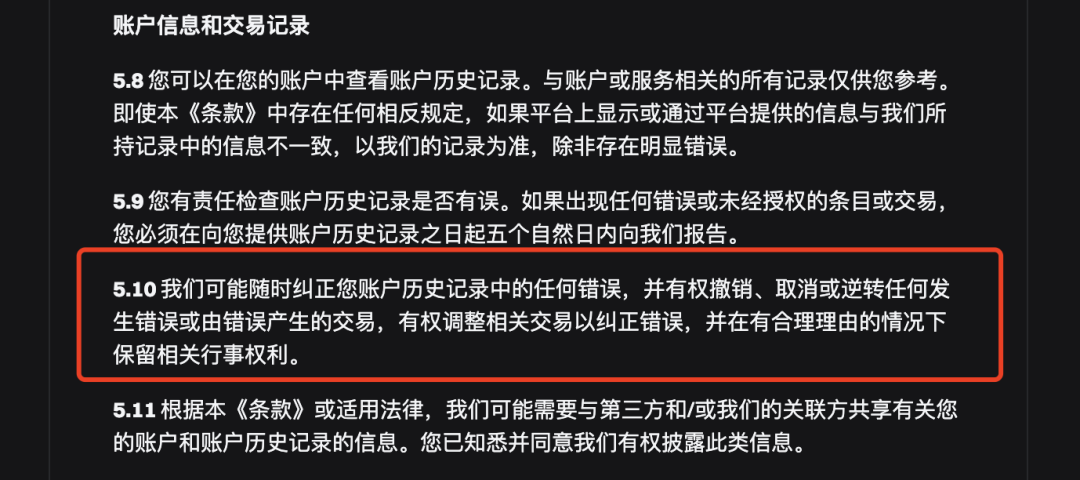
So, if you want to use BG, you have to agree. If you agree, then if something goes wrong, you have to follow the agreement and roll back if BG says so.
In fact, other platforms also have a history of rollbacks. For example, in September 2021, FTX's SOL-PERP contract plummeted due to liquidity issues, causing some users' high-leverage positions to be liquidated, and transactions seriously deviated from spot prices. Subsequently, FTX issued an announcement in advance, announcing the rollback of some transactions. Previously, OKX also had a small-scale rollback, and it also issued an announcement throughout the process to explain the scope and standards of the rollback, and did not generate negative public opinion.
Back to this incident, is it reasonable to roll back when there is a user agreement?
Obviously, this is the same as some Internet companies’ bugs and system rollbacks, which is reasonable but not up to standard. Looking at the above case in detail, we can find that before and after the rollback, other platforms issued announcements immediately, with transparent procedures, clear standards, and corresponding compensation plans.
On the other hand, this time BG may be eager to cut off the flow of funds and prevent arbitrageurs from transferring funds, which led to too hasty actions and too rough procedures. It is precisely because of this rough operation that an irreversible platform credit discount has been caused - the market can understand that the platform saves itself when the system has problems; but the operation of the covert operation first, followed by a set of lawyers' letters and cross-exchange freezing operations is really unacceptable to users.
Q5: Can users sue Bitget for running a casino? Can they recover their losses?
Now, social media opinion has fermented to the point of "If your BG sends me a lawyer's letter, then I will sue you for opening a casino."
OK, OK, you are ready to love and hate each other, right? So, is it possible? Can this help users recover their losses?
First, let’s look at Article 303 of China’s Criminal Law: The crime of opening a casino refers to organizing gambling or providing gambling conditions for the purpose of profit.
On this basis, combined with Mankiw’s previous tweets, “Mankiw Research | Is cryptocurrency perpetual contract trading gambling or financial derivatives? Mankiw compares the current global regulatory situation” and “Mankiw’s Legal Education | Why are virtual currency exchange contracts suspected of opening casinos when they bring orders and rebates?”, there are indeed court cases in mainland China that have identified cryptocurrency perpetual contracts as illegal gambling, and some players who bring orders and rebates are considered accomplices to the opening of casinos by the casinos.
Lawyer Mankiw is currently defending several exchanges, and his defense is to deny the gambling nature of the exchanges’ perpetual contracts:
1. On the one hand, in terms of global regulatory policies, overseas countries recognize contracts as financial derivatives, and the mainland is the only one that recognizes them as gambling. This is not simply a matter of different laws, but may be a problem of some people's lagging understanding of the Web3 industry.
2. On the other hand, from the perspective of social governance, if investors really want to maintain the mainland's practice of identifying contracts as gambling, they should be prepared. These exchanges will be investigated, and the records of playing contracts in the background and the withdrawal records will be all there. If they are caught, they will be punished for gambling (administrative punishment).
So, if you are willing to turn the table over, you can go to those regions that have issued precedents that "contracts are gambling" and report the case, let them unify the judgment standards, and then those who play contracts will first receive an administrative penalty for participating in gambling?
Attorney Mankiw's Summary
The VOXEL contract incident is basically a war of public opinion in the market. It is true or false. We are not stakeholders and can only watch the show. It is better to let the bullets fly for a while. Anyway, BG said that the incident report will be released soon. In addition, since the lawyer's letter and the public security freezing of accounts have already begun, it is not something that can be ended by simple verbal attacks.
/ END.