I. Global Macroeconomic Variables Reshape Asset Pricing: Inflation, the US Dollar, and a New Round of Capital Game
In the second half of 2025, global financial markets entered a new era dominated by macroeconomic variables. Over the past decade, loose liquidity, global collaboration, and technological dividends formed the three pillars of traditional asset pricing. However, in this cycle, these conditions are undergoing a systematic reversal, and the pricing logic of the capital market is undergoing a profound reshaping. Cryptoassets, as a leading indicator of global liquidity and risk appetite, are seeing their price trends, fund structure, and asset weights driven by new variables. The three most critical variables are the stickiness of structural inflation, the structural weakening of the US dollar's creditworthiness, and the institutional differentiation of global capital flows.
First, inflation is no longer a short-term volatility that can be quickly suppressed; it is beginning to exhibit a more "sticky" nature. In developed economies, represented by the United States, core inflation has remained consistently high above 3%, far above the Federal Reserve's 2% target. The core reason for this phenomenon lies not in simple monetary expansion but in the continuous consolidation and self-amplification of structural cost drivers. Although energy prices have fallen back to a relatively stable range, the surge in capital expenditures driven by artificial intelligence and automation, the rising prices of upstream rare metals during the green energy transition, and the rising labor costs caused by the reshoring of manufacturing have all become sources of endogenous inflation. At the end of July, the Trump administration reaffirmed that it would fully reimpose high tariffs on bulk industrial and technology products from China, Mexico, Vietnam, and other countries, effective August 1st. This decision not only signals the continuation of geopolitical tensions but also suggests that the US government considers inflation an acceptable "strategic cost." Against this backdrop, the costs of raw materials and intermediate products faced by US companies will continue to rise, driving a second round of increases in consumer prices and creating a pattern of "policy-driven cost inflation." This is not traditional overheating inflation, but rather policy-driven, embedded inflation, whose persistence and penetration into asset pricing will be far greater than in 2022.
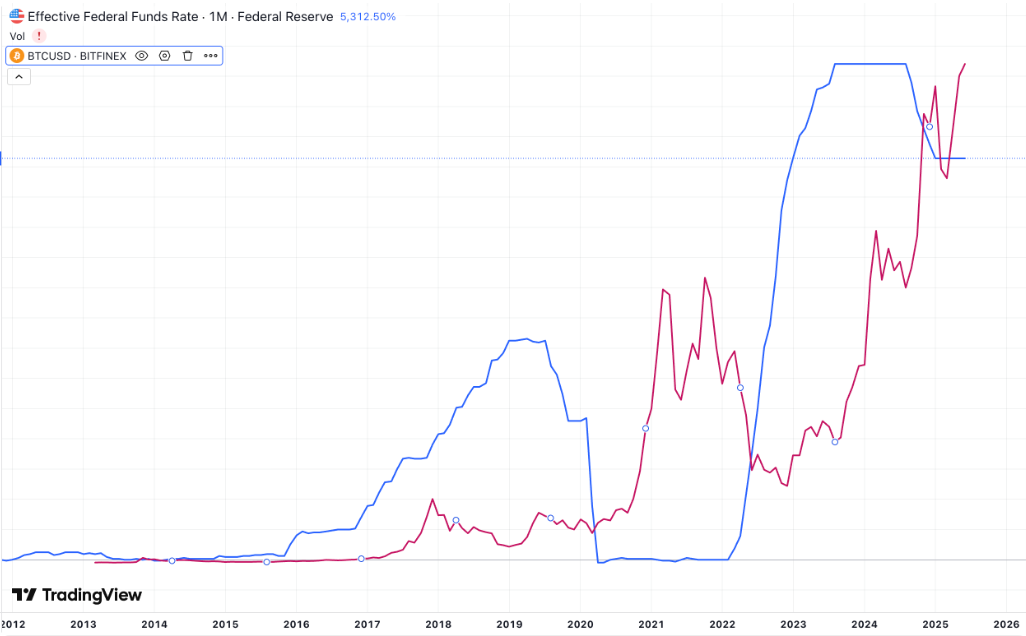
Secondly, with inflation still high, the Federal Reserve's interest rate policy is unlikely to loosen quickly. The market expects the federal funds rate to remain elevated above 5% until at least mid-2026. This has led to "suppressive pricing" in traditional stock and bond markets: the bond market's yield structure has inverted, duration products have suffered severe losses, and the stock market faces a continued increase in the discount factor in valuation models. In contrast, crypto assets, particularly Bitcoin and Ethereum, are valued more based on a three-pronged model of "expected growth, scarcity, and consensus anchor." They are not directly constrained by traditional interest rate instruments. In fact, in a high-interest environment, their scarcity and decentralized nature attract more investment, demonstrating "anti-monetary cycle" pricing behavior. This characteristic has gradually transformed Bitcoin from a "highly volatile speculative asset" to an "emerging alternative store of value asset."
More profoundly, the US dollar's global anchoring role is facing structural weakening. The US fiscal deficit continues to expand, exceeding $2.1 trillion in the second quarter of 2025, an 18% year-on-year increase, reaching a record high for the same period. At the same time, the US's position as a global settlement hub is facing challenges from decentralization. Countries such as Saudi Arabia, the UAE, and India are promoting large-scale currency-to-currency mechanisms. Cross-border payment systems such as the RMB-dirham and rupee-dinar are beginning to replace some US dollar settlements. Behind this trend lies not only the cyclical damage inflicted by US dollar policies on non-US economies, but also these countries' active attempts to decouple from the "single currency anchor." In this environment, digital assets have become neutral, programmable, and decentralized alternative media of value. For example, stablecoins like USDC and DAI have rapidly expanded in over-the-counter (OTC) transactions and B2B cross-border payments in Asian and African markets, becoming a digital extension of the "underground dollar system" in emerging markets. Bitcoin, on the other hand, has become a vehicle for capital flight and a safe haven for global funds against currency devaluation. In Argentina, Nigeria, and Turkey, for example, residents' purchasing power premium for BTC has reached over 15%, reflecting genuine demand for safe-haven capital. Notably, as the trend toward de-dollarization accelerates, the dollar's internal credit system is also showing signs of fatigue. In June 2025, Moody's and Fitch simultaneously downgraded the US long-term sovereign credit rating outlook to "negative," citing "structurally irreversible chronic fiscal deficits" and "political polarization impacting budget execution" as the primary reasons. Rating agencies' systemic warnings about US Treasuries triggered increased volatility in the US Treasury market, prompting safe-haven funds to seek diversified reserve assets. Purchases of gold and Bitcoin ETFs surged during the same period, demonstrating institutional funds' preference for reallocation to non-sovereign assets. This behavior reflects not only liquidity demand but also a "valuation flight" from the traditional asset system. With US stocks and bonds increasingly overvalued, global capital is seeking alternative anchors to rebalance the "systemic security" of its portfolios. Finally, institutional differences in global capital flows are reshaping the boundaries of asset markets. Within the traditional financial system, tightening regulation, valuation bottlenecks, and rising compliance costs are limiting the expansion of institutional capital. In the crypto sector, particularly driven by the approval of ETFs and the relaxation of audit regulations, crypto assets are gradually entering a phase of "compliance legitimacy." In the first half of 2025, several asset management companies received approval from the US SEC to launch thematic ETFs targeting crypto assets such as SOL, ETH, and AI. Funds are indirectly entering the on-chain market through financial channels, reshaping the distribution of funds across assets. This phenomenon reflects the increasing dominance of institutional frameworks over the flow of funds.
Thus, we can see an increasingly clear trend: changes in traditional macroeconomic variables—including the institutionalization of inflation, the blunting of US dollar credit, the prolonged high interest rates, and the policy-driven diversion of global capital—are jointly driving the dawn of a new era of pricing. In this era, value anchors, credit boundaries, and risk assessment mechanisms are all being redefined. Crypto assets, particularly Bitcoin and Ethereum, are gradually moving from a liquidity bubble to a stage of institutional value inheritance, becoming direct beneficiaries of the restructuring of the macro-monetary system. This also provides a foundation for understanding the "mainstream logic" of asset price movements in the coming years. For investors, updating their cognitive structure is far more critical than short-term market judgment. Future asset allocation will no longer simply reflect risk appetite but also a deeper understanding of institutional signals, monetary structure, and the global value system.
II. From MicroStrategy to Public Company Financial Reports: The Institutional Logic and Diffusion Trends of the Coin-to-Stock Strategy
In the 2025 cycle, the most structurally transformative force in the crypto market comes from the rise of the "coin-to-stock strategy." From MicroStrategy's early attempts to use Bitcoin as a corporate reserve asset to the increasing number of publicly listed companies proactively disclosing details of their crypto asset allocations, this model has evolved from an isolated financial decision to a strategic behavior embedded within the system. The coin-to-stock strategy not only bridges the gap between capital markets and on-chain assets but also fosters new paradigms in corporate financial reporting, equity pricing, financing structures, and even valuation logic. Its widespread adoption and capitalization effects have profoundly reshaped the funding structure and pricing model of crypto assets. Historically, MicroStrategy's Bitcoin strategy was viewed as a "go-for-broke" high-volatility gamble, particularly during the sharp decline in crypto assets between 2022 and 2023, which led to widespread skepticism about the company's stock price. However, in 2024, as Bitcoin prices broke through historical highs, MicroStrategy successfully restructured its financing logic and valuation model through a structured "coin-to-stock" strategy. Its core lies in the synergistic drive of three flywheel mechanisms: the first is the "stock-to-coin resonance" mechanism, whereby the company's BTC holdings, through rising prices, continuously amplify the net asset value of crypto assets in its financial statements, thereby driving up its stock price. This, in turn, significantly reduces the cost of subsequent financing (including additional issuances and bonds). The second is the "stock-to-debt synergy" mechanism, which introduces diversified capital through the issuance of convertible bonds and preferred stock, while leveraging the market premium of BTC to reduce overall financing costs. The third is the "coin-to-debt arbitrage" mechanism, which combines traditional fiat currency debt structures with the appreciation of crypto assets to achieve cross-cycle capital transfers. After successfully demonstrating this mechanism at MicroStrategy, it was rapidly imitated and structurally transformed in the capital market.
By 2025, the cryptocurrency-to-stock strategy is no longer limited to experimental configurations within a single company; instead, it has spread to a wider range of listed companies as a financial structure with both strategic and accounting advantages. According to incomplete statistics, as of the end of July, over 35 listed companies worldwide had explicitly included Bitcoin on their balance sheets, 13 of which also included ETH, and another five were tentatively allocating to mainstream altcoins such as SOL, AVAX, and FET. The common characteristics of this structural allocation are: on the one hand, it creates a closed-loop financing loop through capital market mechanisms; on the other hand, it uses crypto assets to enhance corporate book value and shareholder expectations, thereby boosting valuations and equity expansion capabilities, creating a positive feedback loop.
This widespread trend is primarily supported by changes in the institutional environment. The GENIUS Act and the CLARITY Act, which officially came into effect in July 2025, provide a clear and compliant path for listed companies to allocate crypto assets. Specifically, the "mature blockchain system" certification mechanism established by the CLARITY Act directly categorizes core crypto assets like Bitcoin and Ethereum as commodities, stripping the SEC of their securities regulatory authority and creating legal legitimacy for including these assets in corporate financial reports. This means that listed companies no longer need to classify their crypto assets as "financial derivatives" and instead can include them in long-term assets or cash equivalents as "digital commodities," and even, in certain scenarios, include them in depreciation or impairment charges, thereby reducing accounting volatility risk. This shift allows crypto assets to be included in mainstream financial reporting alongside traditional reserve assets like gold and foreign currency reserves.
Secondly, from a capital structure perspective, the crypto-equity strategy creates unprecedented financing flexibility. Under the Federal Reserve's high interest rate environment, financing costs for traditional businesses remain high, making it difficult for small and medium-sized growth companies, in particular, to leverage expansion through low-cost debt. Companies that invest in crypto assets, however, can leverage the valuation premiums generated by rising stock prices to not only achieve higher price-to-sales and price-to-book ratios (PS and PB) in the capital market, but can also use the crypto assets themselves as collateral to participate in new financial operations such as on-chain lending, derivatives hedging, and cross-chain asset securitization. This creates a dual-track financing system: on-chain assets provide flexibility and yield, while off-chain capital markets provide scale and stability. This system is particularly suitable for Web3-native businesses and fintech companies, allowing them to achieve far greater capital structure flexibility within a compliant framework than traditional approaches.
Furthermore, the crypto-to-equity strategy has also triggered a shift in investor behavior. With crypto assets widely allocated to public company balance sheets, the market has begun to re-price these companies' valuation models. Traditionally, corporate valuations are based on metrics such as profitability, cash flow expectations, and market share. However, when companies report large crypto holdings, their stock prices begin to exhibit a high correlation with the price of the cryptocurrency. For example, the share prices of companies like MicroStrategy, Coinbase, and Hut8 have far exceeded the industry average during Bitcoin's bullish cycle, demonstrating a strong premium for the "gold content" of crypto assets. At the same time, a growing number of hedge funds and structured products are beginning to view these "high-coin-weighted" stocks as ETF alternatives or proxies for crypto exposure, thereby increasing their allocations in traditional portfolios. This behavior has structurally driven the financialization of crypto assets, allowing Bitcoin and Ethereum to exist not only as assets in their own right but also as indirect circulation channels and derivative pricing functions in the capital market.
Furthermore, from a regulatory strategic perspective, the spread of the crypto-to-equity strategy is also seen as an extended tool for the United States to maintain its "dollar's voice" in the global financial order. Amidst the growing global trend of CBDC (Central Bank Digital Currency) pilots, the continued expansion of RMB cross-border settlements, and the European Central Bank's push for digital euro testing, the US government has not actively launched a federal CBDC. Instead, it has chosen to shape a decentralized dollar network through stablecoin policies and a "regulatable crypto market." This strategy requires a compliant, high-frequency market entry capable of large-scale deposits. Publicly listed companies, as a bridge between on-chain assets and traditional finance, precisely fulfill this function. The crypto-to-equity strategy can therefore be understood as the institutional support for the US financial strategy of replacing the US dollar with non-sovereign digital currencies. From this perspective, listed companies' allocation of crypto assets is not simply an accounting decision, but a path to participate in the restructuring of national financial structures. A more far-reaching impact lies in the global spread of capital structure. As more US-listed companies adopt the crypto-to-equity strategy, listed companies in Asia Pacific, Europe, and emerging markets are following suit, seeking to gain compliance space through regional regulatory frameworks. Countries like Singapore, the United Arab Emirates, and Switzerland are actively revising their securities laws, accounting standards, and tax regimes to open institutional channels for their companies to allocate crypto assets, creating a competitive landscape for crypto acceptance in the global capital market. It is foreseeable that the institutionalization, standardization, and globalization of crypto-to-equity strategies will be a key evolutionary direction for corporate financial strategies over the next three years and will serve as a crucial bridge for the deep integration of crypto assets with traditional finance.
In summary, from MicroStrategy's single breakthrough, to the strategic diffusion of this strategy by numerous listed companies, and finally to its institutional and standardized evolution, the crypto-to-equity strategy has become a key channel connecting on-chain value and traditional capital markets. It represents not only an update to asset allocation logic and a restructuring of corporate financing structures, but also the result of a two-way game between institutions and capital. In this process, crypto assets have gained wider market acceptance and institutional security, completing the structural transition from speculative assets to strategic assets. For the entire crypto industry, the rise of the crypto-to-equity strategy marks the beginning of a new cycle: crypto assets are no longer merely on-chain experiments but have truly entered the core of global balance sheets.
III. Compliance Trends and Financial Structure Transformation: The Path to Crypto Asset Institutionalization Accelerates
By 2025, the global crypto asset market is at a historical juncture where the wave of institutionalization is accelerating. Over the past decade, the crypto industry has shifted from a focus on innovation outpacing regulatory progress to one driven by compliance frameworks. Entering the current cycle, the core role of regulators has evolved from "enforcer" to "system designer" and "market guide." This reflects a renewed understanding of the structural influence of crypto assets within the national governance system. With the approval of Bitcoin ETFs, the implementation of stablecoin legislation, the launch of accounting standards reform, and the capital market's reshaping of digital asset risk and value assessment mechanisms, compliance is no longer an external pressure on industry development, but rather an internal driving force for financial restructuring. Crypto assets are gradually being embedded in the institutional network of the mainstream financial system, completing the transition from "gray financial innovation" to "compliant financial components." The core of this institutionalization trend is primarily reflected in the clarification and gradual relaxation of the regulatory framework. Between late 2024 and mid-2025, the United States passed the CLARITY Act, the GENIUS Act, and the FIT for the 21st Century Act, providing unprecedented clarity across a range of regulations, from commodity identification, token issuance exemptions, stablecoin custody requirements, KYC/AML regulations, to the applicable boundaries of accounting standards. The most structurally impactful of these legislation is the "commodity" classification system, which classifies foundational public blockchain assets like Bitcoin and Ethereum as tradable commodities, explicitly excluding them from securities law regulation. This classification not only provides a legal basis for ETFs and the spot market but also creates a definitive compliance path for enterprises, funds, banks, and other institutions to incorporate crypto assets. Establishing this "legal label" is the first step in institutionalization and lays the foundation for subsequent tax treatment, custody standards, and financial product structuring. Meanwhile, major global financial centers are competing to promote localized institutional reforms, fostering a competitive landscape where regulatory silos are shifting to regulatory high ground. Singapore's MAS and the Hong Kong Monetary Authority have both introduced multi-tiered licensing systems, incorporating exchanges, custodians, brokers, market makers, and asset managers into differentiated regulatory frameworks, establishing clear entry barriers for institutions. Abu Dhabi, Switzerland, and the UK are piloting on-chain securities, digital bonds, and composable financial products in their capital markets, enabling crypto assets to not only exist as an asset class but also gradually evolve into underlying elements of financial infrastructure. This "policy experimentation field" mechanism not only fosters innovation but also promotes the digital transformation of the global financial governance system, providing a new path for institutional upgrades and coordinated development for the traditional financial industry.
Driven by these institutional drivers, the underlying logic of the financial structure has also undergone profound changes. First, there has been a restructuring of asset classes. The proportion of crypto assets in the allocation strategies of large asset managers has steadily increased year by year, from less than 0.3% of global institutional allocations in 2022 to over 1.2% in 2025, and is expected to exceed 3% in 2026. This proportion may seem small, but the marginal flow represented by the trillions of dollars in assets is sufficient to reshape the liquidity and stability structure of the entire crypto market. Institutions like BlackRock, Fidelity, and BlackRock have not only launched BTC and ETH-related ETFs but have also incorporated crypto assets into their core asset allocation baskets through proprietary funds, fund-of-funds (FOFs), and structured notes. Their role as a risk hedging tool and growth engine is gradually taking shape.
Secondly, there is the standardization and diversification of financial products. Previously, crypto asset trading was primarily limited to spot and perpetual contracts. However, driven by regulatory compliance, the market has rapidly evolved into a diverse range of product forms embedded in traditional financial structures. Examples include crypto ETFs with volatility protection, bond-like products pegged to stablecoin interest rates, on-chain data-driven ESG asset indices, and on-chain securitized funds with real-time settlement capabilities. These innovations not only enhance crypto asset risk management capabilities but also lower the barrier to entry for institutional investors through standardized packaging, allowing traditional funds to effectively participate in the on-chain market through compliant channels.
The third layer of financial structural transformation is reflected in clearing and custody models. Starting in 2025, the US SEC and CFTC jointly recognized three "compliant on-chain custodians," marking the official establishment of a bridge between asset ownership, custody responsibilities, and statutory accounting entities for on-chain assets. Compared to the previous model of custody based on centralized exchange wallets or cold storage, compliant chain custodians use on-chain verifiable technology to achieve tiered asset ownership, isolated trading permissions, and embedded on-chain risk control rules, providing institutional investors with risk control capabilities approaching those of traditional trust banks. This change in the underlying custody structure is a key step in the institutionalization of infrastructure, determining whether the entire chain of financial services can truly support complex structured operations such as cross-border settlement, mortgage lending, and contract settlement.
More importantly, the institutionalization of crypto assets is not only a process of regulatory adaptation to the market but also an attempt by sovereign credit systems to incorporate digital assets into macro-financial governance structures. With stablecoin daily trading volume exceeding $3 trillion and beginning to assume actual payment and clearing functions in some emerging markets, central banks' attitudes towards crypto assets are becoming increasingly complex. On the one hand, central banks are promoting the development of CBDCs to strengthen their monetary sovereignty; on the other hand, they are adopting an open management approach of "neutral custody + strong KYC" for some compliant stablecoins (such as USDC and PYUSD), effectively allowing them to assume international settlement and payment clearing functions within certain regulatory boundaries. This shift in attitude means that stablecoins are no longer a target of central bank opposition, but rather one of the institutional containers in the restructuring of the international monetary system.
This structural shift ultimately reflects on the "institutional boundaries" of crypto assets. The market in 2025 will no longer be divided by the discrete logic of "cryptocurrency circle - blockchain circle - outside the circle," but will instead form three continuous tiers: "on-chain assets - compliant assets - financial assets." Channels and mapping mechanisms exist between each tier, meaning that each asset type can enter the mainstream financial market through some institutional path. Bitcoin has evolved from a native on-chain asset to the underlying underlying asset of an ETF, Ethereum from a smart contract platform asset to a general-purpose computational financial protocol token, and even the governance tokens of some DeFi protocols have been structured and packaged as risk exposure tools for hedge funds and entered the FOF fund pool. This flexible evolution of institutional boundaries has made the definition of "financial assets" truly cross-chain, cross-national, and cross-institutional systems for the first time.
From a more macro perspective, the institutionalization of crypto assets is essentially the adaptation and evolution of the global financial structure in response to the wave of digitalization. Unlike the Bretton Woods system and the petrodollar system of the 20th century, the 21st-century financial structure is reshaping the fundamental logic of resource flows and capital pricing through a more distributed, modular, and transparent approach. Cryptoassets, a key variable in this structural evolution, are no longer merely an outlier but rather digital resources that are manageable, auditable, and taxable. This institutionalization process is not a sudden policy shift, but rather a systematic evolution involving the collaborative interaction of regulators, markets, businesses, and technology.
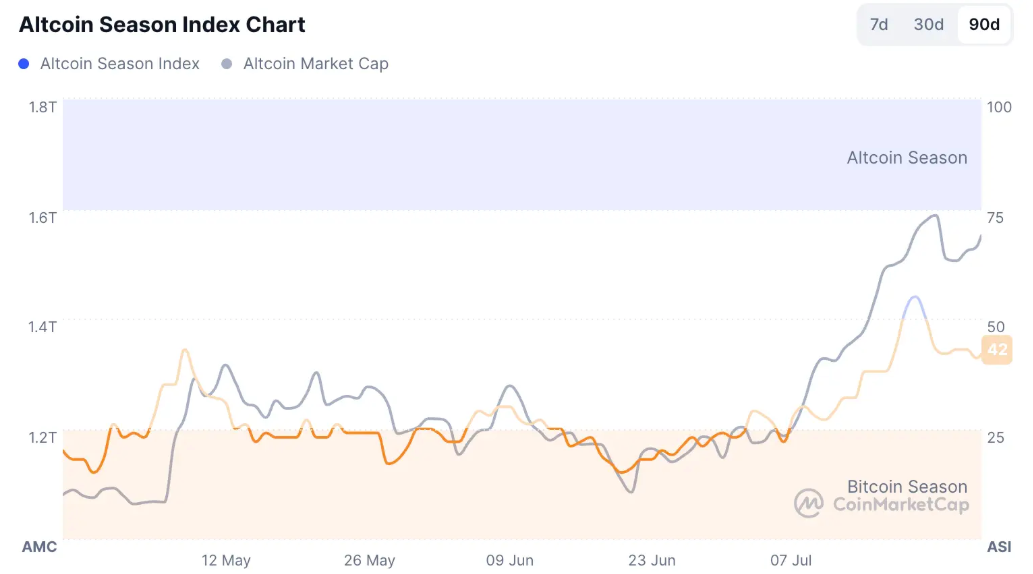
Therefore, it is foreseeable that the institutionalization of crypto assets will further deepen, and over the next three years, three coexisting models will emerge in major economies around the world: one is the "market openness + prudent regulation" model led by the United States, with ETFs, stablecoins, and DAO governance as the core institutional axes; the other is the "restricted access + policy guidance" model represented by China, Japan, and South Korea, emphasizing central bank control and licensing mechanisms; and the third is the "financial intermediary pilot zone" model represented by Singapore, the United Arab Emirates, and Switzerland, providing institutional intermediaries between global capital and on-chain assets. The future of crypto assets is no longer a struggle between technology and institutions, but rather a reorganization and absorption of technology by institutions.
Fourth, Conclusion: From Bitcoin's Ten Years to the Crypto-Stock Linkage, Welcoming a New Crypto Landscape
In July 2025, Ethereum will celebrate its tenth anniversary, and the crypto market will move from early experiments to institutional validation. The widespread launch of crypto-stock strategies symbolizes the deep integration of traditional finance and crypto assets.
This cycle is not just a market revival, but a restructuring of structure and logic: from macro-currency to corporate assets, from crypto infrastructure to financial governance models, crypto assets have truly entered the realm of institutional asset allocation for the first time.
We believe that over the next two to three years, the crypto market will evolve into a three-pronged structure of "on-chain native returns + compliant financial interfaces + stablecoin-driven" development. The crypto-stock strategy is just the beginning; the deeper integration of capital and the evolution of governance models have just begun.