
Author: Fairy, ChainCatcher
Editor: TB, ChainCatcher
Friendly reminder: The "Seven Sins of Bitcoin Ecosystem" listed in this article are purely for ridicule, not for deliberate smearing, nor for discrediting the belief attribute of Bitcoin. We respect Satoshi Nakamoto and also respect time. If there are any harsh opinions, we hope that the ecosystem builders will forgive us.
Pizza Day is celebrating its 14th year, and Bitcoin has broken through $110,000 today, setting a new record. Bitcoin is going up, but the Bitcoin ecosystem seems to be going down.
Bitcoin has grown from a white paper to a new anchor of global assets, and the story of Bitcoin ecology has also changed from a simple technical narrative to a complex picture of human nature, market, power and faith. But under all the noise, few people mention the real problem.
Pizza Day is worth commemorating and reflecting on. At this point, we might as well take a more sober perspective and review the "seven deadly sins" hidden behind the Bitcoin ecosystem.
The light of ideal shines into the difficulties of reality
Bitcoin's market value returned to the trillion-dollar mark in early 2024, and it has been nearly a year and a half since then, but its ecological activity is seriously out of balance with its asset size.
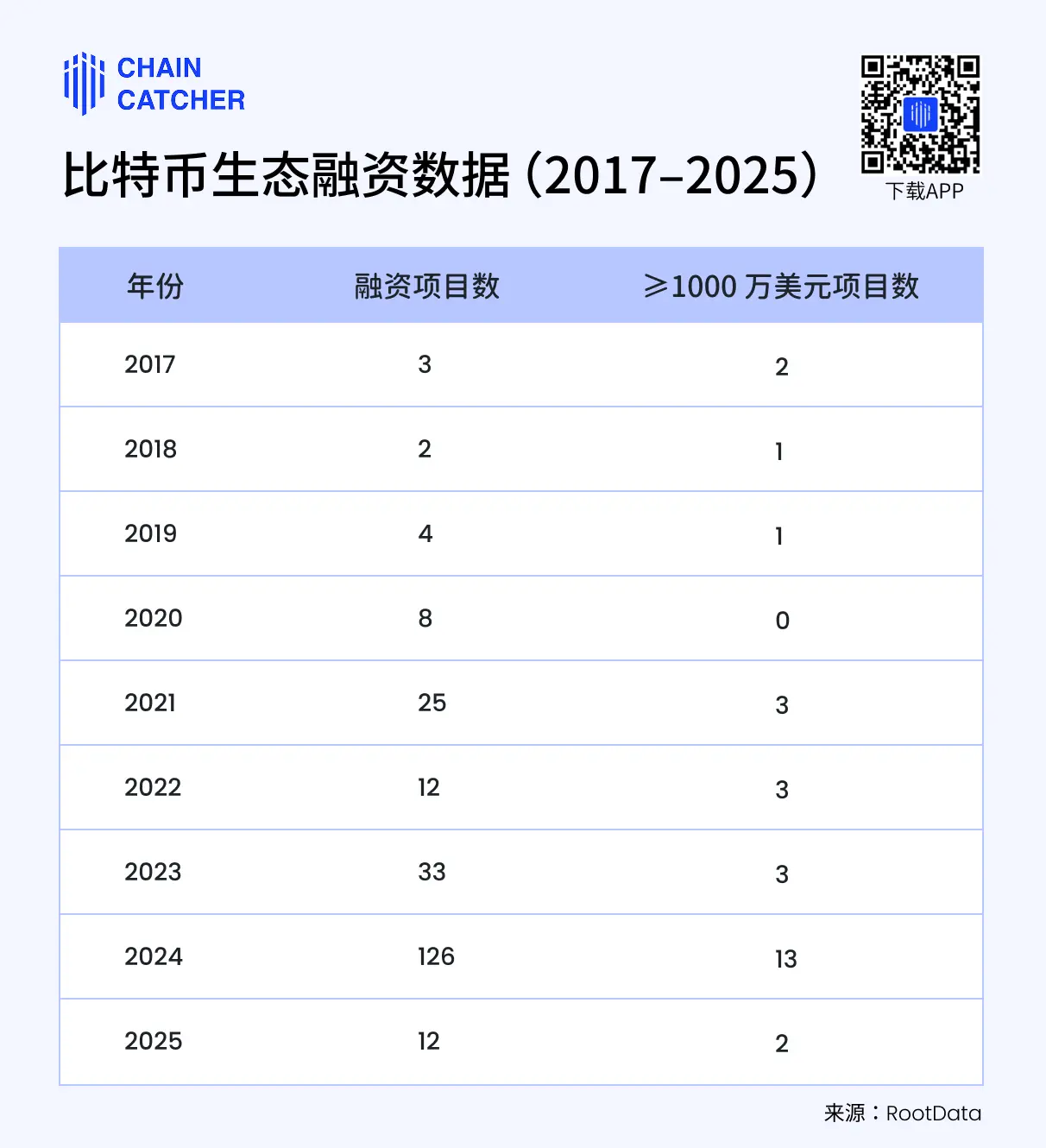
So far, only 13 projects in the Bitcoin ecosystem have completed financing in 2025, compared with 72 in the same period last year and 126 in the whole year. The number of financings has been nearly halved, and capital enthusiasm has quickly receded.
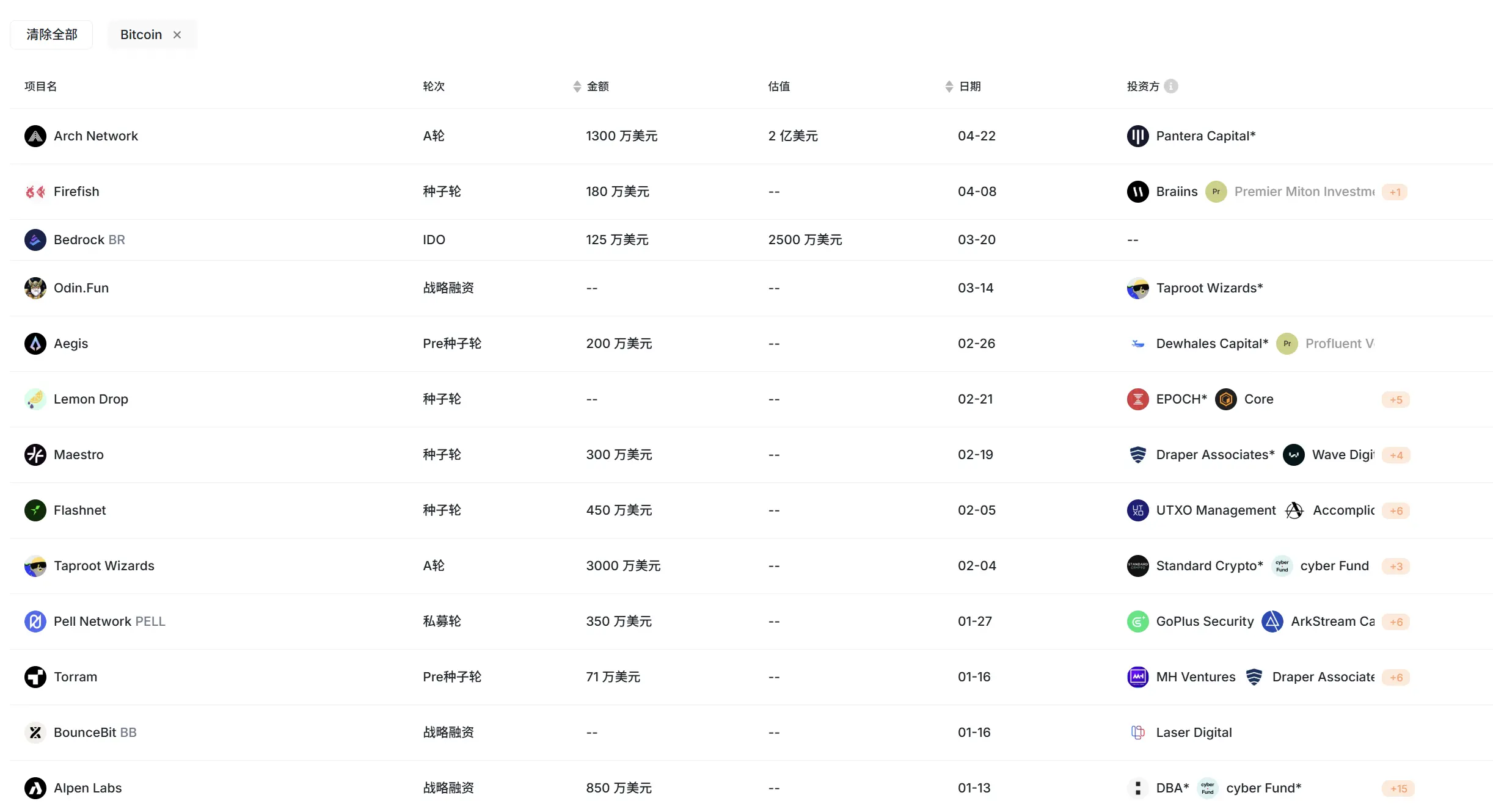
Image source: RootData
Looking at the on-chain data, DefiLlama shows that the current TVL of the Bitcoin ecosystem is only $6.3 billion, one-tenth of the Ethereum ecosystem ($62.3 billion). Among them, Babylon contributed $5 billion, accounting for more than 80%, and the ecological structure is extremely concentrated.
If we compare TVL with the token market value, the problem is even more glaring: BTC's TVL/market value ratio is only 0.2%, far below the average level of mainstream public chains. Ethereum, Solana, TRON and other chains generally maintain above 10%, and their capital utilization efficiency is significantly higher than Bitcoin.
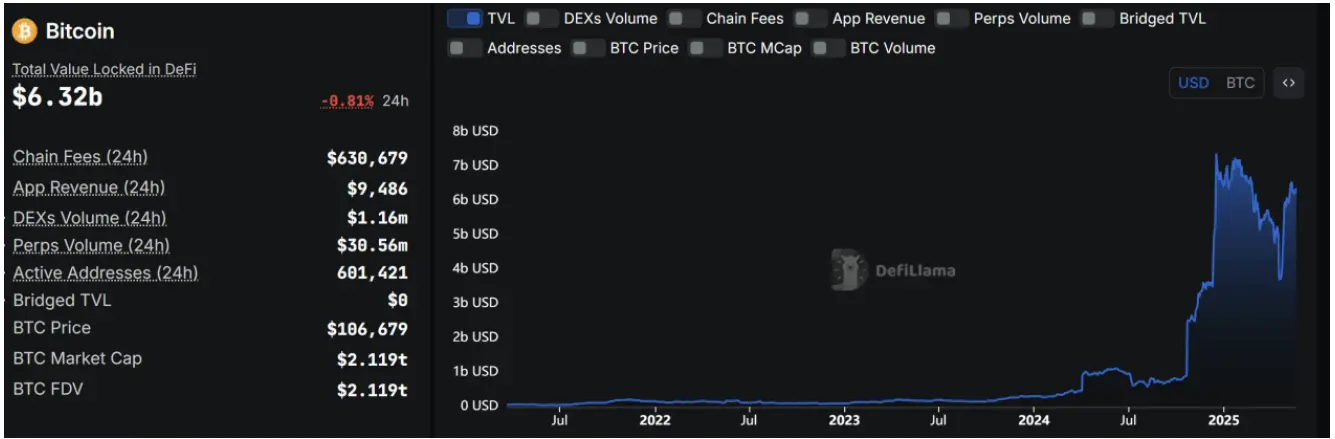
Image source: DefiLlama
In addition, looking back at the star projects in the Bitcoin ecosystem, such as Stacks and Merlin Chain in the L2 direction, Solv Protocol, Babylon, BounceBit in the staking track, and inscription assets ORDI and SATS, most of them continued to be sluggish in price performance.
Although Bitcoin is the "golden signboard" of the crypto market, it is almost a hollow tower in terms of ecological construction. The following are the "seven sins" we have sorted out.
The first sin: the sin of ecological bubble
From the end of 2023 to 2024, the Bitcoin ecosystem will usher in a wave of "massive" awakening narratives. From inscriptions, L2, to re-staking, it seems that overnight, the dormant BTC ecosystem suddenly became a hotbed of innovation. But when the market boom fades, the real results are still scarce.
Many protocols themselves are not disruptive innovations, neither reconstructing the original paradigm nor creating truly new market demand. A large number of projects are just new packaging of old concepts, with weak underlying structures, crude designs, and out of touch with usage scenarios. The relevant teams are uneven, and few have the real willingness and ability to build for the long term.
As community member @blapta said: "From the perspective of business results, almost none of these so-called technologically advanced projects have actually landed. Whether the agreement is established is no longer the focus. After a round of financing, the story is told and the project dies down. This is not only a technical failure, but also a cultural silence."
The Second Sin - Dogmatism and Infighting
Idealism has never been absent in the Bitcoin ecosystem, but when it merges with dogmatism, it quietly degenerates into closedness and self-limitation. In this system that prides itself on "decentralized belief", once the technical route, consensus mechanism and even the development direction touch upon a certain "fundamentalist" position, it is very easy to evolve into a black-and-white struggle between camps.
Almost every major upgrade of the Bitcoin network has gone through a long process of acceptance. SegWit only covered about 50% of transactions two years after its activation, and it was close to 80% four years later; Taproot, activated in November 2021, was also slow, with an adoption rate of less than 1% in early 2023 and only reaching 39% in early 2024. Developers and the community are extremely cautious about the evolution of the protocol.
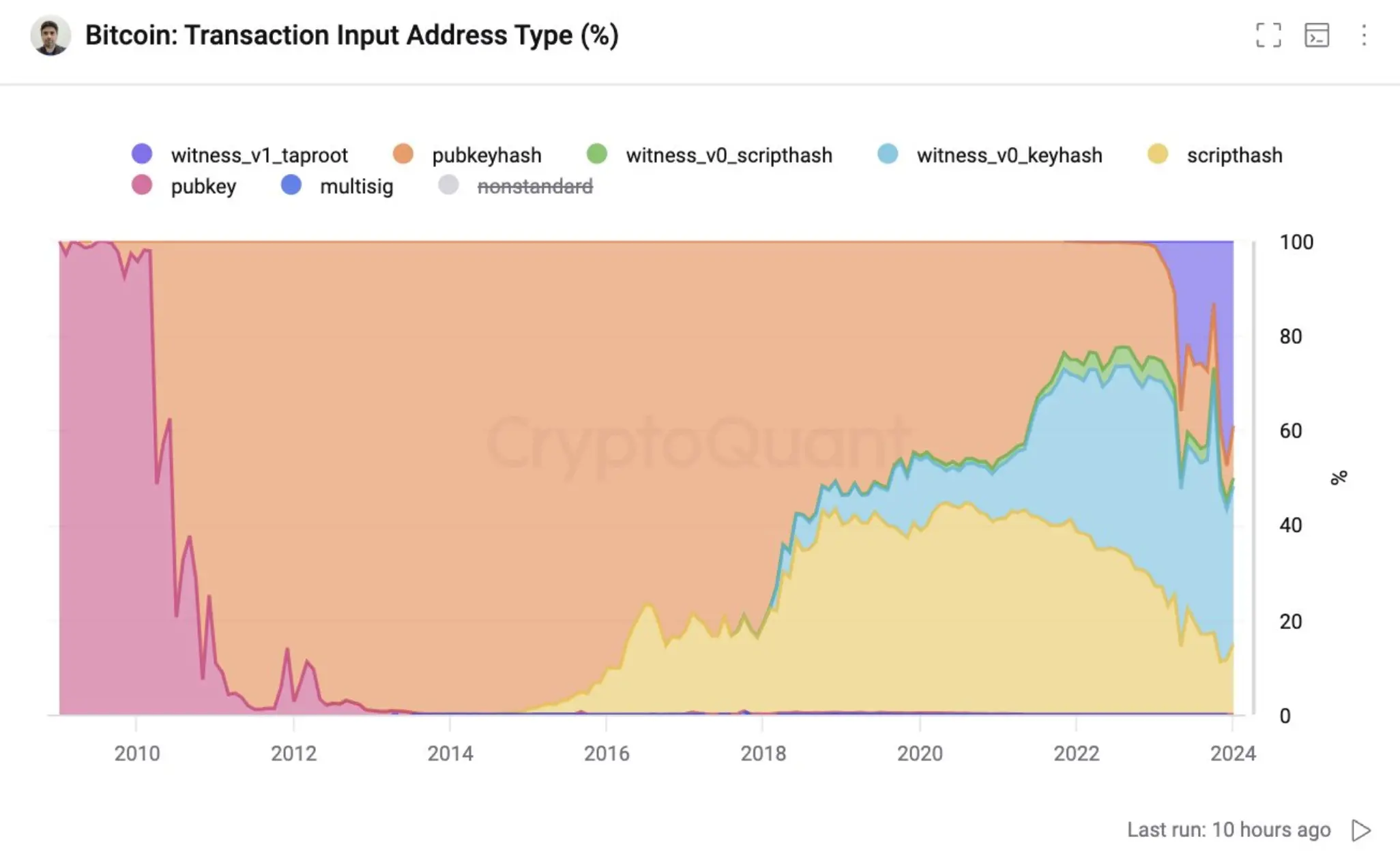
Image source: Ki Young Ju, founder of CryptoQuant
The historical BCH and BSV fork events also confirmed the deep-seated roots of the early ideological divisions and factional conflicts in the Bitcoin community. At the same time, some community members are resistant to innovative directions such as smart contracts and asset issuance. There has always been a long-term game and disagreement between "sticking to the Satoshi route" and "promoting functional upgrades."
The third sin: the sin of talent exhaustion
If developers are the dreamers and foundation builders of a public chain ecosystem, then Bitcoin is experiencing a chronic talent drain crisis. Unlike the vigorous development enthusiasm and commercial momentum shown by Ethereum, Solana and other ecosystems, the development landscape of Bitcoin seems increasingly sparse.
This decline in development capabilities is partly due to its long-term reliance on a donation-driven development model and the lack of a stable, sustainable incentive system, which makes it difficult to attract fresh blood and retain experienced veterans.
According to DeveloperReport data, there are only 359 full-time developers in the current BTC ecosystem, of which the number of full-time developers with one year of experience has decreased by 9.1%, and the number of developers with more than two years of experience has also decreased by 4%. In terms of main chain developers only (excluding EVM and SVM stacks), Bitcoin ranks fifth among all chains, far lower than Ethereum (2,181), which ranks first, and has 6 times the number of developers as Bitcoin.
What is more noteworthy is that among the limited number of developers, as many as 42% focus on expansion solutions, which means that manpower for the construction of Bitcoin's native application layer and other aspects is even more scarce.
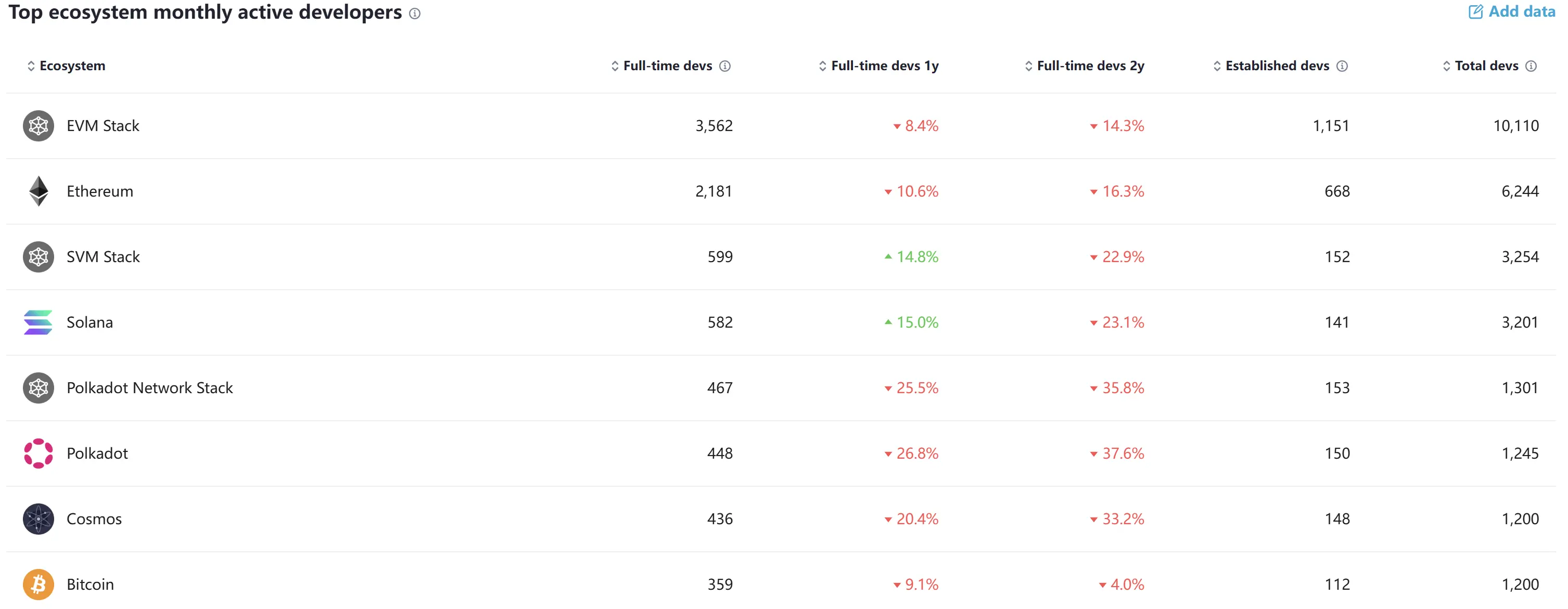
Image source: Developerreport
The fourth sin: the sin of value retention
The huge BTC stock has not been converted into financial productivity, but has been deposited as "dormant capital" on the chain. According to the latest research by Binance Research, only 0.79% of BTC is actually used in DeFi, while Bitcoin that has not been transferred in the past year has accounted for more than 60% of the total supply, and this proportion is still rising.
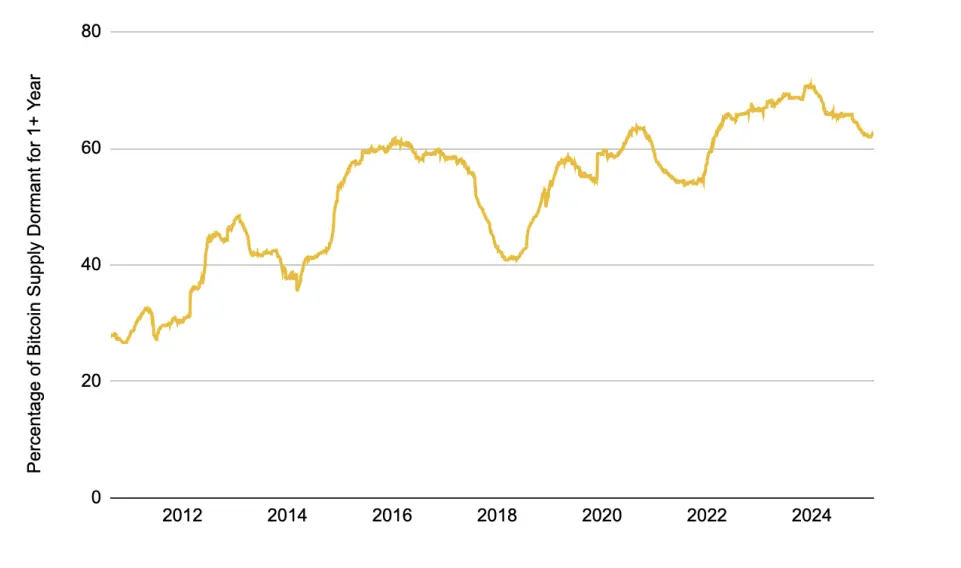
The percentage of Bitcoin that has not been moved in the past year. Source: Binance Research
This not only reflects the further consolidation of Bitcoin's "digital gold" positioning, but also exposes a serious gap in its ecosystem's financial availability. BTC holders have very limited ways to use their assets, mainly concentrated in centralized lending platforms or cross-chain generated WBTC and other forms, but these paths generally face problems such as low yields, high centralization risks, and insufficient security, and lack of appeal.
In contrast, the financial ecology of Bitcoin has not yet established a sustainable asset utilization mechanism, and cannot meet investors' multi-level needs for income acquisition, risk management, and strategy deployment. This "value retention" is becoming a key shackle restricting the evolution of the Bitcoin ecology.
The fifth sin: the sin of misallocated attention
The recent upgrade discussions in the Bitcoin community have fallen into a vicious circle of "high heat and low efficiency": few proposals with real technical depth and development potential are put forward, but instead some "insignificant" issues are repeatedly debated.
Take BIP177 as an example. Although it is only about adjusting the unit display method, it has caused a long dispute in the community. However, those proposals that may really promote the leap in protocol capabilities, such as the CTV + CSFS combination for asynchronous payment and optional payment paths, and BIP360 (anti-quantum attack) to cope with future security challenges, have received little attention.
The BIP system in Bitcoin's governance mechanism, which was not very efficient to begin with, has become increasingly rigid under this mismatch of attention. Core upgrades that truly require extensive testing, evaluation, and collaborative promotion have quietly fallen silent in the discourse competition. Community member @blapta said: "I hope that Bitcoin's community discussion will return to normal discussion as soon as possible. If it is delayed any further, the development will be too old."
The Sixth Sin: Narrative Closure
Amid the fast pace of the crypto industry, the narrative of the Bitcoin ecosystem seems particularly monotonous. The “digital gold” narrative has played a role in consolidating consensus and delivering value, but it should not evolve into a framework that restricts innovation and expands imagination.
In contrast, other chain ecosystems continue to stimulate new interests and new narratives around Restaking, Meme, DePIN, AI, etc., driving the continuous flow of community vitality and financial attention.
Although Taproot Assets, Ordinals, etc. briefly sparked imagination, the lack of sustained narrative promotion and systematic support ultimately failed to form a stable growth curve.
The Seventh Deadly Sin: Lack of Investability
In a market system where capital is driven by profit, "investability" determines the ultimate flow of funds. Speculation is the most real and honest flow logic of funds on the chain. However, the shortcomings of the Bitcoin ecosystem in this regard are extremely obvious: complex deployment, weak liquidity, primitive trading mechanisms, etc., making it difficult for market makers, arbitrageurs, and hot money to enter and exit efficiently.
This can also be seen from the data: except for the short-term capital attention attracted by the Ordinals and Runes craze in 2024, the financing performance of the Bitcoin ecosystem in other years is not very good. It is particularly noteworthy that large-scale financing projects exceeding tens of millions of US dollars are rare, which directly reflects the doubts and reservations of mainstream investment institutions about the "investability" of the BTC ecosystem.
Facing problems head-on can help you go further
We look back to our original aspirations and face reality. Today’s Bitcoin ecosystem is not only a mid-term review of a technical experiment, but also a mirror that reveals the culture and order. The term “seven deadly sins” is just a joke. The real starting point is to hope that the ecosystem can be revitalized and find a direction for sustainable growth.