To be honest, there is still no invitation code for manus, so if you insist that you have no right to speak if you haven't experienced it, just cross it out and it can save you ten minutes.
I want to talk about two major points. One is the current marketing controversy surrounding Manus; the other is Manus’ product tricks.
Products: Not a breakthrough, but a breakthrough
Manus did not achieve a technical breakthrough, which may be the biggest consensus after the controversy. The most core verification case comes from the MetaGPT team (a programming agent team) who replicated OpenManus in three hours.
But there is no doubt that the product that Manus brings to everyone is shocking. It uses AI as the "hand of human beings" to automate a series of processes, including a large amount of autonomous information collection, browser interaction, etc. These will eventually be encapsulated, and users only need to tell Manus what they want to do, and then they can move a chair and watch the performance directly.
If you follow the latest developments in the AI field like I do, you will find that compared to the innovations in deepseek model training, manus is more like a patchwork monster:
1. Task sorting and knowledge base calling. Most models have this capability, and from the perspective of prompt engineering, breaking down and sorting out tasks first will improve the final output of AI. In my daily interactions with AI, I either make a list directly or let AI sort it out for me based on my needs.
2. Information collection, sorting, and analysis. This is Deep Research, which is now basically supported.
3. External tool function call. Whether it is MCP or a large number of open source tools such as browser-use, they have been incorporated into daily usage scenarios.
4. Multi-agent cooperation. It should have been one or two years since Devin started (I don’t remember the exact time). The metaGPT team that reproduced the three-hour version was doing multi-agent cooperation in the field of programming.
Many people are obsessed with the fact that Manus has no innovation, and start to mock others when they see them praising him.
It should be noted that arrogance is the greatest enemy of progress.
You might as well ask yourself: Since they are all existing things, why do they explode all at once when they are integrated? Since they are all existing things, why don’t you sew them together?
People still look at innovation from a very narrow perspective, always clinging to technology but not realizing that innovation in product concepts and business models are the ones that have a more far-reaching impact.
I put an article at the end, which is very good about the understanding of manus products (because it is paraphrased by the team themselves):

This is also the main reason why I wrote this article. I think the points mentioned here are worth careful consideration by everyone who makes products.
Let me tell you what I saw and what Manus can learn:
1. Anti-interference of agent workflow
A similar concept, "flow", is also mentioned when making games.
That is, the user experience of using the product is composed of a series of behavioral processes. For example, if I use Alipay to pay my phone bill, I need to open Alipay, click "Recharge" on the homepage, select my phone number, select the amount, confirm, pay, and receive feedback that the recharge is successful. In such a process, if there is an interference from an external factor, it will interrupt the overall process and cause a decline in product experience.
Although the existing AI agents are not completely exclusive to the user workflow as mentioned above, they do have the problem of occupying workspace. Take the AI reading web pages that everyone may use as an example. AI gives an understanding based on the current web page. You cannot change the current web page, otherwise it will be invalid. Otherwise, you can manually copy the link and give it to the AI in a separate window. Another product I tried recently, same.dev, focuses on directly copying the front-end source code, but there is a problem of interrupting the operation when bypassing the web page, occupying a workspace, and the experience is very poor.
Of course, I am not saying which one is better or worse. But the changes in manus products are meaningful for us to think about the evolution of AI agent forms.
From AI embedded in the browser to AI interactive pages embedded in the browser, the former meets the daily needs of users (AI is only a part of the work and life process), and the latter meets the needs of intelligent agents (reducing interference from irrelevant factors).
AI Agent products only need to expose an interactive page to users, which receives input, displays the process, and spits out output. The process is only allowed to be displayed, and users will not be disturbed by the process.
This reminds me of the problem I mentioned in a previous article about the OKX wallet’s built-in browser. You can’t let users actively interrupt the process to achieve their goals.
The experience of being interrupted in flow is terrible.
2. Rethinking “External Tools”
In the eyes of most people, perhaps only standard protocols such as MCP or packaged libraries can be considered "external tools".
In fact, the so-called tool is a black box with stable input and output that allows users to have clear expectations.
Programming is the most deterministic application scenario in AI. Countless scripts and modules can be packaged as tools.
There is nothing wrong with competing in solving math problems from the perspective of model training; but if you directly take on math problems from the perspective of model application, that would be stupid.
Why not write code to solve it instead of using vector mapping?
Manus actually pointed out the key point in the design of general-purpose agents: don’t try to use AI to directly solve all problems.
AI is just the hand.
Hands use tools to solve problems. Tools can be defined in advance or written on the fly.
People - Hands - Tools - Tasks.
Why do you care how many layers of tools there are in between?
3. Non-destructive to usage scenarios
Students who frequently program must have a deep understanding that different projects have a mess of dependent library versions. As long as one of the key library versions is not correct, the project may run with an error.
This is also the necessity of virtual environment in programming. npm is installed based on project dependencies, python creates virtual environment, docker container, etc., all of which, as far as I understand, are to ensure the independent customization of the environment.
This may be the consensus of all direct toC product-level intelligent entities at this stage: do not invade the user's local environment, use the cloud.
Previously, there were bolt.new and mgx.dev, which all chose to run, write and debug directly in the cloud. However, these are all programming agents, and there is a lack of comparison for general agents.
In stark contrast to Manus's approach, there is another product, Highlight. After you download and install it, a floating window will appear on your desktop, which contains some AI-integrated operations based on the applications in the current workspace.
Does it seem eye-catching?
For example, if I don’t know how to crawl, can I go to the browser page and let Highlight crawl it for me?
From my personal experience, highlighting has interfered with the original workflow, because I have to open the process for highlighting to operate. But in fact, anyone will switch pages back and forth during work, and it is impossible to wait for AI operations to complete. In addition, if AI uses my browser crawler, is it using my IP, and will it affect my future visits?
The local scene was destroyed.
These points are not hard to think of when you just talk about them. But I think it is worthwhile to understand how to carry out a series of designs in a framework.
Finally, let me say a few words about the manus upper limit, which is my personal expectation.
My expectation is to control expectations - AI cannot do everything for us. Even if AI modules are introduced into smart homes in the future and become "tools" that can be used by "human hands"; even if more and more "tools" appear on the desktop that allow us to control production-level software only with natural language; in many cases, humans must still do process control inspections, because AI's cognition of the world is based on a huge black box, and they will have "hallucinations".
In any case, since we believe that human reality is greater than AI reality, humans need to test the production of AI. The more we give to AI, the more content needs to be tested. This will eventually balance on a boundary.
This boundary is the upper limit of general-purpose Agent products.
Marketing: Not afraid of controversy, but afraid of no controversy
Looking at this wave of manus going viral, it is more accurate to say that there is a "hand of God" guiding it in secret rather than a spontaneous controversy within the circle.
This pair of God's hands must have come from the official. Isn't it wonderful to lead others with hands?
First, I asked Grok to summarize Manus' major marketing events during this period:
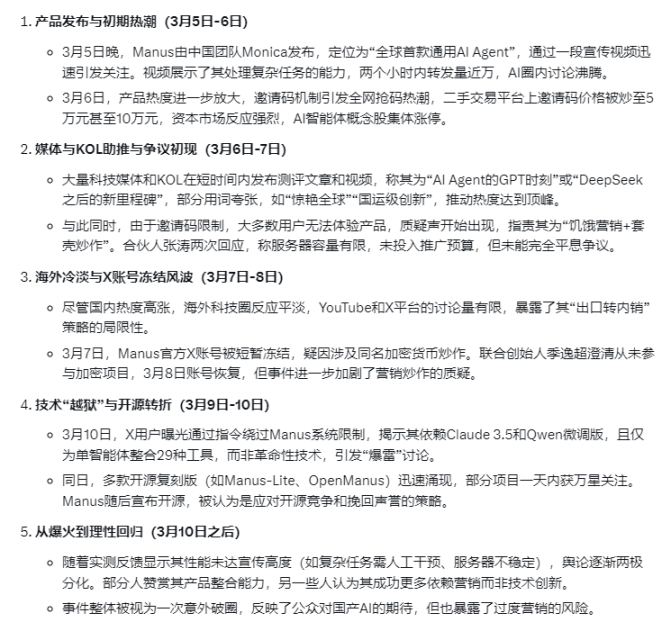
It can be clearly seen that the official core slogan is "the world's first general AI Agent."
This is a very controversial statement.
A. For those outside the industry, this statement is very eye-catching;
B. For people like me who pay attention to it but are not in the industry, I can tell at a glance that it is a word trick: I have introduced the product above, it is a patchwork, and it is not the first one in any case; but if you add the word "daily", there has never been such a consumer product that claims to handle general tasks and has caused such a big public opinion. In addition, the slogan is originally exaggerated, so it is understandable to say so;
C. As for people in the circle, I think most of them would be quite indignant. After all, the results of their hard work in research were stitched in, or they might say that this thing did not have much technical content in their eyes, but he stole the limelight.
——An opposing position emerged.
Where there are opposing positions, there will be debate, and public opinion will eventually continue to ferment, bringing a leverage effect to Manus's propaganda.
Don't look at the appearance, look at the results.
As a result, Manus has gained global attention. This marketing has a very good value for money.
And the invitation code mechanism.
While the attention is fully drawn, the invitation code is strictly limited. On the one hand, it is based on cost considerations, and on the other hand, it is also to cover up the shortcomings of the product. After all, the "universal" model is exaggerated. Once it is opened, it will be immediately blown up by various bugs and feedback from the A-type people. In that case, it will not be an opposing position, but a one-sided one, and it is likely to be a failure. From this perspective, the invitation code mechanism is actually similar to an early test. As many codes as there are devs to fix bugs, so that seed users can help improve the product first.
There is also the hunger marketing plan. The essence of hunger marketing is to compete for attention. All those who use the invitation code will inevitably be scolded by those who "love but cannot get", which is normal.
What happened later, such as the freezing of X accounts, technical jailbreaking, and open source, were regarded by many as the consequences of excessive marketing.
My personal opinion on this is that the AI community is still too literary. I suggest you get involved in the crypto community and learn some shamelessness.
The manus team is actually doing well. After all, the previous product Monica has been stable and profitable. However, many small teams are still struggling on the edge of poverty. At this time, you tell me not to over-market? If you can achieve high marketing results at a low cost, why not?
Can the face support the R&D team to continue working? Can the face provide enough funds for innovation?
Face is worthless. In this age of entertainment to death and information explosion, attention is valuable.
The cruelest and most challenging part of the crypto circle is that it is so close to money itself that all you can see are the truest human nature and the bloodiest routines (it’s not the routines that are bloody, it’s you).
You should have principles in life, but you cannot but understand and learn to accept some realities that are not in line with your principles.
Otherwise you will die miserably.
References
Complete review: How did Manus come about? | Geek Park
Behind the popularity of Manus, how do Agentic AI products build lasting competitive advantages?