
Author: Ignas
Translation: Shan Ouba, Golden Finance
The general view at present is that each new L2 added will further aggravate the problems of deteriorating user experience (UX) and dispersed liquidity, and is therefore bad news for ETH.
However, we have already embarked on the "point of no return" for L2 expansion and there is no turning back.
It’s time to redefine the narrative and view new L2 launches as positive news for Ethereum.
Am I being naive?
In fact, the L2 release of Kraken and Uniswap is indeed beneficial to the Ethereum ecosystem.
You see, Kraken’s Ink and Unichain have joined the L2 race, but they are not independent L2s, but have joined as members of the OP Superchain.
The first benefit of the OP Super Chain Alliance is (eventually) achieving a frictionless user experience between all member L2s.
Hyperchain is a unified, interoperable chain network capable of bringing together groups that have traditionally been viewed as competitors.
In addition, this also brings financial benefits to OP Collective.
When a new L2 joins the OP superchain, it commits to contribute the higher of the following two:
- 15% of its on-chain net profit (total sorter revenue minus fees paid to L1), or
- 2.5% of its total income.
Currently, about 30 L2s in the OP superchain have contributed 15,800 ETH (about 40 million US dollars) to the Optimism Collective.
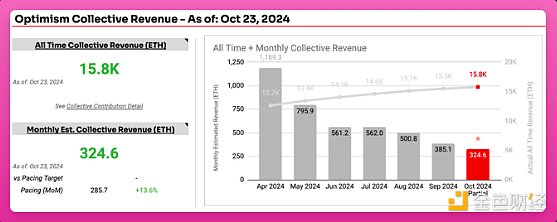
Currently Base and OP Mainnet are the largest contributors.
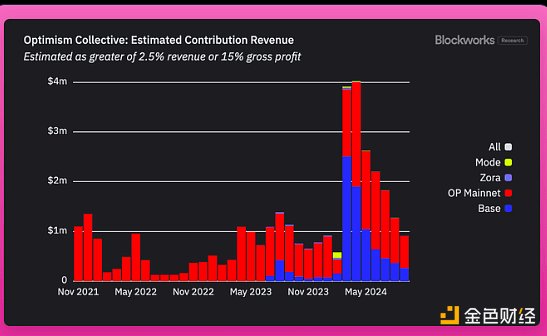
With the addition of Kraken and Uniswap’s Unichain, revenue is expected to increase further.
These funds will help drive the future development of Optimism and Ethereum:
- Public goods: Provide financial support to projects in the Ethereum ecosystem, such as infrastructure and development tools.
- Network Growth: Support the development of OP Chain and drive Ethereum adoption.
- Innovation: Provide financial support for new technological advances.
$40 million may not be a lot, but at least Optimism Collective has a value accumulation mechanism.
Ethereum L1 can learn from Optimism and encourage L2s to invest value back into ETH at least on a social level, even if it is not technically possible to do so.
This is a key factor in favoring ETH.
After reading Vitalik’s four-part series on “Possible Futures of the Ethereum Protocol”, I don’t see any new, clear L2 profit models.
He mentioned that Ethereum-based rollups can improve L1 efficiency, ensure higher security, and bring more value to the main chain through tighter integration and seamless interoperability.
However, more and more major players are choosing to join the OP Stack instead of issuing Ethereum-based rollups.
Perhaps L1 can advocate for wider adoption of Ethereum-based rollups.
Vitalik also discussed how L1 can be scaled to accommodate specific use cases that should remain on L1 in order to preserve value.
As more L2s join the OP Superchain under a shared revenue model, rather than launching L2s independently, financial support for the Ethereum ecosystem has increased.
This also provides more incentives to solve user experience and liquidity problems in each L2.
Can’t wait to see the “seamless flow of capital within the super chain” come true soon.