Compiled & translated by: Deep Tide TechFlow
Host: Taiki Maeda
Podcast source: Taiki Maeda
Original title: Bitcoin: The Beginning of The Most Hated Rally
Broadcast date: April 16, 2026
Key points summary
For the past month, I've been heavily buying BTC because I believe the bottom has been reached. In this video, I'll explain in detail why BTC has broken out of its past 4-year cycle, is climbing up the "wall of fear," and is embarking on an upward trend that almost no one believed in.

Summary of key viewpoints
On Sentiment and Cycles: The Questioned Rally
- “I think we are at the beginning of the most skeptical rally in history – people still don’t believe it, and that’s where I can make the most money.”
- “When everyone is in a state of fear, they have either already shorted or are already out of the market—at this point, who can continue to sell?”
- “In April of this year, we saw the lowest fear-greed reading in the entire history of cryptocurrency. The market is now more fearful than during the FTX crash, Three Arrows Capital, and the COVID-19 pandemic. And Bitcoin is currently at $74,000.”
- "My overall view is that you can make the most money at major market turning points—be aggressive enough at the bottom and decisive enough at the top."
Regarding top and bottom judgment: Marginal buyer framework
- "The core framework for judging buying and selling opportunities consists of only three questions: What is the current position structure? Who else will sell? Who else will buy? Prices are always determined by marginal buyers and marginal sellers."
- "The market is forward-looking. The assumption that 'Q4 will guarantee the bottom' has been circulating in the market for six to seven months. If everyone agrees that Q4 will be the bottom, then the bottom should appear before this consensus is reached in Q4."
Regarding STRC (Stretch) and Saylor: Perpetual Motion Buying
- "When the demand for Stretch surged after Bitcoin reached $60,000, rather than during the market freefall, it was the market indirectly telling us that Bitcoin was justified at its current price, or even below its fair value."
- “Separate the information from the transmitter. People dislike Stretch because they dislike Saylor as a person. But it’s unwise to let emotions about people influence investment decisions.”
- “Saylor is essentially telling us that he will predictably go long on Bitcoin with billions of dollars in the first two weeks of each month.”
On Strategy and Bias: Rejecting the Beta Trap
- “Every time I try to find an alternative to Bitcoin to get beta benefits, I end up being the beta one – I buy Ethereum, I buy all sorts of DeFi tokens, and then I find myself stuck with losses.”
- "As traders, we are not hired to predict whether Saylor will go bankrupt in two years. What we are hired to do is: look at the current price, ask ourselves whether it will be higher or lower in two months or six months, then assess the risk-reward ratio and place the next bet."
- “The parabolic rise of altcoins often occurs in the middle and late stages of a bull market. If my judgment is correct, Bitcoin has just bottomed out, so we are still in the very early stages of a future bull market. At this time, focusing on low-risk assets and then slowly rotating is the right approach.”
On reflexivity: Price determines fundamentals.
- "When Bitcoin goes up, people call it digital gold and a store of value; when it goes down, the threat of quantum computing reappears. That's how the market works."
- "When it drops to 60,000, quantum mechanics suddenly becomes a big problem again. I guarantee that at some point the price will start to rise, developers will put forward quantum mechanics proposals, and then everyone will say, 'The quantum problem is solved, I can continue to buy.'"
- "Don't forget the power of dreams. I think people are very frustrated right now, and everyone needs a positive rebound. I hope the market will rise soon. Always think about reflexivity—never forget that Bitcoin can actually rise, and it really has risen many times in history."
When others are fearful, I choose greed.
Taiki:
For the past month, I've been actively buying Bitcoin because I believe a bottom has formed. In this video, I'll explain why I think Bitcoin has broken out of its four-year cycle and why I believe we're at the beginning of one of the most questionable bull runs in history.
Warren Buffett famously said, "Be greedy when others are fearful, and fearful when others are greedy." This is easier said than done. When you open social media, everyone's saying Q4 will definitely drop to $55,000, so hold your cash and wait; then when everything starts rising, they say Q4 is a sure thing for altcoins. It's incredibly difficult to see through this noise.
First, I'd like to talk about the word "crisis." In Chinese, "crisis" is composed of two characters: danger and opportunity. As a Japanese person, I think this is a good reminder for investors and traders—when everyone is fully leveraged and heavily invested in a bull market, you need to sense the danger; when everyone senses danger, you need to smell the opportunity. Because when everyone is in a state of fear, they have either already shorted or are already out of the market—at that point, who can continue to sell?

A good angle to observe is this: when Bitcoin was at $66,000, I looked at the monthly Fear & Greed Index, which calculates the prevailing sentiment reading at the beginning of each month. This April, we saw the lowest Fear & Greed reading in the entire history of cryptocurrency. In other words, people are more fearful now than during the FTX crash, the Three Arrows Capital collapse, Luna going to zero, and the COVID-19 pandemic—and Bitcoin is currently around $74,000. Sentiment is indeed terrible; people are losing money, and some are saying quantum computing will drive Bitcoin to zero, and so on. But is it really that bad? I don't think so.
Of course, pessimists might say, "This time is different. This index doesn't take into account the special circumstances of 2026. It doesn't understand quantum risk, it doesn't understand the four-year cycle, and it doesn't understand the narrative of a guaranteed bottom in Q4." But I believe that the index itself already incorporates volatility, price movements, and market sentiment; those negative narratives about crypto assets are already reflected in the data. Of course, maybe I'm wrong, like that Japanese soldier still fighting in the jungle 20 years after the end of World War II—perhaps buying AI stocks is wiser than buying cryptocurrencies. But overall, I believe that you can make the most money at major market turning points—be aggressive enough at the bottom and decisive enough to sell at the top.
I don't consider myself a particularly outstanding trader, but at least I look at the data and ask myself who will sell and who will buy. Historical data shows that buying Bitcoin when the Fear & Greed Index is below 20 doesn't guarantee short-term profits, but if you have a long enough time horizon, it's usually a good entry point when everyone is panicking. People like to buy when the market is euphoric—it feels much better to rush in when everyone on social media is saying it will go up. But statistically, Bitcoin has a long-term upward trend, so you can usually make money over a longer period. However, I think the past two months, with Bitcoin below $70,000, may have been a good time to accumulate. I'm not suggesting you use 5x leverage, but rather that going long now will likely yield far better returns than shorting. Shorting should be done at the top, not after a 50% drop.
How to identify market tops and bottoms?
Taiki:
To elaborate on my theory of Bitcoin bottoming out, I'll start with my theory of topping out—because my logic for predicting the top in October 2025 is actually the opposite of my current theory of bottoming out.
Simply put, Bitcoin is a commodity; the more buyers, the higher the price; the more sellers, the lower the price. Therefore, you must ask yourself three core questions: What is your current position structure? Who else will sell? Who else will buy? Price is always determined by marginal buyers and sellers. This framework applies to judging any asset: Should I buy this token? Should I short it? Should I go long?
Looking back to September last year, before the Q4 peak, the market was filled with voices saying "Q4 is the altcoin season is secure"—because this pattern had occurred in Q4 after the halving in 2021 and 2017, so everyone said it would definitely happen again, going all in with leverage, predicting Bitcoin would reach 250,000 and Ethereum would reach 10,000, both were guaranteed. These people lost money, but they're not bearish now—at least when I scroll through social media, those who were most bullish at the peak are now predicting Bitcoin will drop to 45,000.
My framework for identifying market tops is based on observing the state of DAT (Digital Asset Pool). The last bull market and the 2021 bull market were both driven primarily by Michael Saylor and DAT, and their buying power was a crucial indicator. What I observed at the time was that while Bitcoin's price was constantly hitting new highs, MST's MNAV was continuously collapsing, meaning Saylor might no longer be able to support Bitcoin at $125,000. Of course, some said "this time is different," but that wasn't the case. Ethereum was similar—Tom Lee poured a lot of money into it, pushing it vertically upwards, and then he started to run out of ammunition; marginal buyers disappeared. His weekly Ethereum purchases were shrinking, so I felt shorting Ethereum was reasonable—fundamentally, a $600 billion market cap couldn't sustain it. Once Tom Lee ran out of money and received his rewards for promoting Ethereum, the price should fall. The top logic at the time was: DAT buying momentum was exhausted, market positions were extremely long, naturally leading to a large number of marginal sellers pushing the price down and triggering liquidations, which is what happened later.
I believe a bottom is forming now—the exact opposite of what happened back then. DAT was losing momentum then, and now it's regaining it, especially with Saylor. Back then, the positioning was extremely bullish, while now the market generally believes "Q4 will inevitably be the bottom"—many are overweight in cash or even shorting, and many on Twitter have long since left crypto to trade gold or oil, becoming geopolitical experts with very little exposure to crypto. In reflexive assets like crypto, price increases can create more buying demand, just as price decreases create more selling pressure.
I think the assumption that "Q4 guarantees a bottom" is very hasty. The market is forward-looking, and this assumption has been circulating in the market for six to seven months. By Q1 and Q2, more and more people actually believed it, selling Bitcoin at a loss just to buy it back cheaper eight months later. I'm not saying these people are necessarily wrong; I'm willing to be a contrarian, but for a new low to actually be reached in October, two conditions are needed: first, people have already positioned themselves for this and are waiting to sell; second, there must be extremely strong selling pressure to push the price to a new low. Currently, the market's expectation of a Q4 bottom is already very strong, and most people who really wanted to sell have already done so. For a new low to be reached in October, a major panic event is needed, which isn't impossible, but this analysis is too hasty. My analysis and judgment of the current situation are: the risk-reward ratio for going long is very good. The resurgence of Saylor and STRC is a significant new development. I believe my assessment of the "wall of market anxieties" was ahead of its time, as was my assessment of STRC—people are still skeptical, and that's precisely where I can make the most money.
STRC core logic latest update
Taiki:
Let me quickly recap my Stretch (STRC) argument. Simply put, Saylor has essentially abandoned the game of purely pursuing MST or MNAV premiums; all his talk now revolves around Stretch. The core logic is: he holds approximately $55 billion or more of Bitcoin, roughly 3.7% of the total supply. He wants to use this Bitcoin as collateral to issue credit products, managing risk in layers—essentially borrowing money to buy Bitcoin. If this succeeds and Bitcoin appreciates significantly, the APY he pays to borrowers will be covered by the Bitcoin price increase, thus creating long-term value for shareholders, which he calls "increasing the amount of Bitcoin held per share." I'm not a die-hard MicroStrategy or Saylor fan, something you've likely observed over the past six months. But I think this is a new development worth watching.
He files an 8-K filing every Monday, detailing his purchases from the previous week. A few days ago, he announced that he had bought $1 billion worth of Bitcoin using Stretch—which has been almost his only consistent source of purchases over the past few months, making Stretch a good way to track Bitcoin's movements.
Stretch works by issuing new shares of STRC when the price exceeds $100, selling them to the market, and then using the proceeds to buy Bitcoin. Holding Stretch essentially means lending money to Saylor, earning approximately 11.5% APY, paid monthly. If you hold before the X dividend date (usually mid-month), you'll receive the dividend around the end of the month or the beginning of the following month—for example, holding until April 14th would yield approximately 96 cents per STRC share, translating to roughly an 11.5% APR. When Stretch first launched, the interest rate was around 7-8%, but there was little market demand. STRC only truly stabilized in recent months after Bitcoin stabilized around $60,000.
The target price range is $100—this doesn't mean it will stay at $100 forever; interest rates are determined by the market: if STRC is in short supply and rises above $101, it can lower the interest rate; if it falls to 99 or 95, it can raise the interest rate. Now, setting 11.5% as the equilibrium point, I think it's a pretty good product with sufficient market demand.
Prior to the X dividend date on March 13th, he purchased approximately $1.5 to $1.6 billion worth of Bitcoin. Holding STRC does not have a time-weighted reward; you only need to hold it before the deadline. Therefore, we can see STRC trading volume experiencing a parabolic increase in the days leading up to the X dividend date, with marginal Bitcoin buying concentrated during this window.
Before the ex-dividend date at the end of February, buying activity was relatively low; by March 12th, purchases had reached approximately $400 million, and this pattern repeated monthly. As long as there is market demand for Streck, Strategy will continue to buy Bitcoin. As long as the market allows him to continue financing BTC purchases through this tool, he will continue buying. Specifically, the X dividend date was the last day of February, with relatively low purchase volumes. However, by March 12th, purchases surged to approximately $400 million. This trend indicates that as long as demand for Streck persists, investors will continue to buy Bitcoin. Saylor will also continue to purchase Bitcoin as long as the market allows.
STRC April Progress Overview
Taiki:
In March, I released a bullish video based primarily on the following observations: March trading volume showed a clear parabolic upward trend, while volatility gradually decreased. This indicates that the market has shown great interest in the 11.5% annualized yield (APY) or annualized return (APR) and is willing to hold this financial instrument long-term; the market generally believes that a Bitcoin price between $60,000 and $70,000 is reasonable. Within this price range, the market is willing to provide financial support to investors; Saylor's current cash reserves are sufficient to support operations for the next two years. In the short term, if investors can accept the associated risks of Stretch, this could be a good yield-generating tool.
Based on these factors, I conclude that this trend will continue. Saylor purchased $1.56 billion worth of Bitcoin in March, and I expect him to buy more in April. If this trend continues, the market will have to repric, anticipating further buying in May, June, July, and beyond. And with Bitcoin prices below $70,000, this is undoubtedly a very attractive investment opportunity.
Furthermore, I predicted that more institutions would adopt STRC. The recently launched on-chain Stretch project (in which I personally participated in mining) may further accelerate this trend. So, have these predictions been validated? The answer is yes.
First, let's look at BlackRock's Strategy Preferred Shares ETF. This fund has approximately $13 billion in assets under management (AUM), and its benchmark index is determined by the Intercontinental Exchange (ICE). Notably, as of this week, Strategy Preferred Shares have become the ETF's second-largest holding, including STRC, SDRK, and STRF.
What's even more interesting is that this portion of the market capitalization was approximately $200 million in March, growing to $344 million by April—just when everyone on Twitter and social media was saying it was a Ponzi scheme that would ultimately end in tears, BlackRock was increasing its holdings. Of course, ICE and BlackRock's endorsement of Stretch doesn't mean other institutions will follow suit. BlackRock's increased purchases could also be for future resale, so it's not necessarily particularly sticky capital. But it's fair to say that the capital stickiness of fixed-income ETFs is generally higher than that of random dog holders on Solana.
Let's look at the trading volume data for April. This is an estimated figure for the 10 trading days prior to X's dividend date—I estimated it using figures from bitcoin.co combined with 8-K files, so it's an approximation. According to data from these websites, he bought approximately $3 billion worth of Bitcoin in April, concentrated in a two-week window—which might explain why Bitcoin rose from around $67,000 to around $75,000. I've identified this pattern, and going long on Bitcoin below $70,000 carries relatively manageable risk. I'm still holding these long positions; we'll see what happens next.
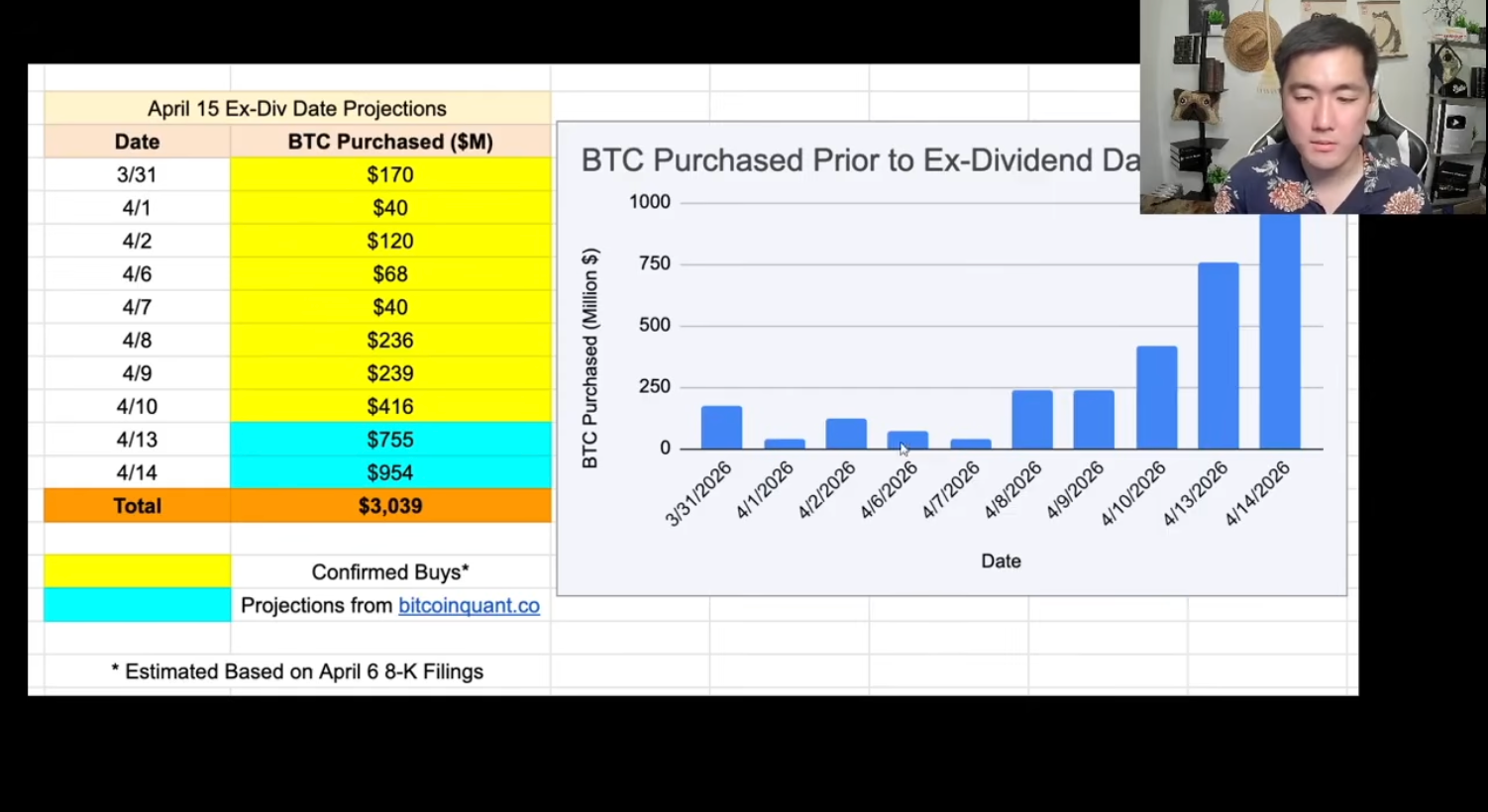
Let me ask this question again: He bought 1.6 billion in March and about 3 billion in April. How much will he buy next month, June, July, and next year? I don't know, but I tend to think it will exceed 1 billion, maybe even 2 billion or 3 billion. In my last video, I predicted he would buy about 2 billion, but it still exceeded my expectations, so maybe I should be more optimistic, which is one of the reasons I continue to add to my Bitcoin holdings.
Of course, the market is forward-looking, and the strategy of "buying two weeks before the dividend date of X" will only be effective for a limited time; the market will eventually absorb this effect. But as long as this marginal buying continues, it would be strange if Bitcoin didn't rise—especially since the stock market has essentially returned to historical highs, and geopolitical tensions are being priced in by the market.
Some say Saylor is the only buyer of Bitcoin—and it certainly feels that way. But Saylor can't print money out of thin air; the market decides whether he can buy. He can only buy when the market is willing to buy his product. When Stretch's demand surged after Bitcoin reached $60,000, rather than during the market freefall, it was the market indirectly telling us that Bitcoin was reasonably priced at its current level, or even below its fair value. I'm not sure, but the risk-reward ratio for Bitcoin is likely quite good. Like I said, Saylor can't just buy; he needs people to give him money, and people will only give him money when they are comfortable with the future price of Bitcoin.
What are the risks associated with STRC? How should these concerns be addressed?
Taiki:
Next, let's talk about the risks—which is also what everyone dislikes most about Stretch.
First, there's the leverage risk. He is indeed borrowing money to buy Bitcoin, which is a gamble and carries risk. Some argue that if the pool becomes too large—if he borrows 20 billion, 30 billion, or 40 billion—it could be a significant risk to Bitcoin. Of course, if he borrows that much to buy that much Bitcoin, I expect Bitcoin to have already risen considerably by then, because it's a reflexive asset. Stretch will perform poorly when Bitcoin falls because it's backed by Bitcoin; if Bitcoin rises, you can borrow more, and the market will believe Stretch can continue operating. So, even in the worst-case scenario—Saylor being liquidated—he would need to push up the price of Bitcoin before it crashes, which is logically possible, but in that scenario, I'd go long on Bitcoin first.
As of recently, he has approximately 22 months of dividend coverage. Even if the price of Bitcoin remains stagnant, he can pay dividends for over a year. Of course, this number will shorten if he continues to borrow money. The worst-case scenario is that Bitcoin remains stagnant—if he continues to borrow money to buy Bitcoin and the price doesn't react, his cash reserves will run out, potentially forcing him to sell Bitcoin, issue MSTR at less than 1x MNAV, or default on paying Stretch dividends. This is possible. But it won't be next month, nor within three months; it will be at least six to eight months later, when we will have a clearer picture to determine if the crypto industry is truly collapsing.
Another argument is that if Stretch becomes large enough, it will pose a systemic risk to the entire crypto ecosystem, making Ethereum a safer investment. However, my view is that Saylor won't sell these Bitcoins, so the risk isn't as pressing as it sounds. People always overanalyze how he could fail, and I think part of the reason is that they want to see him fail—he is indeed a bit eccentric, posting AI-generated images every day, which frankly I find awkward, but that's not a reason for investment decisions.
Stretch effectively gave him the ability to buy low and sell high. He borrowed billions to buy Bitcoin around $70,000. Assuming Bitcoin rises to $140,000, MSTR's MNAV will increase. At that point, he could easily issue MSTR shares on the open market, cash out to repay Stretch debt, and complete deleveraging. How do you think the market will react? I think it will be very positive—good job, Saylor, buying at $70,000, cashing out at $140,000, and even increasing his holdings per share. He could also push Stretch above 101, thus lowering the APY for the next issuance, as the market would be willing to accept lower interest rates. He could also pay back the money he borrowed, reducing dividend payouts. Saylor has considerable control over this situation. My interpretation is: he thinks Bitcoin is very cheap at $74,000 to $75,000, he wants to continue buying, and at some point in the future he will start reducing the dividend yield. But I'm not Saylor's psychoanalyst, so I can't say for sure.
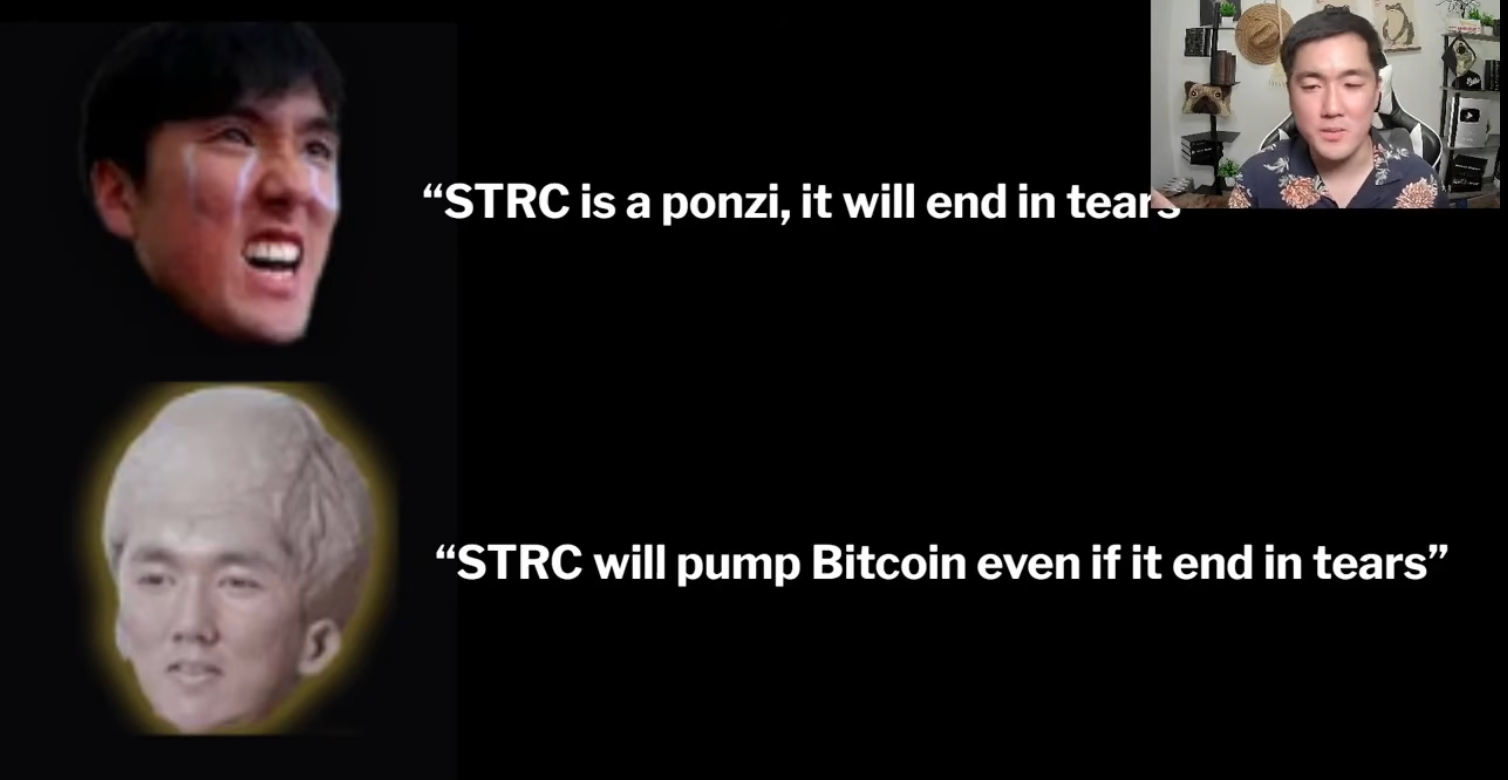
If Bitcoin skyrockets and then crashes four years from now, someone will post screenshots to mock me. But from a trader's perspective, instead of shorting Bitcoin now, I'd rather stand with Saylor—he'll continue buying. Even if this market eventually collapses, it means Bitcoin will first surge, and I want to go long during that period. If he successfully deleverages, this story could even have a happy ending. Saylor has said Stretch could reach a trillion-dollar market capitalization; I'm not sure if that will happen, but who knows? Maybe in some parallel universe, Bitcoin really will become a million-dollar asset, and Stretch will become a 9% yield product backed by Bitcoin held by every ETF.
Regarding the argument that "Ethereum is safer," Saylor holds approximately 3.7% of the Bitcoin supply, while Tom Lee has bought 4% of the Ethereum supply in less than a year. If you're concerned about concentration risk, Tom Lee actually poses a greater threat to Ethereum than Saylor does to Bitcoin—although Tom Lee doesn't have the same leverage risk as Saylor. Moreover, if Stretch continues to grow, Tom Lee will eventually follow suit with a similar product, Ethereum will rise, Kyle Samani will use Solana, and everyone will be fully invested in 2027, followed by a complete crash—a rather poetic ending. I hope I can accurately sell at the top again then. Tom Lee just reached his 4% Ethereum holding, thus receiving 500,000 Bitmine shares as a reward, worth approximately $10 million at current prices.
Separate the information from the transmitter. People dislike Stretch primarily because they dislike Saylor as a person. But it's unwise to let emotions about a person influence investment decisions. I'm not a die-hard MSTR fan; my IQ is only 100. I can't convince myself to buy MSTR; I'll just go long on Bitcoin. But you must separate the information from the person transmitting it.
Saylor is essentially telling us that he will predictably invest billions of dollars to go long on Bitcoin during the first two weeks of each month. If the same thing happened with Ethereum, people would be cheering—it's just that because it's Saylor, people are disgusted.
The past seven months have been terrible for crypto holders; everyone forgot that Bitcoin could actually rise. Consider this scenario—what if Bitcoin had actually risen? It's possible; it's happened many times in history, just look at Bitcoin's long-term chart. Right now, everyone's debating whether to buy in Q1, Q2, or Q4 to guarantee a bottom—but Bitcoin is a good asset, and I think you should consider buying some below $70,000. Those overly fixated on the Q4 theory will see the most skeptical surge in Bitcoin's history if it actually jumps directly. The market climbs the wall of anxiety—look at the stock market, it's already back to all-time highs, but everyone's still in a panic. The market is forward-looking; if everyone agrees on a Q4 bottom, then the bottom should appear before that Q4 consensus.
My strategy and position allocation
Taiki:
Let me talk about my plans and holdings. In the last video, I mentioned that I held Hype and Bitcoin, as well as some cash to add to my positions during market downturns. During this recent downturn, I bought Hype—actually, I didn't continue adding to Hype, but instead significantly increased my Bitcoin holdings, including both spot and futures. My current position is quite large, and I hope I won't be liquidated, but that's also possible. I'm also mining the on-chain Stretch project, which I'll discuss later. If the market really starts to rally sharply, I might continue holding my spot position and then consider shorting Solana.
My logic for shorting Solana is the same as when I shorted Ethereum: simply put, the L1 narrative is dead, the unlocking of FTX legacy tokens will continue for several more years, and the "dog-bull" mentality is basically over, so overall I'm bearish. Of course, I haven't made a complete decision yet; my current stance is bullish.
In the last cycle, I was long on altcoins, reasoning that if Bitcoin rose, altcoins would rise too. But the reality is, most altcoins are garbage; there are too many on the market, and much of it is pure hype. In the last cycle, even "cycle leaders" like Solana only started moving after Bitcoin doubled from its bottom—Bitcoin bottomed out at $15,000 to $16,000, and then altcoins followed suit as ETF expectations rose. So, my current strategy is to hold Bitcoin. If I want a larger version of Bitcoin, I'll add leverage; I don't need to buy Ethereum or random DeFi tokens to act as my beta, because every time I do that, I'm the one who gets trapped in the beta.
I tend to focus on Bitcoin and Hyperliquid. I think the logic behind Hyperliquid is quite clear, so I'll continue to hold it. If Bitcoin rises significantly, I can transfer some profits elsewhere, because altcoins often experience parabolic rises in the mid-to-late stages of a bull market. If my judgment is correct, and Bitcoin has just bottomed out, then we are still in the very early stages of a future bull market. At this point, focusing on low-risk assets and then gradually rotating is the right approach.
History also shows that new tokens tend to perform better, while older tokens with large unlocked tokens and VC holdings struggle to rise. If Bitcoin reaches $100,000, new narratives and hot topics will inevitably emerge; we'll see then. For now, let's focus on Bitcoin as the ultimate asset, and then look for opportunities to chase altcoin returns.
How to airdrop Farm STRC on-chain
Taiki:
Now let's talk about on-chain Stretch mining. In my last video, I mentioned mining Saturn, and I want to clarify one point first—Stretch is not risk-free; please do your own research. However, I believe that: with billions of dollars in on-chain DeFi, earning 3-4% returns, while also carrying various smart contract-level risks; compared to that, Stretch does have risks, but is it really that much riskier than keeping your money in a DeFi protocol that's frequently hacked? I'm not sure.
Strategy has been actively promoting its on-chain Stretch product because Saylor understands this is a prerequisite for his continued Bitcoin purchases—only if people continue to buy Stretch can he have the funds to buy Bitcoin. At the Bitcoin Mining conference, Saylor discussed the concept of "digital credit": using Stretch plus some buffers (holding USDC and US Treasury bonds, etc.) as collateral to issue a stablecoin. Even with a Stretch interest rate of 11.5%, this product could offer a yield of approximately 8 to 9%—a better form than digital bonds. At a recent digital asset summit, he also mentioned that someone is developing a senior/junior tranche product based on Stretch, with the junior tranche being riskier but offering higher returns, and the senior tranche the opposite—this is already underway.
Looking at Stretch's data, the growth rate is explosive, so I think it makes sense to pay attention to these on-chain derivative projects. If someone tokenizes Stretch and builds leveraged products on it, I'd like to participate in mining. Frankly, in the past six or seven months, I've had a hard time finding a protocol I can confidently recommend, but I think this direction is genuinely interesting.
The on-chain Stretch project might be the first "Saylor-approved on-chain project"—not guaranteed to rise, but it might genuinely have Saylor's backing. For example, APYX is collaborating with Saylor on Twitter Spaces—a knock-off project partnering with Saylor, which is entirely new in the on-chain ecosystem.
In the last video, I mentioned that the TVL (Total Value Scale) was around 40 million, and it's now approaching 130 million, a good growth rate. The token allocation for the first quarter of mining is 5% of the total APYX supply, starting on February 27th. It will either continue for 12 weeks or end early when the TVL reaches 1 billion—the latter is unlikely, so it will probably end around mid-to-late May. I participated in the first 6 weeks when the TVL was relatively low, and I've already transferred my holdings to Saturn. Frankly, I don't know who the ultimate winner will be; participating in multiple projects to diversify risk might be more prudent.
They secured $800,000 in funding from Binance and other institutions. The first quarter of mining started on April 8th and will either continue until August 8th or end early if the TVL reaches 500 million. One uncertainty is that the token distribution ratio for the first quarter hasn't been disclosed yet; this lack of transparency is somewhat unsettling, but the team should announce it at some point. If you've participated in USDA mining before, Saturn's mechanism is similar—it has USDAT (backed by US Treasury bonds, similar to USDC) and a staking version, stUSDAt (with more rewards from Stretch and Treasury bonds, but also higher risk; currently, the return is around 10%, still in its early stages, and should increase later). I'm currently mining USDC/USDAT on Curve LP, which offers 20x credit acceleration. Pendle mining typically offers higher returns, but I'll stay on Curve for now.
I chose the USDAT version instead of the staking version because I didn't want to be directly exposed to Stretch risk—though that might sound strange, since I'm advocating for Stretch while not directly holding it. My logic is: I've already worked by indirectly betting on Stretch by holding Bitcoin. If you can accept the risks of Stretch, then buying Bitcoin makes sense, because if you can accept it, others can, demand will continue to flow, and the machine will keep turning.
Finally, I'd like to say: Let positive days heal market sentiment.
Taiki:
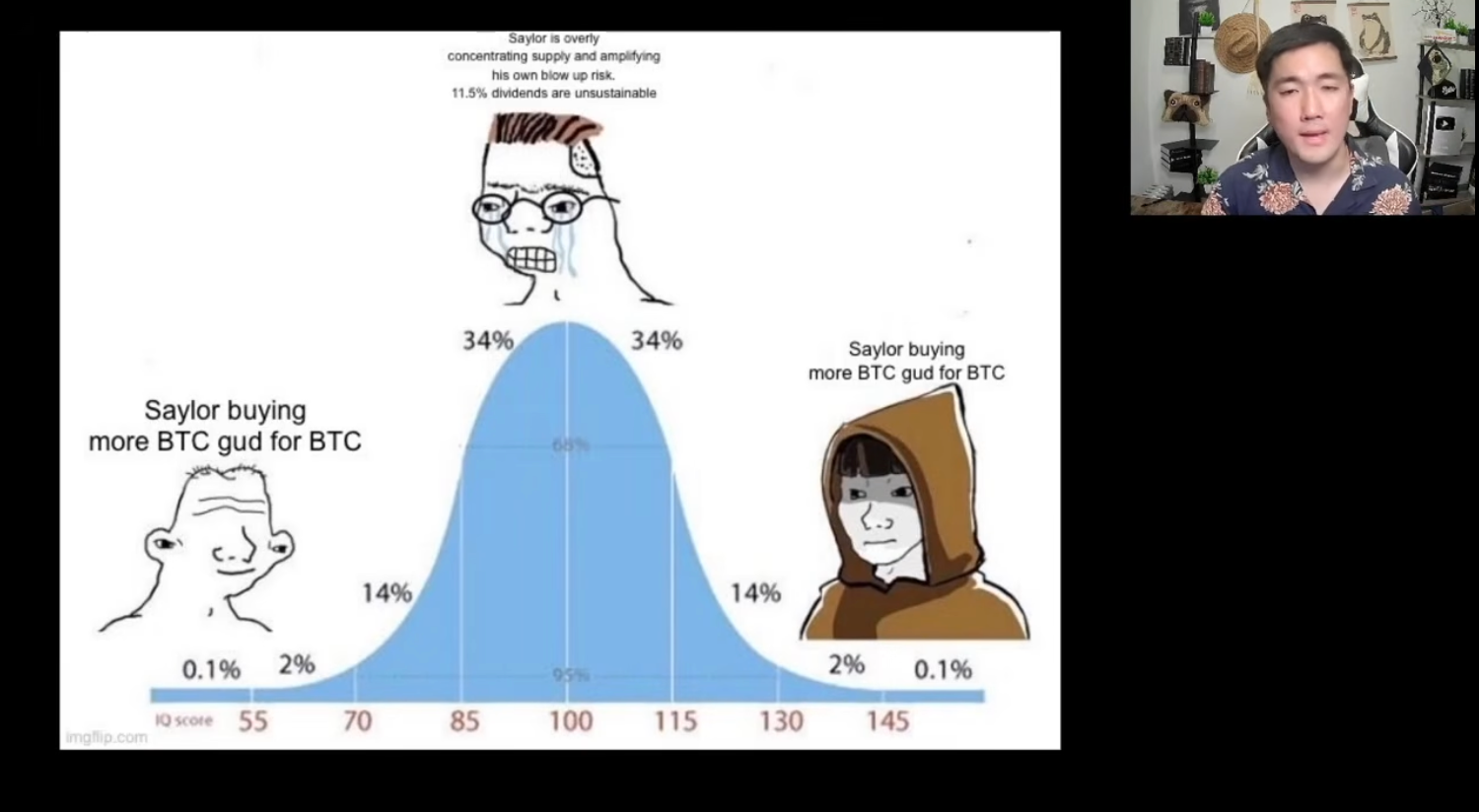
Finally, let's talk about the conclusion. I like this "mid-curve" chart, and I can talk about it because I myself am a mid-curve—a mid-curve in recovery, trying to evolve towards the left or right curve, but clearly I'm probably still a mid-curve. The argument for the mid-curve is that "stretch is unsustainable," and at first glance it makes sense—it certainly looks dangerous. But as traders and investors, we're not hired to predict whether Saylor will go bankrupt in two years. What we're hired to do is look at the current price, then ask ourselves whether it will be higher or lower in two months, four months, six months, twelve months, then assess the risk-reward ratio, and place the next bet.
My view on Stretch is incredibly simple: Saylor buying Bitcoin is good for Bitcoin. The market is willing to let him continue buying, and as long as this trend continues, Bitcoin will go up. I don't know when this trend will end, but as long as it continues, I will hold Bitcoin and sell when things change. Just like the AI bubble and the crypto bubble—at any point in a bubble, you can say "it's a bubble," but bubbles can last longer than you expect, and Saylor might even successfully deleverage at some point.
My logic for buying Bitcoin is: Bitcoin below 70,000 is cheap, so I'll buy it, add a small futures position as a sideline, and then probably close it out at some point. I recorded this video on April 15th. If you see it a week later, I might have changed my mind and will update it on Twitter.
Reflexivity is key; remember this cycle: Bitcoin price rises → people start saying "this is digital gold," "a store of value," "Bitcoin is effective" → perceived fundamental improvement → price continues to rise; the reverse is true when it falls—Bitcoin falls, the threat of quantum computing suddenly becomes a topic, and people are hesitant to buy; Bitcoin rises, a Bitcoin developer proposes a quantum solution, and everyone cheers to continue buying. Think about this: when Bitcoin was at $120,000, nobody cared about quantum mechanics, including those who were always aware of the risks, because the price was rising, so you didn't care; the price fell to $60,000, and suddenly quantum mechanics became a big problem again. I guarantee that at some point when the price starts to rise, Bitcoin developers will propose a quantum solution, and then everyone will say, "The quantum problem is solved, I can continue buying." Stretch works the same way—Bitcoin rises, Stretch looks safer, demand increases, Saylor buys more Bitcoin, and Bitcoin continues to rise.
To write a complete bullish story: Bitcoin rises because of Stretch, Ethereum rises because of Tom Lee's version of a similar product, Solana's DAT version is released, Solana rises, everyone is fully invested in 2027, and then everything crashes—it's quite poetic. If that day comes, I hope I can accurately sell at the top again.
In short, my core idea is: Saylor buying Bitcoin is good for Bitcoin, so I'll hold Bitcoin. If circumstances change, I'll sell Bitcoin. I like Bitcoin, and I'm always looking for a good entry point, which I think is below $70,000. Let's buy, add a little bit of contracts, and see what happens next.
Don't forget the power of dreams. I think people are very frustrated right now, and everyone needs a positive rebound. I hope the market will rise soon. Always think about reflexivity—never forget that Bitcoin can actually rise, and it really has risen many times in history.