Written by: Awang, Web3 Lawyer
The invention of the steam engine did not reduce coal consumption; instead, it allowed coal to be used in more applications. The invention of the ATM did not replace bank tellers; instead, it enabled bank branches to expand into more communities. This is the Jevons Paradox—when technology reduces unit costs, demand is released from those previously squeezed out by prices.
Stablecoin payments follow the same path: one is to supplement the cross-border payment market, and the other is to enable 1.4 billion people worldwide who lack banking services to access the financial network for the first time.
Faced with such a global market as Day1Global, the question that arises is: what kind of license do I need to launch a stablecoin payment project?
Therefore, this article will use my years of experience in applying for licenses and practical experience (I have basically done or participated in all stablecoin payment + on-chain finance projects) to sort out the compliance and licensing strategies for stablecoin payment projects.
As markets and regulations change, there are many areas not covered here, so please feel free to discuss and exchange ideas :)
I. Compliance does not equal license
When people see news reports of companies receiving MiCA CASP awards or MAS MPI application announcements, these naturally become points of reference. However, for most early-stage projects, the outcome for others is not necessarily their starting point.
"How do I obtain a license in compliance with regulations?" is not a question that can be answered directly. Before answering, we need to break down three often-overlooked prerequisites:
- Clarifying one's own business model requires a license at this level—but stablecoin payments are not a single track. Acquiring, receiving, crypto cards, OTC, and stablecoin issuance each have completely different regulatory frameworks.
- Estimate whether the business scale can afford this level of compliance costs—MiCA CASP requires a total investment of at least one million US dollars, and MAS MPI is of the same level, which is something most early-stage projects cannot afford.
- With compliance budget in place, team in place, and funding channels aligned—if any one of these three points is missing, even the most expensive license won't get going.
Behind these three premises lies the same distinction: compliance posture and compliance license are two different things.
The former—KYC processes, AML monitoring, Travel Rule data fields, and auditability—must be built into the product architecture from day one; there's no room for negotiation. The latter—which license to obtain and when to upgrade—is a decision made progressively based on the scale of the business.
Of course, there are exceptions. If you have ample financial backing, or if you're going to serve institutional counterparties with high compliance requirements from day one, or be involved in heavily regulated businesses like stablecoin issuance, then obtaining a Tier 1 license like MiCA or CASP is reasonable. However, for most early-stage projects that need to survive first, compliance decisions are a constrained optimization problem.
Posture is essential, but license can be obtained later.
II. Five Dimensions of Compliance and Licensing Decisions
What about the license? Compliance decisions are never a single-variable optimization.
First, the business model. Payment is not a single sector, but a whole combination. Acquiring, receiving, crypto cards, cross-border settlement, OTC, and stablecoin issuance each have completely different regulatory frameworks. For example, a company with the same annual revenue of $10 million might need EMI/PI/MSO + MSB/SRO for B2B cross-border settlement, while it might need Visa/Mastercard entity status for B2C crypto cards—the two systems have almost no overlap.
Furthermore, stablecoin payments almost never involve pure stablecoin transactions—fiat on/off-ramp transactions are always intertwined. All licensed combinations discussed in this article implicitly include the fiat currency license (EMI, PI, MTL).
Second, business volume. Look at TPV (Total Payment Volume, annual transaction volume) and take rate %. The take rate for B2B cross-border settlement is usually 0.1-0.5%, for consumer encrypted cards it is 1-2%, and for OTC matching it is 0.1-0.5%—the same TPV can generate ten times more revenue under different business models.
Third, compliance costs. This is not just about application fees and legal fees. The substantive costs of local offices, compliance personnel, and directors, plus ongoing costs such as annual audits, regulatory reports, and compliance technology stacks, can add up to several times the application fee.
Fourth, funding channels. Obtaining a license does not guarantee the ability to open an account. Each license has a different funding path, so you must confirm that the path is viable before choosing a license. This is the most likely point to stall business operations.
Fifth, time. MSB: 3-4 months, SRO: 6-9 months, MiCA CASP: 12-18 months. Time is not an independent dimension, but a constraint that runs through the previous four dimensions—business model determines which license you wait for, scale and cost determine how long you can sustain compliance spending, and access determines how long it takes to actually scale up after obtaining the license. Moreover, some time windows are hard: the MiCA transition period expires on July 1, 2026, after which CASPs without MiCA authorization cannot operate in the EU.
"License can wait" does not mean you can wait indefinitely. Only by overlaying the timeline can you accurately locate your position on this map.
III. A Quick Overview of Mainstream Stablecoin Payment Licenses
The higher the level, the wider the range of partners are willing to cooperate with you, but the annual compliance costs also jump by orders of magnitude.
The most common licenses for stablecoin payment projects are listed in order of "compliance level" and "counterparty signal strength":
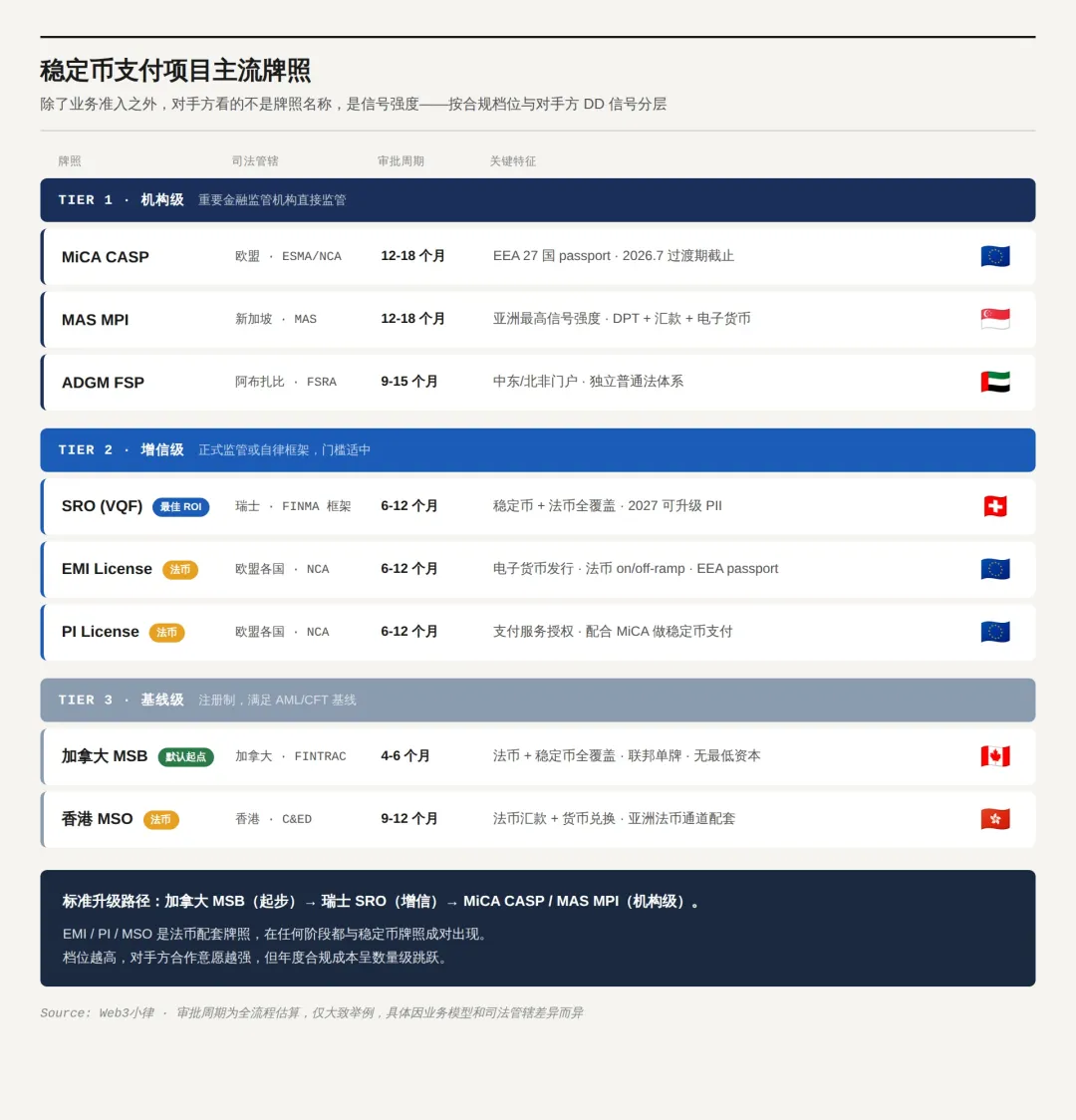
The "Tier" here is not a legal classification, but an industry consensus—the common tiering logic used by counterparty compliance teams during due diligence. Tier 1 is a full-fledged license directly regulated by major financial regulatory agencies; Tier 2 is a transitional license with a formal regulatory or self-regulatory framework but lower barriers to entry; Tier 3 is a registration-based system, mainly meeting AML/CFT baselines.
Two license plates in this article deserve special mention.
- Canadian MSB has the broadest business coverage among Tier 3 suppliers—handling both fiat currency and stablecoins—making it the default starting point for early-stage projects.
- Swiss SRO has the highest ROI among Tier 2 suppliers—its business coverage is equivalent to that of MSB, but its competitors have a higher level of signal strength, and it has a clear path to upgrade to PII (after the new regulations take effect in 2027).
These two forms the standard upgrade path for most early-stage projects from Phase 1 to Phase 2.
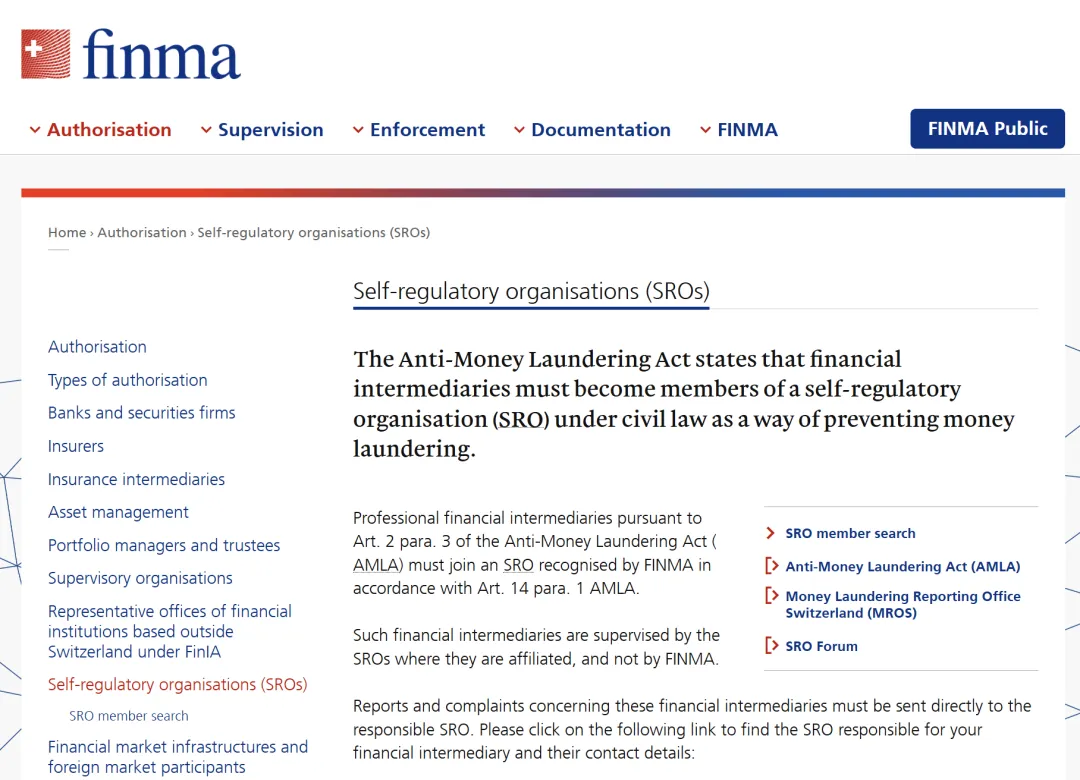
https://www.finma.ch/en/authorisation/self-regulatory-organisations-sros/
IV. Three Stages of Compliance and Licensing: Minimization → Credit Enhancement → Institutional Level
By overlaying the five dimensions of "business model × TPV × compliance cost × funding channel × time" onto a timeline, the compliance and licensing path of early-stage projects is not a one-time decision, but a progression of three stages.
Phase 1: Minimize compliance and get the business running first.
The goal is simply to get the business running legally. What you need is "the most economical and compliant entity + a usable funding channel for cooperation".
The two most common paths:
- A single license with broad business coverage plus a funding channel partnership. A Canadian MSB (Management Service Provider) is the standard configuration at this stage—FINTRAC registration, with initial costs of tens of thousands of US dollars, has explicitly covered Dealing in Virtual Currency since 2020. After obtaining the MSB, using a crypto-friendly PSP (Private Service Provider) as a funding channel can support basic operations.
- The two lightweight licenses allow for geographical and business division of labor. The combination of the Canadian MSB and the Hong Kong MSO can basically meet the needs of most businesses—the MSB manages the stablecoin business, while the MSO manages cross-border fiat currency transactions in Asia, with the two licenses complementing each other.
The most important thing at this stage is to get your business up and running quickly. This is suitable for early-stage projects to validate Product-Factory (PMF) or for players whose business models do not require advanced licenses.
The cost is profit sharing (the channel provider takes 0.3-1%) and business dependence on partner strategies. Regulatory oversight is also tightening – the industry consensus is that "outsourcing doesn't absolve you of regulatory responsibility," meaning that as the actual business provider, you still bear compliance responsibility.
At this stage, a Tier 1 license is not an asset, but a burden.
If your annual income is below USD 1 million, try to avoid changing your regional license if possible.

Rain Raises $250M to Expand Stablecoin Payments Infrastructure
Rain has perfected the logic of the first phase. Founded in 2021, this company, which provides stablecoin payment card infrastructure, aimed to have over 200 enterprise clients, an annualized transaction volume of $3 billion, and coverage in over 150 countries by early 2026, including Western Union. However, its compliance architecture at this stage primarily consisted of multi-state MTLs in the US plus Visa Principal Membership—not relying on MiCA or MAS MPI. It wasn't until January 2026, after completing a $250 million Series C funding round with a valuation of $1.95 billion, that Rain explicitly included "expanding licensed markets" in its funding announcement.
A company with an annualized transaction volume of 3 billion and a valuation of 2 billion US dollars only considered obtaining regional licenses as something to do after Series C.
Phase Two: Credit Enhancement and Endorsement After Business Scales Up
You're not just "making the business run legally," you're "making larger competitors willing to cooperate with you."
When TPV reaches USD 500 million to 2 billion and annual revenue is USD 5 million to 15 million, the bottleneck is usually not whether there are enough licenses, but whether the signal strength of the counterparty's due diligence is sufficient.
When European banks, stablecoin issuers, and TradFi institutions approach you, their compliance teams will require you to provide regulatory endorsements that are "more serious than MSB's." Tier 3 licenses will be questioned in this kind of due diligence—not because they are non-compliant, but because the signal strength of the "registration system" is insufficient.
The standard procedure is to add a Tier 2 license.
The most natural upgrade path is from a Canadian MSB to a Swiss SRO (VQF) – the business coverage is the same, but the counterparty's signal strength is one level higher, the initial cost is hundreds of thousands of dollars, and the annual operating cost is in the same range. SRO is currently a highly recognized self-regulatory license in European crypto regulation, covering both stablecoins and fiat currencies.
If you can pair it with an EMI or PI fiat currency, you can cover the DD requirements of European institutional counterparties and also open up European fiat currency business.
Singapore-based DTCPay follows this standard path. This stablecoin payment company previously held licenses in Singapore, Hong Kong, Australia, the United States, and Canada—covering multiple licenses across the Asia-Pacific region. In July 2025, it obtained a Green Light Letter from the Luxembourg CSSF, and in October, it officially received its EMI License, opening a passport to the European market (EEA 30 countries, 450 million people). By March 2026, when it completes a USD 10 million Series A transaction, European market access will be in place.
First obtain the credit enhancement license, then use compliance milestones to leverage the next round of financing—this is another strategy of "using Tier 2 licenses as leverage after business volume increases".
OKX obtained a PI License from the Malta MFSA in February 2026, following a similar but more passive approach. OKX had already obtained a Malta MiCA License in January 2025—allowing it to legally conduct stablecoin trading and holding. However, the need for a PI license stems from its plans to launch OKX Pay and OKX Card, which involve the Eurocurrency on/off ramp. Under the MiCA + PSD2 dual framework, stablecoin payments involving stablecoins (defined by EU law as Electronic Money Tokens, EMT) require an additional PI or EMI license. Even a company of OKX's size cannot escape this requirement.
This path is essential for all players who want to make payments using European stablecoins.
At this stage, compliance is not about "pursuing the highest standards," but about "matching counterparties' expectations and market access requirements."
Phase Three: Institutional Licenses
The third stage is not about who has more money.
When an annual income of over USD 15 million is generated and the company aims to establish itself as a "financial infrastructure," compliance decisions enter the third stage—EU MiCA CASP, Abu Dhabi ADGM FSP, Singapore MAS MPI, and Switzerland PII / Crypto-Institution. Initial total investment starts at millions of US dollars, with annual operations reaching several million US dollars.
However, this type of license is not a "more expensive version of SRO"; it follows a completely different regulatory logic. MiCA and MAS MPI require capital adequacy, bankruptcy remoteness, fiduciary duty, independent directors, internal audit, and DORA compliance—it's a competition of your operational experience, the maturity of your compliance team, the robustness of your IT systems, and the professional background of key personnel.
Even if you have money, if your team lacks licensed operating experience, your IT system hasn't undergone regulatory-level stress testing, and your compliance system isn't well-established, the regulators won't issue you a license, and even if they did, you wouldn't be able to sustain it.
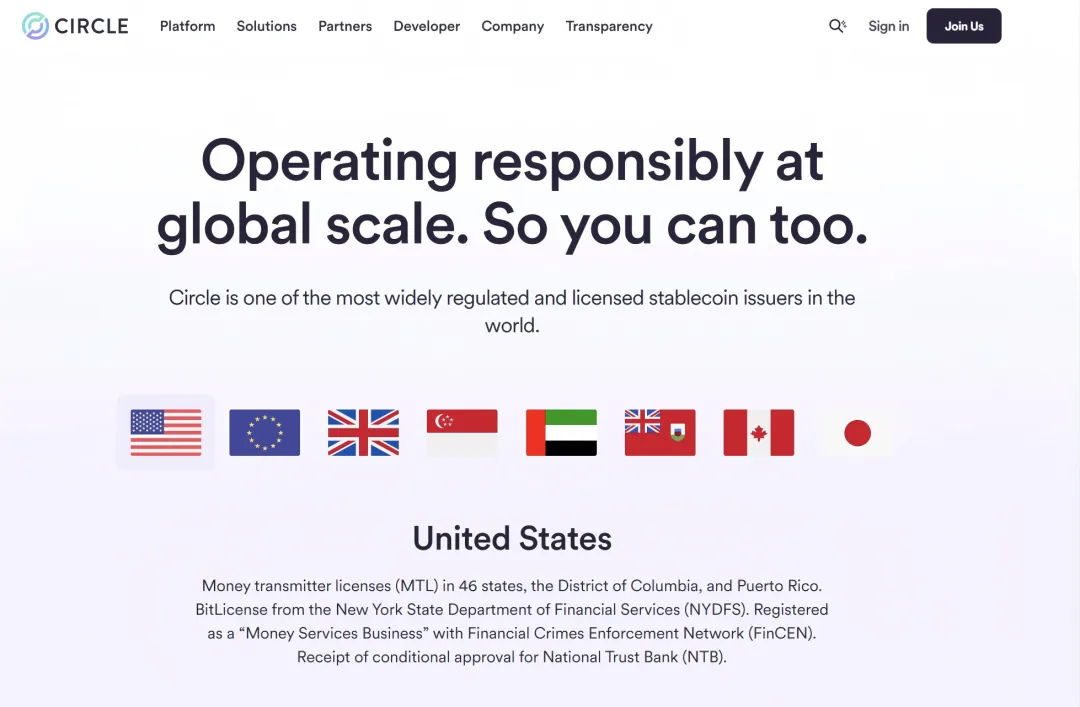
Circle serves as a reference point. As of early 2026, the company held licenses at different levels in nine jurisdictions, ranging from a US state-level MTL to French EMI, UK FCA EMI, Singapore MAS MPI, Abu Dhabi ADGM FSP, and Bermuda BMA Class F—this wasn't achieved in a single application, but rather through a decade of accumulation starting with a state-level MTL in 2014.
Why can't we skip the first two stages?
The regulators won't issue you a license. What the regulators approve of is a gradual approach.
In the application review process for Tier 1 licenses such as MiCA, MAS MPI, and ADGM FSP, "fit and proper" is a core aspect. Regulators look at your compliance operation record, the maturity of your risk control system, the robustness of your IT system, and the work experience of key personnel.
The success rate for a company starting from scratch to directly apply for MiCA CASP or MAS MPI is extremely low—regulatory preferences favor a "gradual compliance upgrade" trajectory, rather than a "one-step leap."
The regulatory logic behind this is actually quite simple and completely consistent with traditional finance. Traditional banking licenses are issued in the same way; no one can skip payment licenses and trust licenses to directly obtain a banking license.
The cost of skipping a level isn't just application rejection. Even if regulators issue you a higher-level license for strategic reasons, you may not be able to meet the corresponding substantive compliance requirements. The size of the compliance team, the investment in IT systems, and the maturity of the risk control system required by MiCA are levels that early-stage projects cannot achieve from scratch within 18 months.
You can buy a license, but you can't buy ability.
However, another path is to directly acquire a licensed company with operational experience—Paxos's 2024 acquisition of Finland's EMI Membrane Finance follows this logic, granting EU EMI + MiCA compliance upon completion of the acquisition. Acquisitions simultaneously provide licenses and capabilities, but this requires sufficient funding and integration capabilities, making it an option generally not suitable for early-stage projects.
V. The Cost of Mismatch
The three-stage process seems clear, but the cost of the mismatch stage is quite severe.
The first problem is excessive compliance. Having secured seed funding, some companies feel they should "align with the leaders" and jump directly to the third stage, applying for MiCA CASP or MAS MPI. After 18 months, compliance costs have burned through $1 million, the business hasn't been fully validated, and they can't present a compelling narrative for their Series A funding. This is using the compliance budget intended for the SoV path on MoE business—the most common mismatch in early-stage projects.
Secondly, they bet on the wrong market. In 2024-2025, many projects staked on a single Polish VASP or Australian DCE license, hoping to enter the EU or Australian market via passport. However, changes in regulatory pathways disrupted all expectations. The risks of relying on a single license will only increase in an era of fragmented regulation—compliance practices in 2026 have shifted from "optimizing a single jurisdiction" to a "composite compliance architecture."
Thirdly, the banking channels are blocked. This is the least discussed aspect in compliance discussions.
A license only defines "what you are allowed to do," while the banking channel determines "whether you can actually conduct business."
It's common for Canadian banks to refuse to open accounts for crypto MSBs. Many early-stage projects that obtain licenses are unable to open accounts, rendering their entire architecture useless.
However, this is highly case-specific—two companies holding the same Canadian MSB license may have vastly different outcomes: one may be able to open an EMI channel such as BVNK or ClearJunction, while the other may not. The difference lies in the UBO structure, business model, KYC documentation, and even luck.
The most common risk control trigger points in a UBO structure:
- Chinese mainland passport holders as ultimate beneficiaries – most European EMIs have explicit or implicit rejection policies.
- BVI → Cayman → Multi-layered offshore structure of the operating entity – triggering enhanced due diligence or even outright rejection
- UBO's past associations with cryptocurrency exchanges – common reasons for rejection
High-risk keywords in the business model description:
The presence of "OTC" in the onboarding file almost automatically triggers manual review.
- "peer-to-peer payments", "unhosted wallet", and "self-custodied wallet"—all trigger the same event.
- "aggregator" and "crypto mixing"—directly shut down most EMI channels.
- The combination of "gaming" and "crypto" is equivalent to a high-risk label in the current environment.
Geographic dimension: Any description in the transaction path involving nodes in Iran, Russia, or North Korea is an immediate rejection.
The danger of these trigger points is that they don't appear in the rejection letter. The standard response from EMI is "not a good fit at this time," and you never know which word will land you in the bag.
Choosing a bank channel cannot be done by simply following a map. Due diligence must be conducted in advance—and whether an account can be opened ultimately depends on the nature of your business and its regulatory classification.
VI. MoE or SoV: The Switch That Determines All Costs
Why these three stages? Why does the compliance cost differ by an order of magnitude at each stage?
Behind this is an underlying shift: the role of stablecoins in stablecoin payments is extending from "medium of exchange" to "store of value".
This switch determines the order of magnitude of your compliance costs.
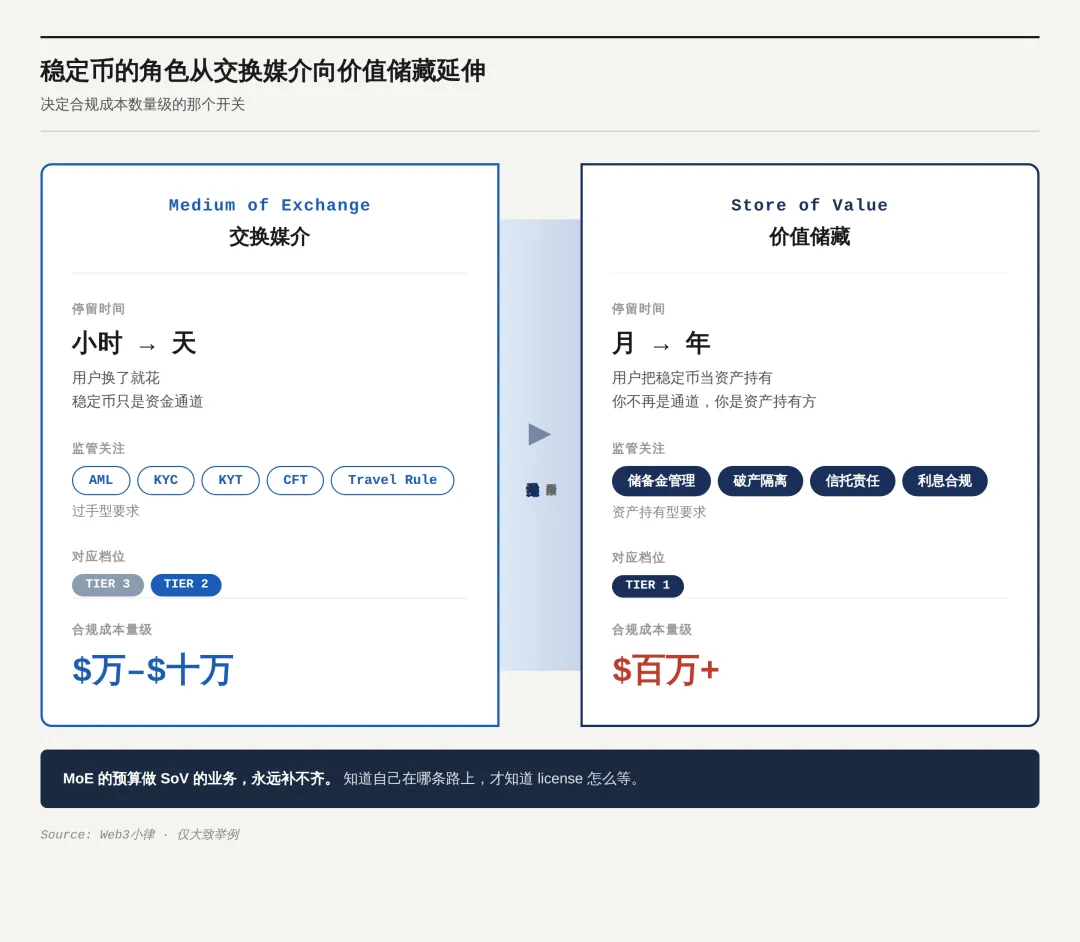
In the MoE phase, stablecoins are merely a conduit for funds. Users exchange fiat currency for USDT to spend immediately, with the holding time measured in hours or days. Regulators focus on "transfer-type" requirements such as AML and Travel Rules. Licenses like the Canadian MSB and Hong Kong MSO are designed around MoEs, with low barriers to entry.
In the SoV (Stablecoin on Demand) phase—users begin to hold stablecoins as assets, with holding periods increasing from days to months and years. At this point, you are no longer a conduit; you are an asset holder. Regulatory focus shifts to reserve management, bankruptcy remoteness, fiduciary duty, and interest rate compliance—each corresponding to a higher-level license.
The transition to SoV (Stablecoins) is expected to become a global regulatory consensus in 2025-2026. The US GENIUS Act (signed in July 2025) defines stablecoins as "payment stablecoins," restricting issuance rights to specially licensed issuers or banks regulated by the OCC—Stripe's Bridge has already received OCC Initial Trust Bank Approval, and Circle, Ripple, Paxos, and Fidelity are all in the queue. Hong Kong's HKMA Stablecoin Ordinance (effective August 2025) and the issuance of the first batch of issuance licenses in March 2026 require capital adequacy ratios and reserve management at the same level as banks.
Regulators have already included stablecoin issuance at the "financial infrastructure" level—the regulatory path leads directly to banking licenses or quasi-banking licenses.
The implications for early-stage projects are clear: when designing a business model, you need to figure out whether you want to be a MoE, a SoV, both, or achieve it through DeFi.
The compliance costs of the two paths differ by an order of magnitude. MoE's budget for SoV (Socially-Oriented Enterprise) business will never be enough to cover the costs.
Of course, MoE and SoV are not mutually exclusive switches. Many projects start with MoE, but as users begin to keep balances in their wallets and hold them for longer periods, such as days to months, their businesses will naturally shift towards SoV. This evolution itself is not the problem—the problem is whether your compliance architecture has upgraded along with the business model. The three-stage progressive logic is essentially a response to this evolution.
Knowing which path you're on is the key to understanding how long you need to wait for a license.
VII. Returning to the first question
"Which license should I get?"—This is the question posed at the beginning of this article.
After tracing the five dimensions, three stages, three types of mismatches, and the underlying logic of MoE/SoV, this question naturally evolves into a set of more specific judgments: What stage is my business currently in? What does my counterparty want? Is the bank willing to open an account for me? Am I on the path of MoE or SoV?
Upgrade in stages to match your size. Licenses are a follower indicator for business, not a leader indicator.
Get the business up and running first.