Compiled & translated by: Deep Tide TechFlow
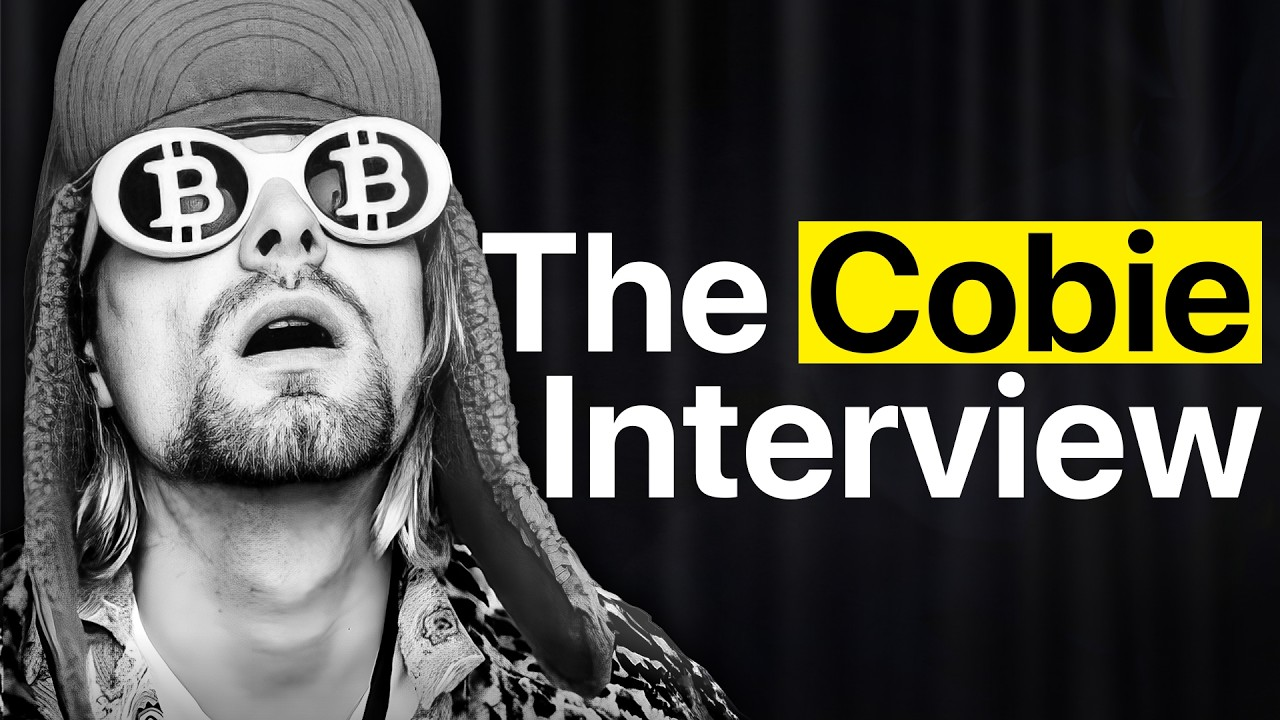
Guest: cobie
Host: threadguy
Podcast source: threadguy
Original title: An Unfiltered Conversation with Cobie
Broadcast Date: April 22, 2026
Key points summary
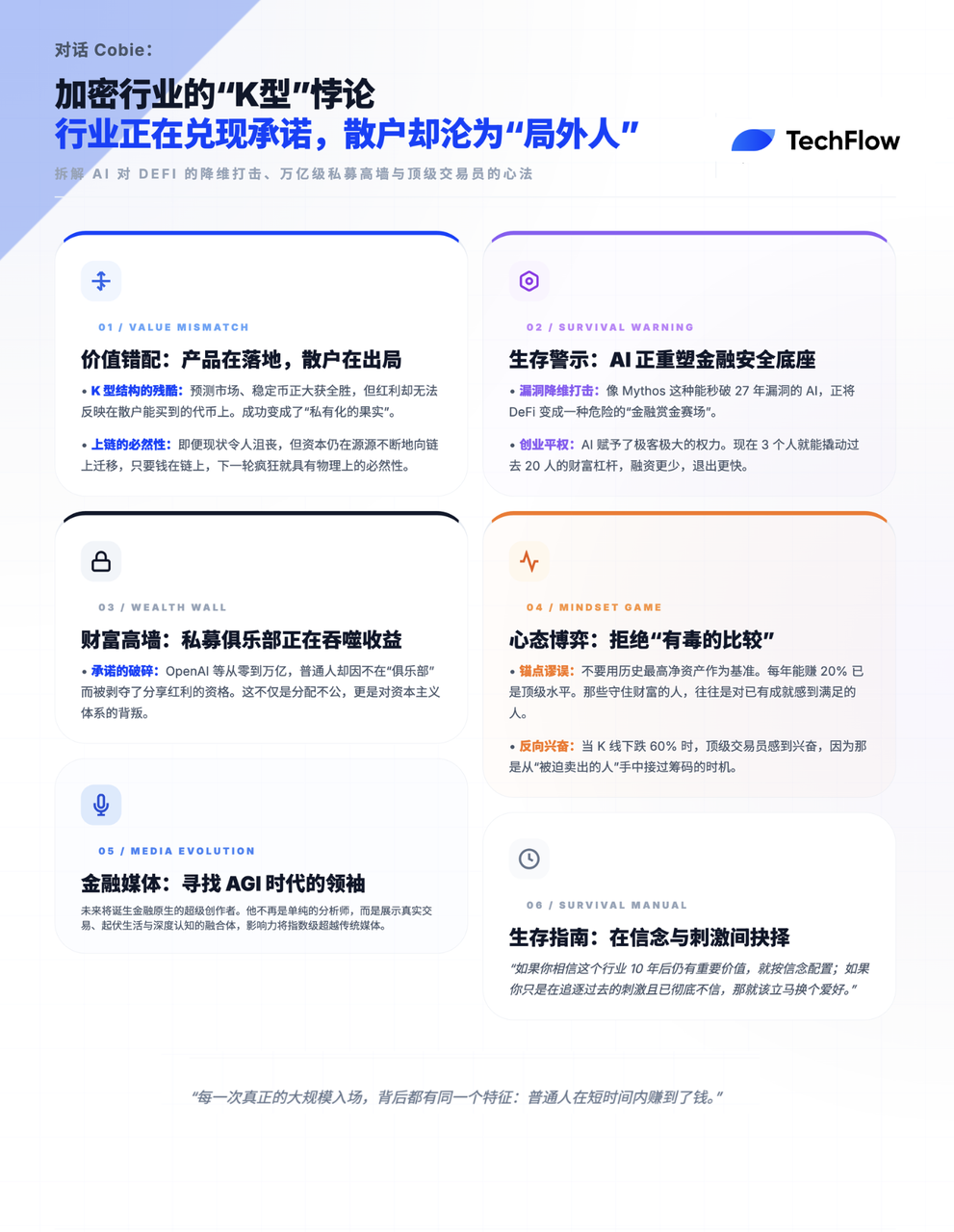
In this episode, Cobie and Threadguy start by discussing Cobie's recent work at Coinbase, then expand to the future of DeFi, AI, Bitcoin, memes, tokenized stocks, the private market, and financial media. Cobie's core assessment is that the crypto industry is experiencing a K-shaped divergence: stablecoins, prediction markets, and on-chain transaction infrastructure are making real-world progress, but ordinary investors find it difficult to capture these achievements through public tokens. He also believes that AI will drastically change the way startups and market participants operate, and will amplify wealth inequality, but the crypto industry may still redistribute some value through airdrops, on-chain ownership, and open finance. For those experiencing an industry downturn, his advice is straightforward: if you truly believe something will be important in the future, allocate your resources according to your judgment; if you no longer believe and are merely chasing past thrills, then it's time to switch interests.
Summary of key viewpoints
On the “K-shaped differentiation” and distribution dilemma in the crypto industry
- “A strange K-shaped structure has emerged in the crypto industry: on the one hand, we have seen very successful cases (Polymarket, stablecoins); on the other hand, these successes have not been reflected in the asset prices that ordinary people can access.”
- "The crypto industry is delivering on many of its promises... but for the average crypto investor, this is frustrating. You might ask, 'How do I invest in these successful projects?'"
- "It's difficult for us to get investment opportunities in truly well-performing projects, and I'm no exception. However, I do believe there's another reason for a bull market in the crypto industry at a societal level: it's bringing more and more capital onto the blockchain."
- “Every truly large-scale entry into the market has the same characteristic: ordinary people make money in a very short period of time.”
The impact of AI on DeFi and industry barriers to entry.
- “For me, the thing that worries me most about DeFi is artificial intelligence technology like Anthropic’s Mythos model. It could turn DeFi into a financial bounty system.”
- "Now, one can start a business and achieve amazing results in just six months. For example, one person achieved billions of dollars in a month or so (OpenClaw)."
- “AI has changed the economic model for early-stage employees. In the past, being an early-stage employee was a bit like a scam… Now, companies need fewer people, raise less funding, experience less dilution, and exit faster.”
- “When the crypto airdrop model is applied to consumer companies, it can return the value created by users to users. This is somewhat like a capitalist response to universal basic income.”
Regarding the "injustice" in the private equity market and social commitments
- “SpaceX, Anthropic, and OpenAI have grown from nothing to trillions of dollars, yet almost no ordinary people can share in this wealth creation. It’s like the promise of capitalism has been broken.”
- "The current state of the private equity market is a betrayal of the capitalist system. If you're in the 'club,' you can invest; if you're not, you have no chance."
- “The public market is becoming more and more like a ‘liquidity provider of last resort,’ which is actually very similar to the crypto market.”
- "Fifty years from now, people might look back and say, 'You didn't buy it when it was worth a trillion dollars? Why didn't you buy God?' And I can probably only answer, 'I was buying some kind of Memecoin back then.'"
On Trading, Risk, and Top Traders
- “Truly great traders are very self-driven… They record their judgments and results, and constantly update their world model with training data.”
- "Don't compare yourself to that 'perfect version' who makes all the right decisions, and don't use your historical peak net worth as a benchmark to measure yourself."
- “I get very excited when the market suddenly drops by 50% or 60% in a single candlestick. That means you have the opportunity to buy assets from people who didn’t want to sell.”
- "Many people who truly preserve their wealth are those who are content with what they already have. In the financial markets, it's easy to fall into a toxic comparative mindset."
On Bitcoin, Saylor, and Emotion
- "I first realized that MicroStrategy was going viral when my dentist told me that he had 80% of his portfolio in MicroStrategy and 20% in Palantir."
- "What surprises me most about the crypto industry is how intensely you live in the moment. The emotions you feel right now seem incredibly real, but if you think back to three months ago, you might have felt the complete opposite."
- “GCR is like a ‘smart asset’ that’s good at playing mind games. He’s said he has inside information, but that’s probably just to get competitors to stop looking for the APIs or data paths he actually uses.”
On Industry Mindset and the Future
- "If you believe that this industry will still have something important five or ten years from now, then allocate your resources according to your beliefs; if you don't believe in anything and are just chasing past thrills, then you should switch to a different hobby."
- “In the next three to five years, a financial native content creator will emerge… He will showcase his life and the ups and downs of the market. Someone who creates excellent content in a good year could become a phenomenon ten times bigger than Roaring Kitty.”
- "Helping people I don't even know makes my life richer and more interesting. Staying optimistic, hopeful, and connecting with others is a wonderful way of life."
Offered to join Coinbase for free
Host ThreadGuy: You've been quite quiet lately, and everyone's wondering when UpOnly will return, and when you'll be back. What have you been busy with for the past month or months?
Cobie :
At work, my workload is probably heavier now than it has been in the past few years. Actually, I tried to join Coinbase for free a few years ago, even offering to take zero salary, but it didn't work out; they basically rejected me.
I've always felt that there aren't many things in this industry that can truly leverage and substantially change its trajectory, and making Coinbase successful is one of them, so I was really keen to give it a try. After all, I'd been on Twitter for 10 years, and anything that gets me thinking and is more challenging than writing boring jokes is very appealing to me.
AI is the biggest threat to DeFi
Host ThreadGuy: With the recent Arbitrum and LayerZero incidents, coupled with the previous Drift situation, DeFi sentiment has plummeted again. What are your thoughts on the current state of the crypto industry, especially DeFi? Where are we headed next?
Cobie :
I think we're pretty much on the edge of DeFi 2.0. For me, the thing that worries me most about DeFi is artificial intelligence technology like Anthropic's Mythos model . This kind of thing scares me a bit because it could potentially turn DeFi into a financial bounty system.
Once these AI models are more widely distributed, not only will attackers of DeFi systems exploit them, but those who create these systems will also be forced to confront the same capabilities. This means that DeFi may undergo a transformation in the future, ushering in a completely new version, which sounds exciting but also comes with enormous challenges. DeFi is indeed currently in a low mood, with little particularly interesting developments beyond projects like Hyperliquid and Trade XYZ.
K-type encryption industry theory
Host ThreadGuy: You've mentioned DeFi 2.0 and said Mythos is scary. If that's the case, why are you still interested in Coinbase and the crypto industry as a whole? Aren't you disappointed with the future of the crypto industry, or with its current state?
Cobie :
Many of the things you trade now are no longer traditional crypto assets, but rather traded through crypto infrastructure. This has led to a strange K-shaped structure in the crypto industry: on the one hand, we're seeing incredibly successful cases, more than ever before; on the other hand, these successes aren't reflected in the asset prices accessible to ordinary people, except for a very few tokens. For example, Polymarket is thriving. Prediction markets are a very native application of crypto, and now a duopoly has formed between Kalshi and Polymarket. Stablecoins are also becoming increasingly like real and important infrastructure, being applied in more and more scenarios.
However, this situation is frustrating for the average crypto investor. You might ask, “How can I invest in these successful projects? Buy a stake in Stripe? But it’s still private. I can’t buy shares in Tempo or Polymarket either.” These projects are doing well, but you can’t profit from them, while demand for crypto assets and investor interest have declined significantly.
So this is indeed a very interesting time. The crypto industry is delivering on many of the things it promised to do, such as Hyperliquid , Trade XYZ , and HIP-3 , which are really cool projects.
I think we need to look at two things separately: on the one hand, what progress has actually been made in the crypto industry, and on the other hand, the frustration caused by the lack of price increases for memes and governance tokens. This is because it's difficult to access investment opportunities in truly well-performing projects. However, I do believe there's another reason for a crypto bull run at a societal level: it's drawing more and more capital onto the blockchain . As long as capital continues to flow onto the blockchain, the next round of excitement, frenzy, and even arguably foolishness will become increasingly inevitable.
I've been quite optimistic lately. I've been pessimistic about many things in my life, but I've found that pessimism hasn't done me any good. Maybe I should have been more pessimistic about FTX, so I wouldn't have any positions in FTX; maybe I should have been more pessimistic about the NFTs left over from 2021. But overall, pessimism has never benefited me.
Now, I'm trying harder and harder to take a long-term view of things, move forward slowly, and stay positive and optimistic. Maybe my perspective is wrong, but if it is, there's nothing I can do about it.
Opinions on Saylor
Host ThreadGuy: Bitcoin's performance relative to gold and other assets is currently less than ideal. In this environment, people should be re-evaluating Bitcoin's value proposition, but the current discussion revolves around Saylor, Strategy, STREK, and how much supply he holds. Do you think Michael Saylor and his Strategy experiment could become a pessimistic point for the crypto industry?
Cobie :
Actually, I wasn't worried at all until I went to the dentist one time. My dentist suddenly asked me, "Do you own any stocks?" I replied, "I don't know much about investing." He then said, "Have you heard of MicroStrategy?" I thought to myself, "My goodness!" He was probably in his 70s and said he only owned two stocks: 80% of his portfolio in MicroStrategy and 20% in Palantir.
That was the first time I felt this had truly "broken out of its niche." I previously thought only people on crypto Twitter, or those who used to change their profile pictures to laser-eyed people, cared about MicroStrategy, but this dentist was an ordinary person in the real world. Sometimes I even felt that the crypto industry was a virtual existence, like a hallucination I conjured up while sitting at home, but the dentist's words made me realize that Bitcoin is real, and people outside the crypto world know it exists.
I don't know if I'm starting to genuinely worry about Strategy, but it's definitely starting to feel like something's hanging over many people's heads. Before, when people heard Saylor was buying Bitcoin, they thought it was good news; but now, when prices drop, people see it as a warning sign. Of course, once prices go up, the sentiment immediately shifts to "Great, Saylor is awesome!"
What surprises me most about the crypto industry is how intensely you live in the present moment. The emotions you feel right now seem so real, as if you couldn't imagine yourself feeling anything else. But looking back three months ago, you might have felt the complete opposite, so I try to maintain a long-term perspective on these things.
Why didn't UpOnly return?
Host threadguy: Is your dislike of going out the reason why UpOnly hasn't made a comeback?
Cobie :
There's a phenomenon called "second album syndrome." Many artists have a hugely successful first album, but their second often flops, and I think I have this problem too. Every time I think about doing UpOnly again, I start to doubt myself: Do I still know how to be funny? What should I talk about? Do I still understand what's happening in the crypto industry? Who should I invite as guests? Moreover, many of our previous guests have gone to jail, and some have even criticized us because they appeared on our show before committing crimes.
More importantly, UpOnly was born during the pandemic. Everyone was stuck at home, glued to their screens. Bitcoin surged from $4,000, and Ethereum jumped from $80 to $4,000. The DeFi Summer arrived, the NFT craze began, and everyone made a fortune; emotions were running high.
So a lot of people thought UpOnly was a good show because that was when their return on investment was at its best. They felt like whatever they did was right, and our show just happened to be something they would watch on Thursdays. The current market environment is a bit gloomy; people are more angry and more likely to attack each other. I think it would be better to wait for a better time to do it. Besides, I really feel like I'm getting too old now.
Host Threadguy: I understand what you mean by "second album syndrome," but not doing UpOnly leaves a void on the social side of encrypted Twitter. Whenever something bad happens, people want to hear Cobie's opinion; you're like a mouthpiece for encrypted Twitter.
Cobie:
We're all getting too old. You said people want to hear Cobie's perspective, but often I really don't know what to say. This role has become bigger than myself, and the pressure has increased accordingly. People over-interpret your casual remarks, which makes you not want to speak out anymore. For example, I once posted a meme version of John Brown's famous quote, "The easy road and the hard road." At the time, Bitcoin was around $70,000, and some people sent me very angry, even threatening, messages because this half-joking tweet didn't come true.
If you look through all my tweets, probably only 5% will turn out to be correct; the other 95% are wrong. People didn't used to get so angry about these mistakes, but now there's much more negative emotion. I think this is a symptom of our times: the market is becoming harder to profit from, leading to greater polarization, unhappiness, and even despair among many. All of this makes me even less inclined to speak out.
The past decade of the crypto industry
Host ThreadGuy: In 2020 and 2021, when I first started trading Top Shots and NFTs, it seemed like people doing independent e-commerce and sneaker reselling on the internet naturally shifted to the crypto industry because of its talented people, exciting atmosphere, and the latest "games." But now it seems the brightest young people have gone to AI, fintech, or other platforms not directly related to the crypto industry. In 2026, what can we do to re-attract the next generation of young talent to the crypto industry?
Cobie :
If you look back at the major entry events in the crypto industry over the past decade, you'll find a common thread. 2013 marked the first major altcoin cycle, which was also the first one I participated in. There were only about 100 coins at the time, and the first altcoin season attracted a lot of capital and interest . Back then, you had to own Bitcoin to trade altcoins because there were no stablecoins, and centralized exchanges' base trading pairs were all Bitcoin.
2017 was the peak of ICOs (Initial Coin Offerings) , and back then you needed to own Ethereum because it was the primary underlying trading pair. In 2021, we experienced the DeFi summer and the NFT craze . From 2023 to now, we've had the meme cycle . What all these entry points have in common is that ordinary people made money in a very short time, and these opportunities were accessible to everyone.
AI is giving off a similar vibe now. People imagine they could buy a Mac Mini, install OpenClaw, and use the machine to run a business for them, earning $100 million. This kind of "money-making hobby in their spare time" is only going to become more and more popular. Will the crypto industry see something similar again? Has its brand already been damaged? Will it take 5 or 10 years? I don't know. But I'm inclined to be optimistic. History has no reason not to repeat itself, and human creativity is incredibly powerful.
We've witnessed countless groundbreaking innovations in the past, and new things will undoubtedly continue to emerge. Whenever something new is invented and allows many people to profit, a wave of followers will surge in. Brands, sentiments, and positioning change incredibly quickly. NFTs are a prime example. I have some casual friends who bought into ICOs in 2017. Later, because one of their tokens failed to deliver on its promises, they categorized all cryptocurrencies as scams. But when NFTs appeared, they immediately changed their minds, saying, "No, this is different; I'm collecting art." Those previous complaints of "I'll never buy crypto again" were instantly dispelled by projects like Art Blocks. As long as prices rise, everyone is happy; and when everyone is happy, the crypto industry becomes "cool."
Host ThreadGuy: The key to NFTs is that, for the first time, they've attracted new participants—including artists, buyers, and traders. The 2024 AI season also briefly brought that feeling, with AI developers feeling they could make more money launching projects on Solana.
Do you think that new technologies like on-chain stocks, tokenized stocks, Hyperliquid's perpetual contracts, and Trade XYZ can achieve similar results?
Cobie :
What I like about TradeXYZ and Hyperliquid is that they've brought a lot of new capital onto the blockchain, making people who might not have previously been exposed to blockchain technology accustomed to using it. If a large amount of capital is concentrated on-chain, and the volatility of traditional assets gradually decreases, this capital will seek new investment opportunities. At that point, people might invent new DeFi, or other innovative things.
I don't think those who invented crazy projects like DeFi and NFTs will be satisfied with just buying stocks, but tokenized stocks are indeed very attractive because they can attract more people and more wealth into the blockchain field, making blockchain technology closer to the real economy, rather than just a self-circulating leverage sandbox.
As for what will be the next big thing, I never know. If you had told me in 2020 that Ape images would be trending, I would have thought it impossible. So my idea is: in the crypto industry, isolate yourself from risk and try everything new. Not that you should chase every new project, but when something truly novel comes along, don't instinctively laugh it off or say it won't succeed. Instead, ask yourself: if it succeeds, wouldn't that be cool? If so, then I might be willing to give it a try.
For example, if you did this with Hyperliquid, you might become a millionaire through an airdrop. The same applies to Friend.tech or buying Ape images. Every time I see something strange and new, I try to understand it and think about whether it could become a significant innovation.
Host threadguy: If you entered the market a few years ago, almost all the conditions that could drive a bull market in the crypto industry had already been met: Trump publicly supported Bitcoin mining, a strategic Bitcoin reserve, Gensler's resignation, the approval of a Bitcoin ETF, institutional buying, and traditional finance starting to discuss on-chain stocks and asset tokenization.
Aside from speculation itself, all the bullish factors are in place. Will we ultimately find that the crypto industry is merely a tool for traditional finance to tokenize its own assets? Bitcoin has its value, but other altcoins, memes, NFTs, and DeFi are just wasted experiments?
Cobie :
This brings us back to the K-shaped structure I mentioned earlier. We've developed these technologies, built a self-circulating leverage sandbox, and been under pressure from regulators for the past decade. Then suddenly, these technologies became "cool" and compliant, and large companies flocked in, captured the value, and took them private. I think this is a real risk, and part of it has already happened.
The past few years have also been challenging for crypto-native projects. Their pursuit of revenue has ironically increased their risk. When all conditions improve, counterintuitively, this could be a good time to exit. Imagine you've held $10 billion worth of Bitcoin for the long term, and now you see a crypto-backed president, ETF approval, and all the positive factors you just mentioned. You might think, "Could things get any better? Maybe it's time to sell."
The crypto industry often performs best when everyone is asking, "Could it get any worse?" In difficult times, true believers feel they've been given an opportunity. But when good times actually arrive, newcomers may feel they've missed out, while veterans start to wonder: have we already gotten everything we wanted? Therefore, I think the crypto industry, to some extent, needs a "rival." The anti-crypto voices of the past have actually made the crypto community more united and more optimistic about the future.
I don't have any particularly sophisticated analysis. I just think the crypto industry is cool, and I'm optimistic about its future; I've been bullish on it since 2012.
Host ThreadGuy: You keep mentioning the K-shaped structure. If you were a young person facing the late capitalist American empire, where those with the most power were maximizing their own gains, what should a young person do in this environment?
Cobie :
The coolest thing right now is that you can start a business alone and potentially achieve amazing results in just six months. Take OpenClaw, for example; one person achieved billions of dollars in revenue in about a month. Creators and builders used to be limited by not being able to find a team, not knowing the right people, lacking capital, or not being in Silicon Valley. But now, a huge wave of equality is happening, and many things that were previously impossible are now possible.
In the coming years, I believe AI-driven companies will create an unprecedented number of unicorns . It's also changing the economic model for early-stage employees. In the past, being an early-stage employee was somewhat of a scam, because you took on almost all the risks of the founders but only received one-twentieth or even one-hundred-and-fiftieth of their returns. Now, companies need fewer people, raise less funding, experience less dilution, and exit faster. As a founding engineer or early-stage employee, the risk-reward ratio is actually very high because you can find out whether the company will succeed much sooner.
If I were as young as you today, I would probably do one of two things: either work on a project by myself or with a few friends that used to require 10 to 20 people but can now be done by 3; or find the smartest person I know and do everything I can to join their company and do anything that can help it run.
The financial market is increasingly resembling the crypto market. I used to think that crypto would become more like the traditional market, but it turns out that the traditional market is becoming more and more like the crypto market. For those who are really willing to use their brains, the market is still full of inefficiencies and opportunities.
Trillion-dollar IPO
Host ThreadGuy: Now almost everything is traded like crypto assets: oil, silver, gold, and even a single sentence from Trump can cause huge market fluctuations. How do you see the market evolve like this since you started trading?
Cobie :
I generally try to avoid these markets because I don't consider myself "smart money" in them. The exceptions are long-term asset allocations, like some gold I bought a while ago and some long-term non-crypto assets. Otherwise, I try to stay away when these things are being traded excessively.
Markets have their own "personality." I know Bitcoin's personality and can roughly predict its next move. But a new market's personality is completely unknown and it might do very strange things, so I prefer to stay in areas I'm familiar with. If I really want to participate in other markets out of FOMO, I will strictly limit the risk, usually only opening a small position to avoid impulsively opening a large position.
For those who trade full-time and are highly committed, current market conditions may be ideal, but I'm more concerned about the "unfairness" in the private equity market. Companies like SpaceX, Anthropic, and OpenAI have grown from nothing to trillion-dollar or even multi-trillion-dollar valuations, yet no ordinary person has benefited from this wealth creation. This crony capitalism means that if you're in the "club," you can invest; if you're not, you have no chance. Profits are privatized, while losses are, to some extent, socialized.
The public market is increasingly resembling a "liquidity provider of last resort," much like the crypto market. Similar things have happened in the crypto industry: VC rounds are getting bigger and bigger, and tokens are listing with a $16 billion FDV (fully diluted valuation), while just two days earlier its valuation might have been only $100 million.
This makes me feel like a social promise has been broken. The promise used to be: if you work hard and earn money, you can invest in companies you like and share in the wealth they create. If you thought Apple was a cool company in the 1970s, you could buy its stock; if you were right, you could share in Apple's growth. But now? You can only buy a potentially fictitious Anthropic derivative on PreStocks, or open a perpetual contract on some platform? Ordinary people have virtually no access to these real wealth-creating events.
I believe this situation could trigger a social revolution. Historically, every era has had a period of peace, followed by a widening divide between the elite and the general public, ultimately leading to social instability and even the overthrow of the elite. In my view, the current state of the private equity market is already a betrayal of the capitalist system.
Host threadguy: If you were an ordinary person who could only participate in the liquid market, and knew that the best assets would remain in the private market for as long as possible, and in the end you might only be able to buy leveraged exposure at a valuation of $1.5 trillion, what would you do?
Cobie :
I probably won't get involved. Especially with a company like Anthropic, its product is so good it's almost exhilarating. It's like creating a completely new way of working, entirely different from existing company models. 50 years from now, people might look back and say, "Why didn't you buy it when it was worth a trillion dollars? Why didn't you?" And I'll probably only be able to answer, "Back then, I was buying Truth Terminal tokens, thinking Dogwifhat was coming back."
So, the anthropic is the only thing that makes me conflicted. Maybe I'll open a small position, just to prevent myself from opening an excessively large position due to FOMO.
Host threadguy: What about from a societal perspective? If we're at the bottom of a K-shaped economic cycle, what should we do?
Cobie :
Historically, this pattern has repeated itself: in times of peace, the ensuing wealth inequality drives social unrest, ultimately leading to the overthrow of the elite. This recurrence seems inevitable; the only question is when. I believe the emergence of AI is accelerating this process, not slowing it down. Of course, it can also be viewed from another perspective: AI may bring widespread prosperity, but it could also steepen the K-shaped curve of social polarization, further exacerbating the gap between the elite and the lower classes.
There's actually another strange reason behind the crypto bull market . You know, when we do airdrops today, it often seems absurd: people pretend to use a product they don't really want to use, just to get tokens they can sell in the future. But occasionally there are exceptions like Hyperliquid, where users genuinely believe in the product and are unwilling to sell even after receiving the tokens.
Extending this model to real-world startups and consumer businesses makes things very interesting. For example, early Facebook users provided significant value to Facebook: they helped launch the product, provided feedback, and created network effects. However, beyond using Facebook, they didn't gain any upside benefits. Applying the crypto airdrop model to consumer companies, on the other hand, allows users to reap the value they create when the company goes public or generates further value.
This is somewhat like capitalism's response to a universal basic income: you participate in economic activity, and if you're a "super user," you can reap a share of the value. Cryptocurrency can do this very well globally. The first company to do this needs to be incredibly bold. Would Hyperliquid have fared the same way without the airdrop? Perhaps its product was powerful enough to succeed; but the airdrop certainly brought it the best traders, the most capital, and the most loyal supporters. I believe Hyperliquid is one of the most successful flagship cases of airdrops.
There are many reasons why I didn't do that. The token revenue model is very volatile and may not be suitable for all projects. We also considered an on-chain IPO, turning airdrops into real equity and distributing it on-chain. But the company might have needed to mature further before that was appropriate, and later an acquisition opportunity arose, which was a good outcome for the stage at that time. If I were to start another business in the future, I would seriously consider incorporating this mechanism into the plan from day one. However, I think this model might be more suitable for non-crypto consumer businesses than for crypto companies.
Cobie's legendary buy wall
Host threadguy: I've always wanted to know the story behind Buy Wall's tweet. Could you tell it from the beginning?
Cobie :
The real story might not be as cool as the legends you've heard. Here's what happened: I was at home in London when the market suddenly crashed. I was a fairly active trader at the time, so I had a lot of price alerts set. These alerts would wake me up if the market price dropped sharply. Around 1 a.m., I was woken up by an alert, and the chart on my screen showed a huge red line; the price had practically jumped off the screen. I thought to myself, this looks like a bottom.
So I placed a buy order about 2% to 3% below the current price, at around $4,600 . This was basically all my stablecoin balance, which was all the funds I could use in crypto at the time. I put these funds up as a wall of buy orders and then went to sleep.
When I woke up the next morning, I found that only a small portion of the order had been filled; the rest was never filled at all, and the price never came close to that level again. I had actually missed most of the opportunity and ended up having to chase after the price to make up for the remaining position.
I placed the order, tweeted about it, and then went to sleep. The order was filled about two minutes after I tweeted, but I stopped watching it. I get very excited when the market suddenly drops 50% or 60% in a single candlestick. Because, you know, this doesn't mean someone is actively sitting there clicking "sell," but rather someone is being forced to sell to you. This means you have the opportunity to buy assets from people who wouldn't normally sell, so it's a great opportunity.
At the time, I had relatively strong conviction that the macroeconomic cycle had bottomed out. Even if prices continued to fall, I felt that price was acceptable. My tweet was indeed near the precise bottom, and my orders were likely also near the bottom. But people got a little too fixated on this story. In reality, it was basically just luck. Moreover, my net worth wasn't that high at the time; it wasn't some kind of market-saving buy order wall. It was just all the money I had on-chain, and it hadn't even been fully executed yet.
Top 5 Crypto Traders in History
Host ThreadGuy: Many early crypto Twitter (CT) figures have disappeared. For example, GCR has stopped posting, and Light rarely speaks anymore. Much of early history hasn't been recorded. In your opinion, who is the greatest crypto trader of all time? Or, who do you think are the five greatest native CT traders?
Cobie :
This is somewhat similar to the "album problem" I mentioned earlier. Every trader has their own "high season," and some people perform exceptionally well in a certain phase but may not perform well in the next phase.
For example, Su Zhu 's performance in 2021 was definitely in the top five. He had a period of heroic trading, even successfully selling at the top. The problem was, he later re-bought with high leverage too early, resulting in a margin call during the downturn. GCR is clearly also in the top five. He's like a "smart asset," adept at playing psychological games. Often, you know what he says isn't necessarily true, but he's deliberately spreading rumors about himself to achieve other goals. There are many rumors about GCR, some of which he actually spread himself to keep others away from his real alpha. For example, he claimed to have sources within Binance, but this might just be to discourage competitors from searching for the API or data path he actually uses. AAB BTC is also very strong. He always manages to become very wealthy, only to be liquidated later. Light is also definitely one of the top traders. Based on what I know, 2025 could be Light's best year.
What these top traders have in common is their extreme self-motivation . They don't just read through crypto Twitter and ask themselves what trading strategies others have shared. They start with first principles, thinking about how something affects the market and why. They document their thought processes, reflect on the results, and continuously update their models. It's like adding training data to themselves, learning what they did right and what they did wrong.
Those who ultimately suffer margin calls often do so because they've taken on too much risk. Those who manage to both make money and preserve their gains are usually satisfied with their achievements. I think I'm closer to the second type—you could say I'm a bit cautious. I've probably only been completely risk-on in my life four or five times, and I haven't used leverage for many years.
In the financial markets and the crypto industry, it's easy to fall into a toxic comparative mindset. Even if you're already a millionaire, a multi-millionaire, or even have six-figure sums, you might still feel like you're not doing enough because there's always someone earning more than you. I felt that way in 2021. Three Arrows Capital seemed to suddenly emerge in 2019 or 2020, and within just one year, their net worth exceeded mine by many times. Although I'd been trading crypto since 2012, I still doubted myself: Was I too stupid? Was I not taking enough risks? Was I not smart enough?
This comparative mindset is truly toxic. 2021 might have been my best year, but all I could think about was how others performed even better. However, I'm so glad I was able to move on quickly. Don't compare yourself to that "perfect version" who makes all the right decisions, and don't use your historical peak net worth as a benchmark. Earning 20% annually is already among the best investor levels in the world. Many people who truly preserve their wealth are those who are content with what they already have.
Host threadguy: Do you reflect on becoming a Cobie? Do you regret it? Now you are easily recognized in the real world, and a single sentence you post can affect other people's opinions and financial decisions.
Cobie :
I don't regret it much. Many parts of my life are because of that "silly" Twitter account. It would be ungrateful of me to say I regret it. I occasionally regret doing podcasting because, for me, the upside potential is limited, but the downside risk is significant. There were indeed some strange people, even stalkers, who showed up near my previous house.
However, in real life I've only been recognized three or four times, and I rarely go out, spending most of my time in countries where nobody reads my content. I've also cut my hair short, so it's even harder for me to be recognized now.
I don't regret becoming Cobie. However, I occasionally regret some of the things I've written or posted, but there's nothing I can do about it. After all , people often do things they'll regret later when they're 24 or 25. I was very lost back then, just entering the crypto industry, doing random startups and things, with no idea what I wanted to do or why I was doing them.
What excites me about crypto is that it's like a fun financial hobby, like a game. I can learn it and try to do my best, and it channeled my then-wandering energy in an interesting direction.
Reasons for being optimistic about the crypto industry
Host ThreadGuy: Many people are feeling lost right now, unsure of what to do next. What are your thoughts on the future of the crypto industry?
Cobie :
It sounds like you're asking me to write an obituary for the crypto industry. Over the past few years, especially after the FTX incident, perhaps due to a lack of consistent, simple, and strongly trend-driven investment opportunities, people have become increasingly short-sighted, desperate, and anxious. When the market falls, they feel it means everything is over; when the market rises, they can't enjoy it because they're always thinking about selling at the top.
This mindset might work for some, but my advice is: take a long-term view, look five or ten years into the future. If you believe something in the crypto industry will become important in five or ten years, then allocate some capital based on that belief. If you're pessimistic about the entire industry and your only reason for staying is to chase past thrills, then you might want to switch hobbies. Try playing Pokémon cards, sports cards, One Piece cards, or learning AI agent development.
If you truly believe this industry has no future, yet you're still buying and selling every day, causing yourself pain, then why stay here? If you believe these things will become important in the future, then allocate your capital based on your own judgment. The crypto industry is a marathon, not a sprint. Many people who enter think they can become rich overnight within three months, but in reality, accumulating wealth isn't as fast as you imagine. You might stay here for four or five years before finally starting to see a breakthrough. If you don't believe in what you're doing, those four or five years will be extremely difficult because you'll be doubting yourself every day.
So don't always listen to what other people on the internet say, especially those who use cat avatars, have hair like broccoli, or pretend to be Cobie.
Host ThreadGuy: In the crypto industry, there aren't many people who truly achieve success, maintain their achievements, and uphold ethical standards. And you've consistently provided me with a lot of help. Can you give me some personal advice? Also, what are your thoughts on the future of financial media, live streaming, and publicly trading one's own positions?
Cobie :
First of all, I think helping others is a very good thing. One major flaw in my life is that I'm a bit like a golden retriever; I subconsciously assume others have the same intentions as me, that everyone wants to do the right thing, do good deeds, or simply wants to be friends with me because they think I'm a good person. This lifestyle has indeed led me to experience several betrayals and terrible outcomes.
Even so, I still feel that if someone were in a situation I've been in before, and I wished someone had helped me then, then proactively helping them now, maintaining a positive attitude, and helping people I don't even know makes my life richer and more interesting. I think staying optimistic, hopeful, and connecting with others is a wonderful way of life.
As for financial media and live streaming, I think this is a very interesting area. The media industry might see another K-shaped structure . Podcasts like *Call Her Daddy* or Joe Rogan have millions of viewers, but the incremental value per user is likely very low. What you can sell them might be products like perfume or creatine, and the value per user might only be $3.
Some more niche financial media outlets, such as startup podcasts acquired by OpenAI, may have a smaller audience, but their target users are extremely valuable. Each user's economic contribution might not be $3, but $10,000. This phenomenon is interesting because these high-value users are often among the first to embrace a trend and are a group worth growing with.
I predict that in the next three to five years, a financial-native content creator will emerge, potentially becoming a representative figure of a certain trend. This person might publicly disclose their holdings, showcase their life and the ups and downs of the market, presenting what many are experiencing but haven't been well-expressed in a cooler way. They might possess strong personal charisma and be highly skilled in the market, much like Magnus Carlsen (the world chess champion) in the financial world.
I'm not sure if it's ultimately media companies that capture these people, interview them in a journalistic style, or if the interesting individual themselves becomes the center of the content. But one thing is certain: people's desire to make money in unique ways will only grow stronger, and these individuals usually attract a group of like-minded people to gather around them. If the timing is right, someone who produces excellent content in a good year could become a phenomenon ten times bigger than Roaring Kitty (the internet celebrity of the GameStop stock boom). Of course, such a person could also cause serious market disruption, and even end up in jail. So, if you interview him, remember to include a disclaimer stating that you are not endorsing or supporting him.