
Written by: Awang , Web3 Lawyer
Dalio says we are on the eve of a restructuring of the world order. Whether you agree with this assessment or not, one thing is becoming increasingly difficult to ignore: when war, sanctions, and blockades occur simultaneously, which channel will funds choose?
In the previous article, "Whose Dollar? USDT in Hormuz and the Disorderly Dollar System," we traced the path of the dollar's disorder—it remains the world's pricing currency, but its permission is being circumvented. USDT parasitizes the price of the dollar but bypasses the dollar's financial channels. An unpermitted dollar is growing in the cracks.
In this article, we'll look at another path: the Renminbi. It's not a shadow of the US dollar, nor a parasite. It has its own channels, its own clearing system, and its own national backing. But it also has a problem that the US dollar has never had—most people want it, but can't buy it.
One night in March 2026, a fully loaded oil tanker slowed down at the narrowest point of the Strait of Hormuz. A Persian command came over the radio: Stop, pay the fee, or there will be no escort.
The rate is $1 per barrel. $2 million per full-load VLCC. Accepts USDT, Bitcoin, and Chinese Yuan. Does not accept USD.
That spring, this waterway, carrying nearly a third of the world's oil shipments, became a tollbooth. And behind the anxious phone calls and encrypted messages, a previously rarely discussed issue suddenly became urgent:
If we don't use US dollars for settlement, what else can we use?
A Greek shipowner who sails between the Mediterranean and the Persian Gulf had just completed a toll payment using USDT—a digital currency pegged to the US dollar. $2 million, on-chain transfer, arrived in ten minutes—he was already familiar with the process. But then, his partner sent a second message: next time, you can try settling in RMB.
He stared at the screen for a long time, deep in thought. His company was registered in Athens, with clients throughout the Middle East and Europe. He had no Chinese clients, no RMB account, and wasn't even sure which bank in Greece he could open one.
He asked a question that sounded very simple: How do I get RMB?
Most people are debating whether the renminbi can replace the dollar. But perhaps this question is flawed. A more practical question is: can someone who wants to use renminbi obtain it right now?
The answer to this question was far more complex than he had imagined.
I. The world's largest trading nation, with the most difficult currency to buy.
A fact that shouldn't intuitively exist:
China is the world's largest trading nation, but the renminbi is one of the most difficult major currencies to buy in the world.
By 2025, China's trade surplus will reach $1.19 trillion—meaning China earns over $1 trillion annually in net profit margins from goods traded worldwide. However, in global cross-border payment statistics, the RMB accounts for only 3%. China earns a lot of money but spends little. The surplus remains within China's borders, untapped by the rest of the world.
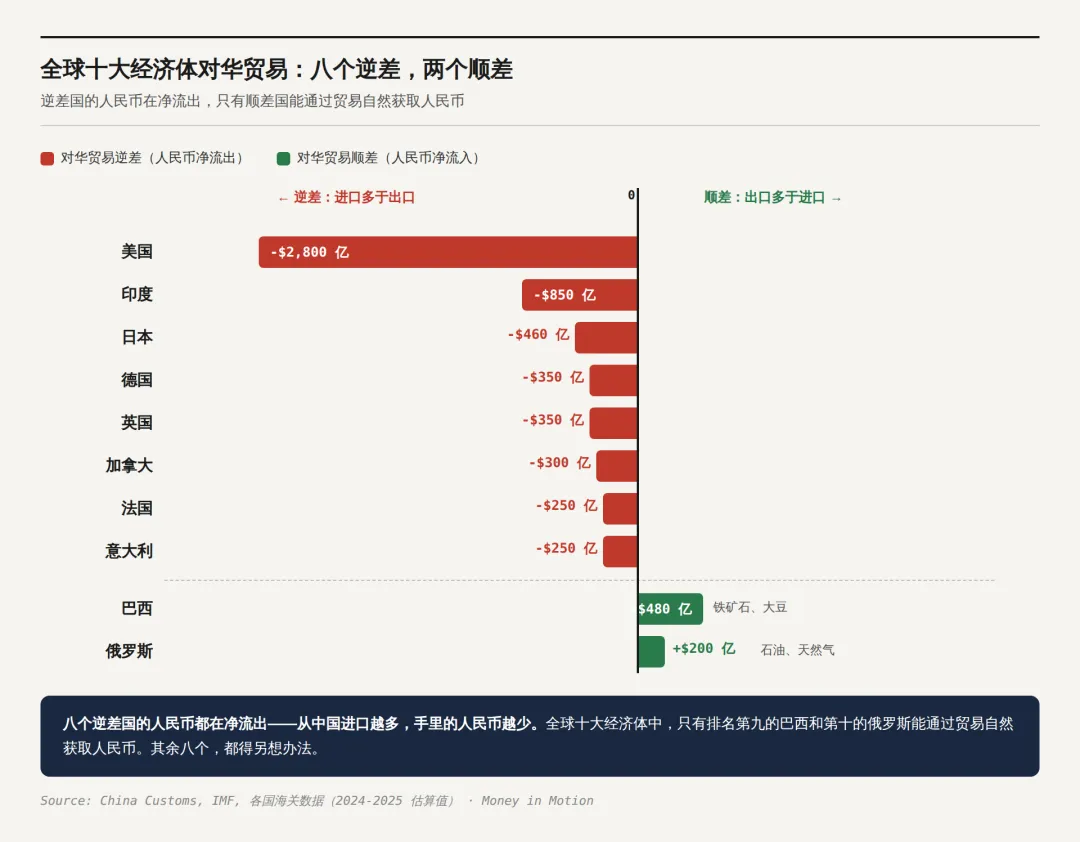
If you want to obtain RMB, there's only one normal path: do business with China and earn RMB. However, among the world's top ten economies, only Brazil and Russia have trade surpluses with China. The other eight are all in deficit—the US has an annual deficit of $280 billion, while Japan, Germany, India, the UK, France, Italy, and Canada are all net buyers. RMB flows out of your hands, not into them.
So, should you buy it on the financial market? The world's largest offshore RMB pool is in Hong Kong, where about 80% of offshore RMB payments pass through. But the pool is shockingly shallow—the total offshore RMB deposits worldwide amount to about 1.6 trillion yuan, while China's annual trade surplus, converted to RMB, exceeds 8 trillion yuan. The entire pool isn't even a fraction of that surplus.
Moreover, the pool is being drained. Three years ago, only 20% of the RMB deposited in Hong Kong banks had been lent out. By mid-2025, that proportion had soared to over 90%—almost all the deposited money had been borrowed.
At the Canton Fair in the autumn of 2025, the manager of an electric tricycle company from Jiangsu told reporters in front of his booth, "Many foreign customers are now actively choosing to settle in RMB. It wasn't us who initiated this; it was the customers who suggested it." He said the number of customers choosing RMB had roughly doubled.
Demand is rising, but liquidity cannot keep up. In October 2025, the Hong Kong Monetary Authority launched a HK$100 billion liquidity injection facility, which was snapped up by 40 banks. Three months later, the quota was urgently doubled to HK$200 billion—funds flowed through Hong Kong as a hub to ASEAN, the Middle East, and Europe. But these are ultimately emergency measures.
The fundamental reason why the RMB pool cannot grow is a basic structural issue in the Chinese economy: China is a surplus country, and the RMB flows back into China with trade, rather than flowing out. Why are US dollars everywhere? Because the US is a deficit country—buying hundreds of billions of dollars worth of goods every year, and the dollars are "spread" all over the world along with the deficit. You can exchange RMB for dollars on the streets of Lagos, and spend dollars in Bangkok's night markets. The RMB is the opposite; the surplus remains within the RMB.
In March, Bloomberg quoted a commodities trader whose company had settled Middle Eastern crude oil transactions in US dollars for the past decade. This year, for the first time, a client requested payment in yuan. He spent three weeks researching how to do it and concluded that opening an account would take six to eight weeks, which his ships couldn't wait for.
"It's not a technical problem," he said. "It's that you don't have a connection."
A pool of one trillion dollars is insufficient to meet the global demand.
II. Gold Bars from New York to Shanghai
Back to the shipowner. He asked how to get the RMB, and the middleman replied with one word: gold.
This is not just a metaphor.
Arthur Hayes—one of the most prominent macro analysts in the cryptocurrency world—described a chain in an article in April 2026:
Countries sell US Treasury bonds → buy gold with US dollars → ship the gold to Switzerland for recasting → deliver it to China's gold market → convert it into RMB → transfer it to Iran through China's cross-border payment system.
I spent some time dismantling this chain. The conclusion is: each link holds true independently, but the causal relationship between them is inference, not evidence. However, each individual link is supported by data. Ultimately, pieced together, they form a relatively complete picture:
- In the spring of 2026, non-monetary gold exports became the largest category of US exports for several consecutive months. Not chips, not airplanes, not soybeans—it was gold bars. Financial analyst Luke Gromen, after reviewing twenty years of US trade records, said this pattern had never occurred before.
- Most of this gold flows to Switzerland. Switzerland has four of the world's largest gold refineries—Valcambi, Argor-Heraeus, PAMP, and Metalor—which do one very simple thing: melt down gold bars from all over the world and recast them into the 1-kilogram standard preferred by China. In 2023, China was the largest buyer of Swiss gold exports, with 25.1 billion Swiss francs. In March 2026, Swiss gold exports to China increased by 18% month-on-month.
- In the same month, the People's Bank of China announced that it had increased its gold reserves for the 15th consecutive month, bringing its official holdings to 2,308 tons.
The main reason for the outflow of gold from the United States is actually the reversal of the COMEX arbitrage trades in 2025—at that time, due to tariff panic, 43.3 million ounces of gold flooded into New York warehouses, and now they are starting to flow out. This is primarily a business transaction.
But all these data point in the same direction:
Gold is flowing from West to East, and in its most primitive form of value transfer, gold is acting as a translator between two incompatible financial systems.
The assets you hold in the dollar world are first converted into an "intermediate format" that is recognized by both sides—gold—and then imported into the RMB world.
This is how international settlements were conducted eighty years ago when the Bretton Woods system was established. Eighty years later, under the pressure of sanctions and blockades, humanity has returned to the era of simply moving metal.
III. A Channel Taking Shape – CIPS
Gold is a transitional solution. The real long-term solution is a payment channel that most Chinese people are not very familiar with.
Let's start with what everyone knows. SWIFT is a global "texting system" between banks. When you transfer money from China to Japan, SWIFT tells the Japanese bank: "There is a sum of money coming from China, the amount, and the payer." SWIFT itself doesn't move money; it only moves information. But precisely because it moves information, whoever controls SWIFT can see the details of every cross-border transaction worldwide.
CIPS is another system built by China—a cross-border interbank payment system. Unlike SWIFT, it can both send messages and move money, integrating message transmission and clearing and settlement. Most of the time, CIPS still uses SWIFT to send messages—approximately 80% of transactions do this. But crucially, it can operate independently. When it needs to operate independently, CIPS can send messages and move money on its own.
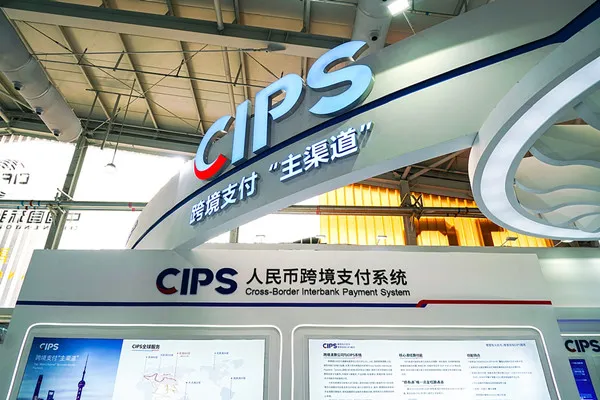
In 2012, the People's Bank of China launched the construction of CIPS. Three years later, on October 8, 2015, the system officially went live. On that day, 19 banks connected, but few people around the world paid much attention. The first transaction completed on the day of launch was a RMB 35 million clearing transaction between ICBC Singapore and Shanghai Baosteel on behalf of a company. On the same day, Standard Chartered Bank completed a RMB transfer from China to Luxembourg for IKEA through CIPS.
A Singaporean trading company and a Swedish furniture company. These were CIPS's first users.
By the end of 2025, ten years later: 193 direct participants and 1,573 indirect participants, covering 124 countries and regions, processing $26.4 trillion annually. From 19 to 193, it has quietly grown tenfold. The shareholder list of CIPS itself is intriguing—the central bank holds 16%, with the remaining shareholders including UnionPay, large state-owned banks, as well as HSBC, Standard Chartered, Citibank, DBS, BNP Paribas, and ANZ. This is not a closed system, but a hybrid entity dominated by China and involving Western banks.
Moreover, the expansion is accelerating. In early 2026, First Abu Dhabi Bank of the UAE joined CIPS, becoming the first RMB clearing bank in the Gulf region—previously, RMB settlements in the Middle East had to go back to banks in China, but now they can be completed directly in Dubai.
The head of DBS Bank's China operations once told the media, "Companies have clear business reasons for using RMB—to optimize cash management, reduce exchange costs, and mitigate uncertainty."
This isn't a geopolitical slogan. This is business people doing the math.
Just because that Greek shipowner can't buy RMB today doesn't mean he won't be able to in three years. Channels are being carved out, one by one.
IV. What can't be bought, and what can't be returned to.
The shipowner ultimately failed to secure the RMB. It was too slow. Opening an account would take weeks, compliance reviews would take weeks, and his ship couldn't wait. He ended up paying in USDT.
But he did one thing. Upon returning to Athens, he instructed the company's CFO to research how to open a RMB account in Hong Kong. Not because it was necessary that day, but because he didn't want to face an option he couldn't choose again.
He wasn't taking sides. He simply realized that people with only one path are too vulnerable in this world. Opening an extra account, taking on an extra channel, isn't because he distrusts the dollar—it's because people with only one path to follow are uneasy.
The gold that flowed out of the United States is currently being recast in a Swiss refinery. It will become 1-kilogram standard gold bars in the Shanghai delivery warehouse, then be converted into RMB and flow into some channel. Perhaps it's a payment for a Chinese company's goods in the Middle East, or perhaps it's a routine payment for an Australian iron ore import by a factory in Shenzhen.
The inability to buy RMB is the current reality; what cannot be returned to are the dollar channels that may be interrupted tomorrow.
Those who have already found the entrance will not turn back.
At least, that shipowner wouldn't.