Author: Rhythm
On June 3, the USD/JPY pair touched 160.44, a new high since July 2024. On the same day, the Nikkei 225 index broke through 68,000 points for the first time, reaching a high of 68,634.74. These two figures combined immediately triggered a familiar narrative in the market: "Carry trades are about to collapse; August 2024 will repeat itself."
This narrative is half true. The other half, the data tells a completely opposite story.
The short sellers didn't withdraw; instead, they increased their positions.
The most direct indicator of the crowding in yen carry trades is the weekly non-commercial positioning report released by the U.S. Commodity Futures Trading Commission (CFTC). It records the net long or net short positions held by speculative traders in the yen futures market.
According to the CFTC Commitment of Traders report, as of the week ending May 26, non-commercial accounts held a net short position of 114,667 contracts in Japanese yen futures—112,993 long contracts and 227,660 short contracts. This represents a further increase of 27,152 contracts in net short positions compared to the previous week.
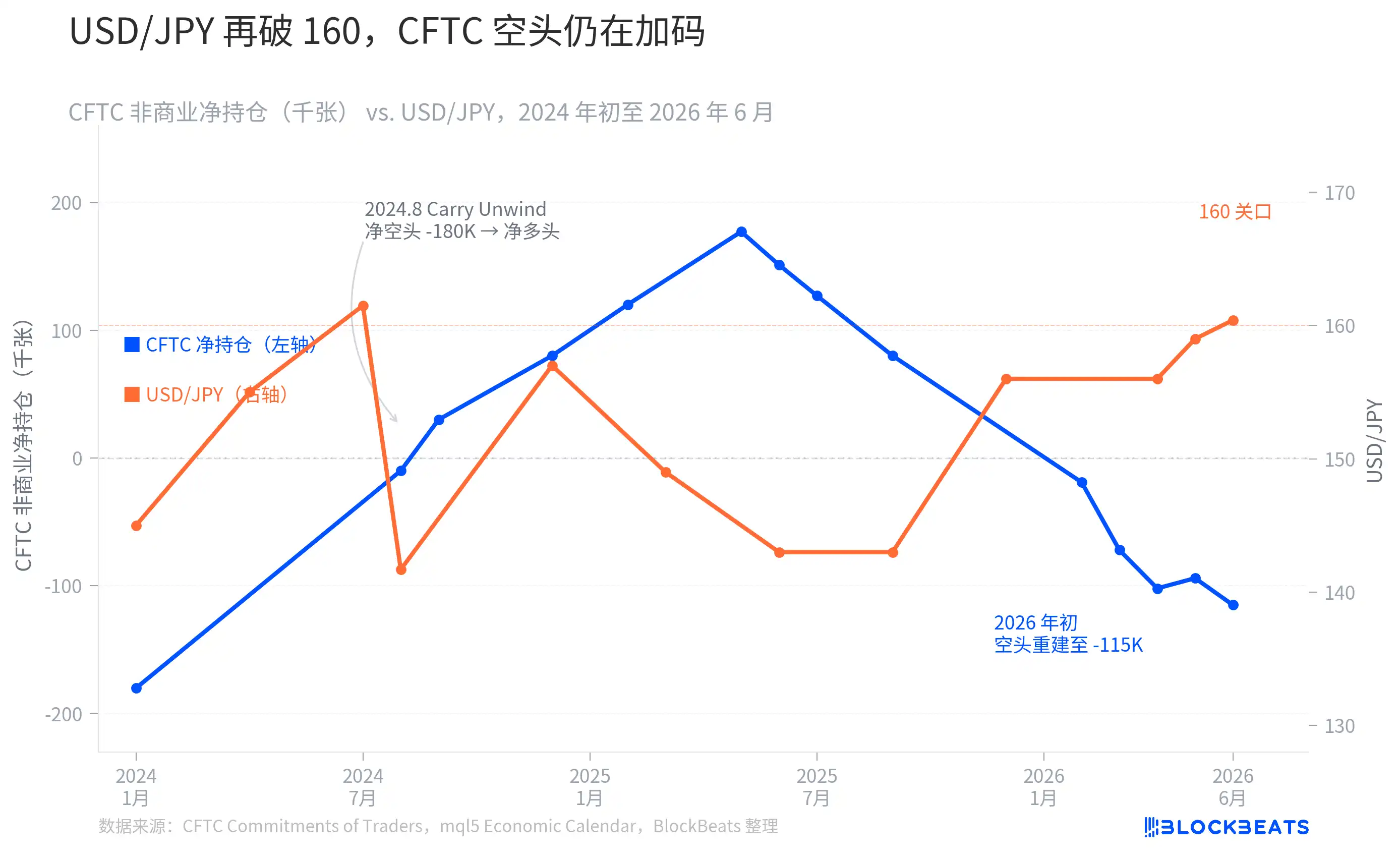
The chart reveals a somewhat counterintuitive trend. In July 2024, USD/JPY reached a high near 161, at which time the CFTC net short position was at a historical extreme of approximately -180,000 contracts. Then, in early August, the Bank of Japan's (BOJ) unexpected interest rate hike, coupled with significantly weaker-than-expected US non-farm payroll data, forced the liquidation of yen short positions within a few weeks. The net short position shrank dramatically from approximately -180,000 contracts, and by the second quarter of 2025, it had reversed to a net long position of over +177,000 contracts—a systemic squeeze did indeed occur in carry trades during that period.
However, the subsequent trajectory was completely opposite to the "crowding narrative." Starting from the end of 2025, net short positions in the Japanese yen began to accumulate again, turning negative in February 2026 and rapidly expanding to -102,000 contracts in April. By May 26, the net short position had reached -114,667 contracts. When USD/JPY returned to around 160, global speculative funds were not fleeing, but rather continuing to increase their positions.
This means that if the BOJ sends a more hawkish signal at its July meeting, or if US economic data weakens more than expected again, this net short position of -114,667 contracts will face similar pressure to be forced to liquidate as it did in August 2024. The Japanese Ministry of Finance is also aware of this – from April 28 to May 27, it used a record 11.7349 trillion yen to buy yen and sell foreign exchange in an attempt to suppress the short positions.
The largest single-round intervention failed to hold 160.
Japan's Ministry of Finance's history of foreign exchange intervention dates back to 1998. In the fall of 2022, when the yen fell to around 152, the Ministry of Finance used a "buying yen" operation for the first time since 1998: it injected 2.84 trillion yen in September and added another 6.34 trillion yen in October, totaling approximately 9.18 trillion yen. That round of intervention briefly pushed the USD/JPY back from 152 to around 127, but the effect only lasted for a few months.
In the spring of 2024, USD/JPY approached 160 again and even broke through it. The Ministry of Finance intervened with about 9.80 trillion yen, which was the largest single operation since 2022 at the time, and also the "first confirmed buy intervention since 2022".
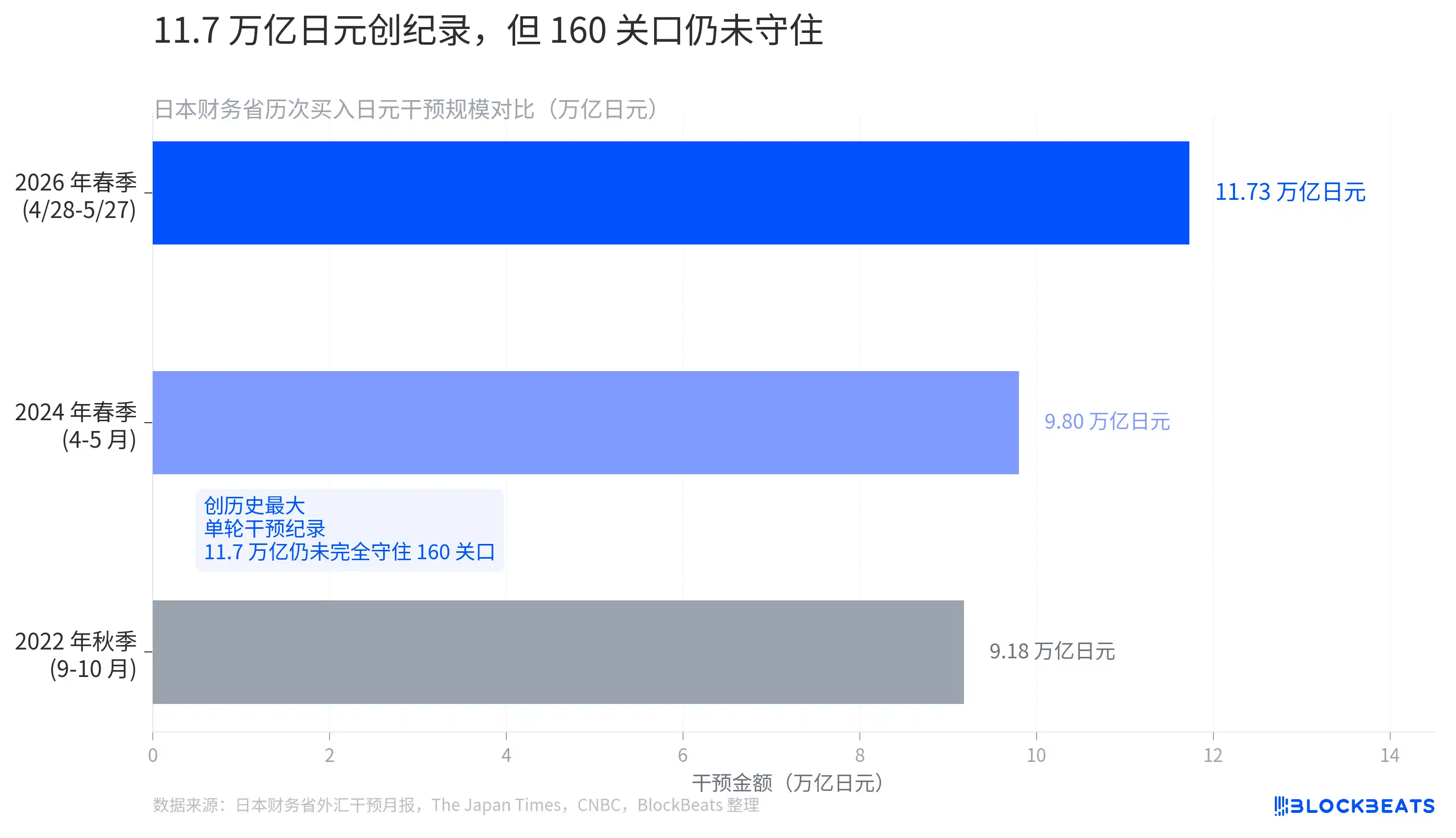
According to monthly intervention data released by Japan's Ministry of Finance on May 29, 2026, the scale of the operation from April 28 to May 27 was 11.7349 trillion yen (approximately US$73.6 billion), the largest single round of intervention on record, exceeding the total amount of intervention for the entire year of 2022, and nearly 2 trillion yen more than in the spring of 2024.
However, less than a week after the Ministry of Finance released the figures, USD/JPY still broke through the 160 mark again. The largest intervention ever failed to completely hold this psychological barrier.
Foreign investors buying Japanese stocks are chasing AI (AI-driven) stocks, not carry stocks; it's also driven by safe-haven funds from margin calls.
If carry trades remain crowded, why is the Nikkei 225 still hitting new highs?
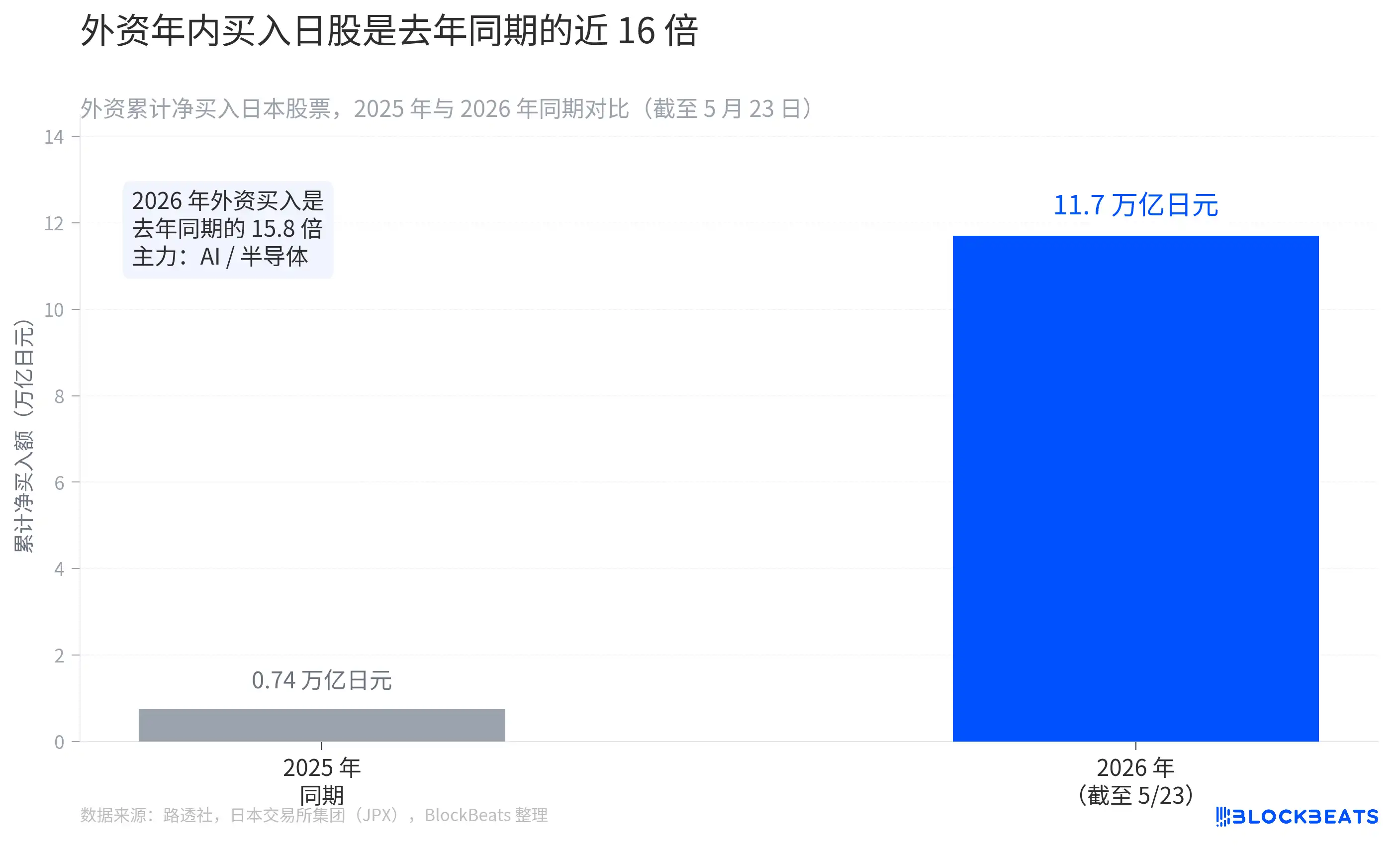
According to data from the Japan Exchange Group (JPX) cited by Reuters, overseas investors have been net buyers of Japanese stocks for the eighth consecutive week, with net purchases reaching 1.08 trillion yen in the week ending May 23. Year-to-date net purchases have totaled nearly 11.7 trillion yen.
In the same period of 2025, net foreign investment totaled only 742.1 billion yen. In 2026, this figure will be 15.8 times that.
The funds were highly concentrated in one area. Among the top-performing stocks during the same period, AI investment platform SoftBank Group rose 17.62% in a single week, and chip designer Socionext rose 12.26%. Reuters' report directly illustrates the buying momentum: Nvidia's earnings outlook boosted the prospects for AI and semiconductor demand, and foreign investors chased this theme through the Japanese market.
This is in stark contrast to the logic of the "carry unwind triggering a sell-off" in August 2024. That was a forced reduction in holdings and indiscriminate selling, with funds withdrawing from the Japanese market. In contrast, the net inflow of foreign capital in 2026 was a proactive choice to enter the Japanese market in pursuit of AI reflation. The driving mechanisms are different, and their implications for the Nikkei index are also different.
Interest rate hikes haven't depressed the stock market, but this relationship is becoming more fragile.
Another counterintuitive aspect of the Nikkei 225 is its continued rise despite the BOJ's continuous interest rate hikes.
According to the Bank of Japan's (BOJ) policy announcements over the past two years, the interest rate hike path has been as follows: In March 2024, the negative interest rate policy will end, and the policy rate will be raised from -0.1% to 0.1%; in July 2024, the rate will be raised again to 0.25%; in January 2025, it will be raised to 0.5%; and in December 2025, it will be raised to 0.75%, the highest level since 1995. At the April 2026 meeting, the rate was kept unchanged at 0.75%, but a vote of 6 to 3 was passed—three committee members (Hajime Takada, Naoki Tamura, and Junko Nakagawa) explicitly advocated for a rate hike to 1.0%.
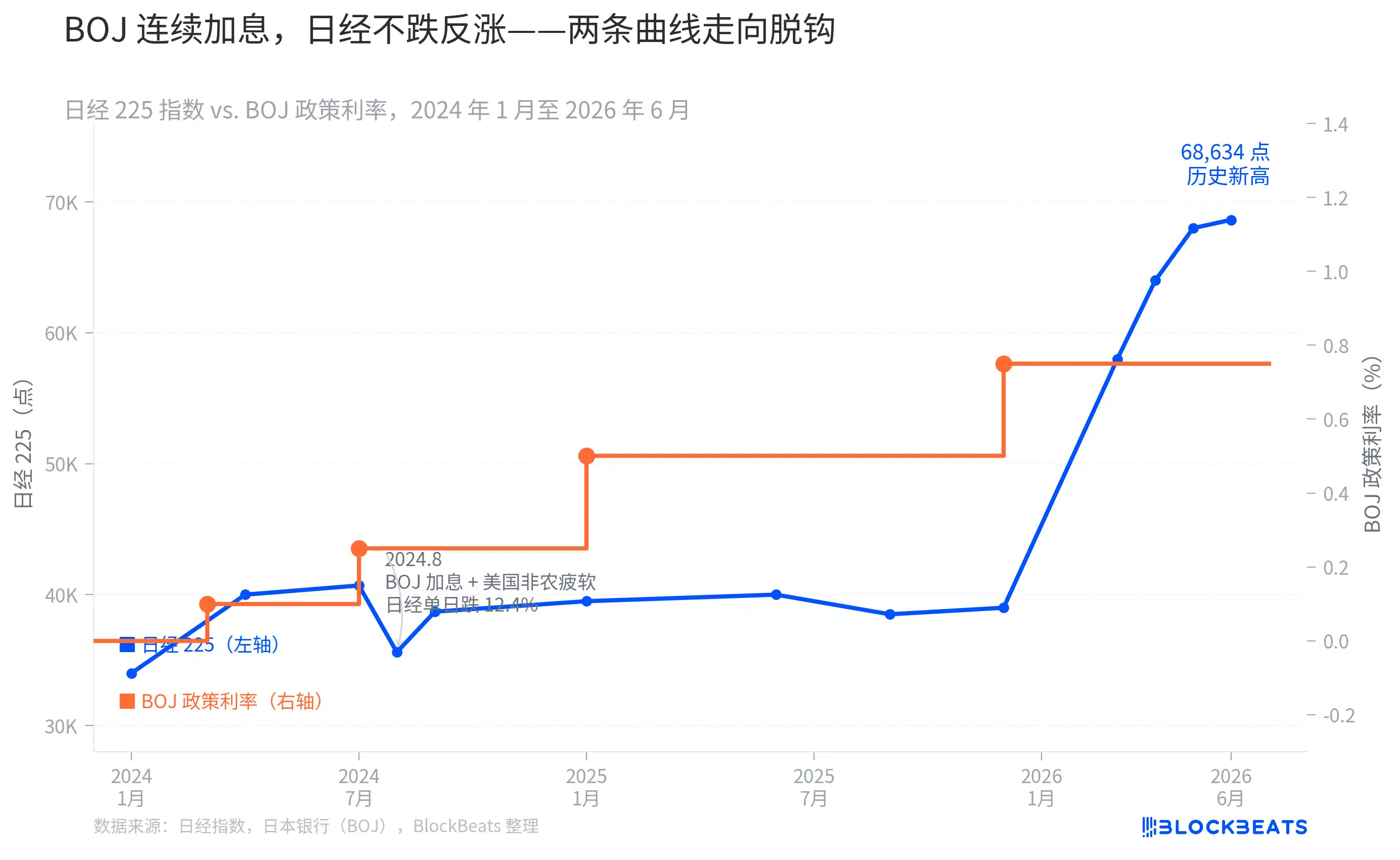
The chart clearly shows that the correlation between interest rate hikes and the performance of the Japanese stock market varies significantly across different periods. The July 2024 rate hike triggered a historic 12.4% single-day drop in the Nikkei 225—this was due to the simultaneous impact of the BOJ rate hike and the release of US non-farm payroll data, which directly triggered a carry unwind. However, the two rate hikes in January and December 2025 were accompanied by the Nikkei 225 climbing from around 40,000 points to its current high of 68,634 points.
The reason behind this is not complicated: when foreign investment is driven by the logic of chasing AI reflation rather than relying on the low interest rate financing cost of the yen, the impact of a small interest rate hike by the BOJ on this part of the funds is quite limited. Of course, this relationship is not immutable—if the BOJ does push interest rates to 1.0% at its July meeting, and the dollar weakens due to other factors, the financing cost of carry trades will rise sharply, at which point the two curves may recouple.
Putting the three charts together, we can get a relatively complete cognitive framework: the yen shorts are still crowded, the Ministry of Finance's largest intervention in history failed to hold 160, but the new high of Japanese stocks is driven by AI and foreign capital market trends—these three things are true at the same time, they are not contradictory to each other, and none of them alone can predict what will happen next.