
Author: Unaware of the Classics
"The opportunity cost of going to college is too high. In today's technological world, everything is developing too fast. If you stay in school all day, you will miss opportunities."
The person who said those words was an 18-year-old named Sebastian Tan. He was not a rebellious student who disliked studying; on the contrary, he was the quintessential "prodigy" in our traditional eyes, holding an acceptance letter from Stanford University, one of the top universities in the United States.
However, his viewpoint is not uncommon within a small circle. In Silicon Valley, the engine of global innovation, a disruptive "anti-college movement" is quietly gathering among the elite. It is no longer the sporadic, legendary stories of students dropping out to start businesses, but is forming a trend of thought with theoretical support, organization, and capital backing.
The core argument of this trend is sharp and direct: four-year colleges, once seen as a golden ticket to the middle class and the American Dream, are increasingly becoming an expensive, slow, and outdated waste.
Is this just a few geniuses talking big without understanding the realities, or is it the prelude to an educational revolution that is about to sweep the globe? Business Insider recently published an article exploring this new countercurrent: the widespread aversion to higher education among Silicon Valley's new generation of tech entrepreneurs, and the rise of the "skip college and go straight to entrepreneurship" trend within the industry.
The article points out that an increasing number of young men are choosing to abandon their university studies and instead join technology companies or start their own businesses, encouraged by some Silicon Valley elites and companies.
Today, let's delve deeper into the content of this article and see what those young people and tech giants at the forefront of the industry are thinking and doing, and what ordinary people can learn from them.
The defector at the Stanford University intersection
Sebastian Tan once walked firmly on a glittering, prosperous road.
Growing up in Pittsburgh, like all his ambitious peers, he regarded Stanford University as a Mecca for entrepreneurship. His idol was Peter Thiel, the creator of PayPal, investor in Facebook, and hailed as the "godfather of Silicon Valley," a true Stanford graduate.
The script for success seems to have been written long ago: get into Stanford, bask in the California sunshine and the aura of wisdom, and then start a company that changes the world.
This April, his dream came true; he was about to fly to Palo Alto to attend Stanford's grand party for freshmen. Before departing, he downloaded a book, Peter Thiel's *Zero to One*. In Silicon Valley, this book is like the *Nine Yin Manual* in the martial arts world.
However, when he opened the book, he found not only an entrepreneurial philosophy, but also a disruptive worldview. In his own words, "This is probably the best book I've ever read, even though I've only read a few pages."
It was also in this spring that a voice, growing louder and louder, echoed in his ears. This voice came from a teenage founder, and also from a tech giant who controlled hundreds of billions of dollars in capital: "The true creators of the future will choose to skip university."
This idea pierced Tan's heart like a thorn. During Stanford's "Admissions Weekend," he met many peers who were just as brilliant and confused as he was. They were among the top scorers on standardized tests across the United States, the most perfect products of the traditional education system, but deep down, they harbored doubts about the system itself.
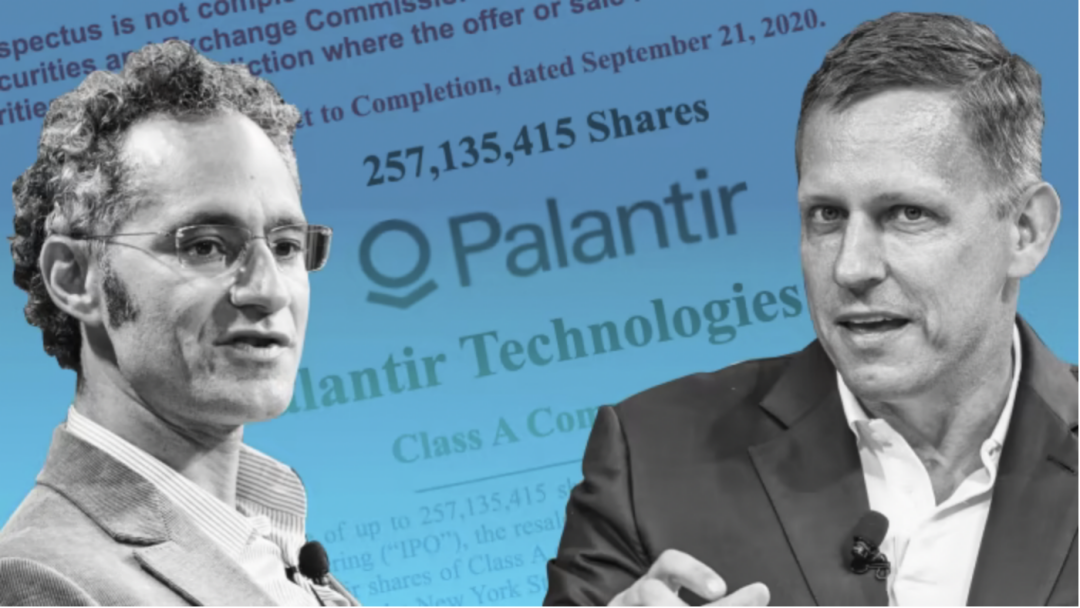
Karp and Till
This skepticism ultimately led them to a common destination—the internship application page of Palantir, a software and defense technology giant.
This company, co-founded by Peter Thiel, launched a highly provocative program: the "Meritocracy Fellowship." Its tagline, like a manifesto, openly declares war on the world's top educational institutions:
“Skip debt, skip ideological indoctrination, to obtain the ‘Palantir Degree’.”
This program offers a one-semester paid internship, with outstanding performers having the opportunity to directly secure a full-time job. It has acted like a giant magnet, attracting over 500 top high school graduates, including Tan.
In April, the dust settled. Tan made the first major decision of his life to defect: accept Palantir's offer of employment and postpone his Stanford admission until the distant year of 2026.
“You don’t learn the practical skills needed to start a business in college,” he explained. “You learn things like computer science theory. If you want to go straight into the workforce, those aren’t very useful.”
Tan's story is not an isolated case. He is merely a wave pushed to the forefront in this massive countercurrent.
Silicon Valley "Heretic" Theories: A Long-Planned "Anti-Intellectual" Revolution
Silicon Valley's sense of alienation from universities is long-standing. From Bill Gates and Steve Jobs to Mark Zuckerberg, the "myth" of dropping out of college to start a business has always been part of the spiritual totem of this land.
But today, the situation has fundamentally changed. This is no longer a fleeting moment of brilliance from a few geniuses, but a systemic movement driven by the combined forces of the economy, technology, and ideology.
The standard-bearer of this movement was undoubtedly Peter Thiel.
This maverick billionaire launched the Thiel Fellowship more than a decade ago, funding 20 to 30 young people under the age of 22 each year with $100,000 each, on the condition that they drop out of school for two years to pursue their own careers.
Thiel's aversion to higher education is multifaceted. He believes that universities not only charge absurdly high tuition fees, saddle young people with heavy debt burdens, but more importantly, they spiritually "corrupt" the best people.
He once quoted an ancient Roman proverb to criticize universities: "Corruptio optimi pessima," meaning that the fall of the highest good becomes the highest evil. In his view, universities, which should be cultivating elites and passing on wisdom, have degenerated into the most rigid and worst institutions of thought.
According to an analysis by *Education Next*, Thiel argues that universities instill a narrow and biased worldview in students, stifling genuine innovation. This view has a large following among Silicon Valley's elite circles.
If Thiel was the spiritual leader of this movement, then Palantir was the "military academy" that put this theory into practice.
Palantir is a big data analytics company co-founded by Thiel. Numerous reports describe it as Silicon Valley's "new gangster" and "startup school," attracting many young people who choose to work there rather than pursue graduate studies because the company offers a highly intensive training system that emphasizes a holistic perspective and practical skills. Now, this "school" has even expanded its enrollment to include high school graduating classes.
Palantir's CEO, Alex Karp, an intellectual with a PhD in neoclassical social theory and a former roommate of Thiel, is more vehemently opposed to universities than anyone else. He openly declared: "Everything you learn in school and university about how the world works is intellectually wrong."
This trend quickly went viral on social media. Adam Guild, who founded a billion-dollar company at the age of 25, posted on X (Twitter) and received tens of thousands of likes: "Degrees are nothing. Learn from those who have built what you want, not those who have never built anything."
His point is incisive: university professors reside in ivory towers, while true knowledge lies in the hands of those who "build" the world. He even likens universities to a "dropshipping" business:
"They (universities) put their logos on young people who are already highly promising and intelligent, and then attribute their success in society to themselves."
This is a brilliant yet biting metaphor, precisely capturing the complex emotions many people have towards the prestige of prestigious universities. Surya Midha, co-founder of the AI recruitment platform Mercer, offered a more manifesto-like summary:
"Self-learners are the new alumnus."
In their view, the internet and AI have made knowledge acquisition more convenient than ever before, making traditional, passive classroom learning seem so inefficient and superfluous. A degree is no longer an honor, but a form of "procrastination."
Who is fueling the "anti-university movement"?
The rise of a new intellectual movement is no accident. Behind this anti-university movement in Silicon Valley lies the convergence of three driving forces.
1. Economic Drivers: Unbearable "Entry Fees"
The most practical factor is money.
College tuition in the United States has skyrocketed over the past few decades. In 2024, the average undergraduate graduate carried nearly $30,000 in federal student loans. The total cost for four years at a top private university exceeded $500,000. This enormous sum is a heavy burden for any family.
At the same time, the rise of the technology industry, especially in the field of AI, has made the myth of "getting rich young" more attainable. Paul Graham, founder of venture capital firm Y Combinator, and others have publicly declared that now is "the best time for college students to start businesses in a decade."
On one hand, there are high sunk costs and uncertain future returns; on the other hand, there are readily available entrepreneurial tools and a surge of capital investment. For the most ambitious and talented young people, the answer to this choice seems to be becoming increasingly clear.
2. Technology-driven: AI makes "going it alone" possible
Technological advancements are fundamentally undermining universities' monopoly on knowledge.
In the past, becoming a good programmer or engineer required systematic and long-term professional training. But today, artificial intelligence and so-called "vibe coding"—a programming style that relies on intuition and AI assistance rather than strict logic—have greatly lowered the technical barrier to entry.
A creative young person can build a product prototype in a few weeks with the help of AI tools, something that might have taken a small team months in the past. As those dropout entrepreneurs have said, they would rather learn from an AI trained to be like Steve Jobs than listen to a professor who has never written a single line of business code lecturing on theory.
The focus of knowledge is shifting from institutionalized "transmission" to personalized "exploration." The world is changing too fast for university curricula to keep pace with technological advancements.
3. Culture-driven: The backlash against "awakening culture" and elitism
This is the deepest and most complex reason. The anti-college movement in Silicon Valley is closely linked to the current culture war in the United States.
On the one hand, this represents the ultimate rebellion against traditional elitism. Technological libertarians, represented by Peter Thiel, fundamentally distrust any large, outdated, centralized institutions, whether governments or universities. They believe in individual ability and market competition, or "meritocracy."
They believe that university admission standards, especially those of Ivy League schools, have become subjective, superficial, and opaque, and are full of biases towards specific groups.
On the other hand, this is also a strong backlash against the "woke culture" and DEI (diversity, equity, and inclusion) policies prevalent in American universities.
The remarks of 22-year-old entrepreneur Sean Schneider are highly representative and controversial. He dropped out of Christian high school to found an AI marketing company. He bluntly stated that dropping out of college was both a matter of efficiency and an ideological choice.
“It (the university) marks DEI,” he said. “It marks institutions of awakening and compromise. At least in the circles I’m in, the sentiment is that these institutions should just die out.”
His views touched a sensitive nerve in American society. In recent years, there has been increasing discussion about the growing marginalization of men in the education system. Data from the Pew Research Center shows that from 2011 to 2023, college enrollment in the United States will decrease by 1.2 million, of which 1 million will be men.
Schneider believed that the school education system was more suited to women and suppressed men's "masculinity." He even made the startling statement: "As a man, you cannot get real satisfaction while receiving a long period of education."
This perspective blends a dislike of "political correctness" with a distinctly "manosphere" existential anxiety. It reveals a significant gender dimension in this anti-college movement, which is primarily a movement dominated by young men.
These three forces intertwined to form a perfect storm, propelling the ancient ship of the university into unprecedented treacherous waters.
A return to rationality: Is the university truly in decline?
When the anti-university sentiment is at its peak, shouldn't we also listen to the other side of the story?
The research of Harvard economist David Deming offers us a sober perspective. Like a patient doctor, he prescribes a "fever reducer" for this feverish debate.
First, Deming warned that "very, very few people are truly self-taught." He likened young people who rely entirely on the internet and AI for self-learning to students who "copy their classmates' homework"—they may be able to solve immediate problems, but they lack the fundamental ability to solve unknown problems.
Secondly, he pointed out that corporate-provided on-the-job training, no matter how excellent, is essentially "narrow and professional." Its goal is to cultivate cogs in the machine that meet the company's needs, rather than well-rounded individuals with a broad vision and adaptability. Universities, especially the liberal arts education they offer, can precisely equip students with "an open attitude towards new things" and transferable skills.
The most crucial factor is the data. Deming points out that despite the high tuition fees, the "college wage premium" has remained stable at between 75% and 80% over the past decade. This means that for the average person, the return on investing in college is still higher than investing in the stock market, real estate, or starting a business.
Even the Palantir Scholarship Program, the "model project" of this movement, reveals a touch of irony. Despite its anti-elitist stance, media reports indicate that its admitted students are largely comprised of those already accepted by top universities like Stanford, Penn, and Columbia. Is this truly a subversion of elite education, or just another form of "talent poaching"?
Deming posed a thought-provoking question: "For those founders who dropped out of school, the question should be: would they have been better or worse if they had gone to college?"
There is no answer to this question. But it reminds us that we cannot only see Zuckerberg's success while ignoring the countless unsuccessful dropouts who went unnoticed. What we see is always survivor bias.
Is this the final chapter of university life, or the growing pains of a new generation?
Looking around, we find ourselves standing at a massive crossroads. On one side are the ancient and solemn halls of the university, and on the other, a bustling and wildly growing new world.
However, the essence of this debate may not be a binary opposition of "going up" or "not going up." It is more like a symptom, revealing a deep crisis in the education system of our time.
Born in the Middle Ages and standardized in the Industrial Age, the modern university's core model—a fixed four-year program, lecture-based knowledge transmission, and standardized assessment system—appears increasingly clumsy and sluggish in today's information explosion and AI-driven world. It's like a well-designed steam engine being required to run on a high-speed maglev track.
Peter Thiel and his followers, like a group of impatient passengers, chose to jump ship and try to pave a faster track for themselves. Their words may have been extreme, even arrogant, but their actions were like a powerful medicine, forcing the drowsy giant ship to start thinking about its course.
What we are witnessing may not be the death of the university, but rather the intense growing pains before its next morphological evolution.
The statement "Self-learners are the new alumni" truly signifies a shift in the center of power in learning. It's moving from institutions to individuals, from passive "education" to active "learning." The internet is its library, AI its personal tutor, and the real world its ultimate testing ground.
Sebastian Tan, standing at the Stanford crossroads at the beginning of the article, ultimately didn't completely burn down the bridge to the past. He still plans to return to Stanford in the future. He sees the value of practice, but also acknowledges the significance of a liberal arts education. Perhaps he simply wants to use those two years to add an "option" to his life.
He said, "My mom really wants me to go to college." This unintentional, most genuine, and endearing reason allows us to glimpse a touch of human warmth within this grand narrative.
No matter how fierce the storm, the ancient temple will not easily collapse. But its doors and windows have been knocked open, and the wind, rain, and sunshine outside will pour in. Future learning will no longer be confined within walls. It will become more hybrid, more personalized, and more lifelong.
The real challenge is no longer "whether or not to go to university," but rather: how should we learn in a world where the future is updated even faster than the curriculum?
No one knows the answer to this question. But the process of finding the answer is the most important lesson in itself.