

Author | Wenser, Odaily Planet Daily
Have you ever wondered how much of the profit from selling an iPhone goes to the various component suppliers?
Recently, overseas tech blogger @BluthCapital, speaking in the tone of Micron’s CEO, mocked the "business playbook" behind iPhones: "For over a decade, Apple has been buying chips from us (MU) for $5, putting them into a metal box, and then selling them to consumers for $99; when we tried to raise the price to $7, they laughed at us. But now, when we try to charge them $50, they instead raise the product price by $250." His words reveal deep contempt for Apple’s recent price hikes and shifting the blame onto memory manufacturers.
The post quickly sparked discussion on social media. This morning, @BluthCapital continued the topic by posting an iPhone 18 cost structure chart with specific numbers to corroborate his view:
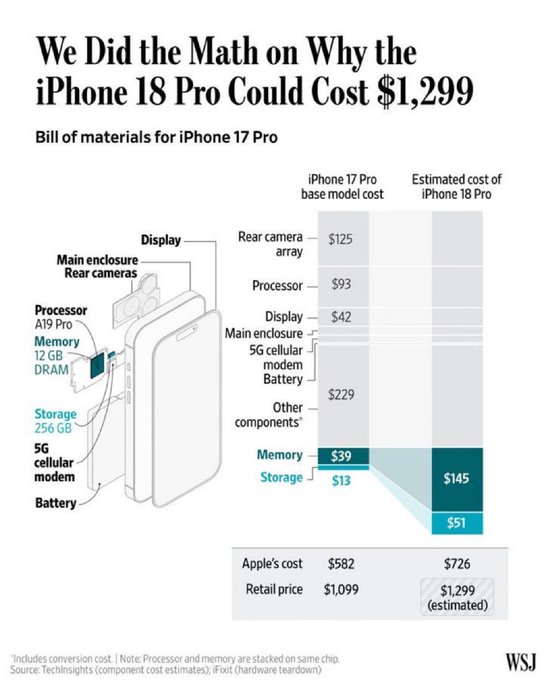
Previously, Micron Chief Business Officer Sumit Sadana also said in an interview with The Wall Street Journal, "During the memory industry downturn, some customers took the chance to drive prices down, leading our company's profits into negative territory." Now, driven by the robust demand from the AI and tech sectors, the memory industry has instead become the party holding the bargaining power. This has made the entire supply chain experience a dramatic reversal of fortune.
The Profit Structure of an iPhone: Apple Takes Nearly 25%, Memory Makers Like Micron Take Less Than 3%
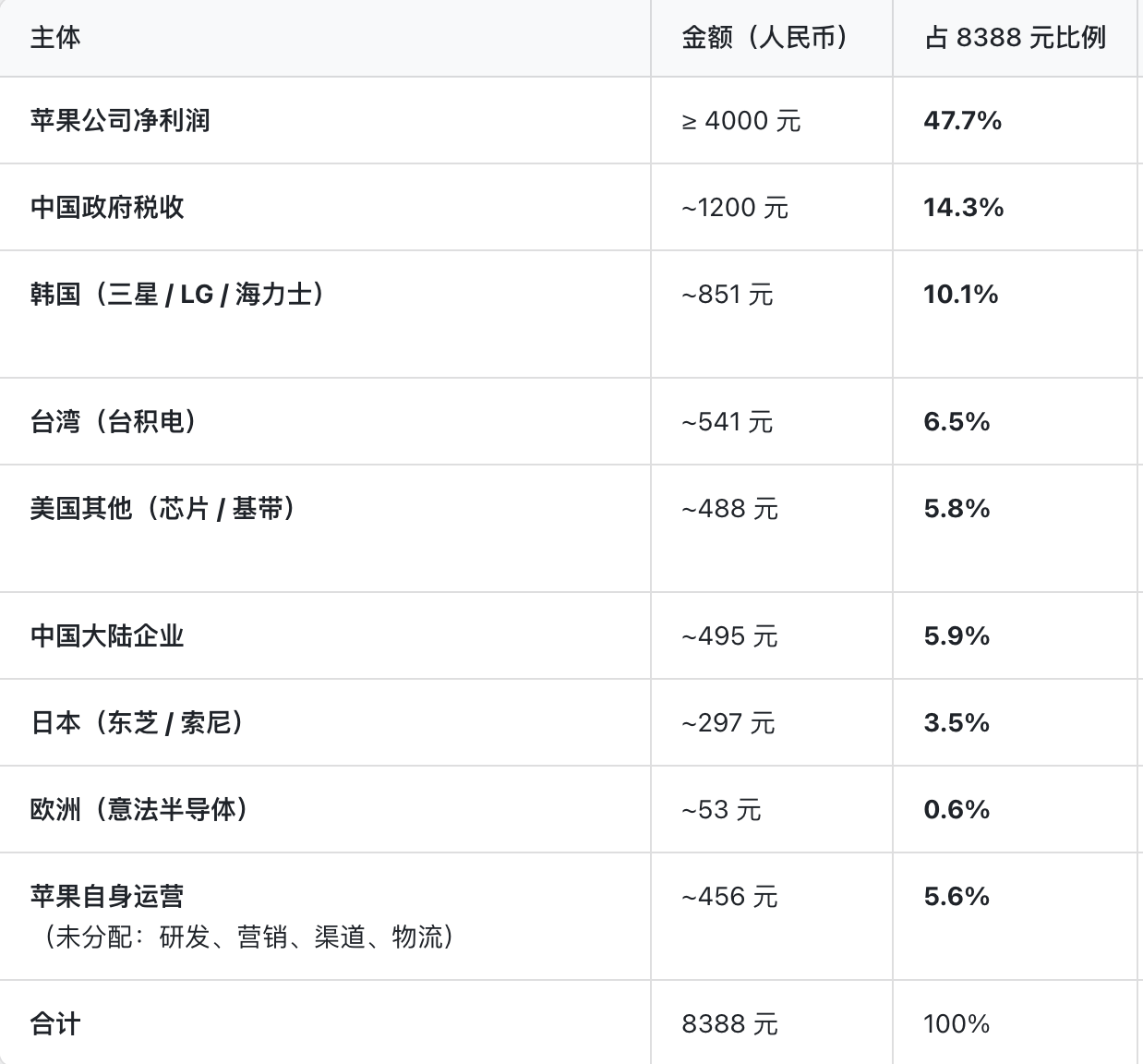
According to estimates, out of the profit from one iPhone, Apple takes about a quarter, memory giants take only about one-thirtieth, and TSMC takes approximately 4%–5% due to its monopoly position. The rest is covered by other hardware suppliers, distribution, R&D, and taxes.
A Look Back at Apple's Financials: Net Margin Stays Above 24% Long-Term, Snagging 75% of the Industry's Total Profit
According to data from organizations like Counterpoint, Apple has long accounted for nearly 50% of the global mobile phone market's operating profits. 2025 IDC data shows that with an 18% market share, it took home about 75% of the industry's total profit.
Based on Apple's latest Q2 2026 data, iPhone revenue was $57 billion, with a net profit of $34 billion and estimated shipments of around 61 million units. From this, it can be deduced that Apple's net profit per iPhone is roughly $320–$340, with a net margin of 33%–36%.
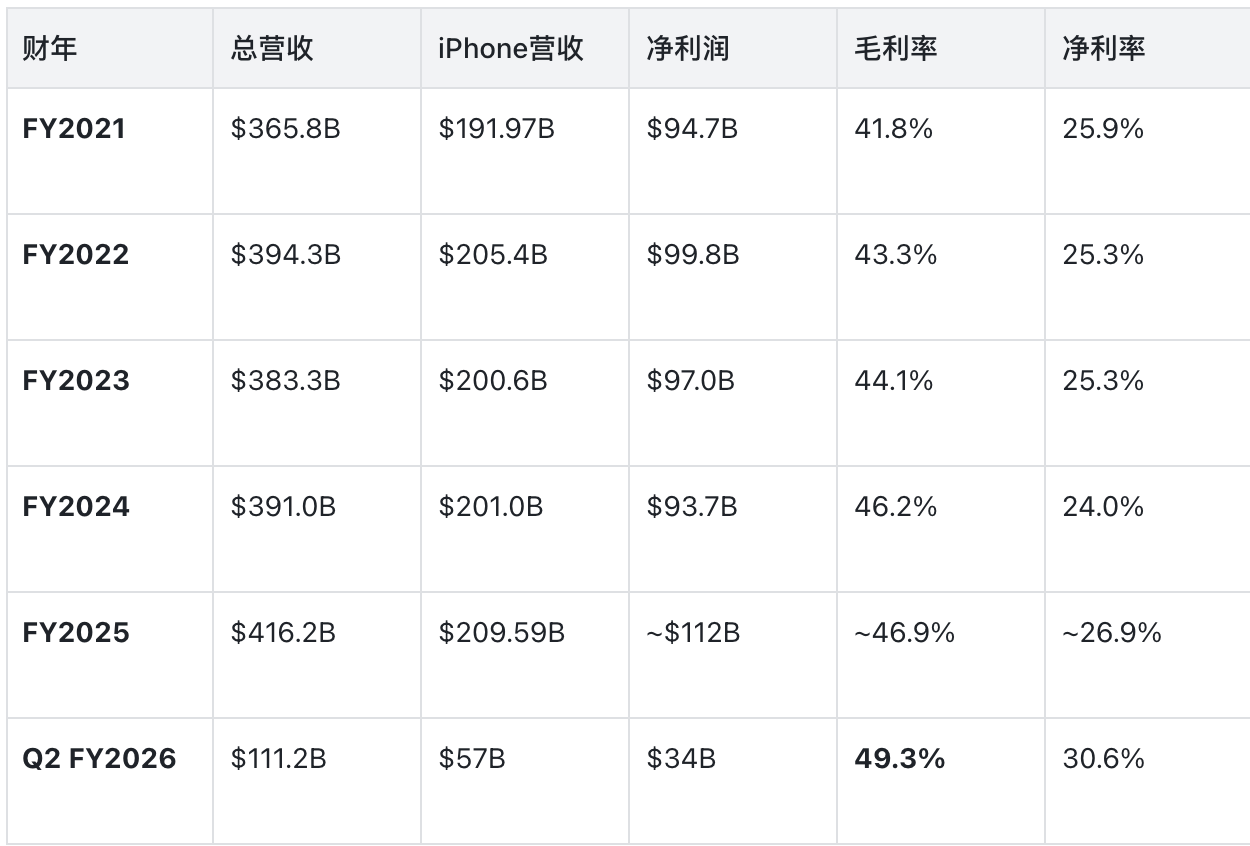
Comparing financial data from the past five years, we can also clearly see that iPhone revenue has been relatively stable overall; net profit has gradually grown from around $94 billion in 2021 to around $112 billion in 2025; while the net margin has remained fairly stable, typically around 25%.
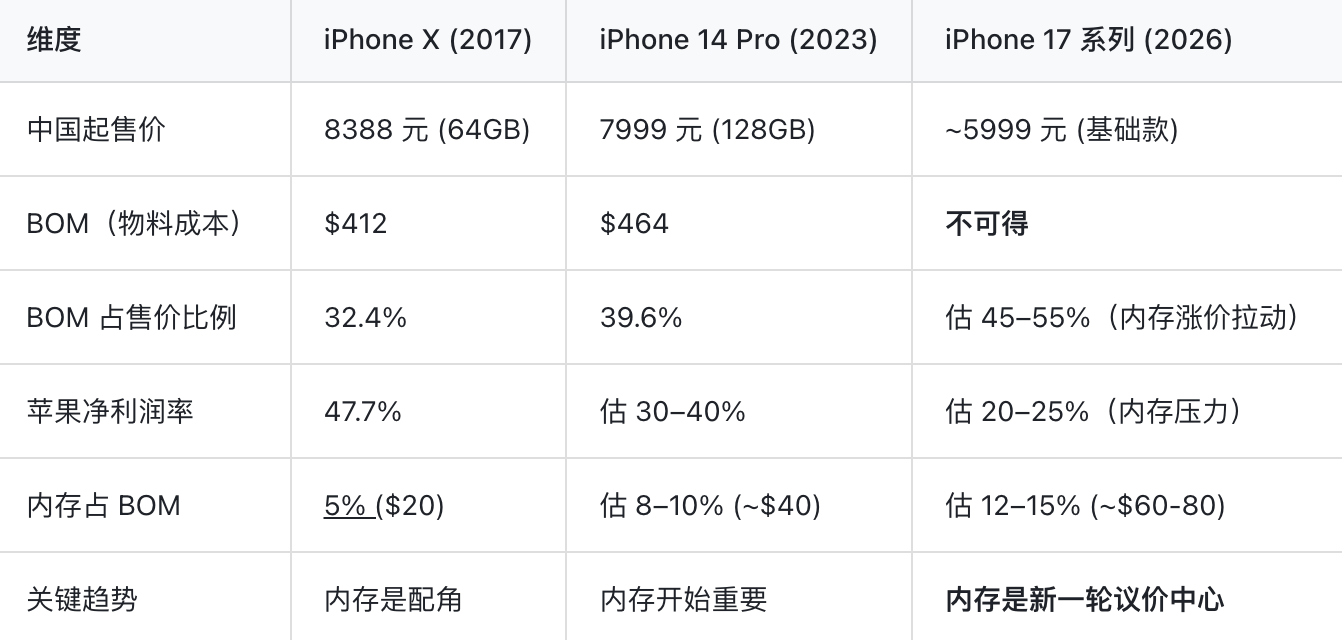
Looking at different models like the 2017 iPhone X, the 2023 iPhone 14 Pro, and the 2026 iPhone 17 series, their profit structures have undergone a series of changes driven by varying memory costs.
From iPhone X to iPhone 17: Memory Costs Double
The role memory costs have played in iPhones has gone through three historical stages: starting as a "marginal component," then becoming an "important component," and now a "critical component."
The 2017 iPhone X Era: The "Marginal Component" Period for Memory
According to Counterpoint's teardown report from that year, during the iPhone X era, Apple's net profit margin once approached 50%, thanks to its longstanding brand advantage and upstream ecosystem position. In contrast, memory manufacturers such as South Korea's Samsung and SK Hynix only accounted for about RMB 135–195 in profit; roughly 1.6%–2.3% of the total selling price of RMB 8,388.
This was the weight of "memory" in the iPhone X era: about 2% of the cost, and almost the component Apple cared about the least.
The 2023 iPhone 14 Pro Era: The "Important Component" Period for Memory
In 2023, with the release of the iPhone 14 series, Apple's material costs saw a slight increase. Taking the Pro version as an example, its BOM material cost reached about $464 (approximately RMB 3,170), accounting for nearly 40% of the selling price, but Apple's net profit margin still remained around 40%.
According to tech media feedback at the time, the above data only applied to the 128GB version, while the cost increase for the pricier memory versions was not high, but the selling price was much higher. This was during a period when camera and processor costs were rising. Consequently, the overall profit of the iPhone 14 Pro ultimately came in 3.7% lower than that of the iPhone 13 Pro.
The 2026 iPhone 17 Era: The "Critical Component" Period for Memory
Fast forward to 2025–2026, the iPhone 17 series has become Apple's mainline model, and memory costs have doubled compared to a few years ago. Currently, memory costs are expected to account for 12%–15% of the BOM material cost, roughly $60–$80.
In summary, below is the relevant data on iPhone costs and memory cost proportions across different periods.
It is worth noting that TrendForce data shows general DRAM contract prices jumped by 93% to 98% QoQ in Q1 2026. Citi predicts the average DRAM price increase will reach 88% throughout 2026. This overall aligns with the upward trend in memory costs. This phenomenon has also been acknowledged by Apple CEO Cook and Musk.
Cook: Memory Price Hike, Unprecedented in 40 Years
On June 17, Apple CEO Cook (Odaily Planet Daily note: He will step down as CEO this September, to be succeeded by former Senior Vice President of Hardware Engineering John Ternu) touched on the cost pressures passed on by memory price hikes in an interview with The Wall Street Journal. He said: "At a time when consumers need devices, supply has decreased, and memory manufacturers are passing on immense price pressures. We absolutely need memory pricing and supply to return to reasonable levels for consumer products. That's the bottom line."
But less than a week later, he quickly changed his tune.
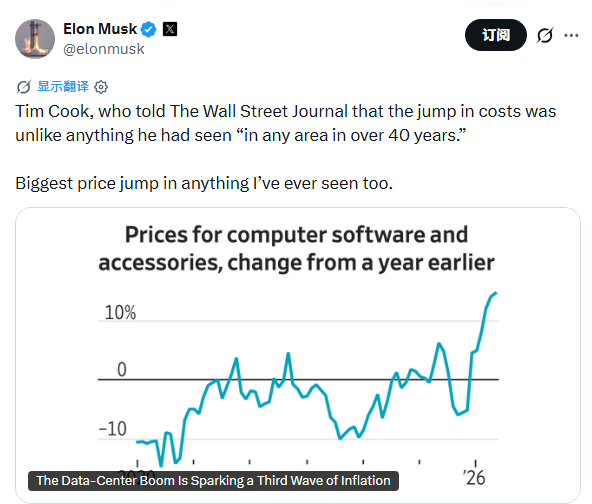
On June 25, Cook again spoke with The Wall Street Journal, calling the cost shock a "once-in-a-century flood." He said: "In over 40 years, I have never seen anything like this in any field." Shortly after, Apple announced across-the-board price increases for products including Mac, iPad, HomePod, Apple TV, and Vision Pro.
Upon the news, Apple's stock price immediately fell 6%, erasing $263 billion in market value; marking its largest drop since April 2025.
Musk: I Haven't Seen This Kind of Situation Either
Cook's remarks also drew strong agreement from Musk. Recently, he similarly posted: "Cook told The Wall Street Journal that this cost surge is something he 'has never seen in any field in over 40 years.' Not me either, this is the most violent price jump I've ever seen."
Thanks to AI Data Centers and HBM, Memory Stands Tall
A closer look at the "memory bull market" that started last year reveals that the key driving factor is still the robust demand from the AI industry.
The industry generally estimates that compared to general servers, each AI server requires 8 times the DRAM and 3 times the NAND.
Driven by such market demand, the three major memory giants — Samsung, SK Hynix, and Micron — are naturally shifting more advanced process capacity toward high-margin HBM (High Bandwidth Memory) and high-end DDR5 products, while proactively cutting consumer-grade production lines like DDR4, thereby leading to a shortage of general-purpose DRAM.
Public data shows that the DRAM content per AI server is 8 to 10 times that of traditional servers. Combined with general server restocking and the proliferation of AI PCs, the supply-demand gap for memory chips continues to widen.
Previously, Micron's staggering 84.6% gross margin in its Q3 earnings report, along with its revenue soaring 346% year-over-year to $41.46 billion, showed countless people the profit-generating power of monopolistic memory manufacturers. On the other side, SK Hynix recently announced its plan to list in the US, seeking to raise about $29 billion to further capitalize on memory demand.
It is no exaggeration to say that memory demand from the AI industry is squeezing and even devouring the memory supply for consumer electronics. Statistics show that the memory used by a single NVIDIA Vera Rubin AI server is equivalent to roughly 14,500 MacBook Neo units—a 1:14,500 ratio that makes the current supply-demand imbalance in the memory market glaringly obvious.
And for memory manufacturers who have long suffered bitter price-squeezing from giants like Apple, now is their time. No wonder, then, that there were reports that Apple is actively lobbying the Trump administration, hoping to secure approval to purchase memory chips from Chinese chip company ChangXin Memory Technologies.
As for whether ChangXin Memory Technologies can stage a wealth-creation miracle in the capital markets like star companies such as SK Hynix and Micron, perhaps the answer will be revealed as soon as next month.

