
People in the cryptocurrency circle generally have a strong sense of adventure. A small number of them are "ignorant and fearless", while most of them have a certain understanding of blockchain technology and virtual currency knowledge. Although my country does not prohibit ordinary citizens from investing in virtual currencies, it does not allow any financial institutions or third-party payment institutions to provide services for virtual currency transactions.
Even so, the development of the cryptocurrency ecosystem in mainland China has become an important part of the global virtual currency ecosystem. Virtual currency exchanges such as Binance, Oui, and Huobi are all founded or deeply participated by Chinese or even mainland Chinese citizens. People in the mainland cryptocurrency community also pay close attention to China's policy supervision of the cryptocurrency community, and even indirectly influence China's political ecological construction for the cryptocurrency community, which is rarely seen in other industries.
From January 12 to 13, 2025, the Central Political and Legal Affairs Commission held a meeting in Beijing, and virtual currency was mentioned at the meeting. People in the currency circle were excited again, and someone shouted: In 2025, the country will legislate on virtual currency ! In fact, part of the reason is the "credit" of some lawyers: using similar stiff lines, accompanied by ding-dong-dong rapid background music, and shouting hard on short videos. In fact, these so-called currency lawyers may not have represented a case involving currency, and may even confuse USDT with USTD. Lawyer Liu said this not because of peer disdain, but I am more disgusted with some people who intimidate or please the public by selling tension and anxiety or fabricating favorable information, regardless of whether these people are lawyers or not.

Will the country legislate on virtual currencies in 2025? Based on the press release of the Central Political and Legal Affairs Commission after the meeting, Lawyer Liu believes that it will not happen. The reasons are as follows:
First, the role of the Central Political and Legal Affairs Commission . The Central Political and Legal Affairs Commission is directly under the Central Committee of the Communist Party of China. In the current political structure of China, it is a component of the central government (Ministry of Public Security, Ministry of Justice) and the superior institution of the Supreme People's Procuratorate and the Supreme People's Court. It is impossible for the Central Political and Legal Affairs Commission to directly decide whether to legislate in a certain field.
Second, the full content of the meeting . The official news website of the Central Political and Legal Affairs Commission of the CPC Central Committee, China Chang'an Net, released the full text of "Central Political and Legal Work Conference Held in Beijing", stating that the main tasks of this meeting were:
"Adhere to the guidance of Xi Jinping Thought on Socialism with Chinese Characteristics for a New Era,..., summarize work, analyze the situation, and study and deploy political and legal work in 2025. " Specifically include:
Make every effort to safeguard national security and social stability and strive to build a safer China at a higher level;
Promote the comprehensive rule of law and strive to build a higher level of rule of law in China;
Implement and improve the system of Party leadership over political and legal work.
The content about virtual currency is in the above point 2, as follows:
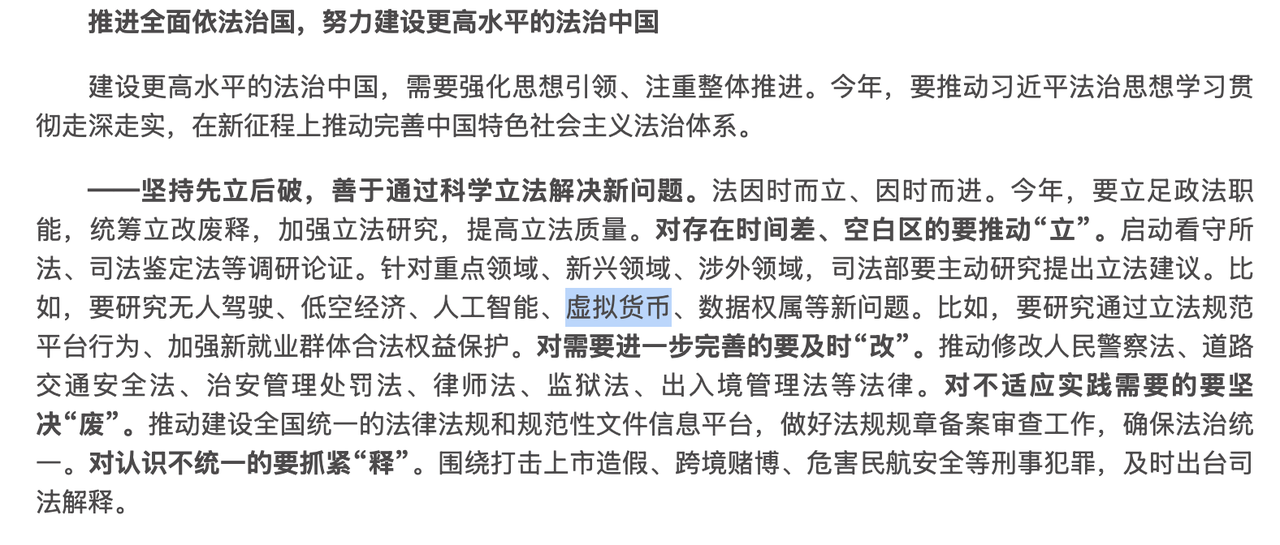
"For key areas, emerging areas, and foreign-related areas, the Ministry of Justice should take the initiative to study and put forward legislative suggestions . For example, it should study new issues such as unmanned driving, low-altitude economy, artificial intelligence, virtual currency , and data ownership."
My understanding of this sentence is that the Central Political and Legal Affairs Commission requires the Ministry of Justice to take the initiative to study specific areas and put forward legislative suggestions, but the distance between legislative suggestions and formal legislation is "very long if you say it's long, but definitely not short if you say it's short." It is almost impossible to see the country legislate on virtual currency in 2025. In addition, the Ministry of Justice also has procedural problems in proposing legislative suggestions in the field of virtual currency.
Third, the influence of virtual currency itself . Just like lawyers or other legal workers always think that law is the first rule of the world, people who enter the cryptocurrency circle always artificially add a lot of value to virtual currency beyond its actual influence. Frankly speaking, virtual currency is still a very niche field in China. Even if there are hundreds of thousands of U merchants now, they are just like ordinary people in China.
Just like the ranking in the second point, virtual currency is at best on par with "unmanned driving, low-altitude economy, artificial intelligence, and data ownership". Take artificial intelligence as an example. Its positive influence in China is definitely greater than that of virtual currency. If legislation is to better regulate and combat virtual currency, it will indeed be earlier than artificial intelligence. Even if virtual currency has a greater impact on the mainstream financial order/foreign exchange management/combating crime, we judge that it is difficult for the country to directly introduce laws specifically targeting virtual currency in the short term. Modifying some judicial interpretations to include virtual currency, or modifying the "9.24 Notice" issued and applied since 2021, is very likely to appear in 2025.