
Note: This column publishes historical research reports of companies in chronological order from old to new for readers' retrospective reference. The views and data in this article are based on the original research time, and some information may have changed.
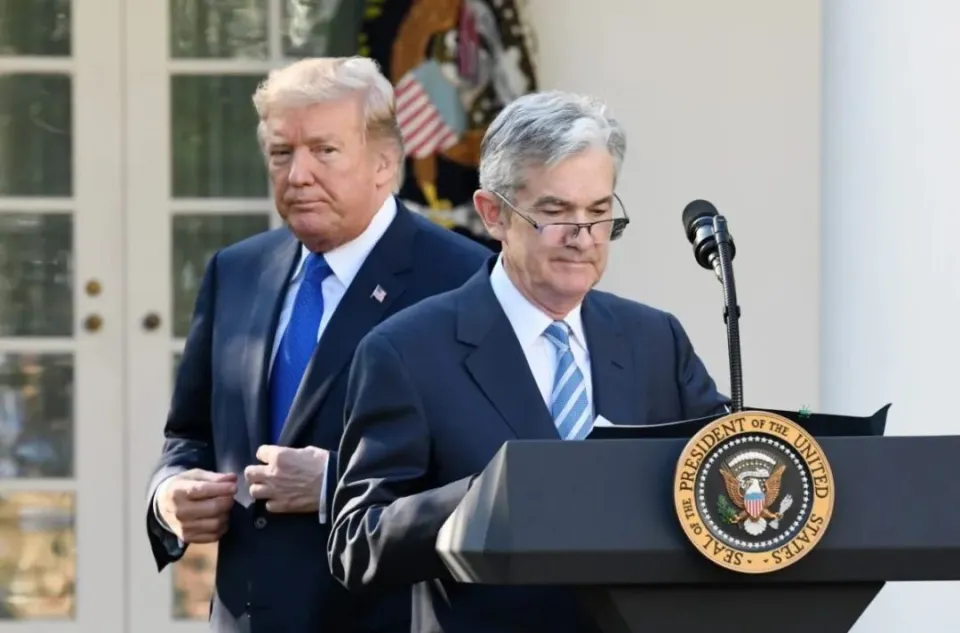
Image credit: Olivier Douliery—Bloomberg/Getty Images
In mid-April 2025, President Trump once again publicly criticized Fed Chairman Powell, suggesting that he would consider replacing him if "interest rates were not immediately and significantly cut." On April 21, Trump's fierce remarks on social platforms and at press conferences directly caused the three major U.S. stock indexes to fall by more than 2.3% that day. The 10-year U.S. bond yield quickly rose by more than 30bp during the sell-off, and the U.S. dollar index simultaneously fell below the 98 mark, indicating that investors' trust in the independence of the Federal Reserve and the U.S. macroeconomic framework has plummeted.
On the Fed side, Powell reiterated in his speech in Chicago on April 20 that "monetary policy independence is a legal right and the cornerstone of maintaining financial stability," and hinted that if political interference occurs, "all legal means will be taken to defend the reputation of the institution." At the same time, the Senate passed two bipartisan resolutions in two weeks, reaffirming that Congress "supports and protects the Fed from political coercion," further highlighting that the incident has risen to an institutional game.
Currently, the policy game between Trump and the Federal Reserve has shaken the market's confidence in the Federal Reserve's independence, causing a crisis of confidence in US dollar assets. The following events in the financial market drive the chain: 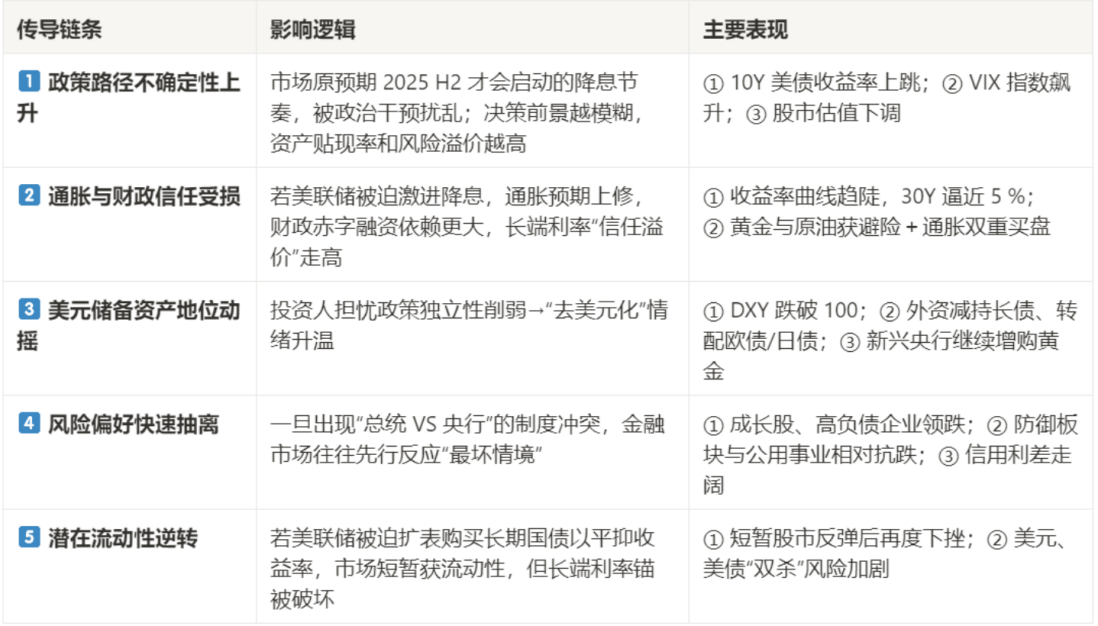
1. Scenario Analysis and Simulation
Based on the current evolution of the situation and historical experience, this article proposes four main scenarios and their corresponding triggering conditions and market impacts.
Scenario A: Full Fed Compromise
o Trigger: Trump's successful executive removal of Powell could force a significant rate cut.
o Impact: Long-term interest rates rose, inflation expectations rose, the US dollar plummeted, gold and crude oil prices rose significantly, and US stocks fell rapidly after a brief rebound.
Scenario B: The Fed maintains its independence
o Trigger: The Fed continues to sit on its hands and openly confront the White House.
o Impact: In the short term, the U.S. stock market fluctuated sharply, investors' risk aversion sentiment intensified, the long-term yield of U.S. bonds fell, and defensive assets such as utility stocks and the medical sector were relatively resistant to declines.
Scenario C (baseline scenario): Limited compromise
o Triggers: Fed cuts interest rates by 25bp symbolically, and both sides use conciliatory rhetoric.
o Impact: Market confidence has been restored, U.S. bond yields have generally declined, U.S. stocks have steadily rebounded, the U.S. dollar has been range-bound, and the valuation of risky assets has gradually recovered.
Scenario D: Trump takes the initiative to back down
oTrigger: Trump shifts focus to other economic issues such as tax reform and infrastructure.
o Impact: Market confidence quickly recovered, U.S. stocks rebounded, the U.S. dollar stabilized and rebounded, gold gave up its previous gains, and value stocks and financial stocks benefited significantly.
2. Current developments and positions of both parties
Trump has been increasing pressure recently, frequently accusing the Fed of being too tight, and bluntly saying that he is considering replacing Powell in exchange for a more dovish policy stance. Powell has repeatedly publicly emphasized the independence of the Fed's policies, saying that it will never cut interest rates hastily due to political pressure. The Senate passed a resolution expressing its firm support for the independence of the Fed, further strengthening the stability of the institutional defense line.
3. Inference of the probability of occurrence of the scenario
Character portrait
Trump : A typical transactional negotiating style, he often uses extreme rhetoric and public threats to exert pressure in order to gain short-term political advantage. However, once the market reacts violently or risks backfire, he tends to quickly find a step and turn to more moderate or alternative policy issues.
Powell : With a background as a lawyer, he emphasizes procedural justice and legality. When Trump first exerted pressure from 2019 to 2020, he successfully resisted political pressure and insisted on making monetary policy based on data.
Supporters behind the Fed : A majority of Congressmen across party lines, large financial institutional investors on Wall Street, and major central banks around the world. These groups view the independence of the Fed as an important institutional foundation for maintaining the stability of the dollar and financial markets.
Legal framework
According to Section 10 of the Federal Reserve Act, a Fed governor can only be removed for "just cause". There has never been a precedent in U.S. history where a Fed chairman has been removed for political reasons. If the president attempts to forcibly remove the chairman, legal proceedings and congressional investigations will be initiated immediately, which will bring extremely high political costs and uncertainty.
Basics of Probability Analysis
The probability estimates for the above scenarios are based on the following factors:
1. Historical behavior pattern : Trump publicly threatened Powell several times between 2018 and 2020, but all ended in compromise between the two sides, indicating that this conflict pattern tends to be short-term pressure rather than long-term stalemate.
2. Current legal and political constraints : The law clearly stipulates that the removal process of Federal Reserve directors is complicated and extremely costly, and politically it is subject to bipartisan support in Congress. The Chairman of the Federal Reserve enjoys strong institutional protection.
3. Market cost constraints : The dramatic reaction of the financial market (such as the surge in U.S. bond yields and the plunge in U.S. stocks) has imposed substantial constraints on the Trump administration, forcing it to rebalance the relationship between political interests and economic performance.
4. Real interest rates and inflation path : The current inflation and interest rate levels in the United States limit the Fed’s policy space. A sudden and substantial interest rate cut may trigger more serious inflation expectations and undermine the long-term stability of the economy.
Taking all the above factors into consideration, this article believes that the sum of the probability of each scenario occurring within the next 3-6 months is 100%, which is a subjective probability estimate based on public information and historical experience:
Scenario A (Powell full compromise) : 10%
oThe legal obstacles are huge and the institutional costs are extremely high, which is only likely to occur in a state of extreme market disorder.
Scenario B (Powell sticks to his principles) : 30%
o Legal support is strong, and the market and institutional investors prefer stability, which provides strong support.
Scenario C (Limited Compromise) : 40%
oThe market and politics are in the best balance, best meet the current interests of all parties and have the highest probability.
Scenario D (Trump backs down) : 20%
· Trump may make strategic concessions under market pressure and shift policy focus to protect economic and market performance.
IV. Asset Allocation Strategy
Based on the scenario probability weighting principle, the recommended cross-asset allocation strategy is as follows:
| Asset Type | Recommendation strategy | Configuration reason |
| US debt | Increase holdings of 5-10 year government bonds | Better risk-return ratio under interest rate fluctuations |
| US stocks | Configure a value-oriented style portfolio | Respond to market volatility and improve stability |
| Gold | Moderate holding (10%) | Protect against tail risks and inflation risks |
| Dollar | Wait and see with a light position, operate cautiously in the range | Avoid the drastic fluctuations caused by uncertainty |
| crude | Moderately increase holdings on dips | Inflation risk and demand recovery after economic stabilization |
| Volatility (VIX) | Buying a small protective position | Deal with tail risks and reduce volatility shocks |
Closely monitor the latest statements from the U.S. Congress and the Department of Justice, and adjust the scenario probability at any time.
Pay attention to the public statements of the Federal Reserve and the White House to judge the changes in policy direction and market sentiment.
· Instantly adjust the allocation ratio of U.S. bonds and gold based on market performance, especially make dynamic adjustments to positions at key interest rate nodes.
V. Research Conclusion
The independence of the Federal Reserve is a key institutional anchor of the U.S. financial market. If it encounters a shock, it will inevitably bring about dramatic fluctuations in financial assets. The most likely scenario at present is a limited compromise between the Federal Reserve and the White House, which will provide space for market recovery. However, investors still need to pay attention to the uncertainty brought about by institutional risks, prudently adjust their asset portfolios, and make timely preparations for risk prevention and control.
Disclaimer : Probability is a subjective estimate based on public information and is not a definite result; please adjust dynamically based on your own risk control framework. The above plan is based on public data and probability deduction (refer to the latest reports from Reuters, Bloomberg, etc.), and is not any form of investment advice; leverage operations and no stop loss strategies are extremely risky, please make independent decisions based on your own risk tolerance, margin level and legal compliance requirements.