
In the current blockchain world, fragmentation is a major challenge. The independence of each chain makes cross-chain transfer of assets and data complicated and inefficient, resulting in high costs and delays for developers and users. In the 7th season update, OP Superchain made "interoperability" a core pillar of the super chain product vision to solve this problem.
With Superchain's interoperability, assets and data can be easily transferred across chains. Developers can make full use of the resources of the entire Superchain, and chain deployers can enjoy the huge network effect brought by Superchain. Such a unified and scalable ecosystem will continuously create new scenarios and promote the innovation and development of blockchain.
Breaking down fragmentation: Superchain advantages
The expansion of Ethereum and its L2 ecosystem faces the problem of fragmentation. In the traditional blockchain model, assets and data often need to be transferred across chains through Ethereum Layer 1, which is both expensive and slow. At the same time, developers need to "cold start" their projects on expensive and complex multi-chain infrastructure, and users face fragmentation and confusion in the user experience.
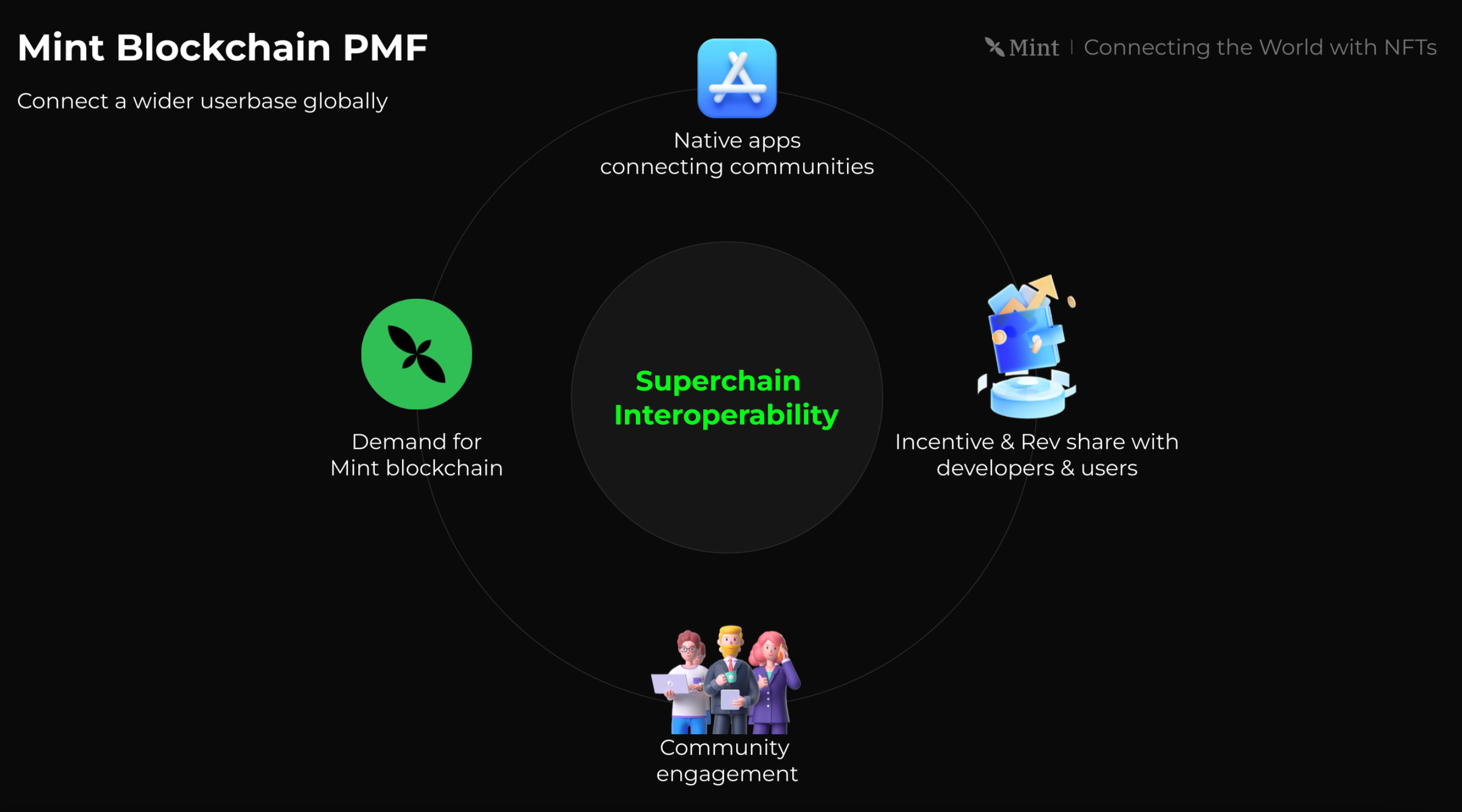
However, by achieving native inter-chain interoperability, Superchain breaks this fragmentation, allowing assets and data to flow across chains while improving the efficiency of developers' resource usage. As a member of Superchain, Mint Blockchain is actively promoting this innovation to help users enjoy a smoother and more efficient cross-chain experience.
How does Superchain work?
OP Superchain is a unified multi-chain network structure that integrates multiple Layer 2 networks built on OP Stack. OP Superchain provides stronger scalability, low latency and higher transaction throughput. Each chain can share the same security model and governance mechanism, and realize low-cost cross-chain communication, asset swaps and other core interactive functions.
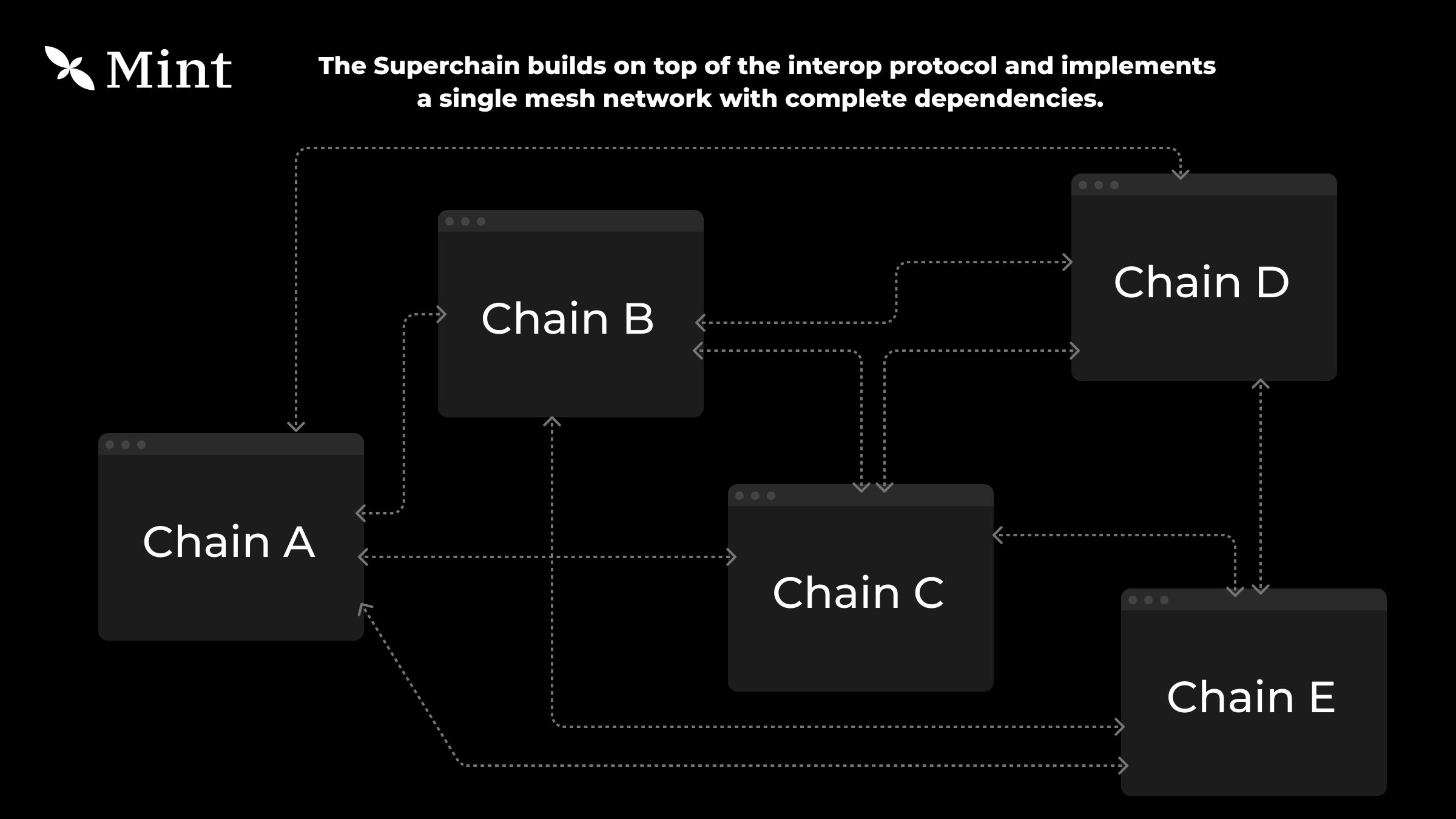
OP Interop is an on-chain interoperability feature based on the OP Stack technology framework, providing the ability to read messages and transfer assets across chains in Superchain through low-latency, secure messaging. Superchain is built on top of the interoperability protocol and implements a single mesh network with complete dependencies. Superchain Interop includes protocol layer messaging and the Superchain ERC20 token standard. Once Superchain Interop is online, it will achieve 2-second cross-chain settlement, minimize fragmentation, unify liquidity, and maximize capital efficiency and utility.
Common standards for interoperability
Superchain's multi-chain architecture requires advanced technical capabilities to ensure a secure communication layer within the platform. This layer will consist of a messaging protocol, Superchain token standards, an interoperability fault proof mechanism, and a set of interoperable chains.
- The messaging protocol allows the creation and sending of cross-chain messages. Two events are required to complete a cross-chain message: the initiation transaction on the source chain and the execution transaction on the target chain.
- SuperchainERC20 is the universal token standard of OP Stack - it is a minimal extended version of the ERC20 standard that makes tokens fungible and portable across Superchain. Without a standardized security model, bridged assets may not be interchangeable. SuperchainERC20 is built on top of the messaging protocol and is the current trust-minimized bridging solution.
- The interoperability fault proof mechanism is a proof system shared by all chains within Superchain. This mechanism interconnects the security of chains, thereby supporting fungible assets in the entire Superchain ecosystem.
- The interoperable chain set includes chains that are configured with "dependencies" - that is, they read data from other chains. For example, OP Mainnet reads data from Mode and Base, Mode reads data from Base and OP Mainnet, and Base reads data from OP Mainnet and Mode. These three chains together form an interoperable chain set.
Superchain Interoperability Architecture
The composition of OP Stack nodes determines its interoperability capabilities. Among them, OP Supervisor is the core role of interoperability services.
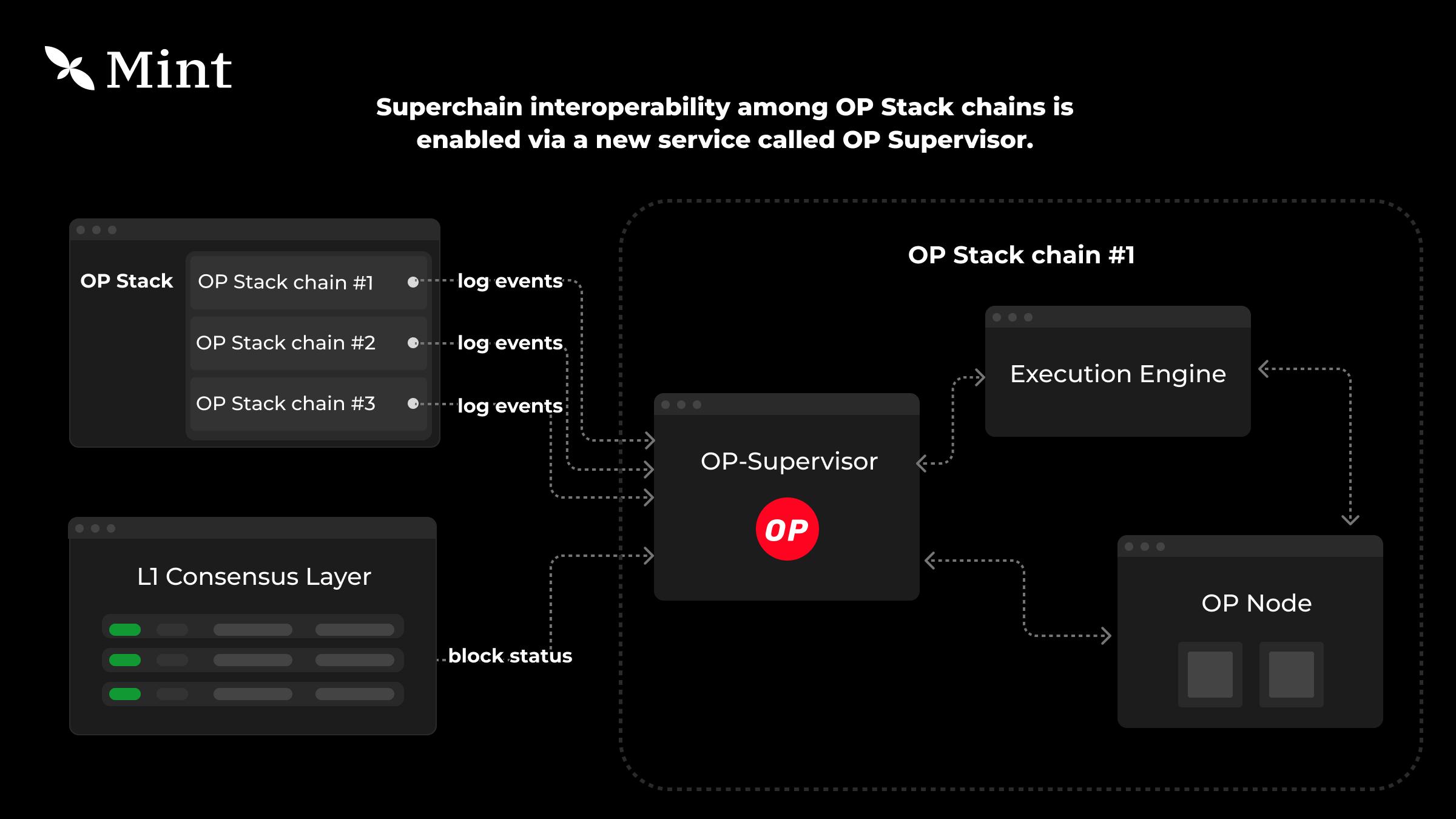
- OP Supervisor is responsible for recording and verifying cross-chain log events and obtaining L2 transaction security information from the L1 consensus layer.
- Through OP Supervisor, each chain of Superchain can synchronize and verify each other's transaction information, thereby achieving efficient cross-chain message transmission.
Superchain interoperability advantages
Superchain’s interoperability provides several significant advantages:
- Low latency and high efficiency : Through optimized cross-chain communication mechanism, fast message delivery and asset transfer can be achieved, improving user experience.
- Cost-effectiveness : Adopting an efficient settlement mechanism to reduce the Gas cost in cross-chain interactions and make transactions more economical
- Seamless developer experience : Developers can leverage Superchain’s native interoperability to easily deploy applications and assets on different chains without the need for complex cross-chain bridging infrastructure.
- Shared security : Based on L1 shared security and OP Stack design, it ensures the reliability of cross-chain interactions and reduces the risks brought by different chain verification mechanisms.
SuperchainERC20: Ideal for Cross-Chain Tokens
As a vital part of Superchain interoperability, SuperchainERC20 provides a concise and reliable solution for cross-chain tokens. With the native Interop protocol, assets can be moved quickly and seamlessly between chains, promoting real-time cross-chain DeFi and seamless chain-to-chain exchanges.
Mint Blockchain's native asset $MINT is the first native token of Superchain and applies the superchainerc20 standard. USDT0 is one of the first interoperable stablecoins deployed on Superchain. It is the omnichain version of USDT, which supports native compatibility on multiple chains and is supported by USDT 1:1 on Ethereum. OP Mainnet and Ink have been launched, and plans to expand to more chains to provide Superchain with fast, secure, and low-cost cross-chain transfer capabilities.
Mint Blockchain: Leveraging Interoperability for Innovation
As a member of Superchain, Mint Blockchain can take advantage of this innovative interoperability mechanism to provide users with a more efficient and secure cross-chain experience. Mint Blockchain's assets and applications will be able to seamlessly interact with other Superchain projects, and users will enjoy a low-cost, high-speed and secure cross-chain transaction experience.
In addition, Mint is building an aggregated liquidity product, Mint Liquid , which is a liquidity product built by the Mint team based on Superchain, ERC7683, Uniswap, Across Protocol and other protocols to support multi-chain NFT and Token asset transactions, and realize multi-chain liquidity aggregation and cross-chain asset interoperability. The Mint Liquid product will greatly improve the transaction efficiency of on-chain encrypted assets, reduce the friction cost of on-chain transactions, better provide price discovery capabilities for new encrypted assets, and promote the prosperity and development of the on-chain trading market.
Driving the Future of Web3
Superchain's interoperability not only breaks the fragmentation problem of cross-chain liquidity, but also provides a more efficient and secure infrastructure for the DeFi and Web3 ecosystems. Through native interoperability protocols, assets and data can flow freely, developers can build cross-chain applications more easily, and users can enjoy a smoother trading experience. As part of the Superchain ecosystem, Mint Blockchain is actively promoting this change, using a unified liquidity layer to improve the efficiency and scalability of on-chain interactions. As Superchain's interoperability continues to advance, Mint Blockchain will work with Superchain to create a new future for Web3 and promote the innovation and popularization of Web3 and on-chain applications.